








































In this article
A phone-link click is not a connected call, and a connected call is not automatically a qualified inquiry. Those distinctions matter when an independent lead website sends requests to another business. The operator needs enough evidence to inspect the route without presenting a single platform count as proof of customer quality.
This guide develops a non-recording call attribution and routing plan for a separately controlled lead asset. It covers source limits, destination checks, controlled tests and minimal operational records. It does not prescribe recording conversations or turn a phone-platform status into a sales result. For the broader asset build, see the local lead-generation website implementation guide. The examples here are hypothetical test scenarios, not actual C3i3 calls or lead results.
What does call tracking actually establish for a lead website?
Call tracking establishes only the observations the implementation collects. A browser event may show an attempted phone action. A telephony record may show an inbound call and its route. A provider review is needed to establish service fit and the next business stage.
Define the stages before selecting a report. A phone-link click can occur without a call being placed. A person can also dial a visible number without clicking. A call can reach voicemail, an automated greeting or an unsuitable destination. These differences prevent a browser total and a phone-platform total from being treated as interchangeable.
What does a completed call status mean?
In Twilio’s Call resource documentation, a completed status means the call was answered and ended normally. That status does not certify a human sales conversation, service fit or an appointment. The documentation also distinguishes statuses such as busy, no-answer and failed.
For a forwarded call, inspect which leg the record describes. The inbound leg reaching the routing system and the destination leg reaching the provider are separate observations. A successful first leg can coexist with a failed handoff. Keep the relationship between the legs in the operational system rather than collapsing them into two apparent leads.
Build a measurement dictionary with each stage, source and limitation. Use that dictionary in reports so a change in platform settings does not quietly change the meaning of “call” between periods.
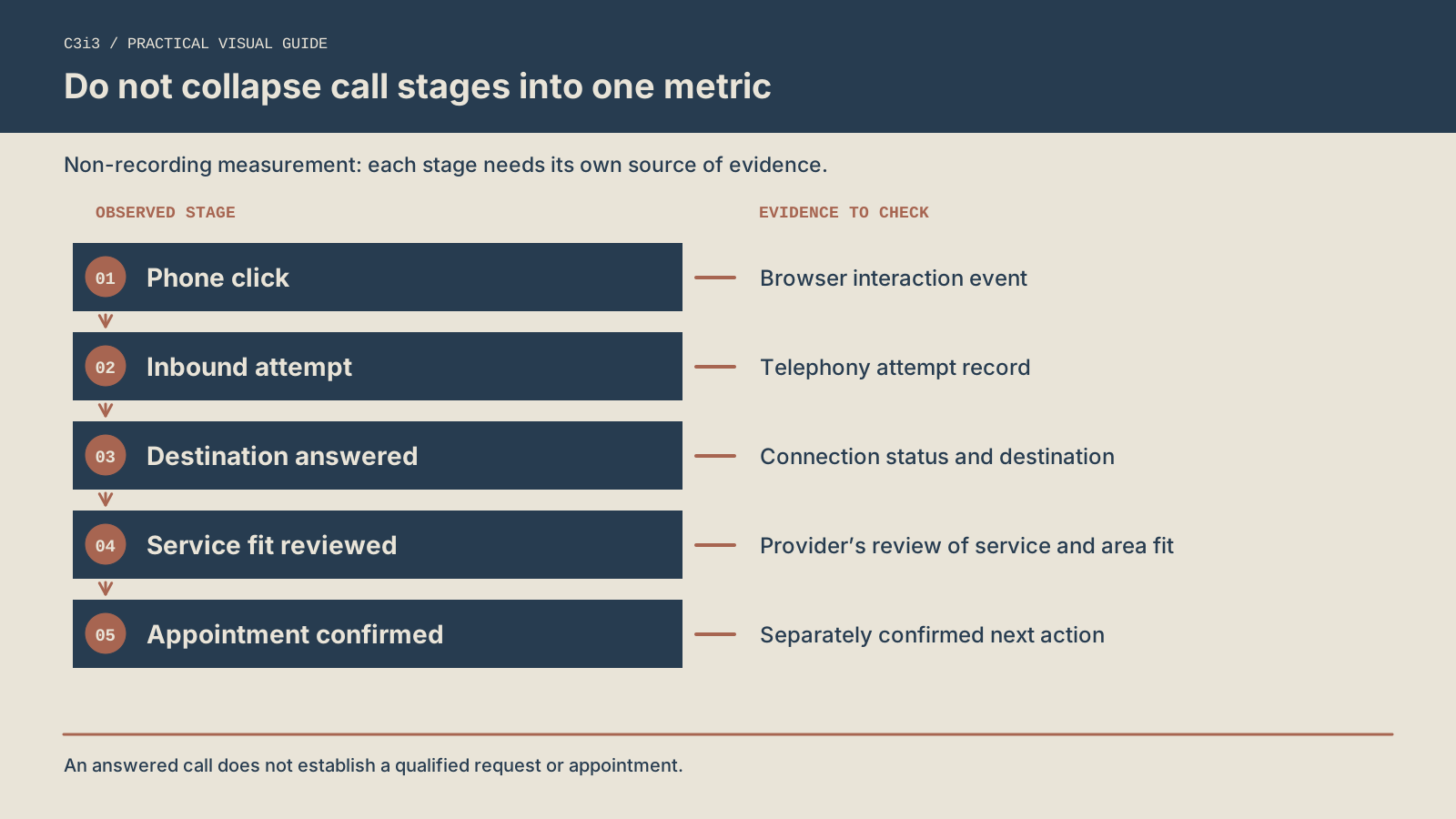
Each stage needs its own evidence. A completed call status does not establish a qualified request.
How closely can a phone inquiry be attributed to its website source?
The confidence depends on how the number is assigned and what source evidence is available. A dedicated route can associate a call with a website or campaign, but it cannot prove every caller’s full journey.
A number displayed only on one asset provides a useful source clue. Callers can still save, share or redial it later. A copied number can appear elsewhere. Dynamic number systems can add session-level evidence where configured and available, but missing browser data or an unobserved later call creates gaps. Keep those limitations with the report.
Does Google Ads call tracking measure all organic phone inquiries?
No. Google’s website call conversion guidance describes tracking calls after an ad click, including a configurable minimum call length. That is an advertising-specific measurement arrangement. It should not be described as proof of all organic calls or of qualification.
A duration threshold can classify a configured reporting action, but duration alone cannot tell you whether the person needs a supported service. A long wrong-number call remains unsuitable. A short conversation might establish a clear next step. Retain a separate provider outcome rather than substituting a threshold for review.
Check the query-to-page map when source quality is poor. The page may be targeting contractor buyers seeking leads while its phone route expects homeowners seeking service. Tracking cannot repair that audience mismatch; it can only help expose evidence worth investigating.
What should be documented before enabling lead routing?
Document the visible number, intended audience, receiving provider, destination rule and unavailable behavior. Assign an owner who can verify the configuration and pause an affected route if it stops matching the public offer.
Create an inventory across the landing page, header, mobile action, contact panel and any other public placement. Check both displayed text and the actual tap-to-call destination. A copied template can show the right number while linking to an old one. Identify whether number replacement scripts alter either value.
Which routing decisions need provider confirmation?
Confirm the receiving line, service coverage, staffed availability and handling of busy or unanswered calls. If another destination participates as a fallback, verify its role and expectations directly through the authorized operating arrangement. Do not silently forward requests to a number that has not been confirmed as an appropriate receiver.
Twilio’s Dial documentation describes connecting callers to another destination and returning call outcome information. Those capabilities require a deliberate configuration. A platform’s ability to route a call does not establish that the receiving business is available or suitable.
Align page wording with the route. The landing-page request sequence explains why the visitor should understand the site’s role and next step. If the provider changes, update the receiving configuration, visible identity explanation and any availability statements together. Keep the configuration history restricted and recoverable.
How do you test the phone route without recording conversations?
Use a controlled scenario matrix, participating callers and participating recipients. Compare expected destinations and states with observed non-recording platform evidence and the receiver’s confirmation.
Arrange the test window so the destination team knows what will happen. Use clearly labeled test records and a brief script that identifies the test. Verify that the test configuration does not activate audio recording or transcription. The purpose is to inspect routing and receipt, not to collect conversation content.
| Hypothetical test | Expected observation | Evidence to retain |
|---|---|---|
| Staffed destination | Participating receiver answers the intended line | Test ID, route version and receiver confirmation |
| Busy destination | Configured unavailable path occurs | Destination state and observed fallback |
| No answer | Published expectation matches actual behavior | Outcome state and receiver check |
| Outside staffed hours | Accurate message or participating alternative route | Test time, time zone and observed result |
| Mobile tap | Device opens the intended dial destination | Page version and destination comparison |
What should happen when a test fails?
Keep the affected route out of live use or pause it until repaired. Trace the failure to the displayed link, inbound configuration, destination rule or receiving line. Repeat the failed scenario after the change, then recheck any dependent state. Do not assume fixing the staffed route also fixes after-hours behavior.
Check the reporting view as well as the destination. One labeled test should remain one test inquiry even if the platform sends several progress updates. Confirm that the operator can find its expected and observed states without counting every update as another caller. This also gives the next reviewer a concrete reference when the route changes.
Record the deployed configuration and test date. A development test with a substitute destination does not establish that production is correct. After release, inspect the public page and a controlled live route test with the same participating arrangement.
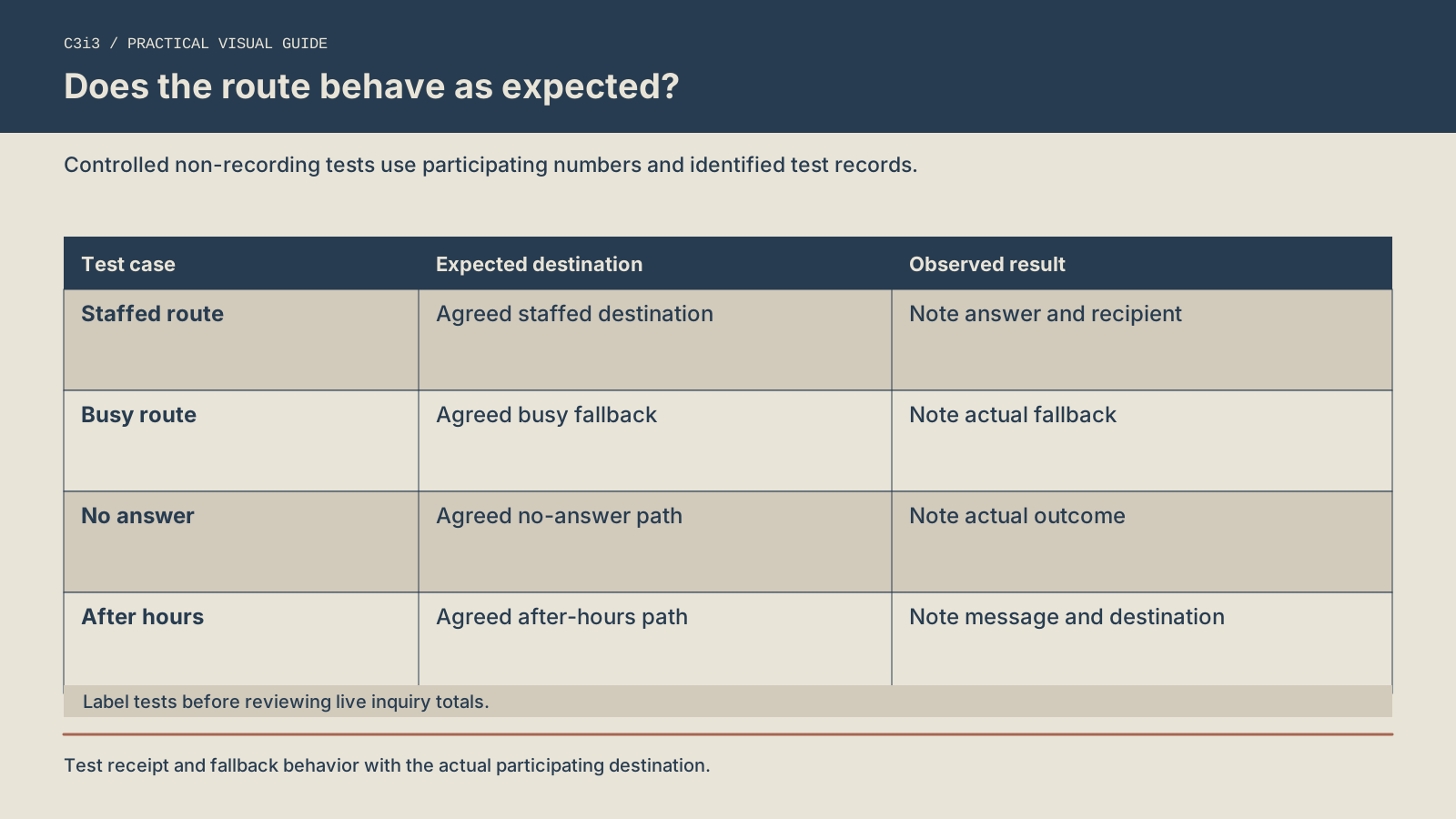
Test only with participating numbers and identify test records before reviewing live inquiry totals.
Which call records are useful without collecting unnecessary information?
Keep the smallest operational record that can support routing diagnosis, duplicate review and a meaningful outcome. Separate restricted contact information from aggregate analytics reporting.
A routing test record can contain a test identifier, route identifier, configuration version, timestamp, time zone, expected destination category and observed state. A live inquiry review may also need a restricted relationship to the received request. Do not copy the caller’s number or conversation details into a general marketing spreadsheet when a limited status field answers the question.
What should stay out of analytics parameters?
Keep names, email addresses, personal phone numbers, exact request text and other identifying details out of analytics event parameters and page URLs. Google’s PII guidance specifically addresses personal information and the risk of URLs or titles carrying it. A general event label should describe the action rather than reproduce the person’s information.
Restrict operational access to people who need it and decide how long each kind of record remains useful. Avoid treating a new identifier as automatically anonymous if it can still be connected to a person through another system. Use aggregate route and outcome summaries for ordinary performance discussions.
A callback stream also needs technical care. Twilio’s Voice webhook documentation explains status callback options. The implementation should interpret the actual call state, preserve relationships and avoid counting repeated notifications as new inquiries. A developer should verify the current platform behavior for the chosen setup.
How do you reconcile phone activity with qualified inquiries?
Link each received request to a reviewed outcome where evidence permits, then preserve unresolved cases. Reconcile unique inquiries rather than assuming every call attempt or platform notification represents a new person seeking service.
Repeated calls may concern one request. A person may submit a form and call afterward. Conversely, a shared household number may represent more than one service need. Use the actual request context in the restricted operating record rather than a crude rule that every identical number is a duplicate.
Which report helps identify the next fix?
Separate route failures, unsuitable service requests, outside-territory requests, provider capacity limits and unknown outcomes. Each points to a different action. Route failures need technical investigation. Repeated service mismatch may require clearer page scope. A provider capacity limit may require an offer or availability change.
The lead qualification guide develops those definitions and denominators. Keep a connection rate separate from an acceptance rate. An appointment requires its own confirmation rather than inference from call length or a completed platform state.
If the website’s form event is missing, use the existing Tag Manager inquiry tracking review for that separate technical problem. This call plan owns the phone route and evidence chain; it should not become a generic guide to repairing every analytics trigger on the site.
What else should you know about non-recording call attribution?
Treat each signal according to what it proves. A click, duration measurement or technical status needs additional evidence before it becomes a qualified request.
Is a phone-link click a lead?
It is an attempted browser action. The device may open a dialer without placing a call, and the eventual destination may not answer. Keep the click in a clearly named interaction measure, then use the appropriate phone and provider records for later stages.
Can a call be completed without a suitable conversation?
Yes. Answered calls can reach voicemail, an automated system or a person with an unrelated request. Inspect the platform’s actual definition and retain provider review as a separate observation. A technical status should not silently become a qualification judgment.
Does a long call prove lead quality?
No. Length is a duration measurement. It can support diagnosis or a configured reporting threshold, but it does not establish service fit, territory or an accepted next step. Use structured outcome evidence and retain unknown cases when the information is missing.
Should source attribution always have a named channel?
No. Some callers save or share numbers, and some journeys cannot be reconstructed. Record unknown or limited-confidence attribution rather than assigning a precise channel without evidence. Reports become more useful when they distinguish observed source information from an assumption.
How often should routing be rechecked?
Recheck when destinations, staffed availability, provider arrangements or page contact elements change. Also assign periodic operational review based on the route’s importance and stability. Keep the previous configuration and test record so the next reviewer knows what changed.

How C3i3 Can Help
C3i3 can help define inquiry stages, review landing-page contact behavior and prepare a controlled non-recording test brief through Lead Generation Campaigns. Our Local SEO work can connect source and service-fit observations to the content people find.
Bring the public contact path, routing inventory and current stage definitions to discuss the measurement gap with C3i3. The aim is a clearer evidence chain and an accountable provider handoff, with technical implementation scoped to the actual systems involved.