








































In this article
A lead-generation landing page must help the visitor recognize a suitable service and understand the next action. An independent lead website has an additional task: explaining the relationship between the site and the provider who may receive the request. A polished design cannot resolve that uncertainty if the operating arrangement is unclear.
This guide focuses on the landing experience for a separately controlled local lead asset. It develops the page sequence, form states and review method rather than diagnosing every possible problem on a company website. For the complete build context, see how to implement a local lead-generation website. The example below is hypothetical and does not describe C3i3 lead inventory, a client result or an available contractor service.
What promise should a lead-generation landing page make?
The page should promise an action the current operating arrangement can fulfill. It might support a request for review or a preliminary service conversation. It should not imply an appointment, immediate dispatch or confirmed job before those stages occur.
Start with the service decision and intended visitor. Explain the work included and the meaningful limits. A page for planned service requests needs a different information sequence from an urgent-service page. The C3i3 emergency plumbing ad-page guide owns that narrower scenario; a general independent asset should not borrow its urgency merely to make a contact button more prominent.
How should the page match search intent?
Match the visitor’s task, not only the search phrase. A contractor searching for “roofing leads” is evaluating acquisition sources, while a homeowner searching for roof work is evaluating a service. The former needs a contractor buyer guide. The latter needs a page with service scope and an honest provider route. Confirm the destination using a service and buyer-question map before designing the page.
Write a one-sentence promise, then ask the receiving provider whether the actual handoff supports it. If the answer requires several exceptions, refine the service boundary or explain the relevant condition near the action. The purpose is to help appropriate people proceed with realistic expectations, not to remove every qualifier in pursuit of a higher raw submission count.
What should visitors see before they submit a service request?
Visitors should see the service and area, understand who operates the site, identify the receiving arrangement and know what happens next. Put essential information on the landing page itself because someone arriving from search may never open the homepage.
The following annotated sequence is a hypothetical planned-service page. The sample wording illustrates information roles and should be replaced with verified business facts.
| Page block | Illustrative content | Why it belongs |
|---|---|---|
| Service and coverage | Request review for the confirmed service within the stated territory | Helps the visitor establish basic fit |
| Site role | Independent inquiry site operated by the identified organization | Explains who is collecting the request |
| Receiving arrangement | Names the actual provider or describes the verified handoff | Prevents an assumed contractor identity |
| Useful service detail | Included work, relevant limits and assessment process | Resolves uncertainty before contact |
| Request and next step | Request details followed by an accurate review explanation | Connects the action to an observable stage |
Where should the identity explanation appear?
Keep a concise explanation beside the main action and make the fuller information easy to reach. Do not rely on a remote footer note to correct a first screen that presents the site as the contractor. Avoid invented crew photographs, project claims or reviews that imply operating experience the site does not have.
Google’s helpful content guidance encourages clear information about who created content and the value it provides. For this page type, the practical application is a visitor who can explain both the offer and the site’s role without guessing.
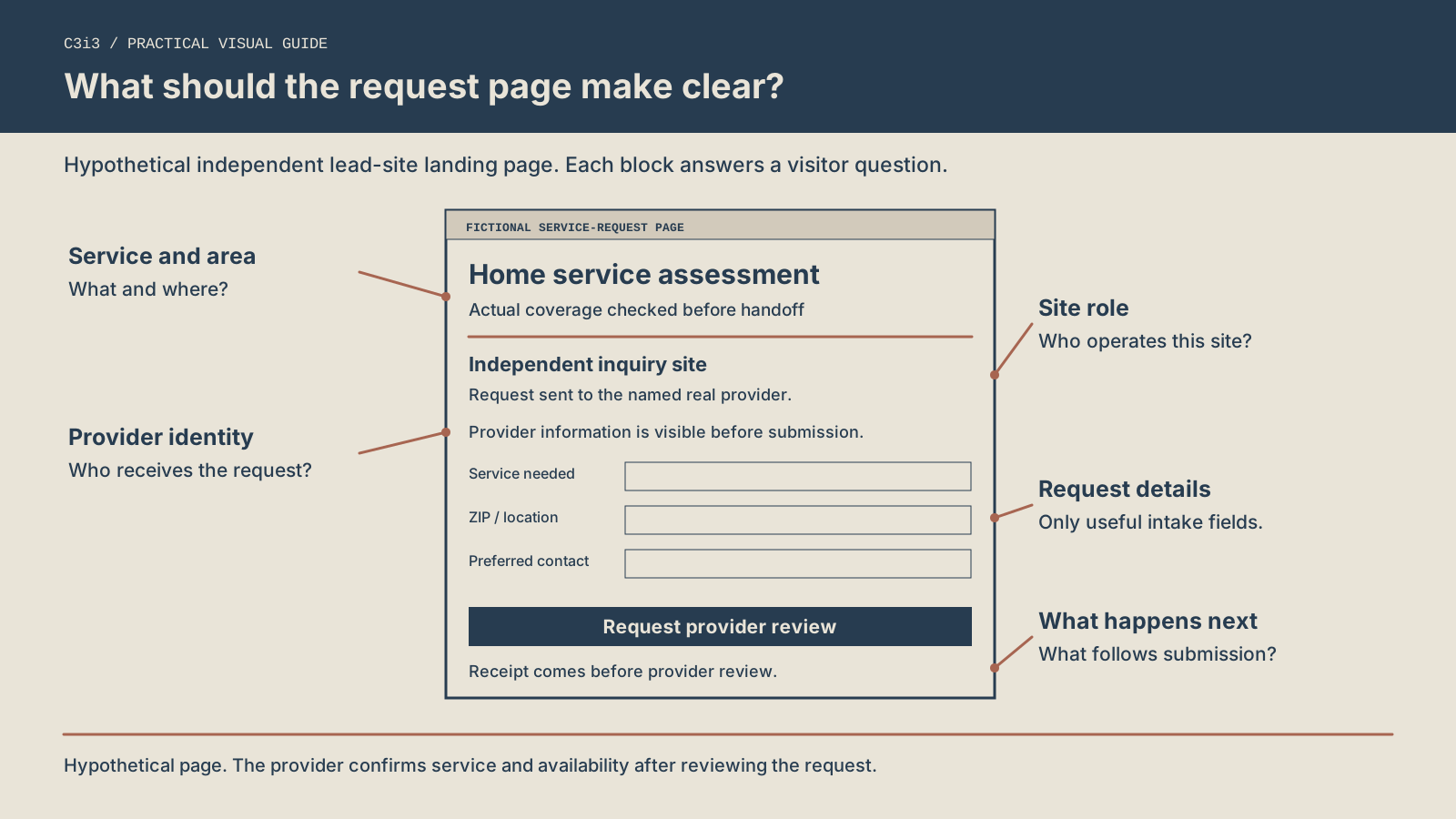
Each visible block resolves a different visitor question. The layout is hypothetical.
How much information should the inquiry form request?
Request the minimum information needed to route the inquiry and begin a useful review. Every required field should have a stated operational purpose, and the form should explain what happens after submission.
A hypothetical first-contact form might ask for service type, general location, a short request description and an appropriate contact method. If a photo or document is not essential to initial routing, consider making it optional or requesting it later through an appropriate channel. Avoid collecting sensitive details simply because a form builder offers another field.
What should validation and confirmation tell the visitor?
Validation should identify the field that needs attention and preserve information already entered. A success state should reflect successful receipt rather than only a button press. If the delivery system cannot confirm receipt, the implementation should not present a definitive success message.
Keep the stages clear: the visitor completes fields, the system checks them, the request is submitted, receipt is confirmed and the provider later reviews it. “Request received for review” describes a different state from “appointment confirmed.” Use the latter only when an appointment actually exists.
Check labels, error messages and touch behavior on a narrow phone. An essential boundary should not disappear beneath a sticky action bar. Let the visitor review the request before submission when the sequence is more complex. The best field count is the one justified by the first operational task, not an arbitrary rule that every service form must contain the same number.
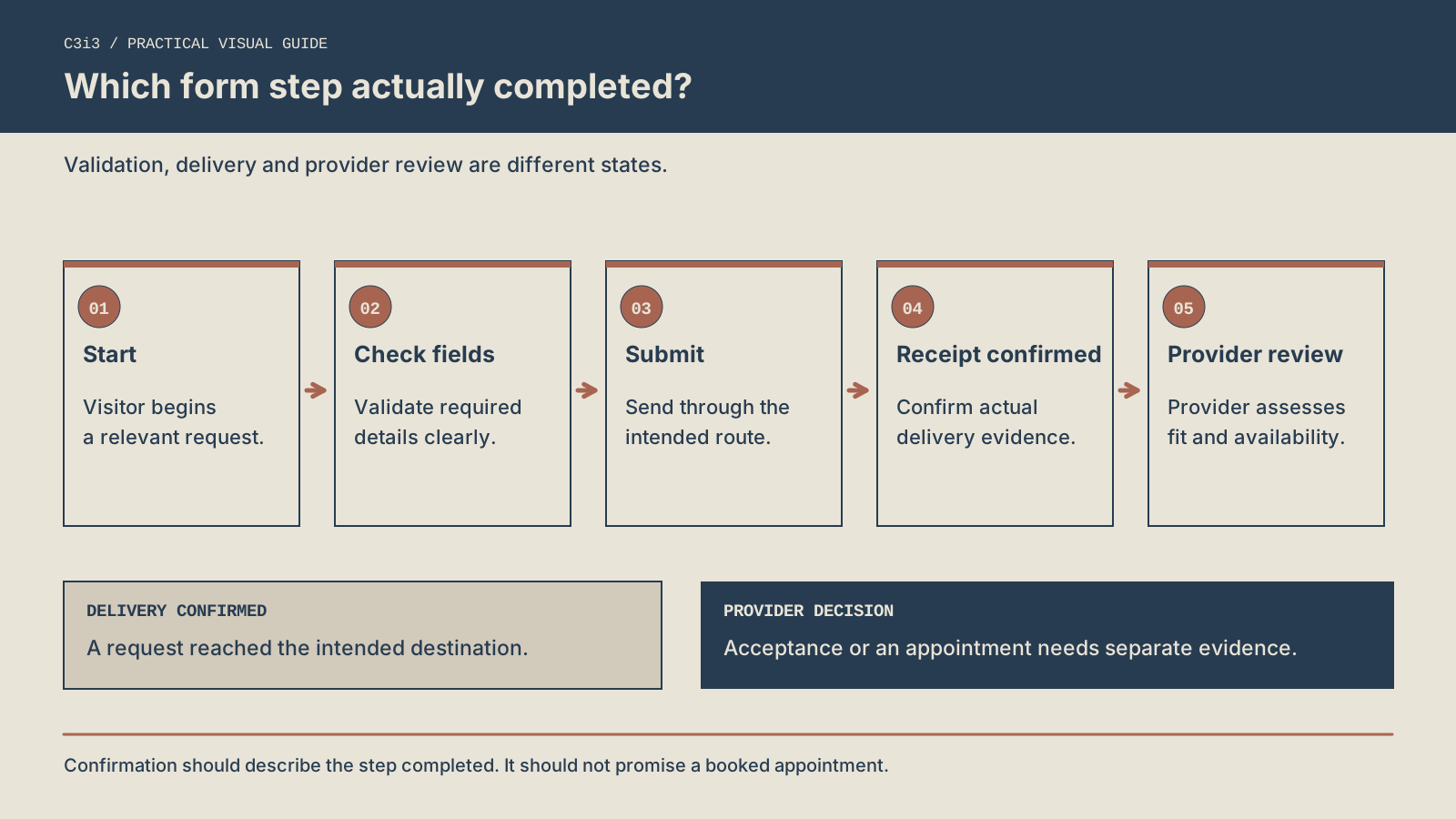
Confirmation describes the step actually completed. It does not promise a booked appointment.
How should phone and form options work together?
Offer contact routes the receiving arrangement can support, then explain their different expectations. A phone option is useful only when its destination and unavailable states have been considered. A form option needs a monitored receiver and an accurate confirmation.
Choose the primary route according to the service process. A planned assessment may work well as a written request that can be reviewed with the relevant details. Another situation may need a preliminary call. More contact choices are not automatically more useful if nobody knows which destination receives each one.
What should happen when a call is not answered?
Define the unavailable path with the provider before publishing the number. The path might use a clearly explained alternative contact option or another participating destination. Test the actual behavior and keep wording aligned with what callers experience. Do not promise a staffed response throughout the day unless that arrangement is real.
Use the non-recording call routing test to inspect displayed numbers, tap-to-call links, destinations and no-answer behavior. A phone-link event alone does not establish that a call connected or that a relevant person made a request.
Explain the request handoff consistently across both channels. A page should not identify one receiving arrangement in the form copy while calls quietly reach a different unconfirmed destination. Keep an inventory of visible numbers, form recipients and confirmation messages so a provider change can be implemented completely.
How do you measure whether the landing page produces relevant requests?
Measure successful receipt and reviewed request quality separately from page interactions. Button clicks and form starts can help diagnose behavior, but they do not establish a qualified inquiry or a provider’s acceptance.
Define the stages before changing the page: action attempted, request received, unique inquiry, service fit and accepted next step. Keep the operational definition beside the report so “lead” does not mean something different each month. Google Analytics provides a recommended generate_lead event, but the implementation still needs to match a verified action.
Which page improvement should be tested first?
Choose the obstacle with the clearest evidence. If visitors misunderstand who receives a request, improve identity and handoff copy. If relevant requests omit information necessary for routing, clarify that field. If forms fail on a phone, repair the technical path before revising headlines. Keep a dated copy of the prior page and note other changes that might affect the comparison.
Review a consistent period and preserve unknown outcomes. A hypothetical increase in submissions accompanied by more out-of-area requests would not establish better performance. The inquiry qualification worksheet shows how service fit and provider acceptance can be reviewed with useful denominators.
Keep personal contact details and request text out of analytics parameters, URLs and page titles. Google’s PII guidance identifies platform restrictions. Operational information needed to respond belongs in a restricted request system rather than a general analytics event.
What should be checked before sending visitors to the page?
Check comprehension, service facts, accessibility and the complete request route. Use an unfamiliar reviewer for the explanation and participating recipients for labeled operational tests.
Ask the reviewer to answer five questions from the page: what service is offered, where it is available, who operates the site, who receives the request and what follows contact. Record the first point of uncertainty without explaining it away. A draft that needs the designer’s spoken clarification is not ready.
What belongs in the release record?
Record the page version, approved offer, tested device, expected destination and observed result. Include successful and unsuccessful form states, a phone test if present and the receiving team’s confirmation. Keep test records out of ordinary inquiry totals. Recheck the live page after deployment because environment settings can change recipients and links.
The original contribution of this review is the connection between public wording and actual delivery. A successful technical test does not establish truthful content; accurate content does not establish receipt. Both must pass before the page supports a controlled launch.
For broader clarity problems on a company-owned website, use the website inquiry-path review. For an independent asset, retain the extra identity and handoff checks even when the design looks familiar. They are central to the visitor’s decision about sharing information.
What else should you know about lead-generation landing pages?
Keep the page length, evidence and form states tied to the actual service decision. A clearer request path matters more than an arbitrary design formula.
Should an SEO landing page be extremely short?
It should contain enough useful information to resolve the service decision. Some visitors need a quick action, while others need scope and process detail. Put essentials first and organize supporting answers clearly. Removing needed information to reach a fixed length can increase uncertainty rather than improve the request path.
Can a form confirmation promise an appointment?
Only when the appointment has actually been confirmed through the operating system. A received inquiry normally establishes a review stage. Use wording that matches the observed state and explain how the provider will handle the next step. Do not let an enthusiastic confirmation page invent a later outcome.
Are testimonials necessary to launch?
Use genuine authorized evidence when available, with accurate context. Do not invent testimonials to fill a layout. A page can explain its service scope, identity and process without pretending to have a history it cannot support. Treat illustrations as explanations, never as proof of completed local work.
Should every form field be required?
No. Require a field only when it is necessary for the first review or route. Explain optional information and avoid asking for details the receiving team does not use. Review whether missing information actually prevented useful handling before making the form more demanding.
Can a higher conversion rate hide a weaker page?
Yes. A rate based on clicks or raw submissions can rise while service fit falls. Keep the action definition and denominator visible, then inspect unique requests and provider acceptance. A page helps the business when suitable visitors understand the offer and complete a dependable handoff.

How C3i3 Can Help
C3i3 can assess a landing page’s offer, identity explanation, form sequence and inquiry handoff through Lead Generation Campaigns. Our Local SEO work can connect that page to the search task and supporting content it should serve.
Bring the page, receiving arrangement and examples of appropriate requests to discuss a landing-page review with C3i3. The assessment can identify whether the priority is clearer content, usable form states, routing verification or a better definition of the outcome being measured.