








































In this article
A lead website can produce more contact activity while sending the provider fewer suitable requests. The difference becomes visible only when the operator defines qualification and keeps it separate from receipt, duplicate activity and provider capacity. A single “leads generated” total cannot explain those stages.
This guide is for owners and marketing teams reviewing inquiries from an independent local lead asset before expanding its services or territory. It provides a practical definition, an illustrative worksheet and a review method. It does not describe C3i3 customer results or an existing lead supply. For the complete operating context, see how a local lead-generation website is built and maintained. Here the task is deciding what the received requests actually establish and which change the evidence supports.
What counts as a qualified inquiry for an independent lead website?
A qualified inquiry matches the agreed customer need, supported service and operating territory with enough information to take the intended next step. The definition should be approved by the receiving provider and observable in the operating record.
Write the definition before reviewing totals. A hypothetical planned-service asset might define a suitable request as a person seeking the included service at a property within the confirmed territory who provides a usable response route. If a particular property or project type matters, state that condition. Avoid broad labels such as “good lead” that reviewers can interpret differently.
Is provider acceptance part of qualification?
It can be a later stage, but it should not erase the fit assessment. A suitable request may not be accepted because the provider temporarily lacks capacity. Another request may be outside the service scope regardless of capacity. Keeping those reasons separate shows whether the page attracts the right people and whether the current operating arrangement can handle them.
Preserve a sequence such as received, unique request, service-and-area fit, provider accepted and next step confirmed. A request can move through that sequence as evidence arrives. Do not backfill a later outcome from an earlier signal simply to complete the report.
Google Analytics distinguishes measured events and key events. A reporting designation does not establish service fit. Qualification belongs in an agreed operational definition supported by actual request information and the provider’s review.
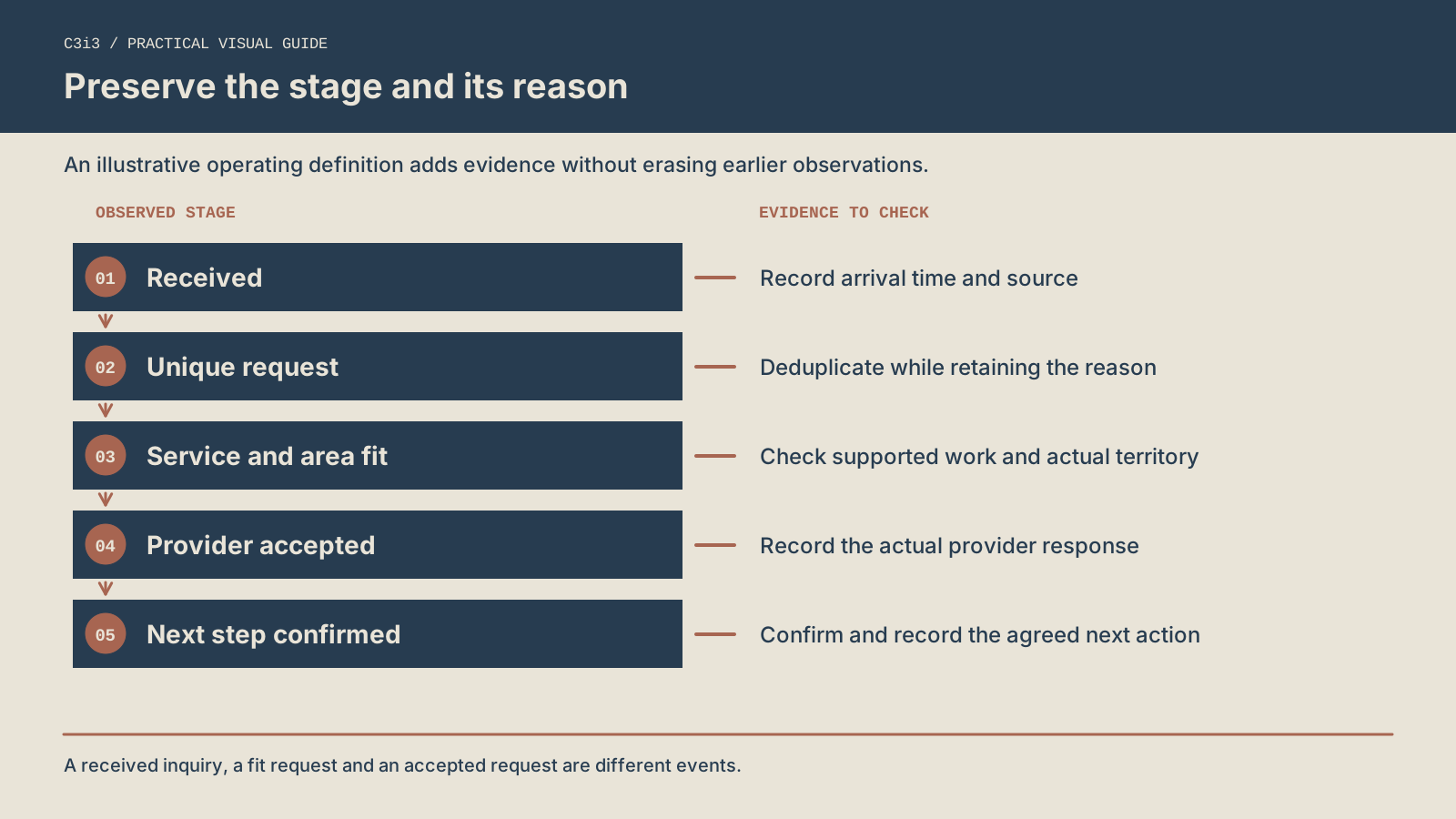
A useful lead review preserves both stage and reason. These stages are an illustrative operating definition.
Which facts should be checked before deciding whether a request fits?
Check the service needed, general location, relevant customer or property context and intended timing when timing affects the offer. Collect only the information needed for that decision, then preserve unknowns where details remain incomplete.
Start with the stated request rather than judging the person from incidental details. A brief inquiry can be relevant even when it needs clarification. A long submission can still concern an unsupported service. Use “needs clarification” when the evidence is insufficient instead of forcing every record into qualified or rejected.
How should timing and territory affect the decision?
Use the actual operating brief. If the provider accepts planned assessments, an immediate-dispatch request may need a different route. If a service is offered only in a confirmed area, outside-area requests should remain distinguishable from wrong-service requests. These reasons point to different page or coverage changes.
Keep the public page aligned with the criteria. If the website invites a service the provider does not accept, qualification review should reveal a content problem rather than place all responsibility on the visitor. The landing-page guide shows how scope and next-step wording can prevent avoidable uncertainty.
The audience boundary matters as well. A contractor searching for “roofing leads” or “HVAC leads” may want to buy acquisition support, while a homeowner needs trade service. Those are separate commercial and service-customer journeys. Use the query-to-page map to inspect intent if requests repeatedly come from the wrong side of that distinction.
How should duplicates, failed routes and unknown outcomes be classified?
Keep a relationship between repeated activity and the underlying request, then classify delivery and outcome separately. A duplicate contact, a routing failure and an unresolved request are different observations.
A person may call twice about one project or submit a form before calling. Those can be multiple contacts about one inquiry. Conversely, a shared phone number may relate to separate requests. Review the service context in the restricted operational system rather than automatically merging every matching number.
Why should delivery failures stay visible?
A failed handoff is not proof that the inquiry was unsuitable. If the destination never received the request, the provider cannot assess it normally. Keep a delivery status and the reason qualification remains unknown. Otherwise technical problems can disappear inside a misleading “unqualified” total.
The non-recording call attribution guide distinguishes phone clicks, attempts and answered destination legs. Use that evidence to inspect receipt without inferring customer quality from call duration. For forms, confirm successful delivery before treating a browser action as a received inquiry.
Use a small, stable reason list: outside service, outside territory, needs clarification, duplicate activity, delivery issue, provider capacity and unrelated message. Add a reason when it resolves a genuine decision, not simply because another label is available. Record unresolved outcomes explicitly and assign a review owner so “unknown” remains an honest state rather than a forgotten backlog.
What does a useful lead qualification worksheet look like?
A useful worksheet keeps stage counts, reasons and denominators visible. The following numbers are hypothetical and exist only to illustrate the calculation. They are not C3i3 performance data or a forecast for any lead website.
Imagine a review period with twelve received contact records. Two are repeat contacts about existing requests, leaving ten unique inquiries. Seven fit the supported service and territory. Five of those are accepted by the provider, and three have confirmed appointments by the review date.
| Stage | Hypothetical count | Interpretation |
|---|---|---|
| Received contacts | 12 | Contact records received in the review period |
| Unique inquiries | 10 | Two repeated contacts relate to existing requests |
| Service-and-area fit | 7 | Two outside territory and one unsupported service |
| Provider accepted | 5 | Two suitable requests await a capacity decision |
| Appointment confirmed | 3 | Two accepted requests have unresolved appointment status |
Which rates answer which questions?
Fit is seven of ten unique inquiries, or 70%. Acceptance is five of seven suitable inquiries, about 71%. Appointment confirmation is three of five accepted inquiries, or 60%, as of the stated review date. Those rates answer different questions and should retain their labels.
The two accepted requests without confirmed appointments are not automatically failures. The review date matters, and their status may change later. Keep the original cohort and update its outcomes without quietly moving records between periods. When counts are small, show the actual numbers beside any percentage so the apparent precision does not hide the limited sample.
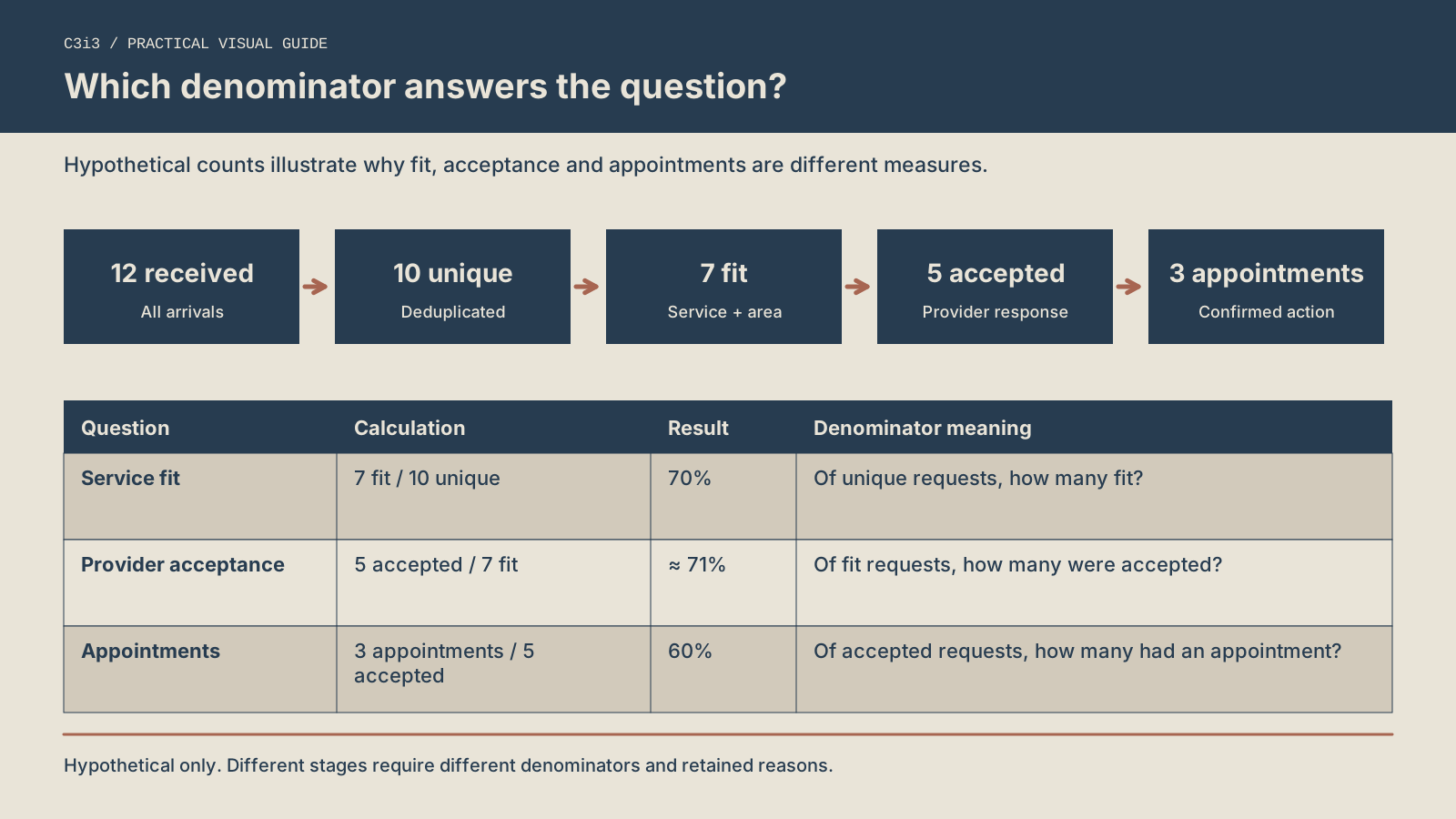
Hypothetical counts: fit is 7 of 10 unique requests; acceptance is 5 of 7 fit requests; appointments are 3 of 5 accepted requests.
How do you turn rejection reasons into a practical improvement?
Connect each recurring reason to the part of the journey that can plausibly cause it. Change the page, route or operating offer that the evidence identifies, then review the same stage after the change.
Outside-territory requests may justify clearer coverage wording or a more visible location field. Unsupported-service requests may indicate a vague headline or search intent mismatch. Delivery issues require routing investigation. Suitable requests awaiting provider capacity require an operating decision rather than merely another page revision.
How can a review avoid assigning blame without evidence?
Keep observation, explanation and action separate. “Three requests asked for an unsupported service” is an observation. “The headline may imply a broader offer” is a hypothesis. Revising the headline and reviewing the next comparable period is an action. Do not present the hypothesis as a proven cause.
Use dated samples with enough context to understand the pattern while limiting personal information. Keep contact details and free-text descriptions in the restricted request system. Google’s guidance on personally identifiable information explains why those details should not be passed through general analytics URLs or event parameters.
Give the selected change an owner and a check date. Avoid changing the page scope, form fields, territory and receiving destination simultaneously unless the operating problem requires it. Multiple changes may be necessary, but the review should then acknowledge that it cannot isolate the effect of one adjustment.
When does inquiry evidence support expanding the lead asset?
Expansion is reasonable when the current offer is accurate, delivery is dependable and reviewed inquiries support a specific additional service or territory. A rise in raw contacts alone does not establish that readiness.
Begin with unresolved operating issues. If the existing provider cannot review suitable requests consistently, more territory may add complexity without improving the customer path. If service-fit data is missing, establish that review before using contact volume to justify growth. If routing fails, repair it before increasing exposure.
What should the next-scope decision record contain?
Record the proposed audience, service, territory, supporting observations, receiving capacity and evidence still needed. Name the new page decision and its distinct content requirements. Confirm who will handle its requests and how the route will be tested before publication.
Compare like periods where possible and note service changes, seasonality and other acquisition activity. A useful review can conclude that the correct next step is maintenance or a narrower offer. Expansion is one possible decision, not the expected reward for filling a report.
Keep the qualification definition stable while comparing results, or document exactly when and why it changed. If the definition becomes stricter midway through the period, a lower rate may reflect the new criteria rather than deteriorating search traffic. A reliable operating record lets the team explain that difference without inventing a performance story.
What else should you know about qualifying rank and rent inquiries?
Keep incomplete evidence and later provider decisions visible. Qualification is a consistent review of request fit, while acceptance and appointments require their own observations.
Is every received message a lead?
A received message is a contact record. It may be a suitable request, repeated activity, an unrelated message or something that needs clarification. Use a specific stage label rather than calling every record a qualified lead. That keeps the initial total useful without overstating what it proves.
Does provider rejection always mean poor lead quality?
No. A suitable request can be declined or deferred because of provider capacity. Record that separately from service or territory mismatch. The distinction helps decide whether the next action concerns content accuracy, the operating arrangement or a different receiving scope.
Should incomplete inquiries be rejected immediately?
Use a needs-clarification state when missing information could change the decision. Identify which detail is required for routing or review. Do not infer an unsupported service or location from an incomplete message. Keep the status unresolved until appropriate evidence is available.
Can one repeat caller create several unique inquiries?
Yes, if the person has genuinely separate service needs. Repeated activity about the same request should remain linked to one inquiry. Review context rather than relying only on a shared phone number, and preserve enough restricted operational evidence to explain the decision.
Should small samples be reported as percentages?
They can be, provided the count and denominator are visible and the conclusion remains cautious. Three appointments out of five accepted requests is understandable. Reporting only 60% hides how few observations support the number. Use the review to select a practical investigation rather than claim a stable universal rate.
What if the provider does not supply outcome information?
Report the stages that can be verified and mark later outcomes unknown. Do not infer acceptance or appointments from receipt or duration. Agree on a minimal structured review before expanding, since missing outcome evidence limits the decisions the website operator can responsibly make.

How C3i3 Can Help
C3i3 can help define a useful inquiry, align page scope with provider requirements and develop a stage-based review through Lead Generation Campaigns. Our Local SEO work can use those observations to refine service targeting and content priorities.
Bring your current definitions, anonymized reason summaries and receiving process to discuss an inquiry-quality assessment with C3i3. A useful starting point is clarifying what the existing records establish before proposing more services, pages or territory.