








































In this article
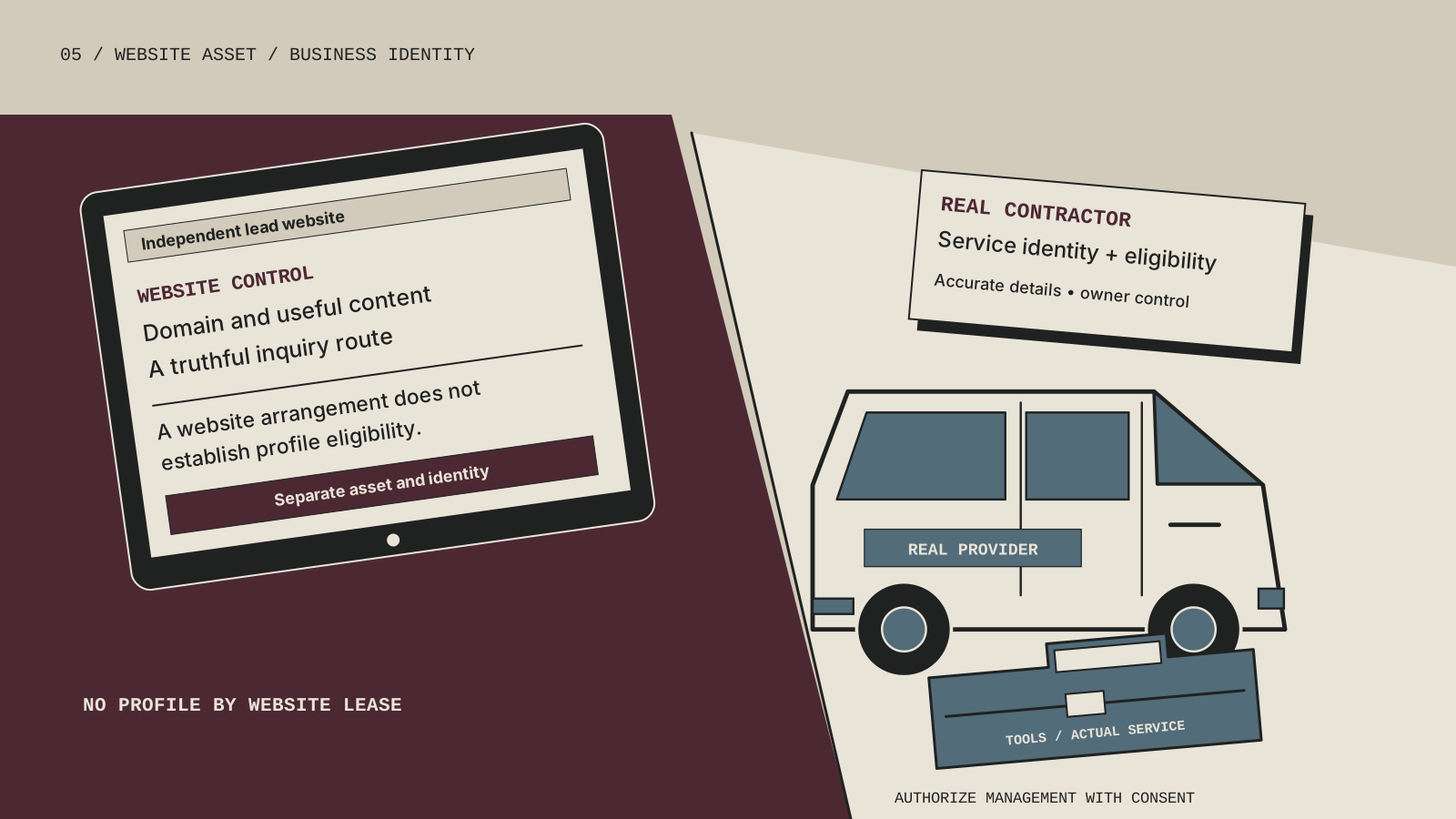
A rank and rent Google Maps proposal can hide an important identity question: which real business would the profile represent? An independent lead website and the contractor receiving its inquiries are different things. Owning a domain, obtaining contractor permission or directing calls to a service business does not make the lead-generation company that contractor.
This guide is for business owners evaluating a proposed website and profile arrangement. It explains Google's current eligibility distinction and offers a worksheet for reviewing the real business, ownership and destinations before changes are made. It does not provide fake-location tactics or verification workarounds. For the broader asset model, read the rank and rent SEO guide; profile eligibility must remain a separate decision.
Can a lead-generation company create a Google Business Profile for its rented site?
No. Google's business eligibility and ownership guidelines explicitly exclude lead-generation agents and companies. An independent rented lead website should not be represented as an eligible contractor business merely because it collects requests for that trade.
The practical planning consequence is straightforward: do not build a proposal around obtaining a Maps listing for the lead asset. A domain, page design or receiving contractor cannot resolve the company's underlying ineligibility. An invented storefront would add inaccurate business information rather than establish a real service operation.
Why does this matter before the site is built?
If the project depends on a profile the lead company cannot legitimately hold, its discovery plan rests on a false assumption. Resolve that assumption while the brief is still being written. The parties may still assess an independent website, but they must evaluate its customer purpose and discovery route on their own terms.
Consider a fictional marketing operator that proposes a site called Harbor Roof Requests and plans to route inquiries to a roofer. The operator maintains pages and contact routing but does not perform roofing. Calling the site a roofing company in a profile would misrepresent the operating facts. Naming the receiving roofer in the website explanation does not transform the operator into that business.
Ask a simple question during review: “Which business actually provides the service described by this proposed profile?” If the answer is the independent inquiry company, the proposal needs correction. If the answer is a contractor, evaluate that contractor's genuine profile separately.
When can the real contractor have an eligible profile?
The real contractor can be considered under Google's rules for its actual operation, including how it serves customers and represents its business. Eligibility belongs to that business. It does not follow automatically from participating in a lead website arrangement.
Google's business representation guidance requires accurate real-world identity and location information. Its service-area guidance distinguishes businesses that visit customers from those that also serve customers at their address. A provider that does not serve customers at its business address should remove the address from its profile.
Does a contractor need a made-up storefront?
No. The review should follow the actual service model, not invent a public location to make a setup appear easier. A plumbing business visiting customers should examine the appropriate service-area requirements. A mailbox, borrowed office or fictional suite is not a substitute for the real operation.
For a genuine plumber working without a storefront, our existing plumbing verification guide addresses that specific question. This article addresses the prior distinction between the provider and an independent lead-generation company.
In a hypothetical review, a contractor can document its real business but the marketing operator proposes using the lead site's separate brand as the profile name. Those facts do not align. Keep the contractor's identity intact and resolve the proposed website relationship before making changes. A useful check should be understandable to the business owner without asking them to interpret a technical workaround.
What can an authorized agency manage without changing business identity?
An authorized agency can manage a real business's profile within the business owner's consent and Google's rules. That is a management role, not a new business identity. The contractor should retain ownership of its legitimate profile and understand the work being performed.
Google's authorized representative requirements require express consent, owner involvement and truthful representation. They also address returning profile ownership to the business owner. Agency access should support the contractor's operation rather than make the contractor dependent on an unrelated lead asset.
What should the business owner ask the agency to show?
Ask which profile is involved, who its primary owner is, who has access and which changes are proposed. Review the business name, website and phone destinations before approving edits. Use named access where appropriate instead of treating a shared password as the management plan.
Google's primary ownership guidance distinguishes owner and manager roles and explains the official transfer process. A change of agency access is different from changing the business represented. Do not assume that transferring an account role makes an unrelated replacement contractor the same business.
A practical agency brief should state the contractor identity, permitted work, reviewer and evidence of completion. For example, the agency might review service wording and update confirmed hours under the owner's direction. It should not quietly substitute a separate lead brand or change the destination to an independent site as part of an unrelated website pilot.
Keep profile management and lead-site maintenance on separate lines in the scope. That makes the responsibility understandable and allows each piece to be evaluated against its own requirements.
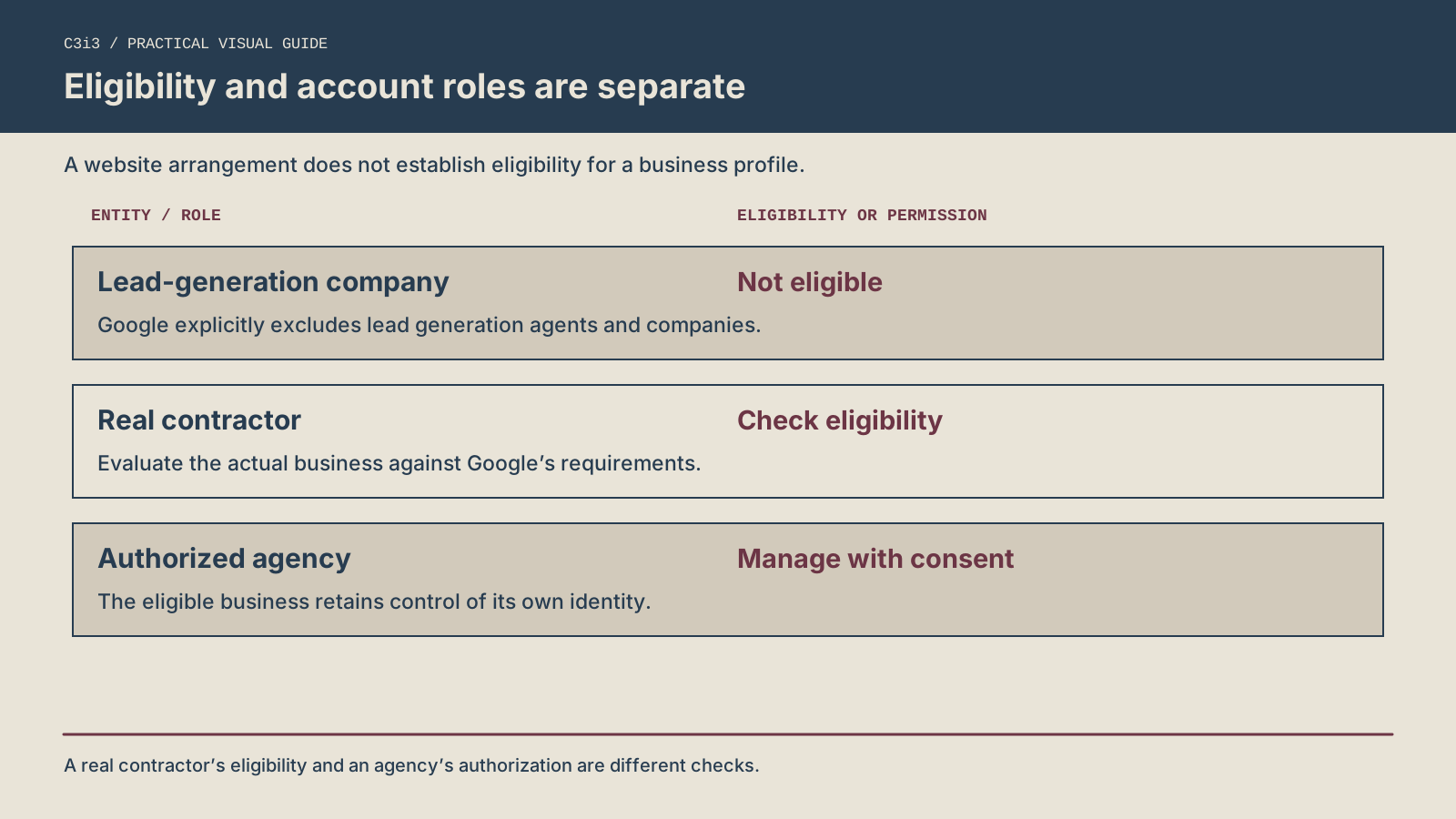
A lead-generation company cannot qualify through its rented site. Evaluate the actual contractor and use consent-based management.
Why do the profile website and phone destination matter?
The profile's destinations help establish which business a customer is contacting. They must represent the real business rather than act as interchangeable endpoints for a lead-generation operation. A technically working link or telephone route can still communicate the wrong identity.
Google's ownership guidance says the profile's authoritative website and phone must be verifiable by the business owner and that website content must be owned and managed by that owner. Its representation guidance also addresses direct phone control and destinations that refer users to another business.
Is a separately rented lead website automatically the contractor's authoritative website?
No. Do not assume that routing requests to a contractor makes the site its authoritative destination. A site retained by an independent operator and potentially redirected to another provider raises a different control and identity question from the contractor's own website.
The correct review starts with the actual arrangement. Who controls the content? Which business does the page say it represents? What will a visitor believe after arriving? Can the contractor verify the authoritative destination? Contractor permission alone does not answer all those questions.
Our digital asset control guide separates registration, hosting, content and contact-route control. That inventory is useful here because a domain login does not establish all the relevant rights or management responsibilities.
In a fictional assessment, an operator proposes changing only the profile link while leaving the contractor unaware that the destination may later route elsewhere. Mark that proposal unresolved. Keep the real contractor's identity and authoritative destinations clear instead of treating profile links as a way to validate the independent lead model.
How do you review a proposed setup with an eligibility worksheet?
Review the setup by identifying the real service business, its profile owner, authoritative destinations and actual location model. Record evidence for each answer. An account invitation is evidence of access, not proof that the business is eligible.
| Review question | Fictional proposed setup | Required decision |
|---|---|---|
| Who performs the work? | A real roofing contractor | Evaluate that contractor separately |
| Who is the proposed profile brand? | An independent inquiry website | Reject the lead-company profile plan |
| Who owns the contractor profile? | Owner access is not documented | Resolve legitimate ownership |
| Whose website is linked? | Operator-controlled site with changeable provider | Do not assume authoritative status |
| Whose phone is used? | Control and destination not confirmed | Verify against actual business |
| What location is represented? | A proposed mailbox | Remove the fictional location approach |
This is an invented review example. It shows why one correct fact, the existence of a real contractor, cannot settle the whole setup. The independent inquiry-brand profile remains inappropriate, and the contractor's ownership and destinations need their own checks.
What should happen when an answer is missing?
Assign a responsible person and a specific evidence request. Ask the contractor to confirm real business information. Ask the authorized manager to identify current access. Keep changes paused where identity or control is unresolved. Do not fill an unknown with information designed to get through a setup screen.
If a verified profile is controlled by someone else, the business owner should follow Google's ownership request guidance. Creating a duplicate is not a substitute for resolving the actual profile. Record the support process and observed outcome without promising that a particular request will succeed.
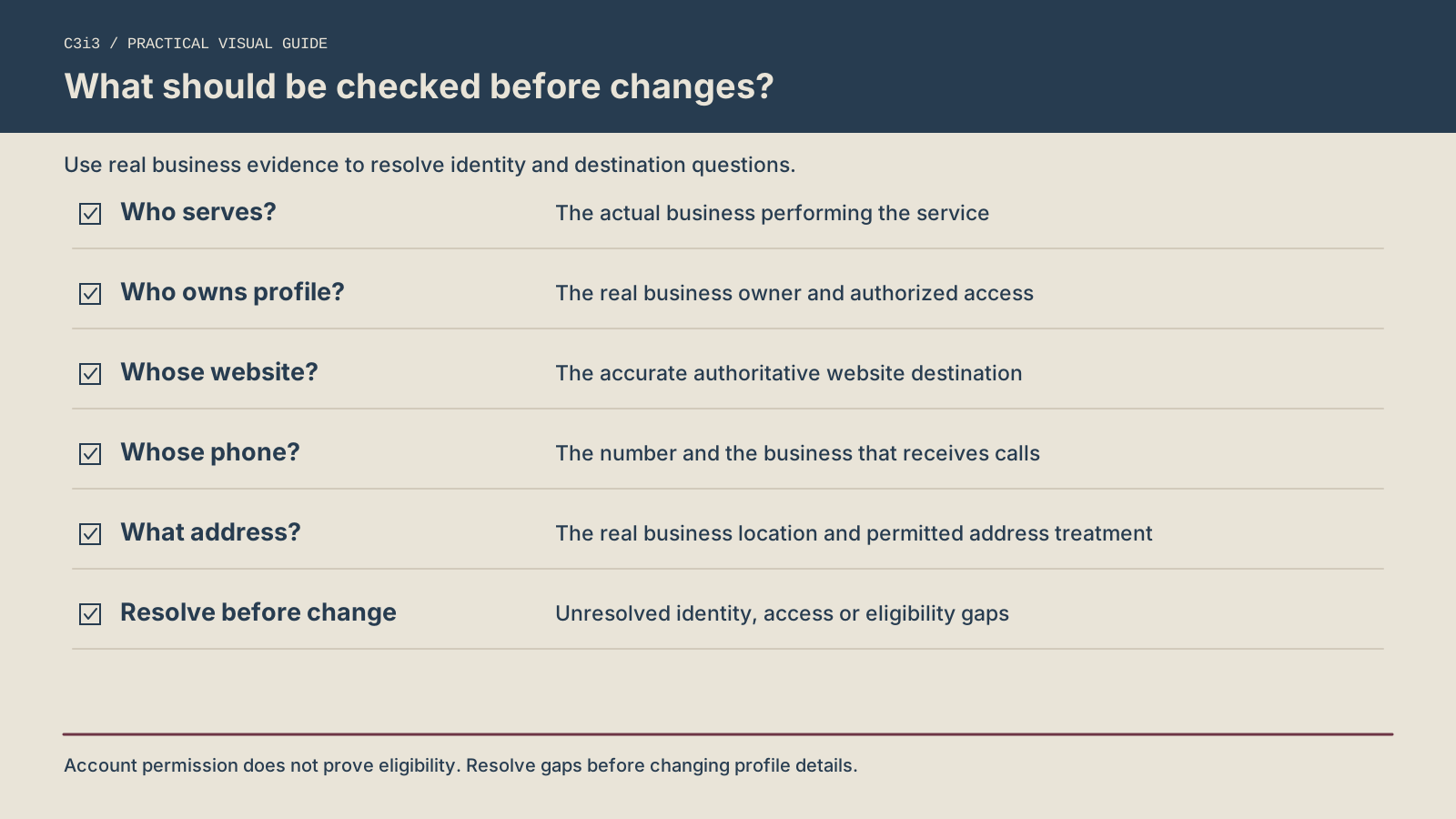
Identify the real provider and owner, verify authoritative destinations and accurate location, then resolve gaps before changes.
How can a lead website operate without inventing a Maps listing?
A lead website can be assessed as a separate web destination with useful service information, transparent identity and a tested request route. It does not need an invented Maps presence to have a coherent purpose. Its discovery and performance must be evaluated from actual evidence.
Start with a page structure that helps customers understand the service and provider relationship. The annotated fictional website example demonstrates those information relationships. Confirm real coverage and provider capacity before opening the inquiry route.
Which search practices should remain outside the plan?
Reject city-swapped domains, thin intermediary networks, paid ranking links and private blog network schemes. Google's Search spam policies address doorway abuse, scaled content abuse and link manipulation. Profile ineligibility is not a reason to pursue those substitutes.
Instead, define what the independent site contributes that a visitor can use: a clear service explanation, an honest coverage decision, provider information and a reasonable next step. Distinct pages should address distinct needs. Ordinary SEO can support discoverability, but no one can promise indexing, placement or inquiry totals.
Measure website activity separately from the real contractor's profile activity. Record where a request originated when that evidence is available, then distinguish delivery, fit and acceptance. Do not attribute every phone call to Maps or the website without support.
A business may ultimately decide its own authoritative website is the more useful place to improve. That is a valid outcome of the assessment. The asset arrangement should follow the customer and operating purpose, with the platform rules treated as a real design constraint from the beginning.
What other Google Maps questions should a business owner ask?
Ask whether consent, location, access or a provider change is being treated as proof of eligibility. Each affects a different part of the setup and needs its own clear explanation.
Does contractor consent make the lead company eligible?
No. Consent can authorize management of the contractor's real profile. It does not change which business the lead company operates or make an independent inquiry brand into the contractor. Keep the management permission and the underlying eligibility decision separate in the project brief.
Can a virtual office solve lead-company ineligibility?
No. An address cannot change a lead-generation company into the service business it refers requests to. Any contractor location also needs accurate treatment under Google's rules. Do not use an invented office, borrowed location or mailbox to create the appearance of an operation that does not exist.
Can the same profile move between unrelated contractors?
Do not treat a profile as a reusable accessory attached to the website. A profile represents a real business. Changing an agency relationship, replacing an inquiry recipient and transferring an actual business are different events. Review the real circumstances and current official guidance before any ownership or identity change.
Does having profile access prove the setup is compliant?
No. Access shows that an account can perform certain actions. It does not establish accurate identity, eligible operation or suitable destinations. Review those facts independently. An agency should be able to explain each proposed change in terms the business owner understands.
Can an agency guarantee profile verification or Maps placement?
No. The agency can help review accurate information and follow the available official process. Google determines verification and visibility. A credible scope identifies work, evidence and unresolved conditions without promising approval or placement. Ask for the actual business and profile facts behind the proposed work.

How C3i3 Can Help
C3i3 can review the distinction between a contractor's legitimate local presence and a separately controlled lead website before a pilot is scoped. Our Local SEO service can connect business information, website purpose and appropriate management responsibilities.
Bring the real service model, current profile ownership and proposed website and phone arrangement. Contact C3i3 to discuss an evidence-based assessment. The aim is a clear, supportable plan for the actual business, with no fabricated locations or claims of guaranteed profile approval.