








































In this article
Choosing rank and rent niches is a service and operations decision before it is a website decision. A promising phrase is not enough. You need a customer need you can explain, a real provider able to accept suitable inquiries and a location scope that matches actual coverage.
This guide helps business owners compare home-service candidates without invented profitability tables. It separates contractor searches such as “roofing leads” from homeowner searches for a roofer, then uses a practical worksheet to examine demand, competition and response capacity. If you need the overall model first, read the rank and rent SEO foundation guide. The goal here is a defensible choice for investigation, not a prediction that one trade or city will produce a particular result.
Which search intent belongs to the business owner and which belongs to the customer?
A business owner searching for “roofing leads” or “HVAC leads” is usually evaluating customer acquisition. A homeowner searching for roof repair or air-conditioning installation is evaluating a trade service. The lead campaign needs to understand both journeys, while each page should have one clear audience.
For the business-owner journey, explain how the channel works, what evidence is available, who controls the asset and how the provider will assess incoming requests. C3i3's separate roofing lead website evaluation and dedicated HVAC website guide address those acquisition questions.
What belongs on the customer-facing lead site?
The customer-facing site needs service information, supported coverage, provider identity and an understandable request process. A homeowner should not have to read a guide about renting websites to learn whether someone can assess a leaking roof. Equally, a contractor researching a marketing arrangement should not land on copy that implies C3i3 performs roofing work.
Build two query lists during research. One records how prospective lead buyers describe acquisition needs. The other records how their customers describe service problems. Use the second to design the lead site's information structure and the first to explain the marketing offer.
Ambiguous terms need closer inspection. “Commercial cleaning” could belong to a facility buyer seeking service, while “commercial cleaning leads” could belong to an operator researching acquisition. Check the actual results and surrounding query language before deciding what a page should answer. This prevents a niche plan from confusing interest in marketing with demand for the underlying service.
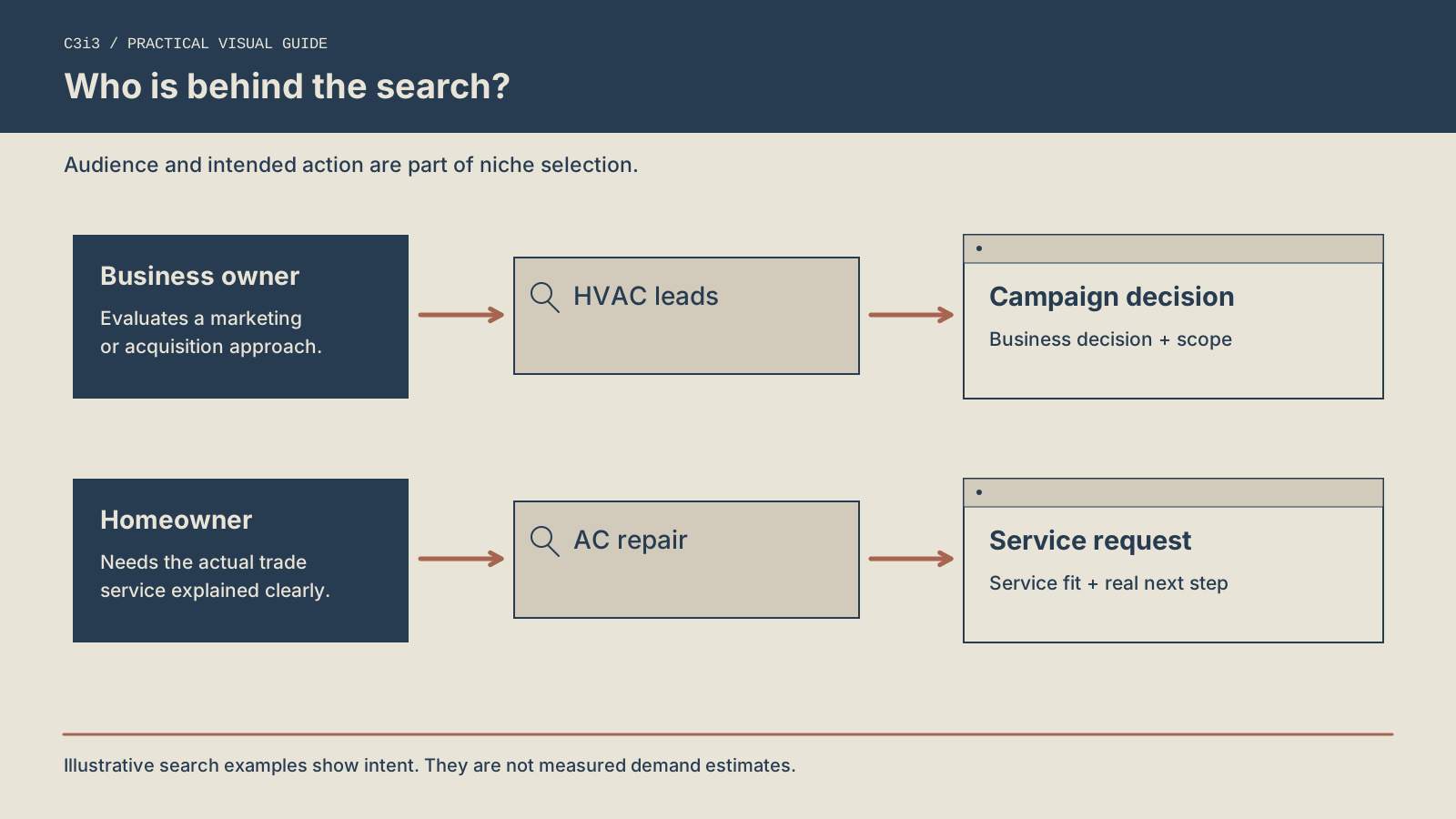
A contractor researching HVAC leads needs campaign information. A homeowner seeking repair needs a truthful provider and service path.
How do common home-service niches differ operationally?
Common niches differ in request urgency, information needed, service boundaries and provider scheduling. Compare those characteristics before building pages. No trade is automatically suitable merely because customers search for it.
| Candidate niche | Customer distinction to explain | Provider fact to confirm |
|---|---|---|
| Roofing | Repair assessment versus replacement planning | Supported roof work and assessment coverage |
| HVAC | Repair versus installation inquiry | Seasonal response and service capability |
| Plumbing | Immediate request versus planned work | Actual response hours and accepted jobs |
| Junk removal | Items, access and scope | Accepted work and assessment process |
| Professional cleaning | Homes versus facility requests | Service types and available scheduling |
| Tree services | Assessment and requested work | Appropriate capability and real coverage |
| Electrical work | Problem investigation versus installation planning | Supported work and qualification evidence |
This is an editorial comparison of operating questions, not a ranking of profitability or measured demand. Verify every service statement with the actual provider. Do not publish technical advice or imply qualifications based on the niche label.
Why can urgency change the niche decision?
An urgent request requires especially clear response expectations. A site that suggests immediate help while routing to an unmonitored inbox creates a mismatch. Planned work may allow a more detailed inquiry and a later assessment, but it still requires someone to respond.
A hypothetical operator considering HVAC repair and installation might find that its proposed partner only has capacity for planned installation assessments. The pilot should reflect that narrower capability rather than advertising every HVAC problem. This choice affects headings, contact wording and the questions asked before a request reaches the provider.
How do you test a location without assuming demand from a city name?
Test a location by combining current search evidence with verified operational coverage. A city name in a domain or title does not establish relevant demand, practical service access or a reason for a separate website.
Ask the provider to describe where it actually accepts work. Capture boundaries and conditions in language its office can apply. Then research service queries in the appropriate market and inspect results for the intended customer need. Record the date, phrase and geographic context so later readers understand what was checked.
What should keyword estimates contribute?
Keyword estimates can help identify language and compare apparent interest. They do not predict visits to a new site or the number of requests a provider will accept. A measured head term also does not establish demand for every longer headline containing it.
Suppose a fictional research brief initially names a broad region. The provider confirms only a smaller working area. The next step is to examine service intent within that supported area, not to retain broad targeting and decline the excess requests later. Unknown local demand remains a research question.
Separate location coverage from Business Profile eligibility. A service area describes where the provider works. It does not create an eligible profile for an independent lead-generation company. Google's eligibility guidance explicitly excludes lead-generation agents and companies.
For page planning, use the existing guide to deciding whether cities need separate pages. A useful location explanation needs verified distinctions that help customers. Repeating a service description with different city names cannot establish that difference.
What should you learn from competing search results?
Use search results to understand the customer tasks already being answered, the types of destinations shown and gaps your proposed site can honestly resolve. Do not treat another site's existence or position as proof that copying its model will work.
Inspect results for a small set of specific service queries. Note whether the visible destinations are provider websites, directories, informational guides or other formats. Read the pages that appear relevant. Ask what they explain well and what a visitor still needs to understand before making contact.
How do you distinguish a useful gap from a missing keyword?
A useful gap concerns a decision. For example, customers may need a clearer distinction between a planned replacement assessment and a repair request. The opportunity is an accurate explanation supported by the provider, not simply a page containing a phrase absent from competitors' headings.
Create a research note with query, observed result type, customer question, available evidence and proposed page purpose. Avoid copying competitor wording or promoting rival agencies in the published article. Record observations as dated samples because results can vary and change.
Reject an apparent opportunity if the only plan is to create many thin intermediaries. Google's spam policies describe doorway abuse and scaled content abuse. They also address manipulative link practices. A niche assessment should not depend on city-swapped networks, paid ranking links or private blog networks.
A narrow site can still be unhelpful, and a detailed site can still miss intent. The relevant test is whether the proposed information improves a customer's understanding and connects that customer with a truthful, workable next step. A competitive result sample informs that judgment; it does not decide it alone.
How do you compare candidate niches with an evidence worksheet?
Compare candidates by writing down verified facts, assumptions and the next evidence needed. Use a readiness decision rather than a fabricated profitability score. The worksheet should make it clear why one candidate can proceed while another needs research or should be rejected.
| Evidence field | Fictional HVAC candidate | Fictional cleaning candidate |
|---|---|---|
| Service | Planned installation assessment | Commercial facility cleaning inquiry |
| Provider capability | Provider confirms supported installations | No provider confirmed |
| Coverage | Provider supplies actual area | Area assumed from a city name |
| Demand research | Specific service queries need checking | Only broad topic interest recorded |
| Useful content | Provider can explain assessment steps | Only generic copy proposed |
| Response route | Named recipient available for testing | Destination unresolved |
| Decision | Continue research before launch | Pause pending operating partner |
These fictional entries do not establish that HVAC is a better trade than cleaning. They show that the hypothetical HVAC proposal has fewer unresolved operational dependencies. Neither candidate is ready for a public launch because demand evidence and other checks remain incomplete.
What changes an entry from assumed to verified?
Attach evidence to the field. Coverage becomes verified when the responsible provider confirms it. A route becomes tested when a controlled request reaches the intended recipient. Demand research becomes documented when the actual phrase, market, source and check date are recorded.
Assign each open item to a person and identify what the answer will change. If a fact would not affect the service promise, page structure or decision to proceed, it may be secondary. Focus the first review on dependencies that can invalidate the proposed customer journey.
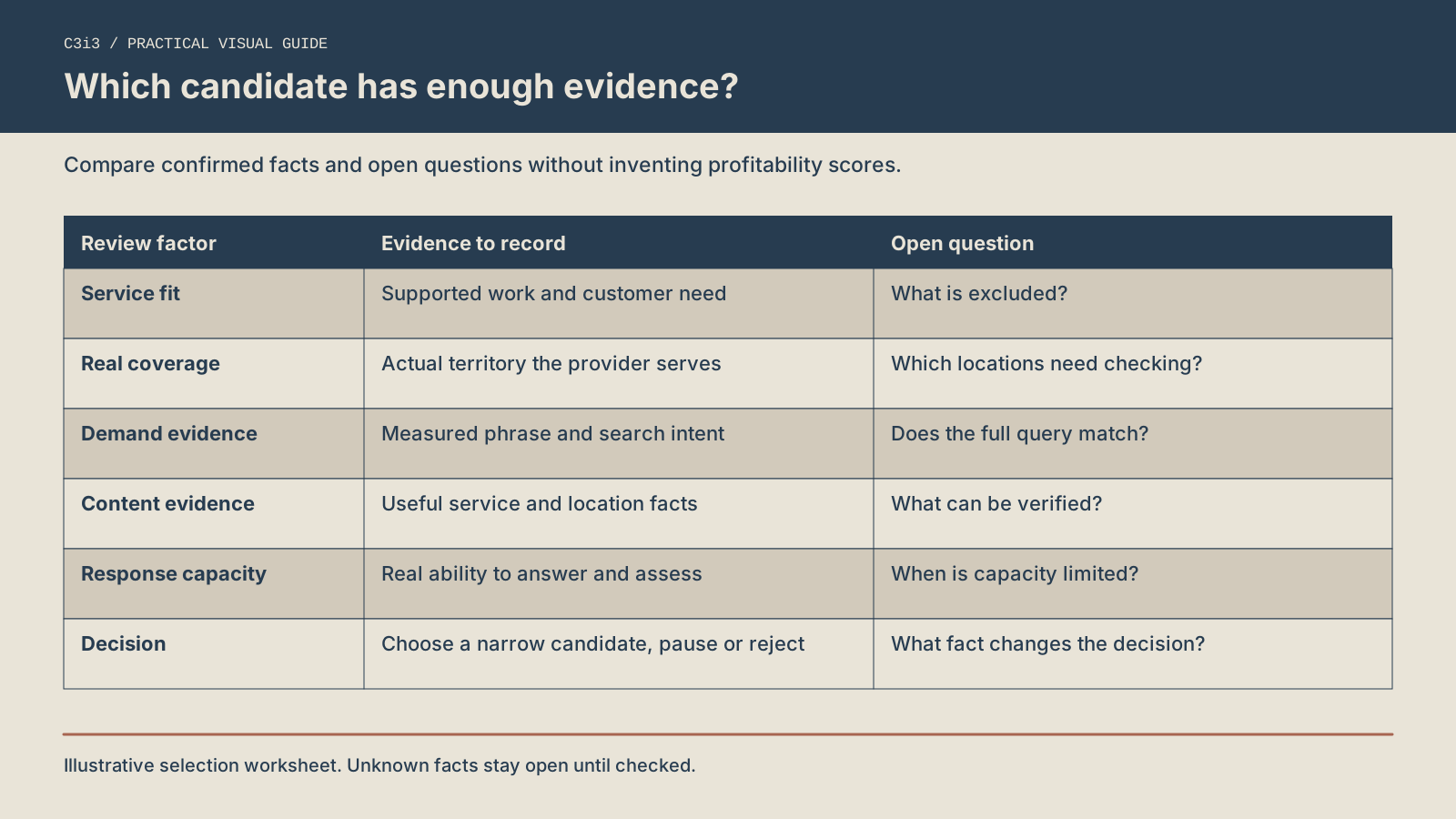
Use evidence and open questions to choose a narrow candidate, pause it or reject it.
When should you narrow, pause or reject a niche?
Narrow a niche when real capability supports only part of the original idea. Pause it when essential evidence is missing. Reject the proposed approach when it depends on misleading identity, unsupported claims or search manipulation.
Narrowing might mean one service type instead of a whole trade, or one verified coverage area instead of a broad region. It should make the public explanation more accurate. A plumbing provider offering planned work should not inherit an emergency promise simply because the operator prefers that query language.
A pause is appropriate when a provider has not confirmed participation, the inquiry destination is unknown or demand research has not tested the intended service. Continue private planning where useful, but do not turn those unknowns into published facts.
What should happen after selecting a candidate?
Write a concise pilot brief covering audience, service, location, provider, page purpose, account control and receipt testing. The website ownership inventory helps resolve control questions. The annotated fictional website helps translate service facts into a usable information structure.
Keep a rejection note when a candidate does not fit. “No provider can support the stated response” is more informative than “bad niche.” It helps the team reconsider later if the underlying facts change. Likewise, a selected candidate remains provisional. Subsequent evidence about visibility, fit or response may require another scope decision.
The purpose of selection is to authorize a coherent next investigation, not to declare a winning market. Preserving uncertainty in the brief helps the team learn from the actual operation rather than defend its first guess.
What other questions help with niche selection?
Ask whether the demand estimate matches the actual customer decision, whether urgency fits the operation and whether multiple sites have a useful purpose. These checks can change the proposed scope.
Is the largest keyword estimate the best niche?
No. An estimate describes a researched phrase, not the fit of a particular provider or website. A broad phrase can include several intentions. Compare specific customer decisions, actual coverage and the ability to answer and receive requests before using estimated interest to prioritize research.
Can one provider support several niche websites?
That possibility needs a service and capacity review, but it should not lead to near-identical sites created to occupy similar results. Start with the customer information structure. Several distinct services may fit one coherent website. Additional domains need a genuine purpose beyond multiplying search entry points.
Should urgent services always be the priority?
No. Urgency increases the importance of accurate availability and prompt response. It can make an unsuitable operating arrangement more apparent. Choose an urgent service only when the provider can support the stated process. Planned assessment work can be a clearer fit for a different operation.
Does an exact-match city domain prove local relevance?
No. It does not prove coverage, provider identity or useful local information. A visitor still needs accurate service details and a suitable next step. Do not use the domain's wording to imply a local office or a contractor identity that the operation cannot substantiate.
What should a business send C3i3 before research begins?
Send the service priorities, actual coverage, customer types, response responsibilities and relevant existing pages. Identify uncertain facts as uncertain. Those inputs help distinguish a viable scoped investigation from a topic that sounds attractive but lacks an operating foundation.

How C3i3 Can Help
C3i3 can assess service intent, compare candidate scopes and connect the findings with a practical Local SEO plan. A scoped lead-generation campaign can bring research, content, design and implementation into one reviewable brief.
Contact C3i3 with the trade, real provider capability and location you are considering. We can discuss the evidence needed before building, including whether improving an existing business website is the more useful starting point.