








































In this article
“Digital real estate” can make an online asset sound simpler than it is. For a lead-generation website, the useful meaning is a collection of controlled accounts, website materials and operating processes. It is a metaphor for an online asset, not ownership of physical property or financial advice.
If you are considering an independent lead website, ask what can actually be accessed, maintained and moved. A domain login does not establish control of the hosting. A copy of the pages does not establish permission to reuse every photograph. Receiving inquiry reports does not establish access to the telephone account. This guide separates those layers so business owners can evaluate a proposed arrangement. For the broader business model, start with how rank and rent websites operate.
What does digital real estate mean for a lead website?
Digital real estate means the website-related assets an operator can maintain and use under the relevant agreements and permissions. The phrase becomes useful only when it is translated into specific components. It should not imply guaranteed demand, permanent platform visibility or a property right over a geographic market.
A fictional site called Harbor Service Requests might have a registered domain, hosted pages, original illustrations and a telephone route. Those components can belong to different accounts and be subject to different terms. Its search traffic is an observed outcome, not something the operator can preserve simply by retaining the domain.
Which claims need a more precise question?
Replace “you own the whole asset” with “who is the domain registrant?” Replace “the site is portable” with “which files, data and permissions are available to rebuild it?” Replace “the leads are yours” with “who may access the requests and for what stated purpose?” Each question reveals a dependency hidden by the broad metaphor.
The distinction also protects the provider's identity. A contractor can receive suitable inquiries without giving the lead-site operator control of the contractor's brand, customer evidence or platform profiles. The website should explain its role accurately and use provider material only with appropriate permission.
For a business considering the model, the practical deliverable is an asset inventory. A polished screenshot or a traffic chart cannot replace that inventory. Ask the operator to demonstrate the relevant controls and explain the parts that depend on third-party services or another party's permission.
What does domain registration actually give you?
Domain registration establishes a registration relationship for a particular name under a registrar's terms. Check the recorded registrant, account access, renewal arrangements and recovery route. Do not treat a familiar domain name or the ability to edit a page as evidence that the right party controls registration.
ICANN describes registrants' rights and responsibilities, including the registration agreement and responsibility for registration information. Its renewal and expiration guidance explains why continuing attention to the registration matters. A website operator should know where renewal notices go and who checks them.
How is DNS different from registration?
DNS determines where the domain's records point. It can be managed in a separate service from the registrar or hosting account. Cloudflare's DNS documentation, for example, describes changing records when an origin address changes. Control of those records affects where visitors are sent, even when nobody edits the website's content.
In a hypothetical audit, the operator discovers that it controls hosting but a former collaborator alone controls DNS. The domain still loads, yet a hosting move would depend on that collaborator. The remedy is to resolve authorized access and recovery before a move is needed, then record the verified arrangement.
A useful domain check therefore has two lines: registration and DNS. For each, name the responsible account, administrator and recovery method. Store sensitive recovery details securely rather than putting them in a general editorial document.
How do hosting, source files and content rights differ?
Hosting keeps the website available through a service. Source files and stored content describe how it is built. Rights determine which materials the operator is permitted to use. Access to one component does not establish possession or reuse permission for the others.
A hosted website builder may provide a convenient editing interface while limiting what can be exported. A source repository may contain page templates without the production database or uploaded media. A folder of exported pages may omit the form integration that sends inquiries. Ask for a demonstration appropriate to the actual platform rather than assuming all sites migrate in the same way.
What should a continuity test cover?
A continuity test should show that the team can recover the intended site and understand its external dependencies. Identify the platform, current backup method, required configuration and media location. Use a private test environment when restoring, so a rehearsal does not alter the live inquiry route.
Platform-specific guidance matters. For example, WordPress's official backup documentation distinguishes database and file backups. That example illustrates why a folder of files alone may be incomplete; it is not a recommendation that every lead website must use WordPress.
Review content separately. List original copy, commissioned artwork, provider photographs and licensed materials. Record relevant permissions and any restrictions that affect future use. If a contractor leaves the arrangement, its project images or testimonials should not automatically remain as evidence for a new contractor.
One practical test is to ask whether another authorized operator could explain what runs the website from the inventory and supporting documentation. If the answer depends entirely on one person's memory, the asset is less controllable than its public appearance suggests.
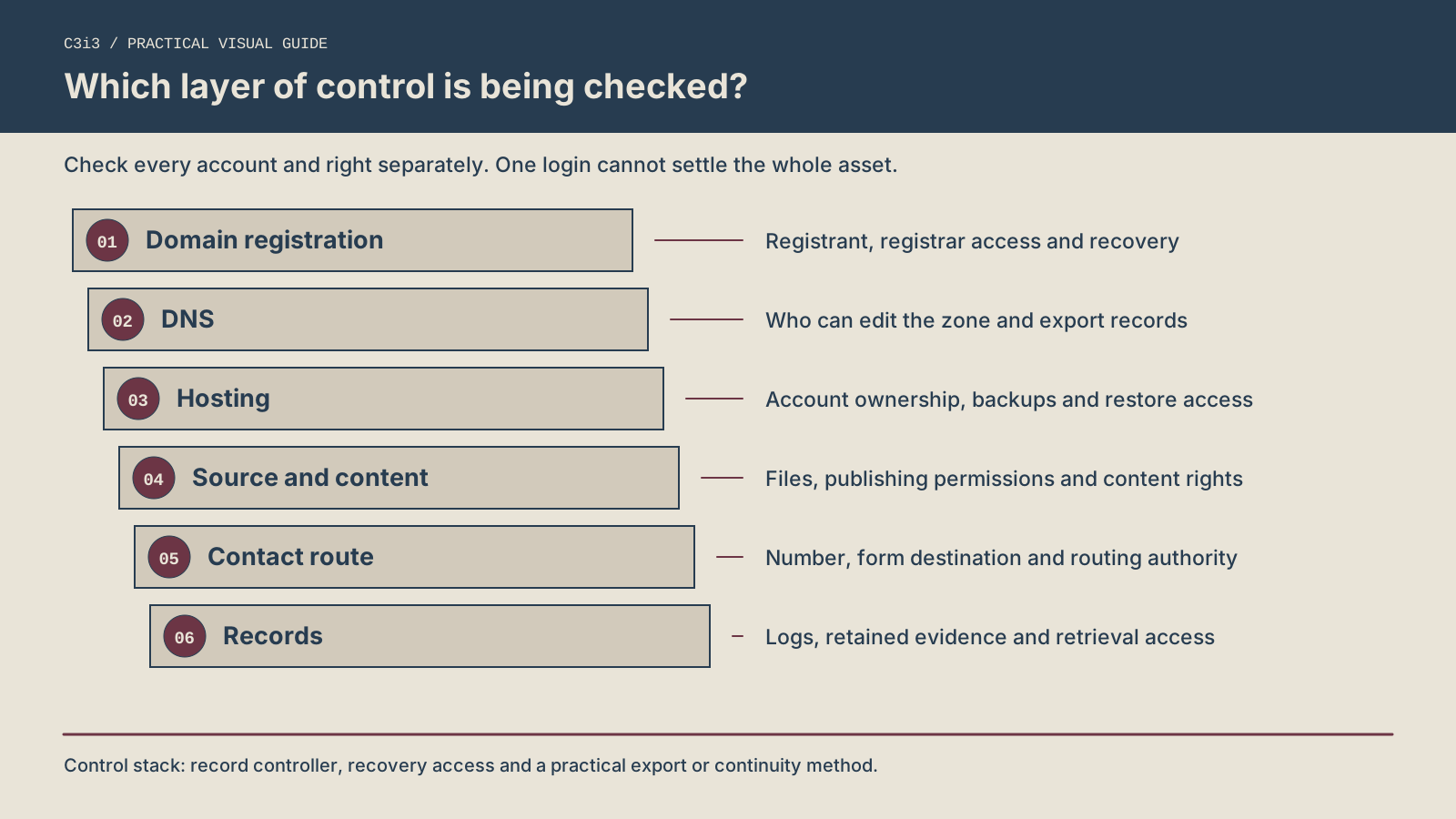
Check each account, its controller, recovery access and export or continuity method separately.
Who controls phone numbers, inquiry records and reporting?
The parties must identify those controls separately, because a website administrator may not control its phone account, inquiry destination or reporting history. Check account access and actual routing rather than relying on a number displayed on the page.
For the phone route, record the service account, authorized administrator, current destination and continuity options offered by that provider. Number movement can depend on service terms and technical eligibility, so do not promise portability without checking the actual account. For forms, identify the receiving system and the party responsible for confirming receipt.
Why are records different from asset files?
Inquiry records contain information about people and service requests. They need a defined purpose and appropriately controlled access. Possessing a website backup does not settle who may use every stored request. Keep customer records out of general design exports, screenshots and shared review documents.
Reporting is another layer. A contractor may see a summary while the operator administers the underlying analytics property. State which reports are available, how definitions are maintained and which observations are missing. A chart of telephone clicks cannot demonstrate connected calls or accepted work.
Use an illustrative test request agreed by the relevant operator to trace the route. Confirm what was sent, where it arrived and who could access it. Avoid putting genuine customer details into the exercise. A successful test establishes the tested path at that time; it does not prove uninterrupted delivery forever.
For an annotated view of what visitors should understand before using that route, see the fictional lead website example. Public explanation and account control need to agree.
How do you audit the asset with a practical control worksheet?
Audit the asset by recording the controller, evidence and continuity test for each operating layer. Separate “verified,” “reported” and “unknown” in your notes. An unanswered question is a task to resolve rather than a reason to mark the entire website as owned.
| Layer | Hypothetical finding | Next verification |
|---|---|---|
| Registration | Operator reports registrant control | Review the correct account and renewal contact |
| DNS | Another supplier manages records | Confirm authorized access and export |
| Hosting | Operator can deploy updates | Document recovery and site dependencies |
| Content | Copy is original; photographs come from provider | Record permitted use for each source |
| Contact | Test form reached intended recipient | Record test date and fallback owner |
| Records | Provider sees request summaries | Confirm permitted access and retention process |
These are fictional findings. In this example, deployment access is verified but registration is only reported. DNS remains a dependency. The sensible next step is to resolve those two questions before describing the site as independently maintainable.
What should the evidence look like?
Use account identifiers, documented roles, a current file inventory and dated test results. Do not circulate passwords or recovery codes with the worksheet. Keep a responsible person beside each unresolved item so the inventory drives action rather than becoming a static checklist.
Review again when a hosting service changes, a provider joins or leaves or a collaborator's access ends. The worksheet documents a current operating arrangement. It cannot guarantee future search performance or remove third-party platform dependencies.
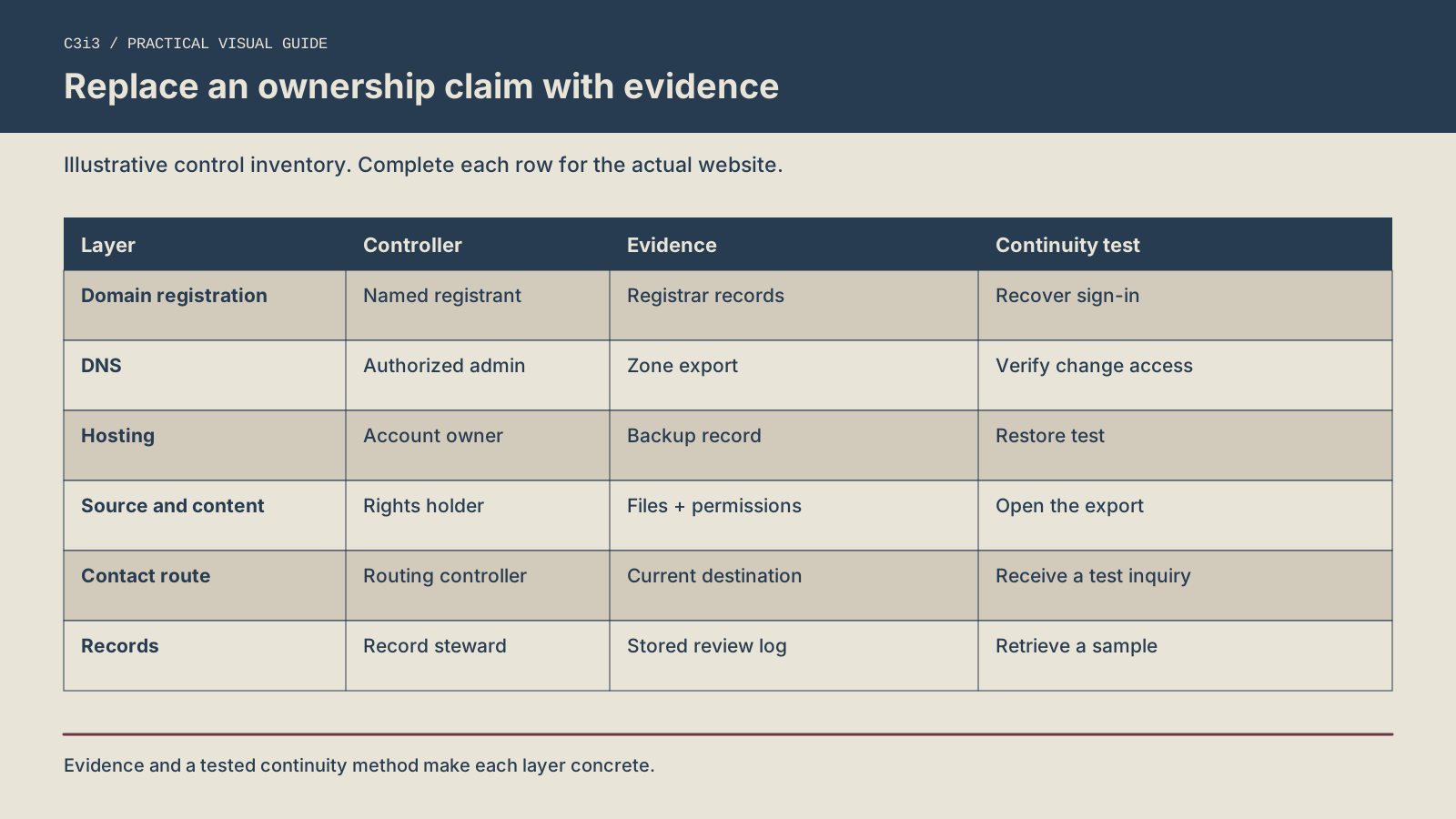
For each asset layer record its controller, proof of control and a tested way to keep operating.
What happens to the website when a provider changes?
The website may remain under the same operator, but its service claims, provider evidence, routing and public explanations need a new review. Replacing the telephone destination alone is insufficient. The new provider must be able to support the information a visitor reads.
Start with an inventory of references to the outgoing business. Review its name, photographs, credentials, reviews, service scope and appointment expectations. Check what permission remains for any retained material. Then confirm the replacement's actual services and coverage before enabling a new request path.
Google Business Profiles require a distinct identity check. Google's eligibility guidance excludes lead-generation agents and companies. A contractor's legitimate profile does not become a transferable accessory of an independently rented website. Read the profile eligibility explanation before planning any profile-related change.
How can the handoff stay reviewable?
Use a short change register covering the old state, proposed state, responsible reviewer and test evidence. Pause an unsupported public promise while the replacement arrangement is unresolved. Keep customer records restricted to their appropriate purpose instead of treating them like reusable page copy.
Finally, repeat the visitor walkthrough. A returning visitor should not encounter a familiar claim supported by a different business without a clear explanation. This is where digital asset control meets customer trust: retaining files is valuable only if the operator can maintain truthful, usable information as the underlying operation changes.
Which ownership questions remain after the inventory?
Clarify the difference between a domain and a website, what participation gives the contractor and how access survives changes. Keep operational evidence separate from disputed rights or performance assumptions.
Is a domain name the same thing as the website?
No. The name, DNS records, hosting and website materials are separate components. A domain may remain registered even when hosting is unavailable. A working website may depend on a domain controlled by somebody else. Record and verify both sides rather than treating one login as proof of the complete arrangement.
Can a contractor rent the inquiry channel without owning the pages?
That is one possible operating arrangement, provided the responsibilities are clear. The contractor should understand its access, the public explanation and what happens when participation changes. Receiving inquiries does not by itself establish rights to the domain, source files or every item of site content.
Does ownership preserve search rankings after a move?
No. Control lets an operator maintain and change the site, but search visibility remains an external outcome. A migration should be planned and checked for technical continuity. Do not describe retained ownership as a promise that positions, visits or inquiry totals will remain the same.
Should all collaborators share the same administrator password?
Use named access and appropriate roles where the service supports them. Keep recovery under the responsible organization's control and review access when people change roles. Our agency account handover guide covers the broader permission discussion; this inventory addresses the separate layers of a lead asset.
Does this guide establish legal ownership rights?
No. The worksheet identifies operational control, evidence and unresolved rights questions. Actual rights depend on the relevant agreements, licenses and circumstances. Resolve disputed or unclear rights with appropriate professional help. Do not use an editorial inventory as a substitute for reviewing the terms that govern the real project.

How C3i3 Can Help
C3i3 can help map the website components behind a proposed lead-generation pilot and connect them with a practical content and maintenance scope. Our Local SEO work can begin with service intent, site structure and the evidence needed to assess discovery.
Bring your current website arrangement, known account controllers and unresolved continuity questions. Contact C3i3 to discuss a scoped review or build. The useful starting point is a clear operating inventory and a customer journey the participating business can support.