








































In this article
Rank and rent website examples are most useful when they show how information connects, not just what a home page looks like. A visitor needs to understand the service, check coverage, identify who may perform the work and know what an inquiry will do. A polished layout can still fail those decisions.
This guide uses a fictional website, Harbor Home Cleaning Requests, to annotate that journey. The name, pages and scenarios are invented editorial examples. They do not describe a C3i3 client, a live service or a proven campaign. The example focuses on information relationships rather than a generic build tutorial. If you are assessing the operating arrangement itself, read how an independently controlled lead website works first.
What does the fictional example website represent?
Harbor Home Cleaning Requests represents an independent inquiry website connecting suitable residential cleaning requests with an identified provider. It is not itself a cleaning contractor. Its structure demonstrates how a site can explain that distinction throughout a customer journey.
For this hypothetical exercise, assume a real participating provider has confirmed recurring home cleaning and move-out assessment requests within a defined service area. It has not confirmed commercial facilities, specialist remediation or immediate appointment availability. Those boundaries determine what the site can say and which options the inquiry path should offer.
Which assumptions must stay visible?
The example assumes the provider has approved its public description and a named recipient can review requests. It assumes the operator controls the website and maintains the routing. A real project must verify those facts. The example does not assume search rankings, incoming requests or appointment outcomes.
A reader should be able to distinguish three roles: the operator maintaining the website, the provider evaluating work and the customer deciding whether to inquire. If the page makes those roles indistinguishable, design polish will not solve the identity problem.
The example also needs no invented Maps listing. Google's eligibility guidance excludes lead-generation agents and companies. The participating provider's legitimate profile is a separate matter. An example layout should never teach a business to manufacture a contractor identity for its independent lead site.
What should a visitor understand on the home page?
The visitor should immediately understand the supported cleaning requests, the site's role and the next step. The home page should help someone choose an appropriate service path. It should not imply that submitting contact details confirms an appointment.
A fictional opening could say: “Explore recurring home cleaning and move-out cleaning requests within our participating provider's confirmed area. This inquiry website connects suitable requests with the identified cleaning business. The provider reviews scope and availability before arranging service.” That is sample wording for the exercise, not approved copy for an actual operation.
What belongs near the first contact option?
Place a concise explanation of the recipient and next action beside the contact option. A visitor should not need to reach the footer to discover that the website is an inquiry service. Offer links to service details, coverage and provider information before asking the person to commit to contact.
The main navigation might contain “Recurring cleaning,” “Move-out requests,” “Coverage,” “Provider information” and “Start an inquiry.” Those labels describe customer tasks. They avoid a collection of vague claims such as “solutions” or “excellence” that leaves visitors guessing.
Evidence should be specific and permitted. If no actual project material is available, explain the service process without inventing reviews or using an illustrative room as proof of completed work. The page can be useful through accurate information alone.
On a phone, check whether the first screen still communicates role and scope. A prominent contact button should not displace all the information needed to understand what it initiates. The home page succeeds when a visitor can choose a fitting path with realistic expectations.
How should service and coverage pages connect?
Service pages should explain distinct requests, while coverage information should establish whether the provider can consider work at the customer's location. Link them where the decision arises. Do not force visitors to infer coverage from a domain name or a decorative map.
| Fictional page | Question it answers | Useful next destination |
|---|---|---|
| Recurring cleaning | Does this support an ongoing home-cleaning request? | Coverage and inquiry |
| Move-out requests | What information is needed before assessment? | Provider information and inquiry |
| Coverage | Can my location be considered? | Relevant service detail |
| Provider information | Who will evaluate or perform the work? | Service detail and inquiry |
The recurring page might explain how the provider evaluates the home's needs and scheduling preferences. The move-out page might ask about the property's condition, intended timing and access. Neither should promise a scope the provider has not approved.
When does a separate page earn its place?
Use a separate page when the customer faces a materially different decision and the provider can support the explanation. Minor wording variants can share a page. Coverage for several locations can live in one clear section when there is no useful difference to explain.
Google's spam policies address doorway patterns and scaled content created to manipulate results. The example therefore uses a coherent information hierarchy rather than a city-swapped network. A real location page would need useful, verified local distinctions.
The niche and location selection guide helps decide which service boundaries to confirm before this structure is designed. Architecture follows the actual offer, not a desire to publish the largest page count.
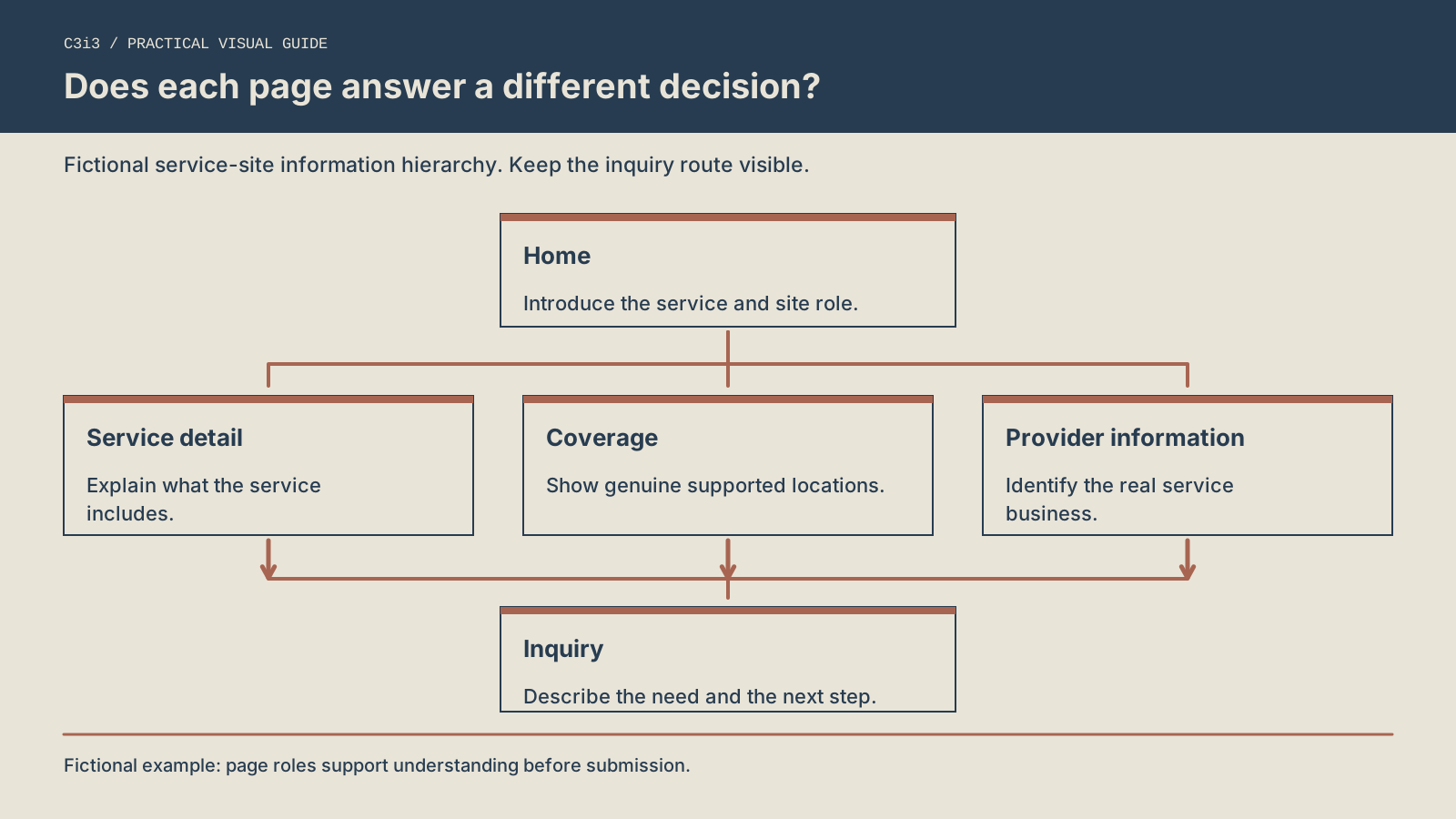
Home introduces the service. Detail and coverage explain fit. Provider information establishes identity before an inquiry.
Where should the site explain who provides the service?
Explain provider identity in the main customer journey, including the introduction, relevant service pages and the inquiry step. A dedicated provider page can supply detail, but it should not be the only place where the relationship becomes clear.
In the fictional example, provider information would identify the actual participating cleaning business and describe only services and evidence that business has approved. The site operator would be identified separately. Avoid headings such as “Our cleaning crews” if the operator has no crews.
What belongs on the provider information page?
Include the business's verified identity, supported work, coverage and appropriate contact explanation. Use genuine credentials or project material only when verified and permitted. Make it clear whether the provider will assess the inquiry, contact the customer or arrange a further discussion.
A common design failure is a generic “About us” page that describes the operator's marketing goals while leaving the customer uncertain about the service business. An inquiry website can explain its role honestly without asking the visitor to understand the underlying commercial arrangement.
Before a provider change, review every place the old business appears. Changing the contact destination while retaining its photographs or claims can mislead returning visitors. Account control does not automatically establish reuse permission. The digital asset inventory distinguishes those rights and controls.
Test identity with a reader unfamiliar with the project. Ask who they believe will perform the service and why. If their answer differs from the real arrangement, revise the visible wording. A clear legal footer cannot repair a main page that consistently implies the wrong provider.
What should happen when someone starts an inquiry?
The visitor should understand what information is needed, who receives it and what happens next. The form or telephone route should support the actual provider's review process. Submission should be described as a request unless the operation can truly confirm a booking.
For the fictional recurring-cleaning path, useful initial information might include service type, general location, preferred timing, a brief description and contact details. The move-out path may need a different scope question. Ask for information that changes fit or response rather than collecting details merely because a form allows more fields.
How should a confirmation message behave?
The confirmation should describe the action actually completed. If the system has only accepted the form, say the request was submitted and explain the expected review process. Do not state that a provider received or accepted it unless the operation has evidence for that claim.
For example, a fictional confirmation could explain that the identified provider will review the request before discussing availability. It should not display an invented appointment time or imply immediate attendance. The exact wording needs to match the real route and response arrangements.
Test a controlled request with the responsible operator. Check the service choice, entered information, destination, confirmation and evidence of receipt. Use fictional test details and avoid creating a real service request. Check telephone behavior separately because a working form does not prove that calls reach the right recipient.
The customer should also have an appropriate way to understand information handling. Keep the main collection purpose visible and connect it with the site's actual privacy explanation. A review of the real collection process is more useful than adding reassuring language that the operation cannot substantiate.
How do you review the example before copying its structure?
Review the example by walking a realistic visitor through the pages and checking what that person can know at each step. Copy the reasoning framework, then replace every assumed fact with actual provider evidence. Do not copy unsupported service promises.
| Review step | Fictional visitor question | Evidence needed on a real site |
|---|---|---|
| Need | Is recurring cleaning supported? | Approved service explanation |
| Coverage | Can my location be considered? | Provider-confirmed coverage |
| Identity | Which business will review my request? | Visible, verified provider identity |
| Action | Am I requesting a review or booking? | Accurate button and process wording |
| Receipt | Where did my information go? | Controlled destination test |
In this worked fictional review, imagine the recurring page is clear but the inquiry button says “Book now” while the process only sends a request. Mark that as a mismatch. Change the action wording and confirmation to reflect provider review, then retest the journey.
What should the review record contain?
Record the scenario, page visited, observed wording, unresolved issue and responsible person. Separate content issues from technical failures. A missing explanation needs editing; a failed destination needs routing work. Neither is established by a general impression that the page looks professional.
Repeat the walkthrough on a narrow phone screen. Check whether links and tables remain usable and whether essential identity information disappears beneath decorative material. The final test is comprehension and a verified route, not resemblance to a competitor's home page.
For the next level of detail, our cleaning lead website guide explains how distinct cleaning business models change the request path.
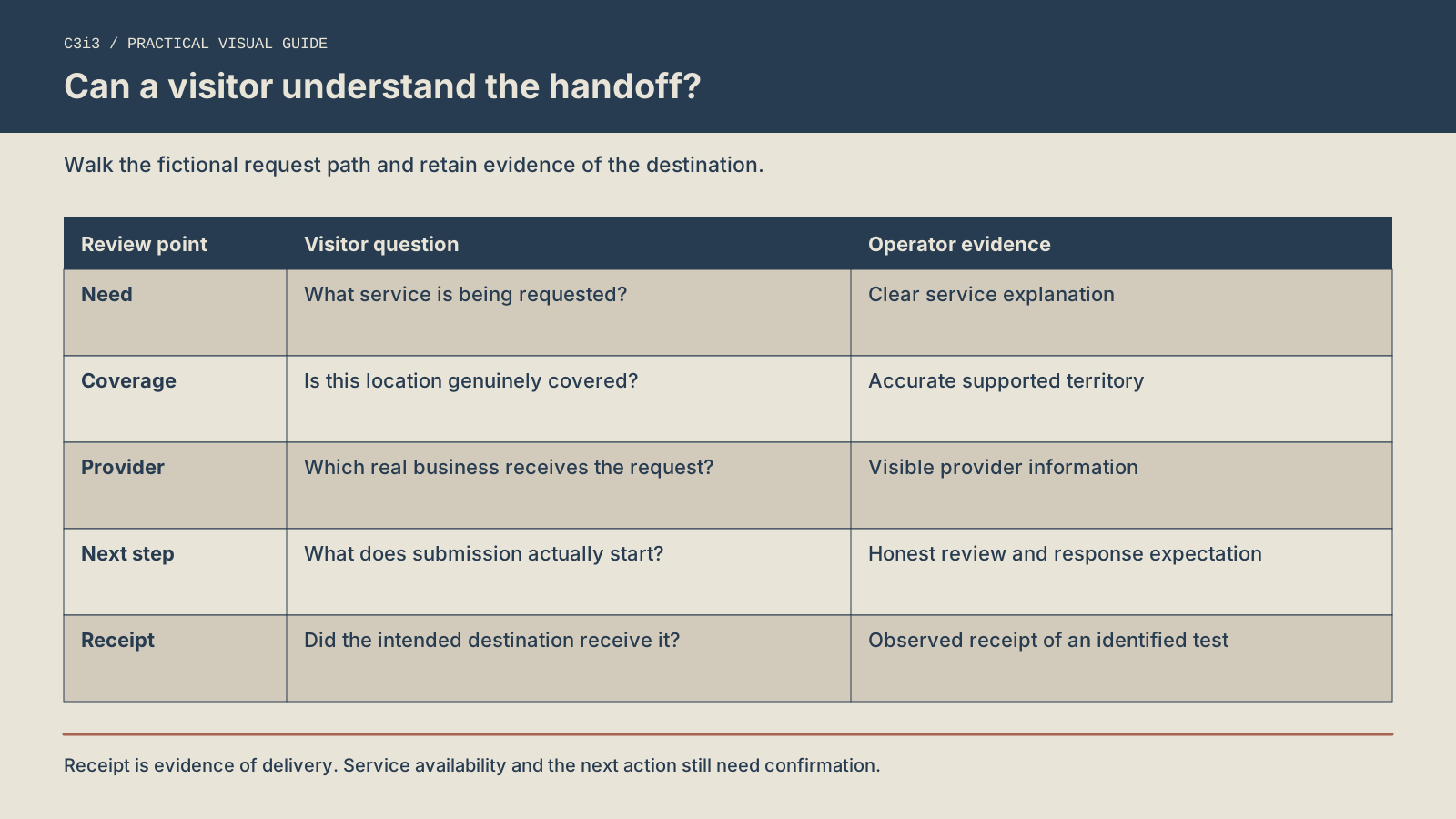
Check service need, coverage, provider identity, the next step and evidence that the request reached its intended destination.
What should you ask when reviewing lead website examples?
Ask which details are fictional, which decisions transfer to your service and what evidence supports the proposed pages. Evaluate comprehension and information quality before adopting the layout.
Is the fictional site a C3i3 campaign result?
No. Harbor Home Cleaning Requests is an invented editorial example used to explain page relationships. Its existence in this guide is not evidence of publication, traffic, inquiries or provider acceptance. A genuine case study would need its own verified evidence and permission to describe the participating business.
Can the same structure work for HVAC or roofing?
The broad decisions can transfer, but the content and request fields must change. An HVAC installation assessment differs from a recurring cleaning request. Use the actual provider's service boundaries and review process. Replacing trade names in otherwise identical copy does not create a useful niche website.
Does every service need its own page?
No. Create a separate page when a distinct decision needs enough useful information to justify it. Related requests can share a clear page when the differences are modest. A small coherent structure is easier to understand and maintain than a large collection of repetitive destinations.
Can illustrative pictures stand in for project proof?
No. Label illustrations and conceptual scenes accurately. They can explain a process or make a page easier to understand, but they do not establish completed work. Use genuine provider evidence with permission when available and avoid captions that make an invented scene appear to document a real job.
Does a well-designed example guarantee search visibility?
No. Design supports usability and comprehension. Search engines still decide discovery, indexing and placement. Google's people-first content guidance emphasizes useful information for an intended audience. A sound example should be assessed for what it helps a visitor understand, not presented as a ranking formula.

How C3i3 Can Help
C3i3 can translate a verified service offer into page relationships, clear content and a tested inquiry journey. Our lead-generation campaign and Local SEO work can support a scoped pilot based on actual provider capability.
Bring the intended service, coverage, provider information and existing website. Contact C3i3 to discuss which customer decisions need clearer pages and what evidence should be checked before a launch.