








































In this article
A manufacturer can have accurate engineering records and still publish confusing product pages. Sales may keep one description, distributors another and the website a third. Product information management software can help organize the work between approved source data and buyer-facing content, but adding a platform is useful only when it solves an identified publishing or governance problem. Start with the catalog task that repeatedly breaks, then decide whether your current systems can handle it.
What problems indicate that a manufacturer may need a PIM?
Look for repeated work rather than a fashionable software category. A specification correction may require edits to the website, distributor spreadsheet, printed catalog and sales presentation. Different people may interpret the same field differently. A missing unit can turn a useful technical value into an ambiguous number. These are signs that the publishing process needs shared definitions and a dependable release method, whether that method lives in a PIM or an existing system.
Record several recent failures with their source, affected destinations, people involved and time to correct. Separate missing information from incorrect information and late delivery. A PIM will not create an engineering approval that never happened. It can provide a more structured place for approved values and enrichment tasks once responsibilities are clear. This evidence becomes the basis for a procurement brief, instead of a long checklist copied from competing vendor websites.
Can your ERP or ecommerce platform already solve the problem?
Review the tools you already license before creating another product repository. Microsoft Dynamics documentation illustrates that an ERP suite can include product definitions, variants and distribution functions. Some commerce platforms can also hold substantial product content. The question is whether your actual configuration supports the required workflow, not whether a category description says that ERP is always operational and PIM is always descriptive.
Ask an administrator to demonstrate a change across two destinations using current permissions and real catalog exceptions. Can a technical reviewer approve a claim without releasing an unfinished translation? Can a distributor receive only relevant attributes? If the existing system answers these needs with manageable effort, a focused process repair may be a better first investment. If it requires fragile spreadsheets and repeated manual mapping, document that limitation for a PIM evaluation. Use the PIM, ERP and ecommerce ownership guide to assign fields before choosing technology.
How do product families and variants change the buying decision?
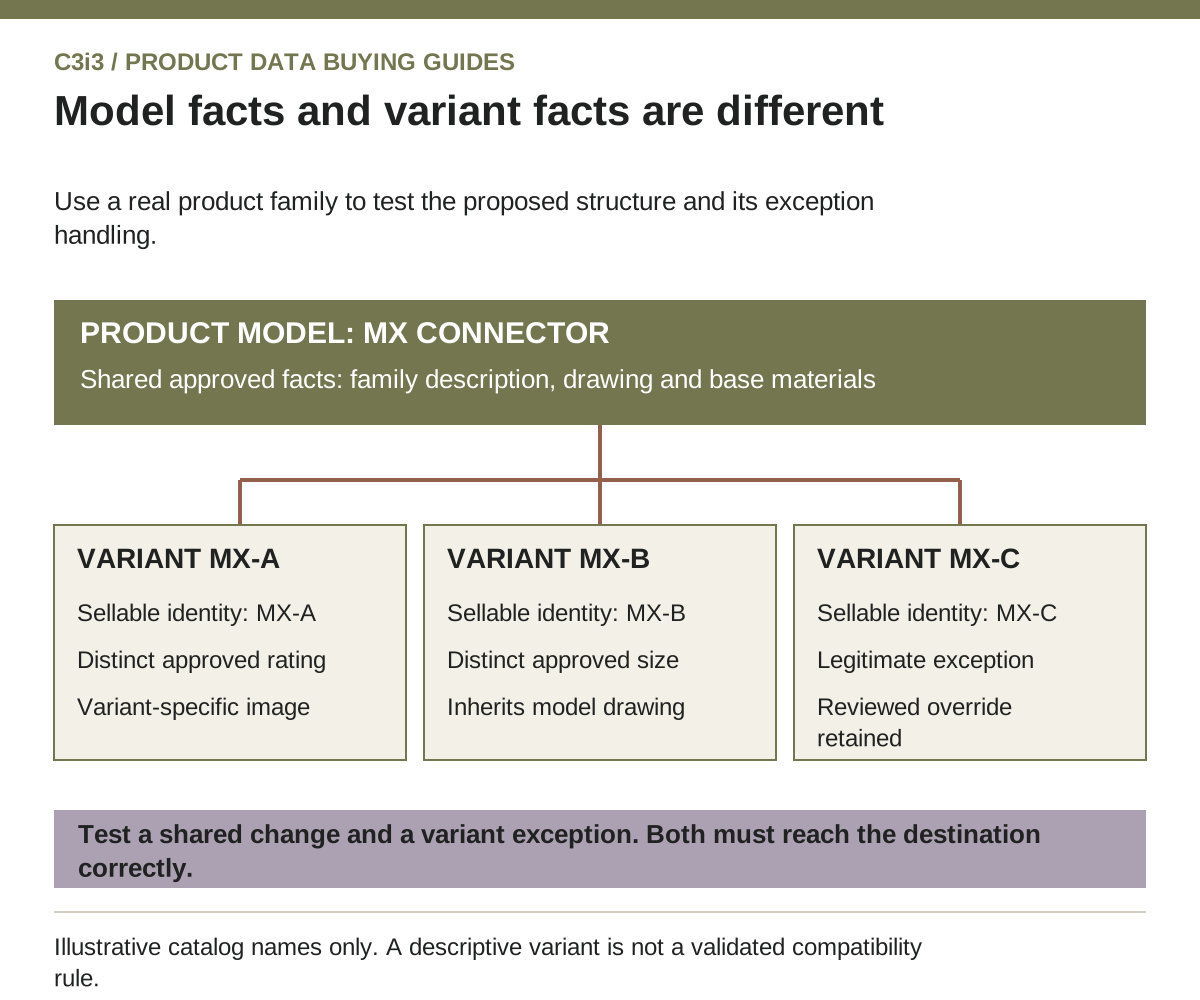
A catalog of simple standalone items is different from a catalog where common specifications belong to a model and a few attributes distinguish each sellable variant. Akeneo’s catalog concepts provide one concrete implementation of families, attributes and variants. Those concepts can help frame a demo, but your own product relationships should determine the model. Do not force engineering configurations into a clothing-style color-and-size example because the vendor’s prepared demonstration uses it.
Bring a standard product, a heavily configured product, an accessory relationship and a discontinued item to the evaluation. Decide which fields are shared and which can vary. If an accessory fits only particular voltage or enclosure combinations, ask where compatibility rules belong and how the website will receive them. Your PIM may describe options without becoming the configuration engine itself. That distinction connects directly to the buyer’s product configuration task and avoids promising compatibility from incomplete descriptive data.
Which publishing channels justify centralized enrichment?
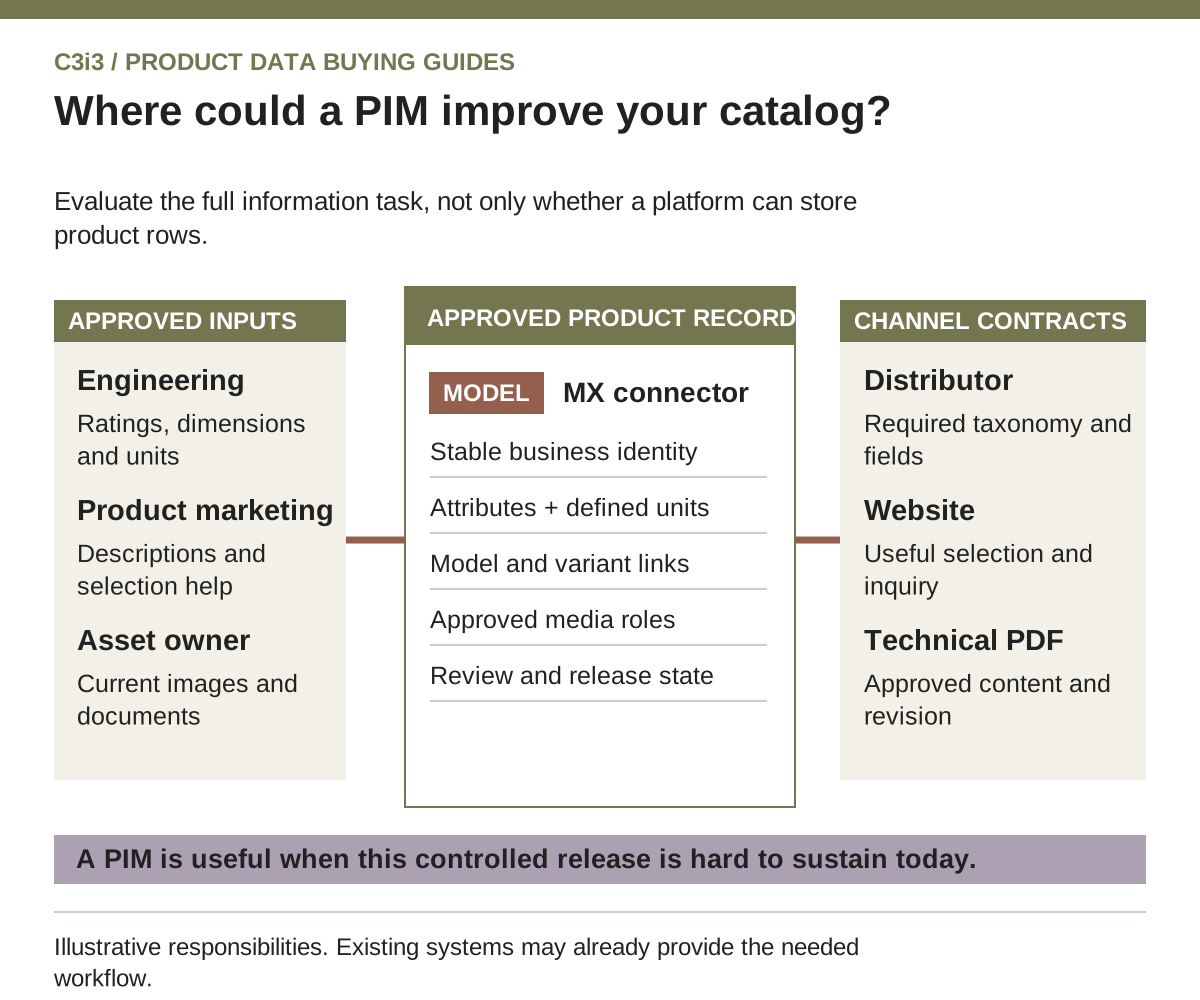
Count distinct information requirements, not just destinations. Two websites may use the same approved product description, while one distributor requires a specific taxonomy, image naming rule and unit format. A technical PDF may need a revision date and a defined approval owner. A multilingual catalog adds translation review and market-specific claims. Centralized enrichment becomes more useful when the same approved product knowledge must be expressed through several controlled views.
Write a small destination contract for each channel: required fields, allowed values, asset roles, release frequency and rejection handling. Decide what happens when a destination rejects an update. A successful export does not prove that the recipient accepted or displayed it correctly. PIM projects often need downstream reconciliation as well as publishing. If the immediate problem is inaccurate shopping stock, read the product feed management guide; a PIM alone is not a replacement for a reliable stock source and update route.
Who should maintain specifications, descriptions and images?
Assign an accountable business owner to each class of information. Engineering may approve ratings and compatibility statements. Product marketing may maintain descriptions and selection guidance. Operations may maintain lifecycle status. A designated asset owner may confirm which image or drawing is current. These are suggested responsibilities to adapt, not a fixed organizational chart. A small manufacturer may combine roles, but the approval decision still needs a named owner.
Define which system may write each field and which systems only consume it. Include exceptions such as a distributor-specific label or a temporary campaign description. Plan how corrections return to the authoritative source instead of being overwritten on the next import. Record who can approve, publish and retract information. No software can resolve a disagreement between departments merely by calling itself the single source of truth. A useful system makes the agreed responsibilities visible and enforceable through a workflow people can actually sustain.
What must an integration prove before purchase?
A connector logo is the beginning of a question, not the answer. Request a documented mapping between source fields, PIM attributes and destination fields. Include units, option codes, parent-child relationships, media references and record identifiers. Establish whether a connector transfers the entire record or only changed values. Ask how it distinguishes a deliberately empty field from a field that was not supplied and should remain unchanged.
Then test a failure: reject one destination field, interrupt a job or change a source value during a review. The implementation partner should show the error record, responsible owner and safe retry procedure. Pimcore’s Datahub documentation illustrates that delivery endpoints have their own configuration and access scope. An available API does not make the complete business integration automatic. Include support ownership for both sides of every connection in the proposal, along with the evidence that will establish acceptance.
How should you scope a first PIM project?
Choose a bounded catalog family and one important destination where the team can observe the full publishing cycle. The sample should include the awkward products that drive effort, not only perfectly clean items. Define the first release by approved workflows: for example, accepting supplier data, reviewing technical attributes, attaching approved media and publishing an accepted distributor file. Avoid a first phase defined only by a large count of imported rows.
Keep future possibilities in a separate list with their dependencies. Additional markets, portals or print catalogs can be sensible later phases once the core model works. A limited rollout can still be designed for future growth, but every speculative capability added to phase one creates configuration, testing and ownership work now. The implementation cost guide explains how those scope choices affect a quote. State which work C3i3 can support through ecommerce development and which platform engineering requires a qualified implementation team.
What evidence should decide whether the investment makes sense?
Set a baseline that reflects the original problem. Track how long an approved specification change takes to reach a destination, how many products are rejected and how much manual rework is needed. Count available staff time honestly; reducing repetitive work does not automatically eliminate payroll cost. Record the ongoing effort required for stewardship, new product onboarding and connector changes alongside any expected benefit.
Request a demonstration using your own sample catalog, followed by a written acceptance plan. Compare the proposal against an improved version of the current workflow, not against deliberately unmanaged chaos. A credible recommendation may be to buy a PIM, improve existing systems first or postpone until ownership is ready. The vendor demo guide turns those options into observable tests. Keep the buying decision separate from a vendor’s promise of faster launches or higher sales unless your own evidence supports the proposed effect.
Include the receiving team in the pilot review. A distributor may accept a file technically yet still need manual intervention because the category mapping is unsuitable. A website may display the right values in a layout that hides the selection detail buyers need. Ask the channel owner to complete a realistic product comparison and explain where uncertainty remains. This separates software acceptance from a useful published result and helps the team decide whether the next improvement belongs in catalog governance, integration or presentation.
Which catalog condition suggests which next step?
| Observed condition | First question | Evidence to request |
|---|---|---|
| One store and stable descriptions | Can the current platform govern the fields? | An approved edit published without parallel spreadsheets |
| Repeated distributor remapping | Are destination requirements truly different? | A source-to-channel mapping and rejected-record report |
| Variant relationships are inconsistent | Where should model and variant facts live? | One difficult family represented without duplicate identities |
| Technical reviews stall releases | Who can approve each claim? | A clear reviewer, owner and release condition |
| Assets are detached from products | Which files are current and reusable? | Approved image and document roles linked to correct records |
| Stock is outdated on shopping channels | Which system owns availability? | A verified inventory update and downstream acknowledgment |
A hypothetical manufacturer chooses a first catalog scope
Consider a hypothetical industrial connector manufacturer preparing a distributor catalog. Its product team maintains engineering-approved dimensions, marketing rewrites those values into several files and the website team chooses images from a shared folder. The first project does not attempt to centralize every business record. It covers one connector family, approved descriptive fields, variant identifiers and a distributor export. Inventory remains in its operational source.
The supplier must demonstrate a dimension correction, rejection of an unsupported unit and replacement of an obsolete image. Engineering signs off the technical fields, marketing approves the description and the distributor confirms the received output. The manufacturer can then compare observed rework with its earlier baseline. No savings or sales result is assumed. The value of this example is the bounded decision and measurable handoff, not a claim about what a particular PIM will achieve.
Key takeaways
- Start with recurring catalog failures rather than a product count threshold.
- Check existing ERP and commerce capabilities before adding a platform.
- Assign approved field ownership and identity rules before integrations.
- Pilot one representative family through an accepted destination output.
- Evaluate ongoing stewardship and recovery work as part of the investment.
Frequently asked questions
How many SKUs justify a PIM?
There is no universal threshold. Consider the number of distinct product relationships, contributors, languages and channel requirements along with the cost of repeated edits. A smaller complex catalog can need more governance than a larger simple one.
Does a PIM replace an ERP?
Usually the decision is about how systems cooperate, but suite capabilities overlap. Inspect the existing implementation and assign ownership by field and workflow. Do not move operational inventory or financial records merely because a new platform can store product information.
Can C3i3 select a PIM for us?
C3i3 can help clarify catalog requirements, buyer-facing content and ecommerce connections. A final platform choice should include your technical stakeholders and qualified implementation providers. This guide does not claim a current vendor referral arrangement or an independent product test.
Sources and editorial method
Prepared from linked primary documentation checked November 20, 2026. Vendor documentation establishes stated features and operating conditions. Comparisons and worksheets are C3i3 editorial analysis; worked examples are hypothetical.
- Akeneo: catalog structure concepts
Vendor documentation for attributes, families, categories and family variants; implementation behavior depends on the selected edition.
- Microsoft: product information overview
ERP suites can already contain product information, variants and distribution functions; inspect existing capabilities before adding a PIM.
- Pimcore: platform overview
Documents overlapping PIM, asset management and commerce capabilities; modules are not a universal required architecture.
- Pimcore: Datahub basic principle
Endpoint configuration separates exposed data, permissions and adapter-specific behavior.
- Shopify: product CSV import and export
A commerce-platform example of product transfer fields, dependencies and update semantics.
Map your product information before choosing another platform.

Tell us about your catalog, variants, selling channels and current systems. C3i3 can help clarify the website, content and product-data requirements so your implementation brief addresses a defined business task.
Explore ecommerce development or tell us about your project.