








































In this article
A commercial cleaning robot is a purchase decision about a building, a cleaning task and an operating team. A machine that looks impressive in a showroom can still be a poor fit for narrow aisles, interrupted cleaning windows or a site without dependable daily support. Your first useful shortlist should describe the work that must get done, rather than the brands attracting the most attention. This guide explains how to create a comparable request for suppliers, separate demonstrated results from specifications and choose a next step without assuming automation will remove all floor-care labor. If you are still comparing robot categories, start with our service robots overview. Here the focus is procurement: what evidence and commitments a buyer should ask to receive.
Which cleaning task are you actually buying a robot to perform?
Begin with an operational sentence: clean these hard-floor routes to this standard within this window, while people continue performing these other duties. A general aim such as “automate cleaning” leaves too much room for conflicting interpretations. Specify whether the job is dry debris collection, hard-floor scrubbing, carpet vacuuming or a combination. Include the type of soil and the result your supervisor accepts. Different tasks can require different machines, attachments or preparation.
Tennant distinguishes scrubbers, sweepers and vacuum equipment in its robotic floor-cleaning overview. That establishes useful category differences, not a recommendation for your premises. Ask shortlisted suppliers to show where their proposed configuration performs the defined task and where manual methods remain. Write exclusions into the scope: stairs, furniture edges, toilets, spills outside the selected process and obstructed areas should not quietly disappear from the cleaning plan. A narrower, repeatable task can be a stronger first project than an ambitious whole-building promise.
How much of your building is genuinely eligible for robotic cleaning?
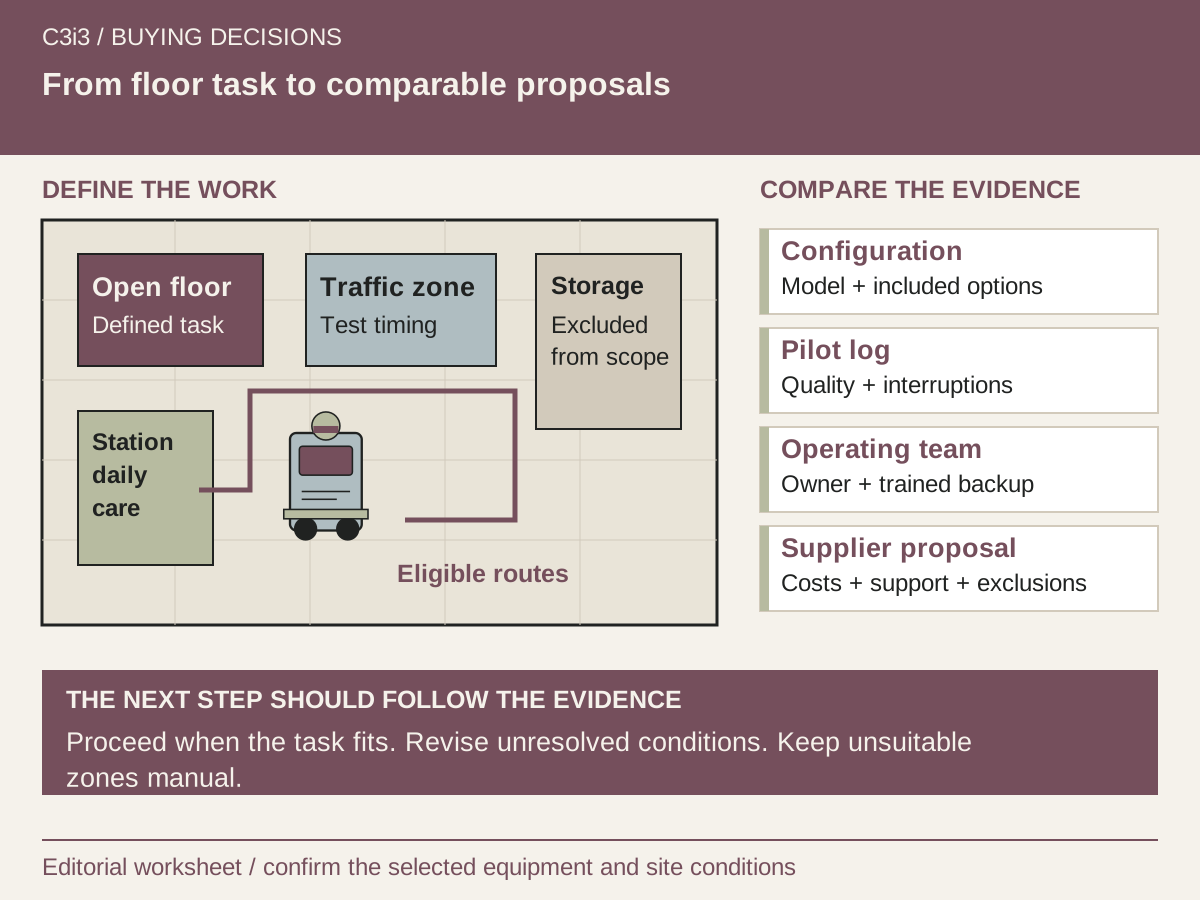
Gross building area is a weak purchasing input. Subtract fixed equipment, storage, inaccessible rooms and surfaces outside the selected method. Identify repeated cleaning zones separately from corridors the machine merely crosses. The eligible area should be a marked drawing with assumptions that both the buyer and supplier can inspect. Otherwise one proposal may describe a whole floor while another prices only the open central zone.
Walk the route with facilities staff and the cleaning team. Note floor changes, restricted doors, ramps, elevator dependencies, loading activity and items that move throughout the day. Record the narrowest practical passage with normal obstructions in place. Do not treat these notes as a self-issued safety approval or invent universal clearance limits. They are inputs for the supplier and responsible site personnel to evaluate against the selected equipment and current operating instructions. Our site-assessment guide explains how to turn observations into a documented test plan.
What belongs in the exact machine configuration you compare?
Use a configuration schedule, not a product name alone. List the robot model, cleaning assembly, battery arrangement, charging equipment, water-handling options, software access and any site integration. Include which accessories are in the initial price and which are optional. If a proposed outcome depends on an option, it belongs in the comparison even when the supplier sells it as a separate line item.
For example, Pudu's CC1 product page identifies separately purchased workstations and a separate carpet vacuuming assembly. That is a reason to verify configuration, not a statement about what every supplier includes. Ask for a written boundary between standard equipment, paid options and site work arranged by someone else. Require the supplier to explain how a missing option changes the daily process. An automatic refill feature has limited value in a proposal if the quoted deployment cannot actually support its intended use at your building.
What must a supplier demonstrate during a useful pilot?
Agree on the evidence before the robot arrives. Select representative zones, typical obstructions and the actual operating window. Define acceptable floor quality, completed coverage, intervention recording and remaining manual work. Record conditions such as staffing, unusual closures and soil levels so the team can interpret results. A quiet demonstration in an emptied space may answer whether a machine moves, but it does not answer whether your daily process works.
Use repeated runs across normal conditions where practical, with an agreed review point rather than an open-ended trial. Ask operators to record why a run stopped, who restored it and how much attention was needed. Distinguish a route completed autonomously from a route completed after repeated manual assistance. Neither result needs to be concealed; both are useful buying evidence. If the demonstration fails a requirement, record the proposed remedy and retest that requirement. Avoid turning a supplier's successful result at a different facility into your acceptance criterion.
Who will keep the cleaning program working after installation?
Identify a named owner for routine deployment, a trained backup and a person authorized to escalate problems. Buyers often compare machine features closely while leaving the human handoff vague. Someone still needs to prepare the route, check the finished floor, respond to interruptions and handle the maintenance tasks required for the chosen configuration. Schedule those responsibilities instead of treating them as free spare capacity.
Brain Corp's deployment guidance emphasizes ownership and training. Your purchasing implication is to request a concrete handover: who receives instruction, which tasks they practice and how a replacement operator is trained later. Include night-shift staff if they will run the equipment. Ask the supplier to observe an ordinary employee starting a job and recovering from an approved interruption. That is more revealing than a specialist operating every demonstration while your team only watches.
How do you compare suppliers beyond the robot itself?
Ask who actually provides service in your location. The manufacturer, distributor, software provider and finance company may be separate organizations. The proposal should name the contact for each issue and explain who coordinates when a fault crosses those boundaries. A general claim of nationwide support is less useful than clear arrangements for your site, operating hours and equipment configuration.
Compare remote assistance, on-site response commitments, spare-part access, consumables and replacement-machine conditions. Request the difference between an acknowledgment target and a repair commitment. Ask what the building should do while the robot is unavailable and whether that fallback creates additional cost. For a multi-location deployment, verify that the support promise reaches every proposed site. The complete quote checklist helps you keep these service assumptions visible rather than burying them below the equipment price.
How should cost and contract terms affect your shortlist?
Compare proposals over the same evaluation period and workload. Include acquisition or recurring charges, implementation, training, software, consumables, maintenance, retained labor and any building work. Keep observed operating evidence separate from supplier assumptions. A low recurring payment can still sit beside significant setup fees or a long commitment; a higher equipment price may include services another bidder excludes.
Choose a financing structure only after the operational case makes sense. Our leasing-versus-buying guide separates ownership, service and exit conditions. For the business case, distinguish usable labor capacity from cash savings. Reassigning staff can improve the service without reducing payroll. The ROI worksheet keeps those benefits separate and includes less favorable operating scenarios. Do not allow a generic payback claim to substitute for a cost model your own team can explain.
When should you proceed, revise the scope or stop?
Proceed when the agreed task works under representative conditions, the support arrangement is credible and the complete proposal fits the operating case. Revise the scope when the evidence shows a manageable limitation, such as an unsuitable zone that can remain manual. Stop when core requirements depend on unproven capabilities, unavailable service or labor reductions the team cannot realistically deliver. A documented decision to keep a task manual is a useful procurement outcome.
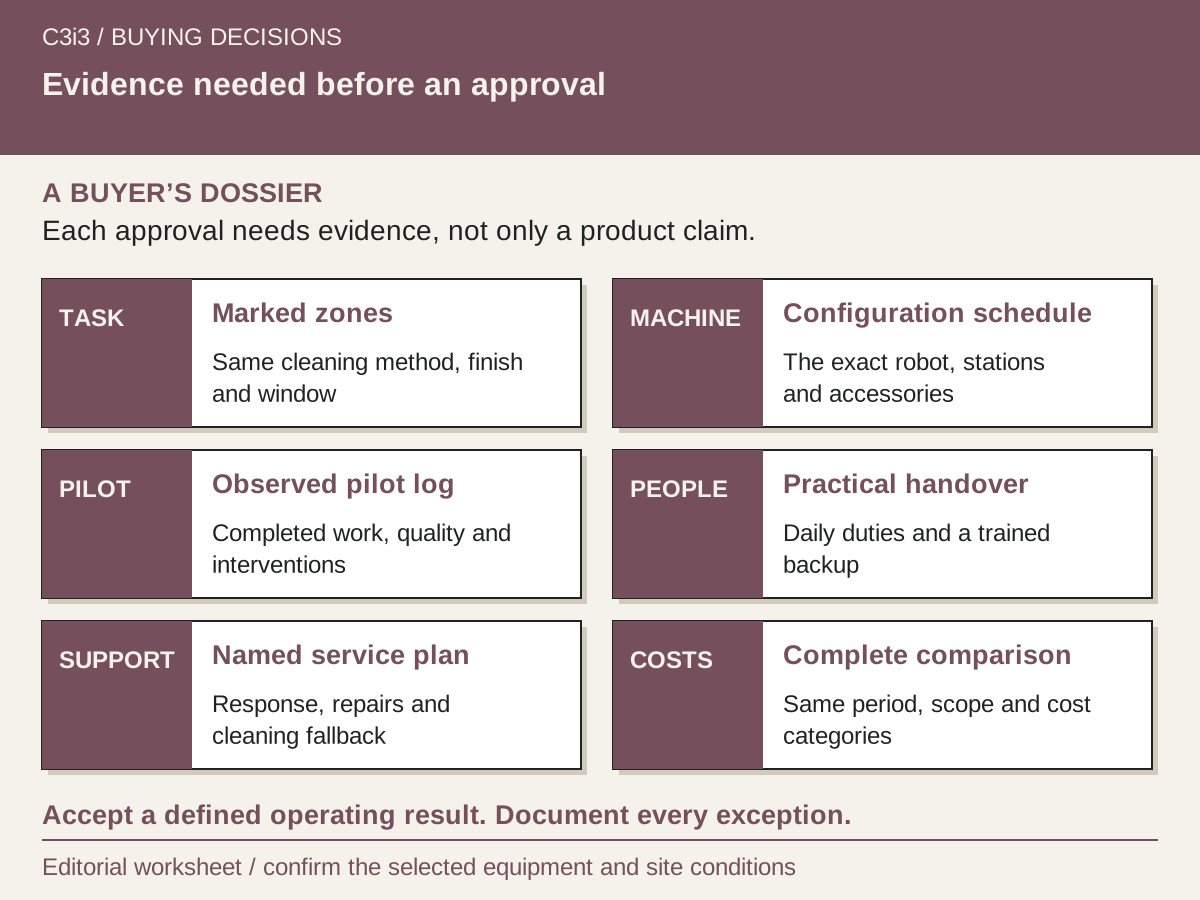
Before approving the next stage, collect the final configuration, marked site plan, pilot log, itemized quote, handover record and unresolved exceptions in one file. Assign an owner and review date to every remaining assumption. Keep your evaluation criteria independent of any promotional relationship with a supplier. C3i3's technical writing services can help a robotics business explain its product and buying process, but equipment selection, site approval and performance commitments need the relevant supplier and responsible facility team.
What should a comparable supplier proposal contain?
| Proposal element | Evidence to request | What it helps you compare |
|---|---|---|
| Task and boundaries | A marked zone plan and acceptance standard | Whether bids cover the same work |
| Exact configuration | Model, attachments, stations and software | What is required versus optional |
| Pilot result | Completed area, quality and interventions | Observed fit in normal conditions |
| People and training | Owner, backup and practiced handover | The actual daily operating burden |
| Support and fallback | Named service party and downtime plan | How cleaning continues during faults |
| Complete economics | Same period, workload and cost categories | The whole operating commitment |
How would this work in a hypothetical building?
Hypothetical example: an office building wants repeatable overnight cleaning in its open lobby and main corridors. The team initially counts every floor surface, then removes stairs, enclosed meeting rooms and areas regularly blocked by furniture. The revised scope becomes a smaller, clearly marked routine rather than a promise to clean the whole property.
Two suppliers test the same approved zones. Both can finish the open lobby, but one proposal depends on a station not included in its first quote. The team records that accessory, preparation time, interruptions and the manual edge work still required. It asks both suppliers to revise their offers against the same task and operating period.
The decision is based on demonstrated cleaning, support and total commitment. The team does not label every unattended robot minute a payroll saving. It identifies the useful work staff could perform during that period and decides separately whether any spending would actually change. This example describes a buying method, not a customer result or a forecast.
Key takeaways
- Define a repeatable cleaning task before choosing a brand.
- Compare eligible floor area and exact configurations.
- Use site evidence instead of translating brochure rates into promises.
- Give daily ownership, support and fallback work an explicit place in the proposal.
- Separate better service, released capacity and cash savings.
Frequently asked questions
Can a commercial cleaning robot clean an entire building?
Do not assume it can. Define the surfaces, routes, access conditions and tasks in scope. Some zones may remain manual because of layout, cleaning method or operating requirements. Ask the supplier to mark inclusions and exclusions on the same drawing used for its demonstration and quote.
Should I choose a robot before speaking with suppliers?
Create a task brief and initial shortlist first, then use supplier assessments to confirm which configurations fit. An early favorite should still demonstrate the required work. Compare several suitable proposals where possible rather than forcing your building to match one machine selected from a video.
Should I buy directly from a manufacturer or through a dealer?
Either route can be suitable if the complete arrangement fits your building. Compare who assesses the site, supplies the exact configuration, trains staff and handles repairs. Confirm service coverage and escalation in your location rather than treating the sales channel itself as proof of better support.
Sources and editorial method
Prepared from linked primary documentation checked November 20, 2026. Vendor documentation establishes stated features and operating conditions. Comparisons and worksheets are C3i3 editorial analysis; worked examples are hypothetical.
- Tennant: robotic floor-cleaning machines
Manufacturer category guidance for scrubbers, sweepers and routine care. Published capabilities do not establish performance at a particular building.
- Pudu Robotics: PUDU CC1 product information
Manufacturer description of cleaning modes, reporting and separately purchased accessories. Confirm the quoted configuration and current regional support.
- Brain Corp: deploying a robotics cleaning program
Supplier guidance on program ownership, operator training and usage review. C3i3 procurement worksheets are independent editorial analysis.
- Brain Corp: BrainOS Clean 2.0 overview
A supplier example of adaptive routing and workflow automation. Promotional improvement figures are not used as forecasts for another site.
Turn your building requirements into a clear supplier brief.

Describe the floor types, operating window, site constraints and buying stage. C3i3 can help organize the evaluation brief and explain technical offerings clearly. Equipment selection, site assessment and installation remain with qualified suppliers and responsible site personnel.
Explore ai workflow planning or tell us about your project.