









































In this article
Cleaning robot ROI becomes misleading when a theoretical cleaning rate is multiplied by a wage and labeled guaranteed savings. A machine can release useful staff capacity without reducing payroll. It can also improve consistency or increase cleaning frequency while total spending stays similar. Those outcomes matter, but they should not be presented as the same financial result. This guide shows how to build an understandable business case from a defined task and measured pilot. Use supplier quotes and your own operating records for financial inputs. The examples explain a method and do not predict a return for a particular robot or building.
What is the correct baseline for a cleaning robot ROI calculation?
Describe the current process before describing the robot. Record the eligible area, required cleaning frequency, accepted floor condition and human tasks used to achieve that result. Use ordinary operating records where possible and identify observations affected by unusual events. A comparison loses meaning if the baseline covers one task while the proposed robot includes additional areas or a different cleaning standard.
Count the whole current task cycle: preparation, movement between zones, cleaning, care and finishing work. Keep categories visible so a reviewer can see what changes. Do not subtract tasks merely because a machine would perform them differently. The site-assessment guide helps define the eligible scope and representative conditions. Once both parties agree on that scope, a pilot can produce evidence for a comparison rather than a collection of attractive activity totals.
How do you distinguish released labor capacity from payroll savings?
Released capacity is time staff can use for something else. Cash savings occur only when spending actually changes, such as a documented reduction in paid overtime or external floor-cleaning expense. Reassigning an employee to detail work can be valuable without creating a wage reduction. State which outcome the project is intended to produce and who is responsible for turning available time into that outcome.
Measure the human work retained in the robotic process, including preparation, routine care, inspection and approved intervention handling. Subtract that work from the relevant baseline before describing time released. Then identify how much of the released capacity is usable in real schedules. Short fragments across shifts may not create a practical staffing change. If the building will increase cleaning frequency instead, show the extra service as an outcome. Do not also count the same time as removed payroll unless a separate, credible spending change supports that claim.
Which robot performance measures belong in the business case?
Use observed completed work in the agreed zones, rather than translating a brochure rate directly into an operating result. Track useful unique coverage, floor quality, elapsed task time and human attention. Explain unavailable areas and repeat passes. A robot can accumulate operating time without delivering the desired result, so runtime alone is an incomplete measure of productivity.
Ask how the supplied reporting defines each metric. Brain Corp's map-centric workflow description is one vendor example of reviewing completed routes. Your evaluation should connect the particular report to inspection of the actual floor. Use repeated representative observations where practical and retain failures or interruptions. The buyers guide explains why capability statements and site-proven outcomes belong in different columns of the decision record.
How do you include all costs without double counting them?
Separate initial implementation from recurring operation. Initial categories can include acquisition or setup, delivery, site preparation and training. Recurring categories can include access payments, software, service, supplies and retained labor. Use the actual structure of the proposal, noting which bundled charges already include other categories. Do not add a service item twice merely because it appears in both a supplier summary and your internal worksheet.
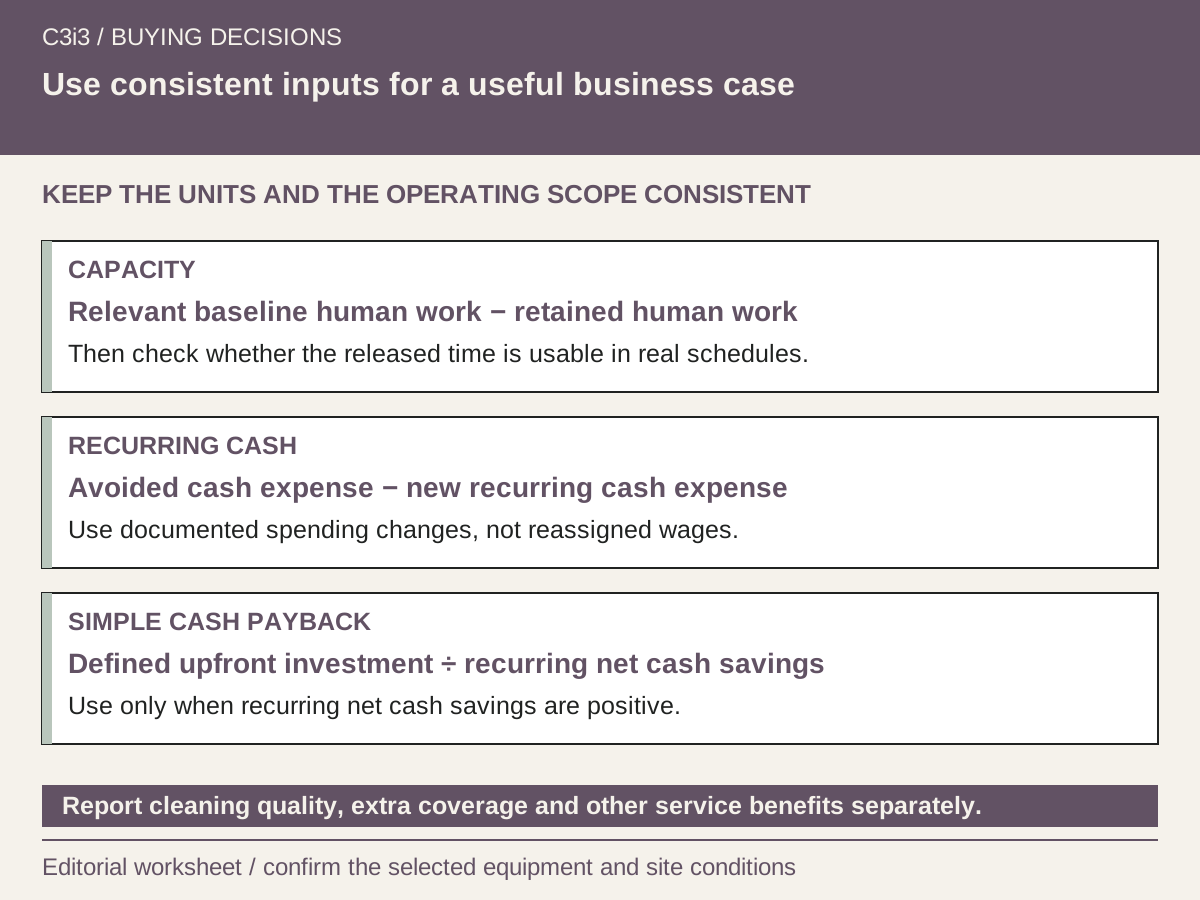
Keep payment timing and operating cost distinct. A comparison of leasing and buying may require finance to evaluate cash flows, funding and residual assumptions over a common period. The quote checklist exposes missing inputs, while the contract comparison clarifies responsibilities. For a straightforward recurring cash comparison, use avoided cash expense minus newly added recurring cash expense. Show what each side includes and avoid counting payroll that has already been retained elsewhere in the model.
How do you test whether the result survives less favorable conditions?
Prepare a base case from observed conditions and at least one less favorable operating case. Change understandable inputs: fewer usable cleaning runs, more staff attention, higher supply expense or a longer restoration period after a fault. These are scenarios, not forecasts. Their purpose is to show which assumptions determine the decision and what evidence would strengthen confidence.
Do not multiply one successful shift across an entire year without accounting for operating days and planned downtime. Ask the team which variables it can control and which depend on the supplier or the building. A case that only works with uninterrupted access and no intervention deserves further evaluation if daily operations regularly challenge both assumptions. Record the minimum outcome needed for your organization to proceed. If quality or coverage is a mandatory requirement, evaluate that requirement before debating whether a favorable financial scenario could offset its failure.
How should you present ROI, payback and nonfinancial benefits?
Present the result as a small decision record: scope, evidence, complete costs, actual cash change, capacity released and remaining uncertainty. If recurring net cash savings are positive, a simple cash-payback calculation can divide the chosen upfront investment by those savings per period. Keep units consistent and define the numerator. If recurring net cash savings are zero or negative, this simple savings-based payback is not positive and should not be displayed as a reassuring number.
Report other benefits separately, such as improved consistency, additional coverage or more time for detail cleaning, using measures the facility can review. A purchase may still be justified on those grounds, but it needs an explicit management decision rather than invented financial savings. Set a review date to compare actual operation with the approved case. Brain Corp's deployment guidance supports treating program ownership and ongoing usage review as operating work. No formula replaces that follow-through.
Which measurements belong in a cleaning robot business case?
| Measure | How to use it | Do not assume |
|---|---|---|
| Baseline human work | Time the same agreed cleaning task | Every paid hour is removable |
| Remaining human work | Include setup, care and interventions | Autonomous means unattended all day |
| Useful coverage | Verify unique eligible area and quality | Runtime equals completed cleaning |
| Actual cash change | Identify spending that really changes | Reassigned labor is payroll savings |
| Complete robot cost | Use quote and operating evidence | Monthly equipment payment is total cost |
| Service improvements | Measure separately from cash savings | Extra cleaning has an invented cash value |
How would this work in a hypothetical building?
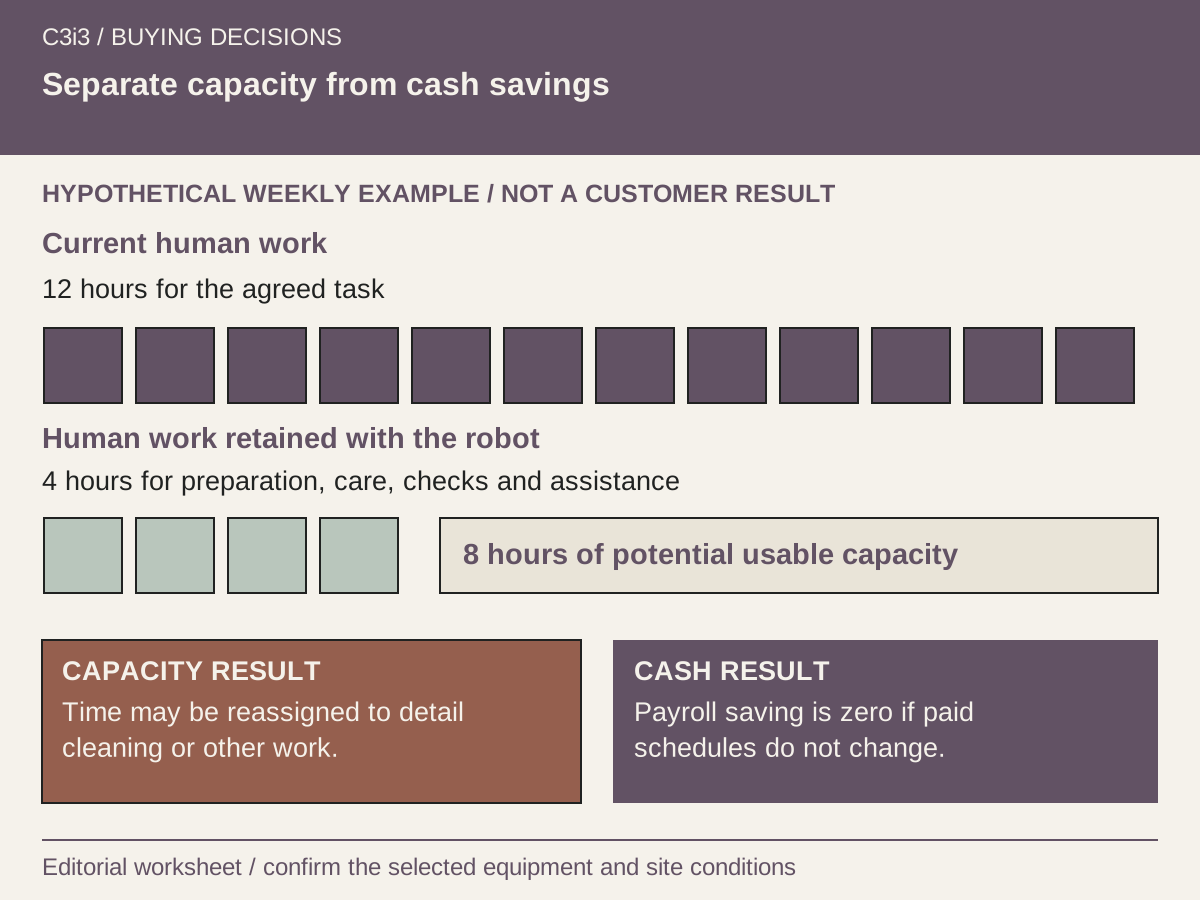
Hypothetical example: a building records 12 staff hours per week for an agreed floor task. In a representative pilot, the robotic process retains four staff hours for preparation, care, inspection and assistance. The measured difference is eight hours of potential capacity, not automatically eight paid hours removed from the budget. These figures are invented to explain arithmetic, not taken from a vendor or customer result.
If all eight hours are reassigned to detail cleaning and paid schedules remain unchanged, the labor-related cash saving is zero. The building can record the additional detail work and its quality separately. If some documented overtime is later avoided, finance can value only the avoided overtime and compare it with the full new recurring expense.
Simple savings-based payback should be shown only if that comparison produces positive recurring net cash savings. Otherwise the team can evaluate the project as a service-quality or capacity investment, revise the scope or decide the case is not strong enough. The worksheet makes those choices explicit.
Key takeaways
- Compare the same task, area, standard and cleaning frequency.
- Subtract retained human work before describing released capacity.
- Identify cash savings from actual spending changes.
- Include the complete proposed operating commitment.
- Keep service improvements and sensitivity cases visible alongside finance.
Frequently asked questions
Does every hour a cleaning robot runs count as an hour saved?
No. Runtime is machine activity. Compare the completed task with the relevant human-work baseline and include retained care, preparation and intervention time. Then distinguish usable staff capacity from actual spending reductions. The same period should not be counted twice as separate benefits.
What if the project improves cleaning but does not reduce payroll?
Record the improvement directly, such as greater consistency, additional accepted coverage or staff time reassigned to detail work. Management can decide whether that outcome justifies the cost. Do not convert it into payroll savings unless paid labor expense actually changes.
Can a supplier guarantee my ROI?
Evaluate any proposed commitment through its exact scope, assumptions and remedies with the appropriate advisers. A manufacturer case study or advertised payback is not evidence of your result. Build the business case from your own workload, complete quote and representative operating evidence.
Sources and editorial method
Prepared from linked primary documentation checked November 20, 2026. Vendor documentation establishes stated features and operating conditions. Comparisons and worksheets are C3i3 editorial analysis; worked examples are hypothetical.
- Brain Corp: map-centric cleaning workflows
Vendor announcement describing route selection and completed-route visualization on specified supported equipment; not a universal capability.
- Brain Corp: deploying a robotics cleaning program
Supplier guidance on program ownership, operator training and usage review. C3i3 procurement worksheets are independent editorial analysis.
- Tennant: robotic floor-cleaning machines
Manufacturer category guidance for scrubbers, sweepers and routine care. Published capabilities do not establish performance at a particular building.
Turn your building requirements into a clear supplier brief.

Describe the floor types, operating window, site constraints and buying stage. C3i3 can help organize the evaluation brief and explain technical offerings clearly. Equipment selection, site assessment and installation remain with qualified suppliers and responsible site personnel.
Explore ai workflow planning or tell us about your project.