








































In this article
A site assessment should replace assumptions with a documented picture of how cleaning will happen. It is not just a building tour or a measurement of open floor area. The supplier needs to understand ordinary traffic, cleaning standards, access restrictions and the support your team can provide. Use this guide to prepare the information, arrange a representative evaluation and record the outcome. Equipment-specific operating limits and workplace requirements belong with qualified suppliers and responsible site personnel. A buyer's worksheet helps them ask the right questions; it does not approve an installation by itself.
What information should you send before the supplier visits?
Provide a current floor plan, cleaning schedule and description of the result expected in each zone. Identify which surfaces receive which method and which tasks remain manual. Include photographs of typical obstructions and transitions where useful, while respecting your building's information-sharing rules. Tell the supplier about loading periods, peak visitor traffic and access restrictions so the visit can observe a meaningful operating period.
Add the practical constraints that influence daily use: available storage, likely charging locations, water handling, network approvals and staff coverage. Ask the supplier which information it needs for the specific machine rather than guessing universal requirements. Keep estimates labeled as estimates until the assessment verifies them. If the initial goal is simply to identify suitable equipment categories, say so. The supplier should not imply that an early screening visit is the same as an accepted full deployment plan.
What must a supplier check about your floor and cleaning result?
Ask the supplier to evaluate the floor materials, condition, soil and cleaning method in the intended zones. Identify transitions, seams, uneven areas, matting and areas where a selected machine cannot perform the required task. The question is not only whether the robot travels across a surface; it is whether the cleaning process delivers the accepted result without creating an unsuitable operating condition.
Keep that evaluation tied to the current documentation for the proposed model. Pudu's CC1 operation guide illustrates that environmental limitations can be specific and detailed. Do not transfer one model's limits to another or use an editorial drawing as an installation instruction. Mark locations requiring specialist review, then record who will resolve them. If the facility needs a particular cleanliness standard, ask the responsible team how the pilot will demonstrate it instead of assuming a completed route proves the standard was met.
How do doors, people and changing obstacles affect the test?
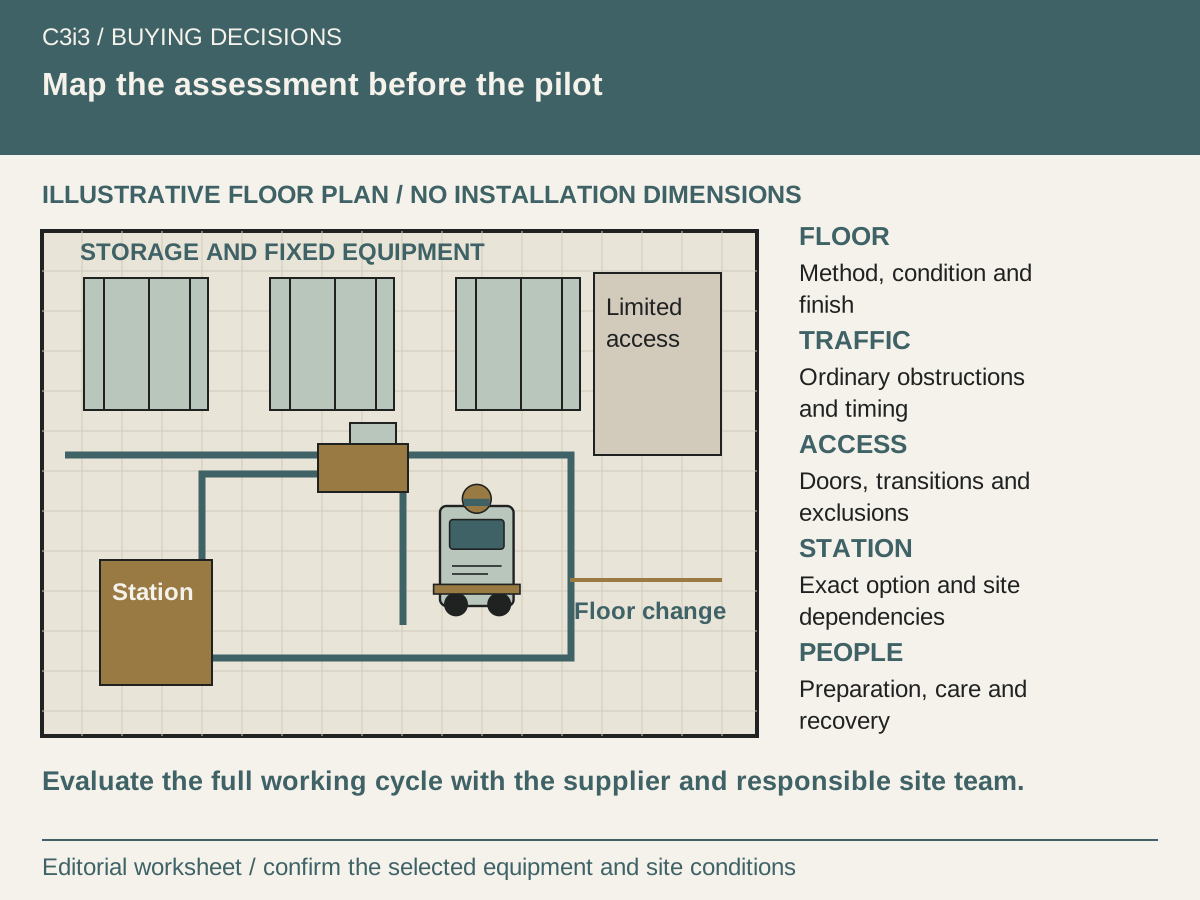
Evaluate routes with the conditions that normally exist. A corridor without delivery carts can behave differently from the same corridor during receiving. A locked internal door, furniture rearrangement or access-controlled zone can break an otherwise attractive plan. Ask the supplier which conditions require a fixed exclusion, another integration, human assistance or a different operating window. Those dependencies should be visible on the assessment drawing.
Agree on a controlled evaluation process with responsible site personnel. Do not create hazardous obstacles or improvise safety tests. Observe approved operations, record interventions and discuss equipment-specific procedures with the supplier. Brain Corp's adaptive routing overview shows that navigation approaches differ across supported systems. It does not establish that a proposed robot will solve every blockage. Request a demonstration of the actual quoted capability in a representative, approved environment.
Where will the robot start, refill, charge and receive care?
Trace the entire working cycle, including the parts outside the cleaning route. Identify where the machine begins, how it reaches the work zone and what happens between assignments. Ask whether the proposed station needs particular utilities, access, space or building work. Request a written boundary between what the robot does, what the station enables and what an employee must still handle.
Model and accessory choices matter. The PUDU CC1 product description lists different station options; a name such as “automatic” should therefore prompt a configuration question. Ask the supplier to identify the exact option and its site dependencies in the proposal. Confirm who inspects and maintains the surrounding area and who is responsible for any preparatory work. A station that cannot be placed or serviced conveniently can change the daily labor and economics even if the machine cleans an open zone successfully.
What should you record during representative cleaning runs?
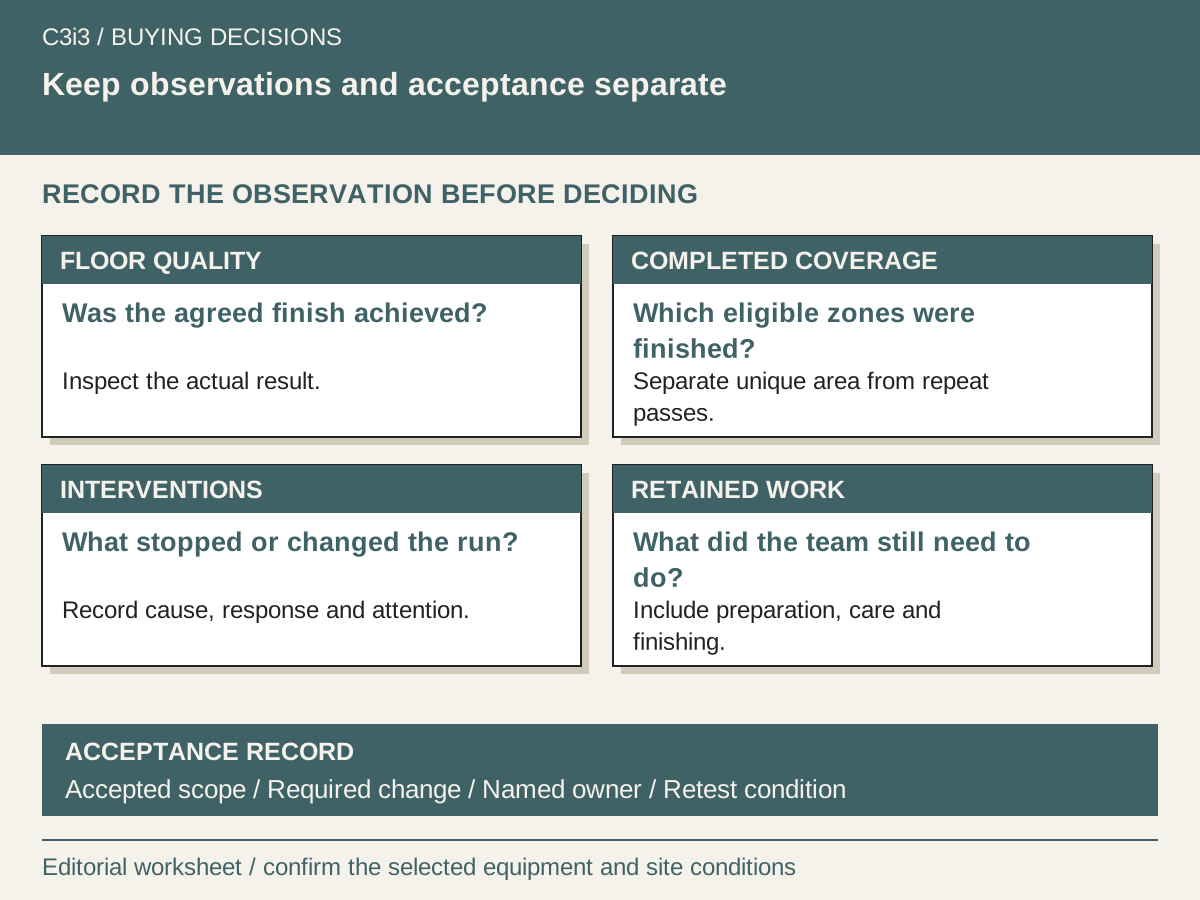
Create a log that connects each run to its approved zones, expected outcome, operating window and observed conditions. Record completed area, visible floor quality, interruptions, staff attention and remaining manual work. Distinguish repeated passes over one area from useful unique coverage. Note why a run differs from the baseline, including unusual soil or a route being unavailable. Keep unsuccessful runs in the record so the team can learn what needs to change.
Where reporting is included, ask the supplier to show how the displayed data maps to the actual floor. Brain Corp's map-centric workflow announcement describes completed-route visualization on supported machines. Buyers should still verify what a particular report measures. A colored map is not a substitute for inspection of the cleaning result. The ROI guide explains how to translate observed time and coverage into a business case without treating every robot hour as a cash saving.
What should the assessment handover contain before you proceed?
Request a marked plan of included and excluded zones, the exact tested configuration and a log of unresolved conditions. The handover should identify required site work, training, ordinary staff tasks and the proposed support arrangement. Assign an owner and a due date to important dependencies. A recommendation such as “suitable after changes” needs to say which changes, who approves them and how the supplier will verify the revised setup.
Use the assessment to request comparable commercial proposals. Link its scope to the quote worksheet and review financing through the leasing-versus-buying guide. Agree what constitutes acceptance of the next stage, including any repeat test. If the building cannot support a core requirement, narrowing the task or retaining a manual process may be the sensible outcome. The purpose is a reliable operating decision, not the completion of a demonstration for its own sake.
What should your cleaning robot site-assessment record capture?
| Assessment item | What to observe | What to retain |
|---|---|---|
| Floor and soil | Material, condition and expected finish | Approved cleaning method and exceptions |
| Routes and access | Normal doors, transitions and obstructions | Included and excluded zone drawing |
| Operating window | Traffic and unavailable areas | Representative schedule and dependencies |
| Stations | Charging, water handling and daily access | Exact accessory and site-work scope |
| Staff workflow | Preparation, care and recovery | Named operator tasks and training plan |
| Pilot evidence | Quality, coverage and intervention log | Acceptance result and unresolved items |
How would this work in a hypothetical building?
Hypothetical example: a warehouse buyer asks for robotic cleaning across its main circulation aisles. An early walkthrough occurs before deliveries and makes the routes look straightforward. The facilities team requests another observation during a normal receiving period, with the supplier and responsible site staff agreeing on the evaluation conditions.
The later assessment reveals that several aisles regularly hold staged goods. The team marks them as time-dependent rather than counting them as continuously available floor area. It also identifies a station location that would interfere with ordinary staff access and asks for a revised proposal.
The resulting pilot uses a smaller set of available routes and records the manual work retained elsewhere. That is a more useful outcome than claiming the machine failed to cover a gross area it never had reliable access to. No actual customer, machine performance or approved installation is implied by this example.
Key takeaways
- Assess the entire operating cycle rather than only the cleaning pass.
- Use normal traffic and access conditions in approved evaluations.
- Keep floor quality separate from completed-route reporting.
- Mark dependencies, exclusions and unresolved conditions on a shared plan.
- Tie the quote and acceptance criteria to the same tested scope.
Frequently asked questions
Is a site assessment the same as a pilot?
Not always. An assessment establishes suitability, constraints and a proposed scope. A pilot tests an agreed configuration and outcome under defined conditions. Ask the supplier what its visit includes, what evidence it will produce and which questions remain for a later trial.
Can I evaluate safety from the robot specification sheet?
A specification sheet cannot establish every site condition or operating procedure. Ask the supplier and responsible site personnel to evaluate the proposed deployment against current equipment documentation and applicable workplace requirements. The assessment record should identify who resolves each relevant condition.
Should the supplier test only when the building is empty?
An empty building can be useful for an initial controlled setup, but it may not represent routine operations. Agree on representative, approved observations and tests for the intended operating window. Record any difference between demonstration conditions and the conditions expected after handover.
Sources and editorial method
Prepared from linked primary documentation checked November 20, 2026. Vendor documentation establishes stated features and operating conditions. Comparisons and worksheets are C3i3 editorial analysis; worked examples are hypothetical.
- Pudu Academy: CC1 Operation Guide V6.0
Model-specific operating and deployment context, including environmental limitations and optional workstations. The selected machine needs its own current documentation.
- Pudu Robotics: PUDU CC1 product information
Manufacturer description of cleaning modes, reporting and separately purchased accessories. Confirm the quoted configuration and current regional support.
- Brain Corp: BrainOS Clean 2.0 overview
A supplier example of adaptive routing and workflow automation. Promotional improvement figures are not used as forecasts for another site.
- Brain Corp: map-centric cleaning workflows
Vendor announcement describing route selection and completed-route visualization on specified supported equipment; not a universal capability.
Turn your building requirements into a clear supplier brief.

Describe the floor types, operating window, site constraints and buying stage. C3i3 can help organize the evaluation brief and explain technical offerings clearly. Equipment selection, site assessment and installation remain with qualified suppliers and responsible site personnel.
Explore ai workflow planning or tell us about your project.