








































In this article
A robot can look impressive in a short video and still be unsuitable for your building. The useful question is what repeatable task it completes, under which conditions and with how much assistance. This guide compares practical business applications and explains how to turn a vendor demonstration into a decision your operating team can evaluate.
Which business tasks can service robots perform today?
Current commercial offerings include internal material transport, selected floor-cleaning tasks and restaurant tray delivery. These are different product categories with different limits. A transport platform does not automatically pick items from a shelf, and a floor scrubber does not clean an entire building’s bathrooms and furniture.
Primary vendor documentation provides concrete examples: MiR material-transport systems, Tennant floor-cleaning robots and Bear Robotics tray-delivery robots. These establish offered task categories, not independent proof of performance at your site. Require a scoped demonstration before accepting broader claims.
Do you need an autonomous mobile robot, a fixed robot or a humanoid?
Choose the physical form that fits the task and environment. Wheeled mobile platforms can suit repeatable movement across supported floors. A fixed workcell may suit a controlled manipulation task. A humanoid may be considered where a particular deployment shows that its form and capabilities address a real constraint.
Do not start with appearance. Write the input, action and acceptable output: which load moves, from where to where, in what condition and within which operating limits? Compare simpler alternatives such as layout changes, carts or established automation. The best purchase may be a narrowly capable machine that reliably completes the defined job.
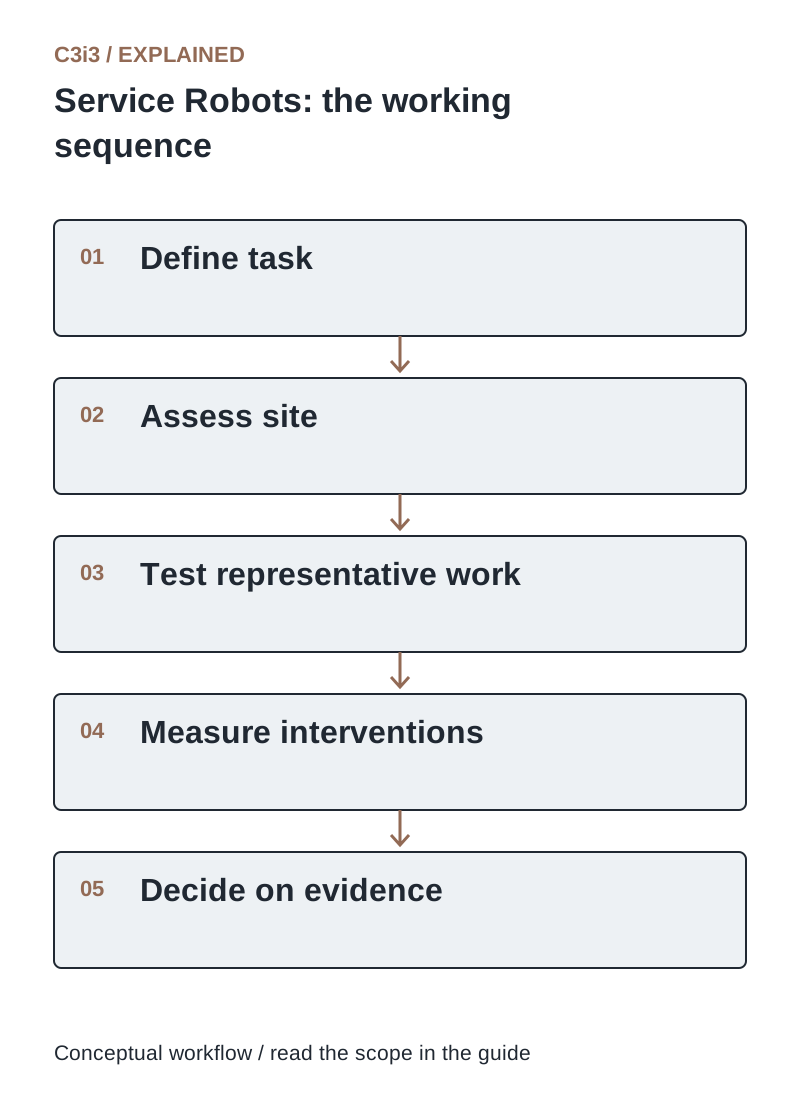
The sequence is: Define task. Then Assess site. Then Test representative work. Then Measure interventions. Then Decide on evidence. Each handoff needs the scope and conditions described in this guide.
What building and workflow conditions affect robot performance?
Assess floor conditions, aisle widths, thresholds, doors, slopes, traffic, lighting where relevant, loading points and charging access. Include how people will request work, load or unload items and recover from exceptions. Manufacturer limits and a site-specific assessment determine suitability.
Use qualified people to evaluate safety and operating procedures for the actual robot system. OSHA’s industrial robot-system guidance provides relevant risk-assessment context for industrial applications; it is not a universal approval of every service robot. Sensor claims alone do not establish that a mixed workplace is ready for unattended operation.
How much does a service robot really cost to operate?
Request the full cost of the supported system: equipment or subscription, commissioning, attachments, software, integration, training, consumables, maintenance and support. Include staff time spent loading, preparing routes and resolving stops. Confirm what the contract excludes.
Calculate the benefit from work actually displaced or capacity actually added. Time released does not automatically become payroll savings. A worker may use it for another necessary task. Compare a purchase and a service agreement over the same operating period, including exit terms and downtime responsibilities. Avoid applying a vendor’s best-case savings claim directly to a different building.
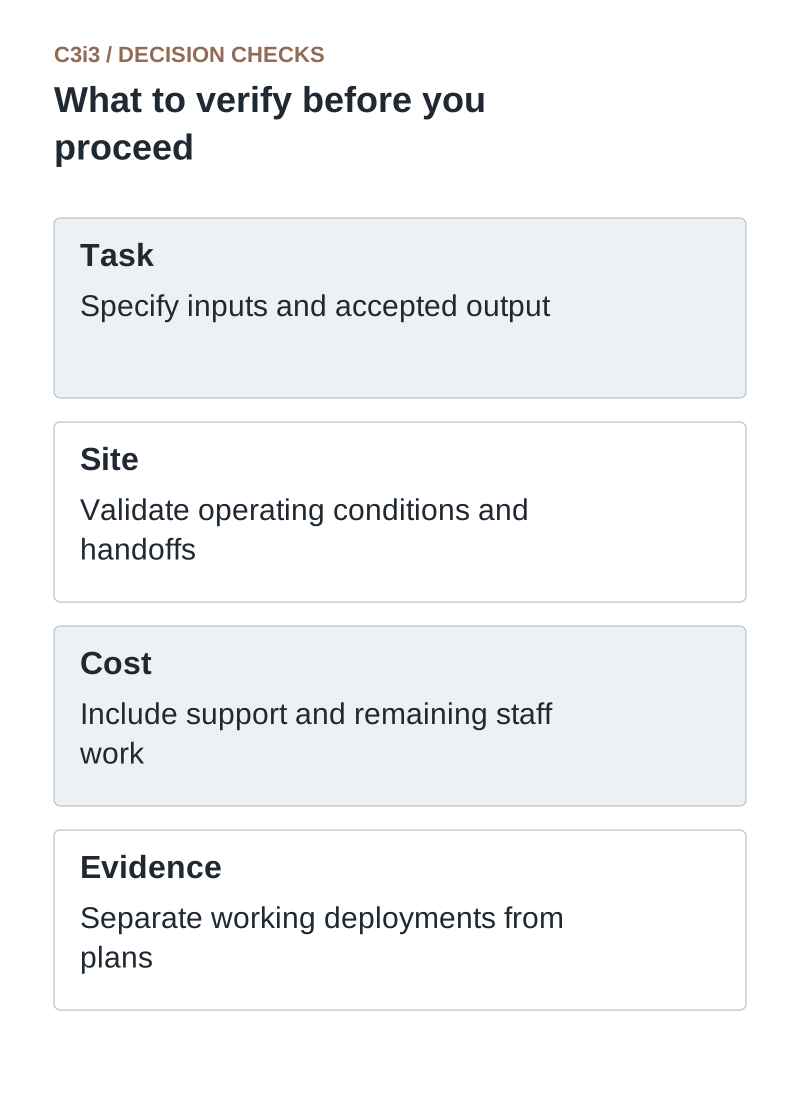
Task: Specify inputs and accepted output. Site: Validate operating conditions and handoffs. Cost: Include support and remaining staff work. Evidence: Separate working deployments from plans.
How do you run a useful robot pilot?
Choose one task, one operating area and a representative schedule. Record the current process before the trial. Agree on acceptance criteria with operations and the supplier, including completion quality, intervention frequency and recovery time. Include busy periods and ordinary obstacles.
Keep a human owner for the pilot and record every intervention. Test the handoffs before expanding the route or fleet. A short supervised demonstration can establish that a task is possible; a representative operational trial investigates whether it is repeatable. Decide in advance what result means continue, revise or stop, so the criteria do not change after the sales presentation.
How do you separate deployment evidence from robotics hype?
Look for a named customer, defined task, operating site, time period and clearly attributed results. Separate a research demonstration, a customer pilot, a commercial deployment and a planned expansion. Ask how much human assistance is involved and whether the claimed metric includes supervised testing.
For example, GXO’s 2024 announcement describes a commercial Digit deployment moving totes, while its October 2026 announcement describes additional sites expected to begin in 2027. Those are different evidence states. Your own purchasing decision still requires a site evaluation and contract appropriate to the task. Broad market excitement cannot substitute for those checks.
What should a robot supplier’s proposal make explicit?
Request a defined task, supported operating conditions, included hardware and software, implementation responsibilities and a service arrangement. Identify who performs site assessment, staff training, maintenance and recovery. Ask what changes require a revised assessment or additional commissioning.
Separate rated specifications from promised acceptance results at your facility. State the observation period and how interventions, downtime and quality failures will be counted. Clarify access to operational data and what happens at the end of a trial or service agreement. These details turn “robot automation” into a project that both supplier and customer can evaluate against the same conditions.
How can robotics businesses explain their products more clearly?
Describe the customer’s task before introducing the machine. Show the load or material, the operating environment, the handoffs and the accepted outcome. Use diagrams to make the remaining human work visible. A product demonstration should identify its conditions and any assistance involved.
For marketing, distinguish current capabilities from planned features and attribute customer results to their documented source. Build product pages around real buying questions about fit, integration, support and cost. Clear communication helps qualified buyers understand whether to request a site assessment. It also reduces the risk that a visually dramatic demo creates expectations the actual product was never designed to meet.
Which robot category matches which task?
Use these distinctions when reviewing your own workflow.
| Category | Potential task | Separate work to verify |
|---|---|---|
| Mobile transport | Move defined loads between handoffs | Loading, unloading and inventory records |
| Floor cleaning | Scrub or sweep supported zones | Preparation, edge work and inspection |
| Restaurant transport | Carry trays between stations | Staff handling and guest service |
| Humanoid manipulation | A documented task in a qualified setting | Generalization, intervention and support |
How would this work in a practical example?
Illustrative evaluation: A robot completes a transport route 30 times during a trial. The team records 26 completions without assistance, four interventions and the total recovery time. It also records loading work and missed delivery windows. This is more useful than reporting “30 robot missions” because it shows the remaining human work and whether the route met the business requirement. The figures illustrate an evaluation method, not a market benchmark.
Key takeaways
- Task: Specify inputs and accepted output.
- Site: Validate operating conditions and handoffs.
- Cost: Include support and remaining staff work.
- Evidence: Separate working deployments from plans.
Frequently asked questions
Are service robots the same as humanoids?
No. Service tasks can be performed by wheeled platforms and specialized machines as well as some humanoid systems. Form does not establish task capability.
Can a robot operate without staff?
Some defined tasks can run with limited direct intervention, but preparation, oversight, maintenance and exception handling remain task- and system-dependent.
Is Robots as a Service cheaper than buying?
Compare complete costs, included support, usage terms and exit conditions over the same period. Neither contract model is automatically cheaper.
Sources and editorial method
Primary documentation checked November 20, 2026. Linked vendor materials establish stated capabilities and announcements; they do not establish independently tested performance at your business. The workflows, comparisons and illustrative examples are C3i3 editorial analysis.
- Universal Robots / MiR: autonomous mobile robots
Vendor documentation for material transport and integration. Site performance needs its own evaluation.
- Tennant: robotic floor-cleaning machines
Vendor product categories and floor-cleaning context. Capabilities depend on the selected model and site.
- Bear Robotics: Servi
Vendor documentation of restaurant transport and bussing assistance, not general autonomous table service.
- GXO: Digit commercial agreement, June 27, 2024
Customer announcement of a specified commercial tote-handling deployment; company-reported evidence.
- GXO: expansion announcement, October 26, 2026
Existing operating context and additional deployments expected in 2027. Future plans are not completed installations.
- OSHA: industrial robot systems and safety
Industrial robot-system risk-assessment context. Applicability depends on the actual system and workplace; not a universal service-robot certification.
Explain what your robotics product does and who it helps.

C3i3 helps robotics and technical businesses explain product capabilities through technical content, product demonstrations and a clear website buying journey. Site assessments, equipment integration and operational safety belong with qualified suppliers and responsible site personnel.