








































In this article
A warehouse does not need to become a completely automated facility to test a useful transport workflow. It does need a well-defined task and realistic handoffs. This guide explains how to choose a first application and evaluate the changes it actually requires.
Which warehouse task makes a sensible first robotics project?
Look for frequent, repeatable movement with recognizable loads and stable pickup and drop-off points. Moving empty containers, delivering components or transferring finished items can be easier to scope than handling every product in a mixed warehouse. Measure the current process first.
Document the load dimensions, mass, stability and handling requirements. A robot’s rated payload is only one selection factor; attachments, center of gravity and transfer methods also matter. Consult the supplier for the actual configuration. If employees spend more time waiting for a load than moving it, transport automation alone may not address the bottleneck.
Can an AMR work in the warehouse layout you already have?
Possibly, but “no rebuild” should be a finding from a site assessment, not an assumption. Review aisles, crossing traffic, floor defects, doors, charging points and staging areas. Small layout changes can be necessary to provide a consistent handoff or prevent parked materials from blocking routes.
MiR’s official product overview describes material movement and fleet integration. Those capabilities do not establish suitability for a specific site. Ask for a route test with ordinary traffic and representative loads, rather than an empty-building demonstration using a different operating condition.
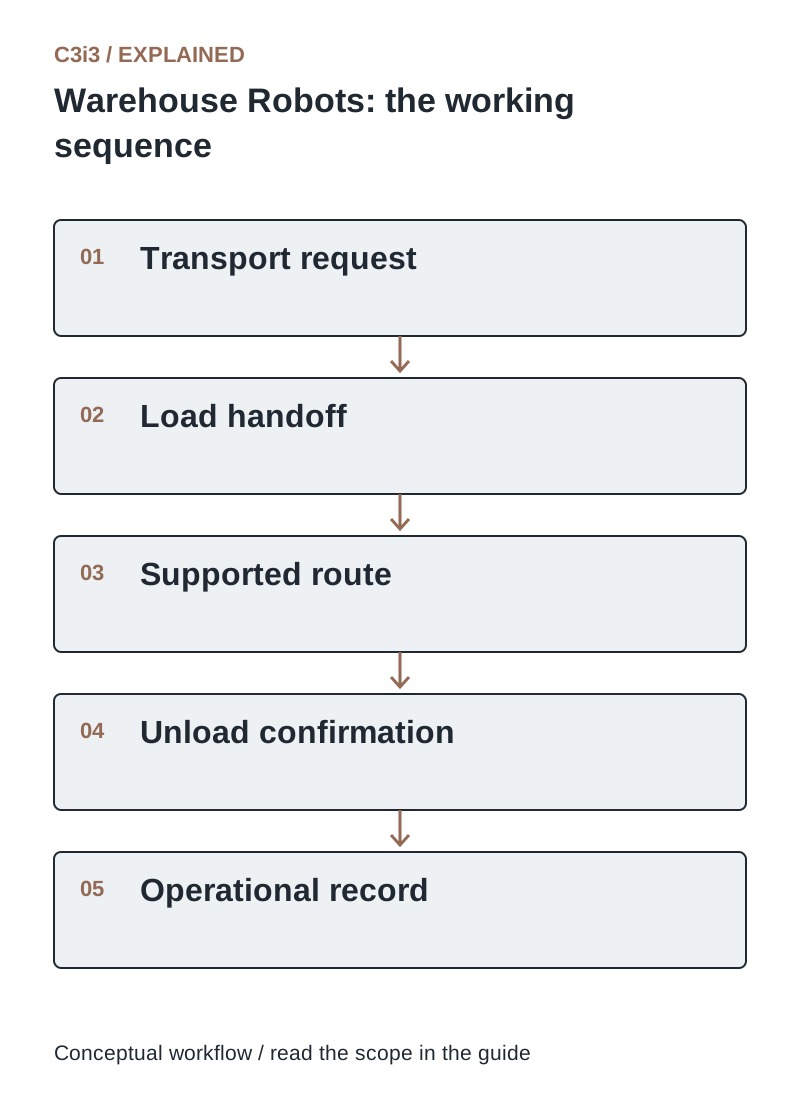
The sequence is: Transport request. Then Load handoff. Then Supported route. Then Unload confirmation. Then Operational record. Each handoff needs the scope and conditions described in this guide.
Who loads and unloads the robot, and why does that matter?
Define each handoff explicitly. A mobile platform may require a person to load a cart, secure a container or confirm delivery. Automated transfers require compatible equipment and controls. Omitting these steps can make an apparently fast route slower overall.
Record waiting time at both ends, not just travel time. Identify who notices a missing load and what happens when the destination is occupied. Design a supported fallback so a stalled robot does not prevent the warehouse from continuing its work. The process is only as reliable as the handoffs surrounding the movement.
Does the first warehouse robot need ERP or WMS integration?
It depends on the task. A small trial might use an approved manual dispatch process, while a production workflow may need orders from the warehouse management system or manufacturing execution system. Start by defining who requests a mission and how completion is recorded.
When integrating, map identifiers, status events, retries and duplicate requests. Test what happens when the connection is unavailable or an order changes after dispatch. Keep an operational queue that people can inspect. A robot that physically reaches a station but leaves inventory records wrong has not completed the whole business task.
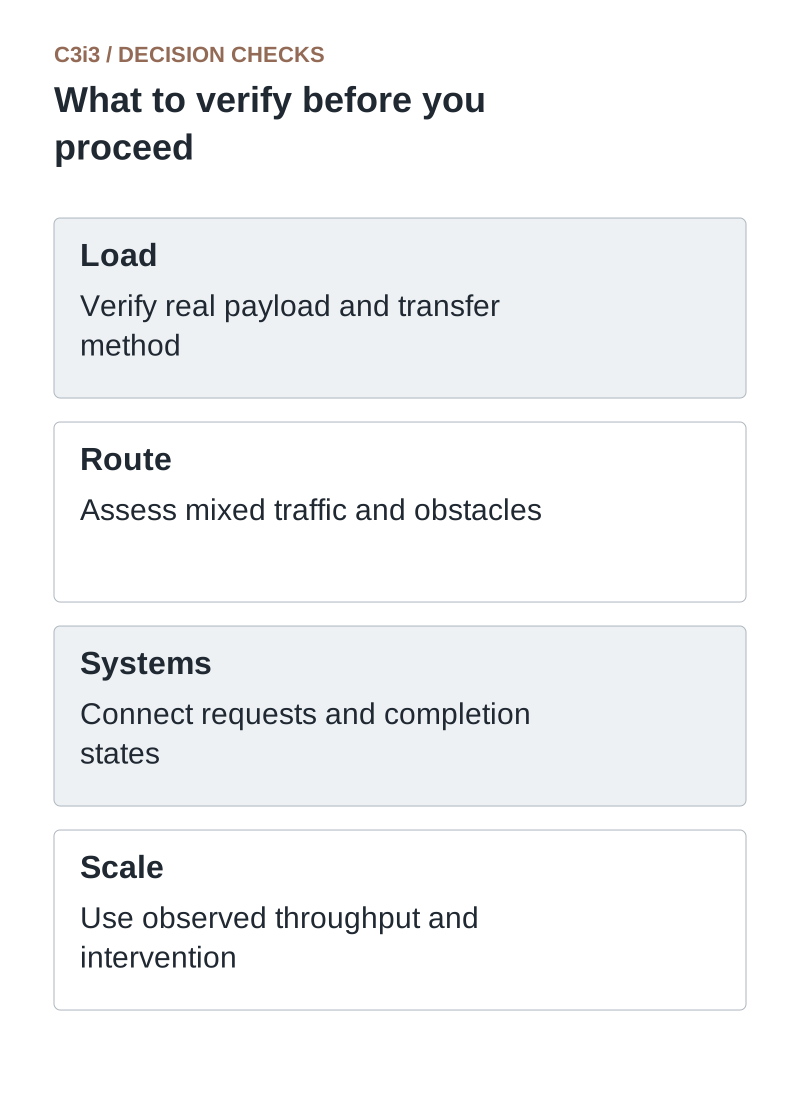
Load: Verify real payload and transfer method. Route: Assess mixed traffic and obstacles. Systems: Connect requests and completion states. Scale: Use observed throughput and intervention.
What should you verify about mixed traffic and recovery procedures?
Have qualified personnel assess the actual system, traffic and operating area, following the applicable manufacturer instructions and workplace requirements. Include interactions with forklifts, pedestrians, doors and other equipment. Do not infer system-level readiness from a generic collision-avoidance claim.
Training and recovery procedures need defined owners. Staff should know the approved response to blocked routes, damaged loads and abnormal behavior. Changes in attachments, routes or traffic may require reassessment. This is part of deployment work, rather than an optional item to add after the robot begins sharing the floor.
How do you decide whether the warehouse pilot is worth expanding?
Compare completed transfers, required delivery windows, intervention time, load errors and total staff handling effort with the baseline. Use representative shifts and volume. Separate rated machine capacity from realized system throughput.
Estimate costs and benefits using observed performance, including charging, support and the remaining handoff work. Review whether the process becomes fragile during peak traffic or when a trained operator is absent. Expand only when the team can explain failures and recover predictably. Replicating an unresolved bottleneck across several robots can make it harder to diagnose.
What belongs in a warehouse transport pilot?
Use these distinctions when reviewing your own workflow.
| Measurement | Record | Reason |
|---|---|---|
| Correct transfers | Load, destination and completion state | Travel alone does not complete the task |
| Timing | Waiting, movement and handoff time | Find the actual bottleneck |
| Human assistance | Interventions and recovery minutes | Reveal remaining work and operating cost |
How would this work in a practical example?
Illustrative example: A warehouse tests empty-tote movement between packing and storage. A worker loads the tote cart, the robot transports it and another worker confirms arrival. The first trial reveals that the drop-off point is routinely occupied. Moving that handoff point improves the whole process more than increasing robot speed. The finding comes from observing the workflow, not from the product specification alone.
Key takeaways
- Load: Verify real payload and transfer method.
- Route: Assess mixed traffic and obstacles.
- Systems: Connect requests and completion states.
- Scale: Use observed throughput and intervention.
Frequently asked questions
Can an AMR pick products off shelves?
A transport platform alone does not establish picking capability. Manipulation, item recognition and shelf interaction require an appropriate integrated system.
Do we need to automate the whole warehouse?
No. A scoped material-transfer workflow can be evaluated independently, provided its handoffs and operational records are defined.
What is the most useful pilot metric?
Use a combination of correct completed transfers, required timing and human intervention. A mission count alone hides whether the work met the need.
Sources and editorial method
Primary documentation checked November 20, 2026. Linked vendor materials establish stated capabilities and announcements; they do not establish independently tested performance at your business. The workflows, comparisons and illustrative examples are C3i3 editorial analysis.
- Universal Robots / MiR: autonomous mobile robots
Vendor documentation for material transport and integration. Site performance needs its own evaluation.
- OSHA: industrial robot systems and safety
Industrial robot-system risk-assessment context. Applicability depends on the actual system and workplace; not a universal service-robot certification.
Explain what your robotics product does and who it helps.

C3i3 helps robotics and technical businesses explain product capabilities through technical content, product demonstrations and a clear website buying journey. Site assessments, equipment integration and operational safety belong with qualified suppliers and responsible site personnel.