







































In this article
A dining-room robot carrying food can look like an automated waiter, but the customer experience contains many tasks beyond moving a tray. This guide helps restaurant operators identify a realistic application, test it during actual service and describe the remaining staff work accurately.
What can a restaurant delivery robot actually do?
A supported delivery robot can carry loads between mapped points and perform its documented navigation and return functions. Bear Robotics’ Servi documentation describes food-running and bussing support. That establishes a transport role, not an ability to perform every action a server performs.
Ask who places items on the robot, who removes them and where the handoff occurs. Bussing support may mean carrying a loaded bus tub to the kitchen rather than autonomously grasping plates from tables. Make the distinction explicit when comparing suppliers and explaining the workflow to staff.
Will a restaurant robot work in a crowded dining room?
Evaluate aisle widths, table spacing, chairs, floor transitions, service stations and changing traffic. The robot must fit the supported route with real diners and staff moving through it. Check manufacturer requirements for the chosen tray and load configuration.
Test during representative service with an approved supervision plan. An empty-room demonstration cannot establish peak-hour performance. Record blocked routes, waiting time and the effect on staff movement. Keep accessible routes clear and review the operating arrangement with responsible staff. A robot that repeatedly blocks the pass can undermine the service improvement it was meant to provide.
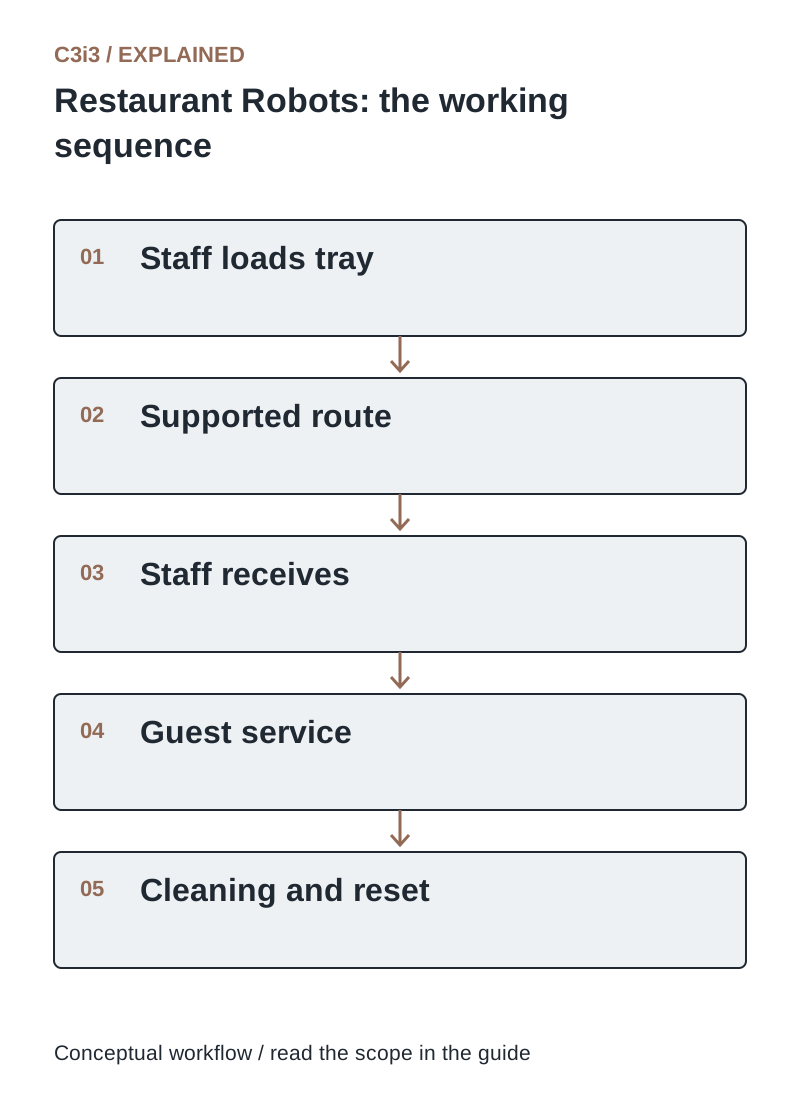
The sequence is: Staff loads tray. Then Supported route. Then Staff receives. Then Guest service. Then Cleaning and reset. Each handoff needs the scope and conditions described in this guide.
How should people and robots divide the service workflow?
Use the robot for a defined transport leg and retain clear human responsibility for food quality, guest interaction and handoff. Designate pickup and arrival points so employees do not search for a tray or leave food waiting without an owner.
Keep the workflow simple enough for a busy shift. Staff should know when to dispatch the machine, when to bypass it and how to report a problem. Test several orders with different handling needs. Any claim about carrying beverages or other loads should follow the selected model’s instructions and the restaurant’s approved operating procedure.
Can the same robot also cook or clear individual plates?
Do not assume so. Cooking equipment, robotic manipulation and mobile tray transport solve different physical tasks. A vendor’s demonstration of one function does not establish another. Ask for documentation of the specific food, utensil, handling and cleaning workflow being offered.
For kitchen automation, involve the responsible operations and food-safety personnel in reviewing the actual equipment and process. Include cleaning, maintenance, changeover and failure recovery. A robot can complete a technically impressive action while still being unsuitable for the restaurant’s menu, service speed or available workspace.
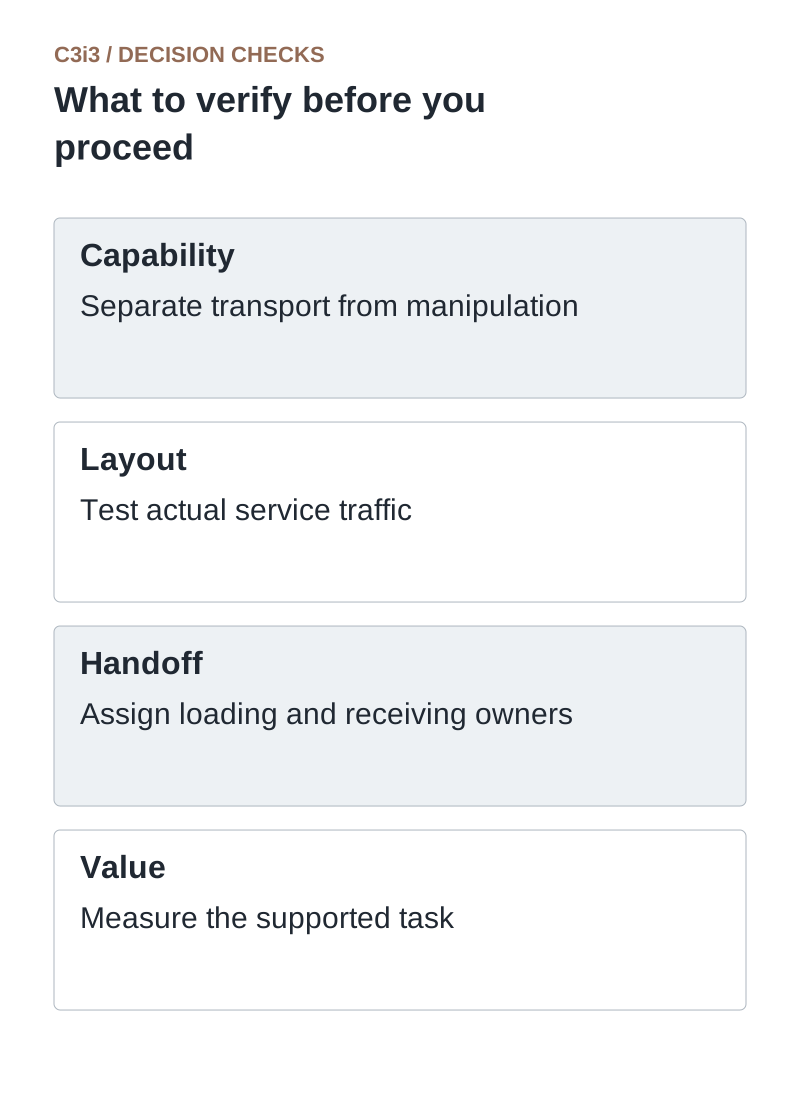
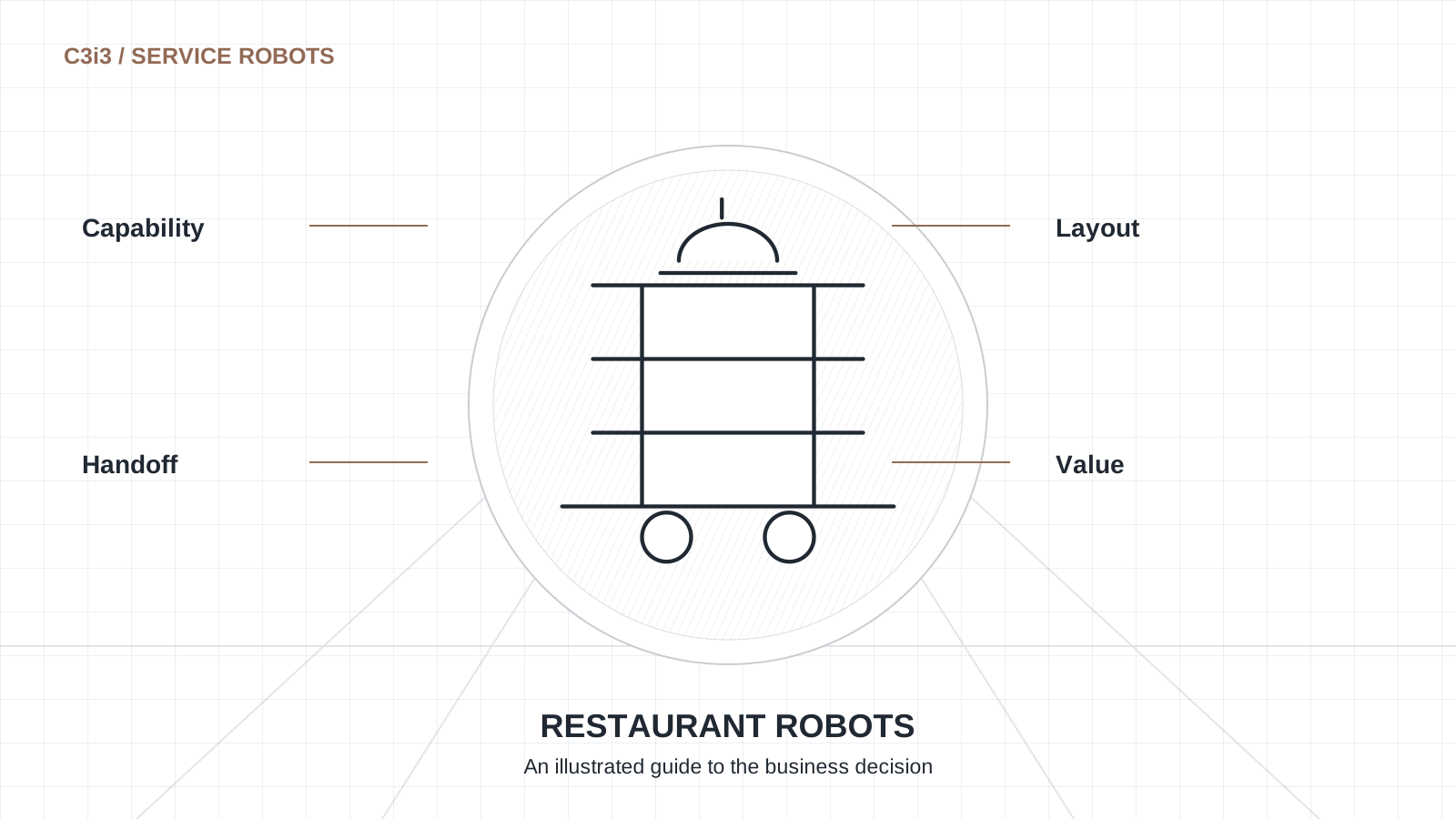
Capability: Separate transport from manipulation. Layout: Test actual service traffic. Handoff: Assign loading and receiving owners. Value: Measure the supported task.
What should a restaurant robot trial measure?
Measure completed useful deliveries, handoff delays, staff walking time, interventions and guest or staff feedback. Compare equivalent service periods and note differences in customer volume. Keep food quality and the dining experience part of the acceptance decision.
Record total work around the machine, including loading, cleaning, dispatch and recovery. A robot may travel continuously while staff gain little useful time if handoffs are poorly placed. Start with one route and establish the baseline before expanding. The test should answer an operating question, not simply produce a novel video for social media.
Which cost and support questions should operators ask?
Request equipment or subscription charges, setup, mapping, training, software, cleaning responsibilities, maintenance and service coverage. Ask what happens when the machine is unavailable during a busy shift and whether menu or layout changes require additional work.
Compare the complete cost with the specific transport benefit, not with the salary of an entire server role. Review trial and cancellation terms. If the principal benefit is more consistent support during busy periods, state that plainly. A credible business case can describe useful assistance without claiming full staff replacement.
Which restaurant tasks need separate capability evidence?
Use these distinctions when reviewing your own workflow.
| Task | Typical question | Do not infer |
|---|---|---|
| Tray transport | Can the system carry this load on this route? | It can pick plates up from tables |
| Bussing support | Who loads and empties the bus tub? | Dish collection is fully autonomous |
| Cooking | Which food process and equipment are supported? | A delivery robot can also prepare food |
How would this work in a practical example?
Illustrative trial: A restaurant tests movement from the kitchen pass to a dining-room station. Servers remain responsible for delivering food to tables. The trial records whether the robot reduces repeated long walks without slowing the pass or blocking aisles. If that transport leg works, the restaurant can assess another route. It has not yet demonstrated automatic table service or cooking.
Key takeaways
- Capability: Separate transport from manipulation.
- Layout: Test actual service traffic.
- Handoff: Assign loading and receiving owners.
- Value: Measure the supported task.
Frequently asked questions
Does bussing mean the robot picks plates up?
Not necessarily. Many systems transport dishes that staff have already loaded. Verify the exact manipulation and transport capabilities.
Can a restaurant robot replace all servers?
A tray-transport function does not establish that. Guest care, judgment, food handling and other duties remain separate tasks.
Should we buy it for publicity?
Novelty may be a marketing consideration, but evaluate the operational route, costs and guest experience independently before committing.
Sources and editorial method
Primary documentation checked November 20, 2026. Linked vendor materials establish stated capabilities and announcements; they do not establish independently tested performance at your business. The workflows, comparisons and illustrative examples are C3i3 editorial analysis.
- Bear Robotics: Servi
Vendor documentation of restaurant transport and bussing assistance, not general autonomous table service.
- OSHA: industrial robot systems and safety
Industrial robot-system risk-assessment context. Applicability depends on the actual system and workplace; not a universal service-robot certification.
Explain what your robotics product does and who it helps.

C3i3 helps robotics and technical businesses explain product capabilities through technical content, product demonstrations and a clear website buying journey. Site assessments, equipment integration and operational safety belong with qualified suppliers and responsible site personnel.