








































In this article
Videos of humanoid robots can compress research, teleoperation, supervised testing and commercial operation into the same visual story. Business buyers need more precise categories. This guide shows how to read deployment claims and request the evidence needed for a scoped purchasing decision.
What is the difference between a demonstration, pilot and commercial deployment?
A demonstration shows an action under stated conditions. A pilot investigates a task in a defined setting, often with additional support. A commercial deployment places a system into an operating business arrangement for specified work. Planned expansion describes an intention whose future result remains unverified.
These labels do not establish equal autonomy, reliability or scale. Ask what the robot does, who assists it and how performance is measured. A paid pilot can still be a pilot, and a commercial deployment can still have a narrow task. Preserve those distinctions when reporting progress to management.
What does the GXO and Digit example actually establish?
GXO’s June 27, 2024 announcement describes a commercial arrangement using Agility Robotics’ Digit for repetitive tote-handling work in a live warehouse. This is a specific named application, rather than a general claim that humanoids can perform every warehouse job.
GXO’s October 26, 2026 update reports operating experience at the existing facility and says additional site deployments are expected to begin in early 2027. Treat the existing operation and the future rollout as different evidence states. The announcements remain company-reported information, not C3i3’s independent performance testing.
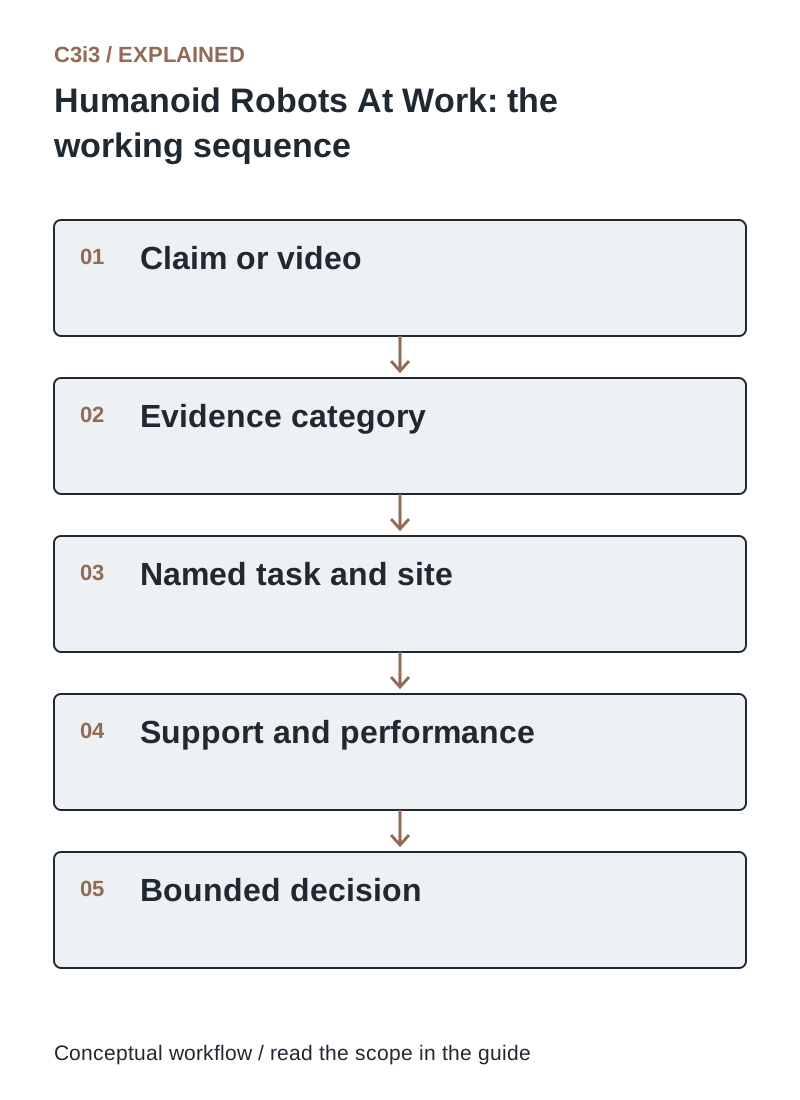
The sequence is: Claim or video. Then Evidence category. Then Named task and site. Then Support and performance. Then Bounded decision. Each handoff needs the scope and conditions described in this guide.
How much human support does a humanoid task require?
Ask separately about setup, task teaching, ordinary supervision, remote intervention and failure recovery. Determine whether a person controls movements, approves actions or only responds to exceptions. “Autonomous” without that operating context is too vague for a business case.
Request intervention counts and definitions across a stated observation window. Include time spent preparing objects and restoring the task after a failure. A system can be useful with human support, provided the support is understood and budgeted. Problems arise when demonstration assistance disappears from the claimed operating cost.
When might a humanoid be worth evaluating instead of another robot?
Consider it when the specific task and site create a reason for the offered physical form and capabilities. Compare established alternatives, including wheeled transport, fixed automation and process changes. Ask which constraint the humanoid resolves that the alternatives do not.
Assess actual object variation, reach, load handling, floors and handoffs using the supplier’s documented limits and qualified site review. Do not infer capability from human-like appearance. A robot shaped like a person does not necessarily have a person’s dexterity, judgment, endurance or ability to adapt to an unfamiliar job.
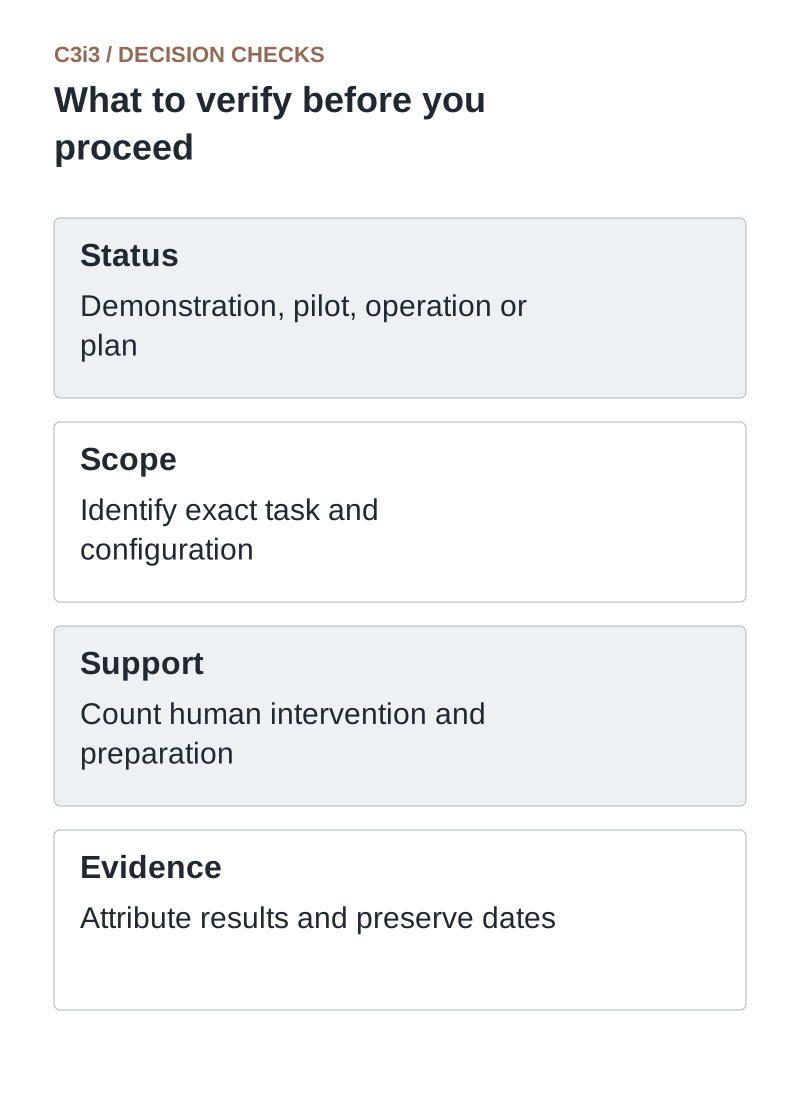
Status: Demonstration, pilot, operation or plan. Scope: Identify exact task and configuration. Support: Count human intervention and preparation. Evidence: Attribute results and preserve dates.
Which evidence should you request before agreeing to a pilot?
Request the exact task definition, supported hardware and software configuration, operating limits, required supervision and acceptance criteria. Ask for comparable deployment evidence and clarify which results are measured, estimated or planned. Review service, support and recovery responsibilities.
Design the trial around representative work, including ordinary variation and interruptions. Establish a baseline and a review window. Have responsible safety and operations personnel assess the integrated system. Keep the pilot’s success claim bounded to the task and conditions actually tested. A successful tote-transfer trial does not establish unrestricted warehouse labor substitution.
How should a business communicate humanoid progress accurately?
Use specific language: “tested this task,” “operating at this named site” or “announced a future rollout.” Attribute reported results and identify the time period. Separate a company’s target from an achieved outcome.
For internal decisions, maintain a claim ledger with source, task, site, date, evidence state and unresolved questions. Revisit it when new information appears. This prevents a future plan from quietly becoming a supposed installed fleet in a presentation. The most useful robotics update explains what changed in demonstrated capability and what still needs validation.
How should you classify a humanoid announcement?
Use these distinctions when reviewing your own workflow.
| Evidence state | What it establishes | Question still open |
|---|---|---|
| Demonstration | An action under the shown conditions | How repeatable is it in operations? |
| Pilot | A defined evaluation is underway | What are the acceptance results? |
| Commercial operation | A named task is in a business arrangement | What supervision and performance apply? |
| Future rollout | A plan or expected deployment | Has the installation actually begun? |
How would this work in a practical example?
Illustrative claim ledger: One record describes a current tote-handling operation at a named facility; another describes a planned multi-site rollout next year. The team marks the first “commercial operation, company-reported” and the second “announced future deployment.” It asks separate questions about task reliability and rollout timing. Keeping those records distinct prevents a roadmap from being presented as a completed installation.
Key takeaways
- Status: Demonstration, pilot, operation or plan.
- Scope: Identify exact task and configuration.
- Support: Count human intervention and preparation.
- Evidence: Attribute results and preserve dates.
Frequently asked questions
Are humanoids already doing paid work?
There are named commercial arrangements for specific tasks, including the GXO and Digit example. That does not establish broad readiness across all jobs.
Does a commercial contract prove full autonomy?
No. Commercial status and degree of autonomy are separate questions. Ask about supervision, interventions and task boundaries.
Can we treat a 2027 expansion announcement as installed capacity today?
No. Report it as a planned or expected expansion until evidence confirms the deployment and operating scope.
Sources and editorial method
Primary documentation checked November 20, 2026. Linked vendor materials establish stated capabilities and announcements; they do not establish independently tested performance at your business. The workflows, comparisons and illustrative examples are C3i3 editorial analysis.
- GXO: Digit commercial agreement, June 27, 2024
Customer announcement of a specified commercial tote-handling deployment; company-reported evidence.
- GXO: expansion announcement, October 26, 2026
Existing operating context and additional deployments expected in 2027. Future plans are not completed installations.
- OSHA: industrial robot systems and safety
Industrial robot-system risk-assessment context. Applicability depends on the actual system and workplace; not a universal service-robot certification.
Explain what your robotics product does and who it helps.

C3i3 helps robotics and technical businesses explain product capabilities through technical content, product demonstrations and a clear website buying journey. Site assessments, equipment integration and operational safety belong with qualified suppliers and responsible site personnel.