








































In this article
A customer who buys an industrial machine may not need another machine next month. They may need setup guidance, consumables, maintenance supplies or a replacement part years later. A retention strategy should reflect that relationship. This guide connects customer questions with practical follow-up workflows and explains how to measure them without confusing repeat revenue with email activity.
What does customer retention mean for equipment and supply businesses?
Retention means maintaining a useful commercial relationship over the buying cycle appropriate to the product and customer. For a consumable brand, that may involve regular replenishment. For an equipment manufacturer, it may involve service, parts and eventual expansion. Define the relationship before selecting a reporting interval.
A monthly repeat-order target can misrepresent products normally replaced after several years. Group customers by product family, account type and expected buying pattern. Look for avoidable reasons they stop buying: incompatible items, unreliable availability, difficult reordering or unanswered support requests. Better follow-up begins with solving those problems.
Which customer questions should your retention content answer?
Answer what customers need after the sale: how to identify the purchased configuration, where to find approved instructions, which supplies fit, how to reorder and whom to contact for an issue. Use controlled product documentation for technical requirements and maintenance intervals.
Separate product education from promotional offers. A buyer trying to resolve a compatibility problem needs a correct answer before another sales message. Connect support topics to the appropriate product or account record so the team can provide context. Avoid inventing a maintenance schedule simply because an automation needs a delay value.
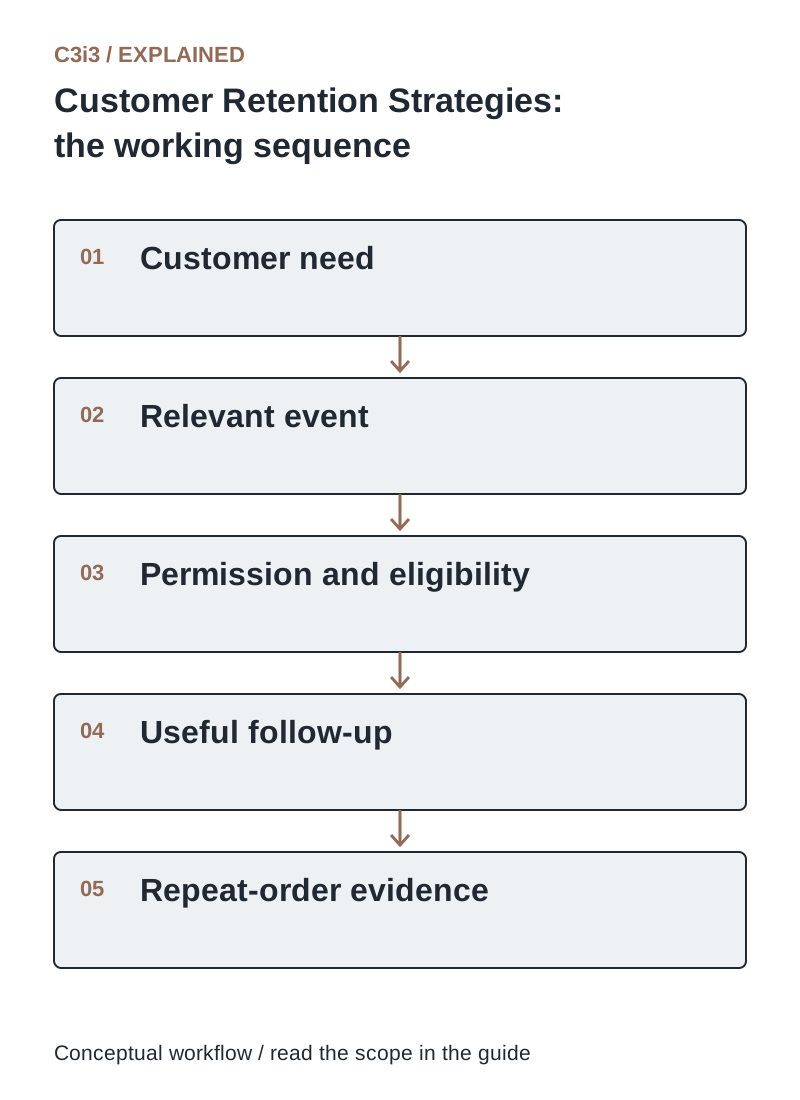
The sequence is: Customer need. Then Relevant event. Then Permission and eligibility. Then Useful follow-up. Then Repeat-order evidence. Each handoff needs the scope and conditions described in this guide.
Which retention workflows should you build first?
Choose workflows tied to a clear customer event. A completed order can lead to useful onboarding. A requested restock alert can notify someone about the exact unavailable variant. An appropriate replenishment reminder can help a consenting buyer reorder a product they regularly consume.
Define entry conditions, suppression rules and exit conditions for each flow. Stop an abandoned-cart sequence after a purchase, and avoid replenishment offers during an unresolved return or complaint where inappropriate. Maintain one view of recent customer contact so separate systems do not send contradictory messages. Fewer relevant messages can be more useful than many disconnected sequences.
What customer data is necessary for relevant follow-up?
Use stable customer or company identifiers, purchased items, quantities, order dates, current product status and communication preferences. For business accounts, identify whether the recipient is the buyer, user or service coordinator. Those roles may need different information.
Collect and retain only information needed for the supported purpose. Do not assume that placing an order creates permission for every promotional channel. Verify the relevant rules with your communication platform and business process. Let customers update preferences, and ensure those preferences propagate to every sending system. A useful retention program is recognizable to its recipient.
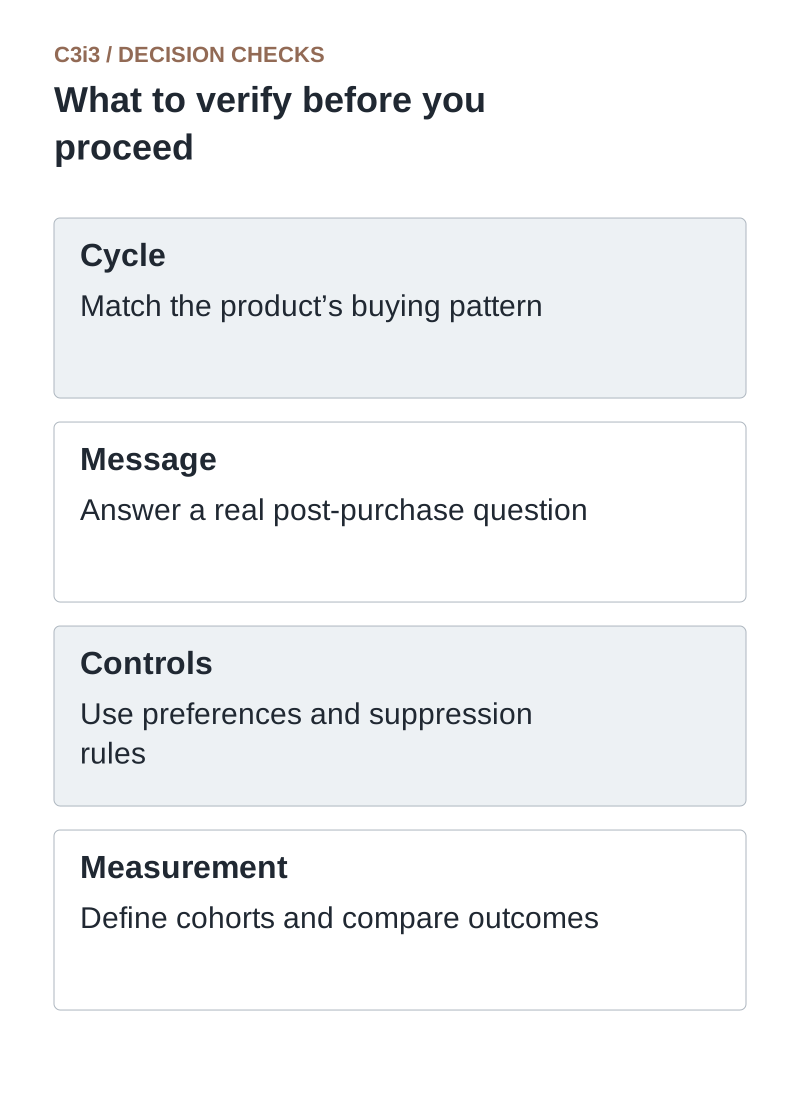
Cycle: Match the product’s buying pattern. Message: Answer a real post-purchase question. Controls: Use preferences and suppression rules. Measurement: Define cohorts and compare outcomes.
How do you calculate and interpret customer retention?
For a defined period, a common customer-retention calculation is: customers at the end minus customers acquired during the period, divided by customers at the start, multiplied by 100. Establish consistent customer identities and the meaning of “active” before applying the formula.
For ecommerce, also review cohort repeat-purchase rates: among buyers who first purchased in a selected period, what share purchased again within the chosen follow-up window? Allow cohorts enough time to mature. Revenue retention can behave differently from customer-count retention, so do not mix the two. Report the denominator and observation window beside every percentage.
How can you tell whether retention marketing caused more orders?
Compare similar customer groups and, when practical, use a suitable holdout group that does not receive the tested promotional workflow. Review incremental orders, margin, returns, complaints and unsubscribes. Platform-attributed revenue is useful operational information but does not by itself prove causation.
Document other changes such as promotions, price increases and product availability. A reminder can receive credit for an order the customer would have placed anyway. Start with one workflow, an explicit hypothesis and a review window suited to the product cycle. Improve the experience based on observed customer needs and measured results.
Who should own the customer-retention program?
Assign shared responsibilities with one accountable owner. Operations supplies reliable order and inventory events, customer support identifies recurring problems, marketing designs useful communications and account teams provide buying-cycle context. Someone must maintain the rules that connect those contributions.
Review a small sample of actual customer journeys together. Look for conflicting reminders, repeated questions and messages sent after a purchase or complaint. Record the root cause and the owner of the repair. Retention improves when the whole relationship becomes easier, rather than when one department increases its send volume while the service problem remains unresolved.
How do you choose the first retention improvement?
Choose a recurring customer problem with a clear event and measurable outcome. If buyers repeatedly ask when an unavailable part returns, start with accurate restock notifications. If they cannot find their previous item, improve reordering before sending more reminders.
Write the hypothesis in plain language: the right customer will receive useful information at the right stage and complete a defined next step with less friction. Specify who is eligible, what stops the workflow and how the result will be evaluated. Test one important change first. This creates evidence the team can use when deciding whether to expand the program.
Which retention measure answers which question?
Use these distinctions when reviewing your own workflow.
| Measure | Useful question | Definition to publish |
|---|---|---|
| Customer retention | How many starting customers remained? | Active-customer rule and observation period |
| Repeat-purchase cohort | Which first-time buyers purchased again? | Cohort start and follow-up window |
| Workflow incrementality | Did the tested communication add value? | Comparison group, margin and exclusions |
How would this work in a practical example?
Illustrative calculation: A business starts a quarter with 200 active accounts, ends with 205 and acquired 25 new accounts during the quarter. Using the stated definition, retained starting accounts are 180 and retention is 180 ÷ 200 × 100 = 90%. This does not show whether marketing caused the retained purchases, nor does it describe revenue retention. The business still needs a consistent definition of an active account.
Key takeaways
- Cycle: Match the product’s buying pattern.
- Message: Answer a real post-purchase question.
- Controls: Use preferences and suppression rules.
- Measurement: Define cohorts and compare outcomes.
Frequently asked questions
What is a good retention rate?
There is no single useful rate for every business. Compare consistent cohorts and buying cycles, and distinguish customer retention from revenue retention.
Can customer-count retention exceed 100%?
Not under the stated formula when identities and new-customer counts are consistent. Revenue retention can exceed 100% when retained customers spend more.
Should retention always use discounts?
No. Correct product guidance, dependable availability, support and easier reordering may address the actual reason a buyer would return.
Sources and editorial method
Primary documentation checked November 20, 2026. Linked vendor materials establish stated capabilities and announcements; they do not establish independently tested performance at your business. The workflows, comparisons and illustrative examples are C3i3 editorial analysis.
- Klaviyo: replenishment-flow documentation
A recurring-purchase workflow example. Product-specific timing remains a business decision.
- Klaviyo: back-in-stock flow documentation
Inventory-aware catalog connections and requested-item notification workflows.
- Google: email sender guidelines
Current requirements for sending to personal Gmail accounts, including authentication and sending practices.
Connect useful customer follow-ups with reliable business data.

C3i3 helps product businesses connect clear websites, useful content and practical customer workflows. Explore marketing automation and discuss the customer task you want to improve.