








































In this article
Buying a box of filters does not tell you when every filter was installed. A customer may purchase for several locations, hold spare stock or follow a manufacturer-specific schedule. A replenishment workflow should acknowledge that uncertainty while making the next appropriate purchase easier.
Which products are suitable for replenishment reminders?
Products with recurring consumption and identifiable reorder behavior are sensible candidates. Consider consumable supplies, regularly purchased accessories and maintenance stock. Exclude durable equipment that does not normally require another purchase on the same cycle.
Group products by their actual use and pack quantities. A single replacement cartridge and a case for several facilities create different buying intervals. Ask customer-facing teams which repeat questions they receive and which items customers unexpectedly run out of. The goal is a useful reminder, not an automated assumption that every previous purchase should repeat.
How do you choose the delay before a replenishment email?
Use observed reorder patterns, customer-provided preferences or a supported consumption estimate, then test the timing. Account for quantity and the time needed to receive the next shipment. Klaviyo’s replenishment-flow guide provides an implementation pattern for recurring purchases; your product context still determines an appropriate schedule.
Do not present a marketing estimate as a technical service interval. For maintenance-critical products, direct customers to the applicable equipment documentation and qualified support. If the installation date or duty cycle is unknown, say so. A reminder can invite a stock check without instructing the customer to replace a component.
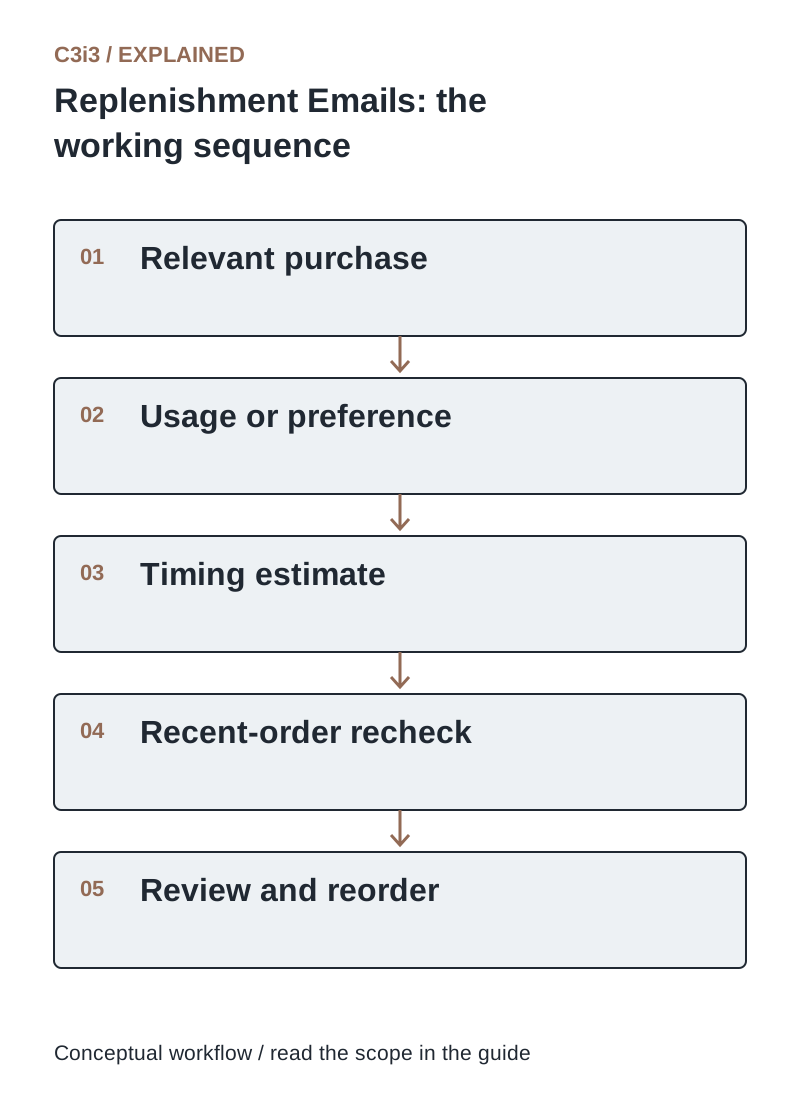
The sequence is: Relevant purchase. Then Usage or preference. Then Timing estimate. Then Recent-order recheck. Then Review and reorder. Each handoff needs the scope and conditions described in this guide.
What order data and preferences should the workflow use?
Use the customer or company identity, purchased SKU, quantity, current item status and subsequent orders. For multi-location accounts, determine whether replenishment relates to a branch, central warehouse or individual buyer. Keep contact roles current when employees change.
Offer a manageable way to adjust or stop reminders. A buyer who orders quarterly should not have to unsubscribe from all useful communications to avoid a monthly prompt. Keep the preference connected to the relevant product or category where the platform supports it. Minimize unnecessary personal details in messaging and analytics systems.
When should a replenishment reminder be skipped?
Skip or reset the reminder when a relevant recent order changes the need. Check returns, cancellations, unavailable products and communication preferences. Review whether an account purchased through sales or another supported route before sending a message that implies it has not reordered.
Coordinate reminders for related SKUs so a multi-item purchase does not generate a series of near-identical emails. Define how a new order affects older scheduled messages. Test quantity changes and a customer who buys a larger pack. The workflow should respond to current behavior rather than mechanically count days from the first event.
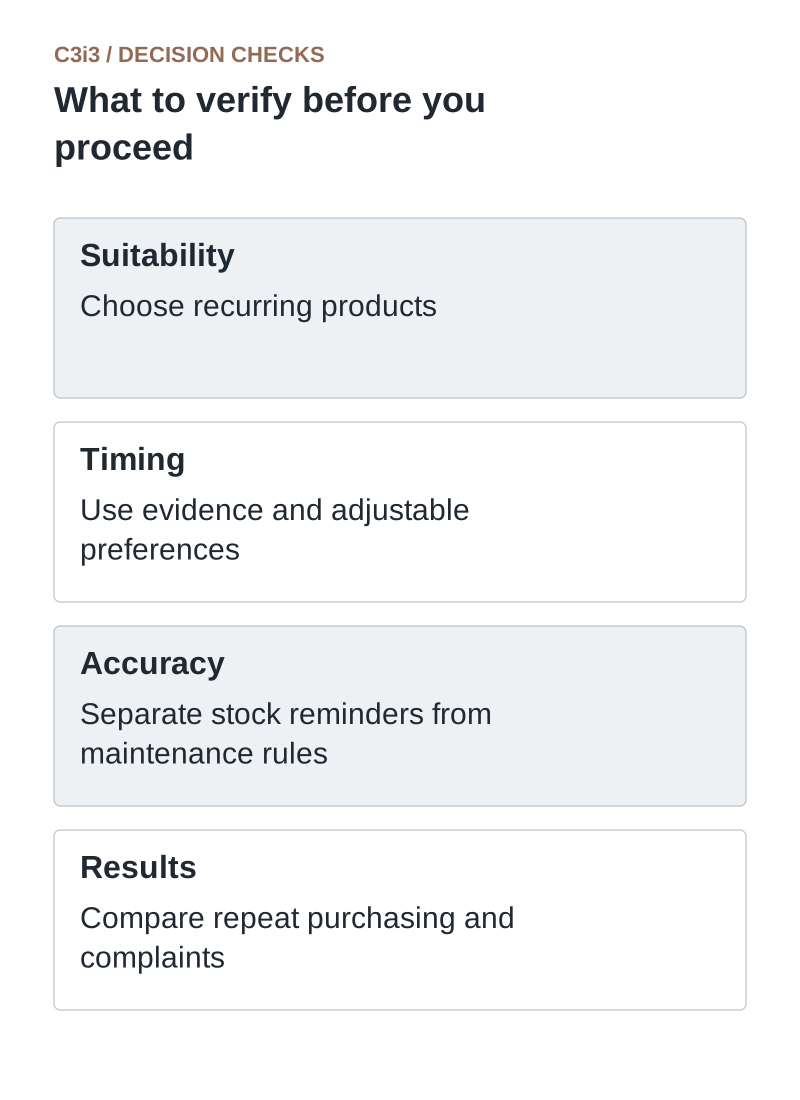
Suitability: Choose recurring products. Timing: Use evidence and adjustable preferences. Accuracy: Separate stock reminders from maintenance rules. Results: Compare repeat purchasing and complaints.
What should a good replenishment email include?
Identify the previous product, explain why the reminder is being sent and link to a current reorder path. Use wording such as “Time to check your filter stock?” when actual usage is unknown. Include current compatibility guidance and a human contact for uncertain applications.
Revalidate price, stock and account terms at purchase. Do not imply that an outdated product remains available or that a new part number is automatically interchangeable. Keep the primary action focused on reviewing the customer’s needs. Helpful reminders respect the difference between being due to inspect stock and being required to replace equipment.
How do you measure whether replenishment reminders help?
Review repeat purchases within an appropriate window, time between purchases, relevant support contacts and contribution after messaging costs. Where feasible, compare with a suitable holdout group. Separate natural repeat demand from incremental purchasing associated with the tested reminder.
Watch unsubscribes and complaints that indicate the timing or product match is wrong. Ask buyers whether the reminder helped them avoid a stockout or merely repeated information they already had. Adjust by product family and account type. A single average delay rarely describes every customer’s real consumption.
What timing evidence supports a replenishment reminder?
Use these distinctions when reviewing your own workflow.
| Evidence | What it can suggest | Limit |
|---|---|---|
| Observed reorder history | A testable reminder interval | Past behavior may change |
| Customer preference | A requested contact schedule | Preference needs a way to change |
| Manufacturer maintenance guidance | Approved technical context | Purchase date alone is not installation date |
How would this work in a practical example?
Illustrative example: A maintenance supplier finds that some customers buy a six-pack for one site and others buy it for six sites. It stops using quantity alone to predict six months of consumption. The new message invites a stock check and offers adjustable reminders. Technical replacement guidance remains linked to the equipment manufacturer’s approved instructions.
Key takeaways
- Suitability: Choose recurring products.
- Timing: Use evidence and adjustable preferences.
- Accuracy: Separate stock reminders from maintenance rules.
- Results: Compare repeat purchasing and complaints.
Frequently asked questions
Can purchase date determine a filter replacement date?
Not reliably by itself. Installation date, equipment requirements and use conditions may differ. Use approved maintenance documentation for technical intervals.
Should larger purchases delay the reminder?
Potentially, but validate the relationship. Larger quantities may represent more users or locations rather than a longer supply period.
Is replenishment the same as a subscription?
No. A reminder invites review or purchase. A subscription creates recurring orders under a separate explicit agreement and process.
Sources and editorial method
Primary documentation checked November 20, 2026. Linked vendor materials establish stated capabilities and announcements; they do not establish independently tested performance at your business. The workflows, comparisons and illustrative examples are C3i3 editorial analysis.
- Klaviyo: replenishment-flow documentation
A recurring-purchase workflow example. Product-specific timing remains a business decision.
- Google: email sender guidelines
Current requirements for sending to personal Gmail accounts, including authentication and sending practices.
Connect useful customer follow-ups with reliable business data.

C3i3 helps product businesses connect clear websites, useful content and practical customer workflows. Explore marketing automation and discuss the customer task you want to improve.