








































In this article
A buyer asks an AI assistant to find a replacement filter with a particular size, price range and delivery deadline. Your brand may have the right item, but a vague description or outdated stock record can prevent a useful match. Agentic commerce makes the quality of the information behind your storefront part of the buying experience. This guide explains what to prepare, what to verify and how to evaluate an initial test without assuming every AI channel offers the same features.
What is agentic commerce, and how is it different from ordinary ecommerce?
Agentic commerce describes shopping tasks carried out with software agents acting on a buyer’s instructions. An agent might interpret requirements, compare items, assemble a cart or help complete checkout. The available actions depend on the platform, merchant integration and buyer authorization.
Ordinary ecommerce asks people to navigate categories and product pages themselves. Agent assistance can shorten that navigation, but the merchant still needs accurate information and dependable fulfillment. Treat “the AI found us,” “the AI recommended this SKU” and “an order was accepted” as separate events. Each requires different evidence and can fail for different reasons.
What product information helps an AI shopper choose the right item?
Start with a stable product identity and the attributes that determine suitability. Useful fields include manufacturer part number, variant, dimensions with units, supported equipment, exclusions, package quantity, price, availability and the actual destination URL. For replacement parts, explain what a product fits and what it does not fit.
Keep important specifications in readable page text as well as the systems that supply product feeds. A photograph of a specification label is not a substitute for accessible product information. Maintain one approved source for each fact so the catalog, page, feed and sales team do not describe four different products.
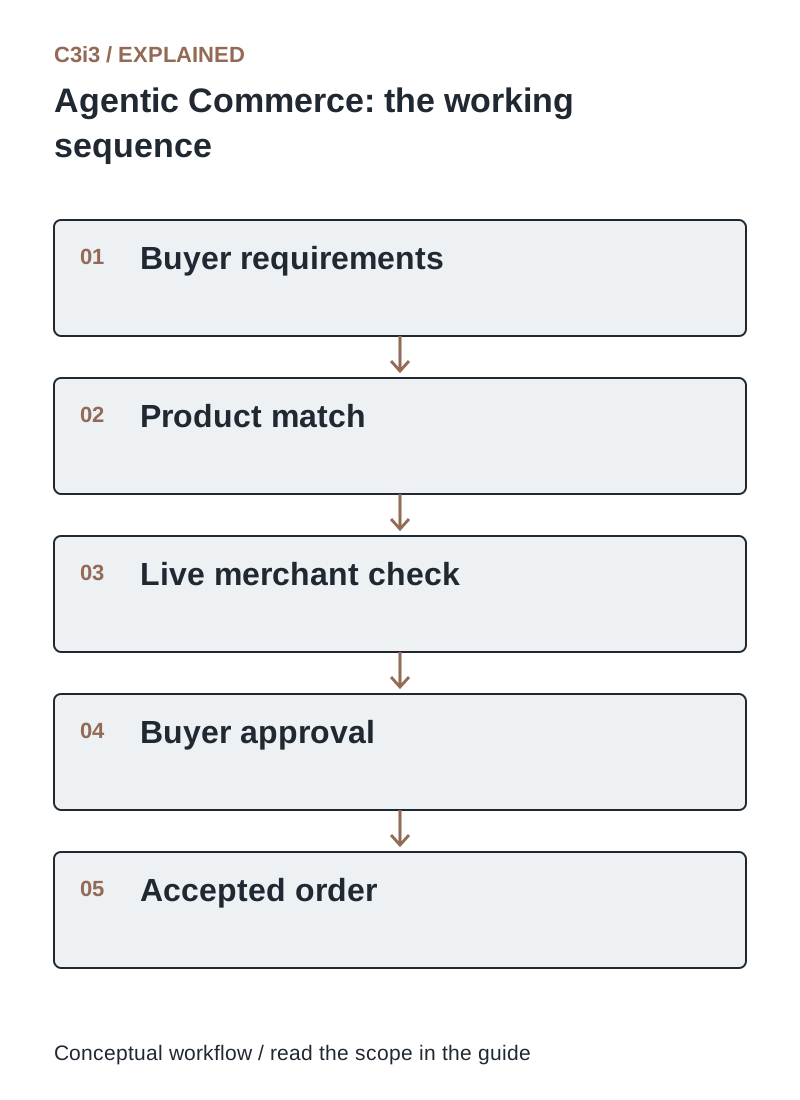
The sequence is: Buyer requirements. Then Product match. Then Live merchant check. Then Buyer approval. Then Accepted order. Each handoff needs the scope and conditions described in this guide.
Does every brand need Universal Commerce Protocol or an AI checkout integration?
No. Choose the integration after identifying the shopping surface and business task. Some opportunities involve discovery and a visit to your website. Others involve transferring a cart or completing an approved native checkout. Google’s UCP implementation overview describes distinct checkout and cart paths and requires integration approval.
Begin with catalog accuracy, shipping information and reliable checkout. Then ask your commerce provider which channel capabilities it supports for your actual account and market. A protocol implementation does not guarantee visibility, platform acceptance or additional sales. Maintain your existing purchasing route while you validate the new one.
How do brands protect pricing, permissions and customer relationships?
Use the merchant’s current systems to calculate price, shipping and availability at the point of purchase. An assistant’s earlier summary should not authorize a different price or override account restrictions. Buyers need to understand who sells the product, what they are approving and how support and returns work.
Assign responsibility for payment failures, duplicate requests and order reconciliation before launch. Keep customer data limited to what the transaction requires, and give access according to role. For business accounts, test whether negotiated pricing, tax settings and purchasing permissions survive the channel handoff. Unsupported cases should return the buyer to a clear merchant-controlled route.
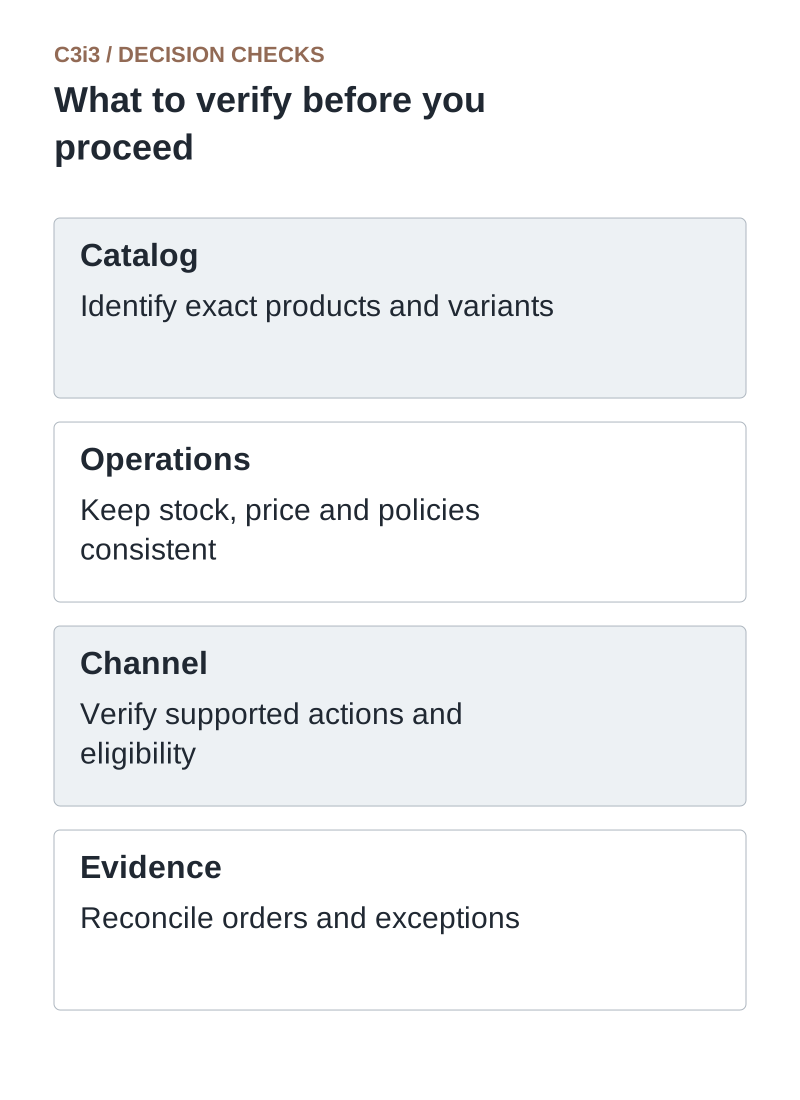
Catalog: Identify exact products and variants. Operations: Keep stock, price and policies consistent. Channel: Verify supported actions and eligibility. Evidence: Reconcile orders and exceptions.
How should a product brand test agentic commerce?
Select a small group of products with stable specifications, reliable stock and uncomplicated fulfillment. Write representative buying questions and document the correct variants before testing. Include ambiguous requirements and unavailable items, because a useful system should ask a clarifying question or decline an unsuitable match.
Trace the journey from product discovery to accepted order and fulfillment. Reconcile channel reports with merchant order records. Review failed attempts and customer support contacts as well as completed purchases. Continue only when the operational team can explain what happened, reproduce the important steps and handle exceptions without losing the customer.
Which metrics show whether AI shopping is helping the business?
Measure product-data completeness, visible availability mismatches, relevant visits, cart handoffs, accepted orders, cancellations, returns and contribution after channel costs. Use consistent definitions and a stated observation period. An AI mention is a discovery observation; it is not a sale.
Where attribution is incomplete, report that limitation instead of allocating every unexplained order to AI. Compare similar products and customer groups when practical, and record promotions or inventory changes that affect results. A small test can establish readiness and reveal friction. It cannot establish a universal conversion uplift or a guaranteed search position.
Who should own agentic commerce inside a product business?
Give the initiative one accountable business owner and name the supporting owners for catalog, operations, payments, customer service and measurement. Marketing can describe the opportunity, but it cannot independently guarantee stock accuracy or resolve an ambiguous payment state. Write a short responsibility map before selecting an integration vendor.
Agree on the supported product range and the conditions that trigger a pause. A recurring inventory mismatch needs an operations response; a wrong product match may require better attributes or clearer compatibility language. Keep these findings in one issue log. This helps the team improve the purchasing system instead of allowing each department to report a different version of success.
What should your first agentic-commerce work plan produce?
Produce a catalog sample with approved product facts, a channel-specific eligibility assessment, a documented buyer journey and a controlled test report. Each deliverable answers a different question: are the facts usable, can the account participate, does the supported task work and what actually happened?
Prioritize fixes that benefit current customers too, such as clear units, stable variant URLs and accurate shipping information. Reserve custom integration work for a confirmed supported path. After the first review, decide whether the evidence supports expanding products, fixing a handoff or waiting for access. A useful work plan ends with a concrete business decision and named owners for the remaining work.
How do AI discovery, cart transfer and checkout differ?
Use these distinctions when reviewing your own workflow.
| Buying stage | What to verify | What it does not prove |
|---|---|---|
| Discovery | The correct item answers the buyer’s need | A recommendation is not an accepted order |
| Cart transfer | Items and options reach the intended merchant cart | The shopper has not necessarily paid |
| Checkout | Final terms, approval and order acceptance are recorded | Payment success does not establish fulfillment |
How would this work in a practical example?
Illustrative example: A maintenance-supply brand tests ten replacement filters. Its team records dimensions, compatible housings and pack sizes, then checks whether a buyer seeking “two replacement filters for housing A” reaches the correct two-pack. A wrong variant is a catalog or matching failure even if the session produces a click. If the right pack reaches checkout but shipping is unsupported, that is a fulfillment-path failure. Separate those findings before deciding what to improve.
Key takeaways
- Catalog: Identify exact products and variants.
- Operations: Keep stock, price and policies consistent.
- Channel: Verify supported actions and eligibility.
- Evidence: Reconcile orders and exceptions.
Frequently asked questions
Can a small brand participate?
A small brand can improve product data and evaluate supported channels. Eligibility for a specific checkout program depends on that program, account and market, rather than company size alone.
Will AI replace my online store?
Your store remains useful for product detail, customer service, unsupported buying cases and transactions that require a merchant website. Plan multiple connected purchasing routes.
Does better structured data guarantee AI recommendations?
No. Accurate structured data can make facts easier for eligible systems to interpret, but it does not guarantee selection, rankings or traffic.
Sources and editorial method
Primary documentation checked November 20, 2026. Linked vendor materials establish stated capabilities and announcements; they do not establish independently tested performance at your business. The workflows, comparisons and illustrative examples are C3i3 editorial analysis.
- Google: UCP implementation overview
Platform integration paths and approval requirements. Feature support is distinct from the full open specification.
- Google Merchant Center: UCP-powered checkout
Program participation and product eligibility. Confirm current account access and market-specific onboarding.
- Google: automatic product-information updates
Automatic corrections and their limits; regular accurate product-data updates remain necessary.
Plan a clear buying journey for your product catalog.

C3i3 helps product businesses connect clear websites, useful content and practical customer workflows. Explore ecommerce development and discuss the customer task you want to improve.