








































In this article
Store owners often hear “support the protocol” before anyone explains which customer action it enables. The practical question is whether your buyers need a supported connection between an AI shopping surface and your store. This guide separates the standard from a particular platform’s implementation and turns that distinction into a useful scoping conversation.
What does Universal Commerce Protocol actually standardize?
UCP defines ways for commerce participants to describe and exchange supported capabilities. It gives platforms and businesses a shared contract for particular actions, rather than asking every participant to invent its own connection. The merchant’s catalog, pricing, fulfillment and order systems still perform their underlying jobs.
The official UCP documentation is the authority for the standard. A platform’s implementation guide explains which parts that platform currently accepts. Do not treat a capability in a specification as proof it is available in every live shopping interface. Record the supported version and implementation path in your project scope.
When does a store need UCP, and when should it wait?
You need a UCP implementation when a chosen integration requires it and the supported buyer journey makes business sense. You may be able to use your existing commerce provider’s integration instead of building a separate connection. Confirm the provider’s account requirements, responsibilities and supported features in writing.
Waiting can be sensible when inventory is unreliable, shipping rules are incomplete or checkout already produces unresolved failures. Fixing those issues benefits existing customers and any future channel. A store seeking only better product discovery should first establish the appropriate product data and channel requirements, rather than assuming a transaction protocol is the missing SEO setting.
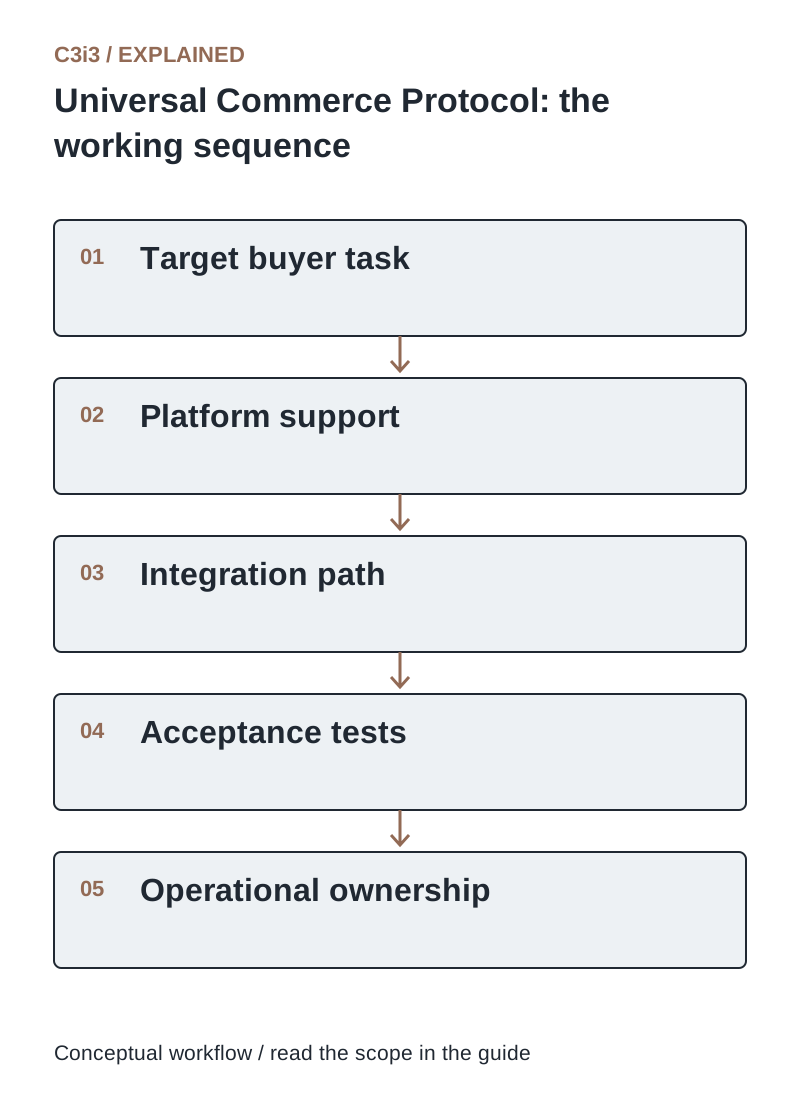
The sequence is: Target buyer task. Then Platform support. Then Integration path. Then Acceptance tests. Then Operational ownership. Each handoff needs the scope and conditions described in this guide.
What is the difference between a cart handoff and native checkout?
A cart handoff transfers the selected items to a merchant purchasing route. Native checkout supports the purchase through the participating platform’s approved experience. These paths create different demands for payment, order updates and exception handling.
Google’s implementation overview describes both paths. Scope the actual path your integration supports and test the complete customer journey. A working cart transfer does not demonstrate that native checkout works. Conversely, a successful payment does not demonstrate that the merchant can fulfill the order, communicate a delay or process a return.
Who owns product data, payments and order support?
Assign an owner for each system and each handoff. The commerce team owns product and selling rules; the integration team connects supported actions; the payment provider handles its contracted payment functions; the merchant’s operations team manages accepted orders. Google states that merchants remain merchant of record for its UCP purchasing experience.
Translate those responsibilities into operational questions. Who investigates a timeout after payment authorization? Which order ID links the platform and merchant records? Where does the customer ask for help? Make those answers available to support staff before launch. A standards-based interface reduces integration ambiguity only when the business has defined its own responsibilities.
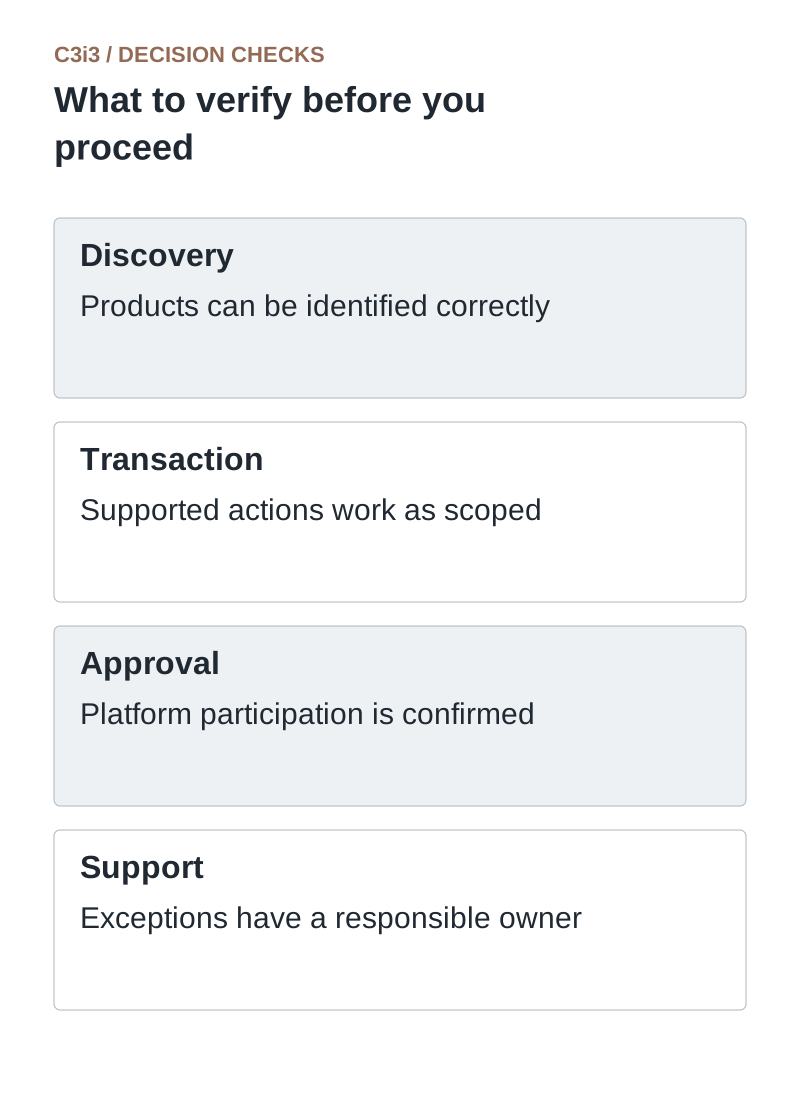
Discovery: Products can be identified correctly. Transaction: Supported actions work as scoped. Approval: Platform participation is confirmed. Support: Exceptions have a responsible owner.
What should an implementation test include?
Test accurate and inaccurate inputs, a changed price, an unavailable variant, unsupported destinations and interrupted checkout. Repeat the final purchase action to check whether the system prevents duplicate orders. Confirm that customer approval relates to the final product, quantity and total.
Use a sandbox or controlled test route appropriate to the provider. Verify authentication and account boundaries, then trace accepted orders into fulfillment and customer notifications. Include a clear escalation route for unsupported cases. Keep a short evidence record for each test: initial state, expected behavior, observed outcome and responsible owner. A homepage badge or valid discovery document is not an end-to-end test.
What determines UCP integration cost and ongoing effort?
Cost depends on existing platform support, catalog complexity, account pricing, fulfillment rules, payment integration and operational monitoring. A provider-managed connector and a custom multi-system integration are different projects. Ask vendors to separate initial implementation, recurring platform charges and ongoing support.
Request a scope that names supported capabilities, excluded cases, acceptance tests and change management. Standards and platform support evolve, so someone must monitor updates and retest important journeys. Compare the cost with a defined business opportunity. Do not budget from a generic claim that protocol support automatically opens every AI shopping channel.
Which integration approach fits your store?
Use these distinctions when reviewing your own workflow.
| Approach | Useful when | Question for the provider |
|---|---|---|
| Provider-managed connection | Your commerce provider supports the chosen path | Which account, market and capabilities are included? |
| Custom integration | Your supported workflow needs additional system connections | Who owns testing and version updates? |
| Preparation first | Data or order processes are not ready | Which customer-facing errors must be fixed first? |
How would this work in a practical example?
Illustrative example: A store’s provider supports a UCP cart path but not the store’s complex native checkout requirements. The useful first release may transfer a supported cart to the store, where buyers choose installation options. The scope should describe that handoff plainly. Calling the project “complete AI checkout” would hide the remaining customer work and make acceptance impossible to evaluate.
Key takeaways
- Discovery: Products can be identified correctly.
- Transaction: Supported actions work as scoped.
- Approval: Platform participation is confirmed.
- Support: Exceptions have a responsible owner.
Frequently asked questions
Is UCP the same as a product feed?
No. A product feed supplies catalog information for a channel. UCP describes supported commerce interactions. A project may need both, with separate owners and tests.
Can I keep my existing payment provider?
Check the target platform’s supported payment requirements and your provider’s integration. Compatibility depends on the actual implementation, rather than the UCP label alone.
Is implementing UCP enough for Google approval?
No. Google’s documentation requires approval for the integration. Merchant preparation, supported capabilities and platform onboarding remain separate steps.
Sources and editorial method
Primary documentation checked November 20, 2026. Linked vendor materials establish stated capabilities and announcements; they do not establish independently tested performance at your business. The workflows, comparisons and illustrative examples are C3i3 editorial analysis.
- Universal Commerce Protocol: official documentation
The open standard and its documented capabilities. Platform support must be checked separately.
- Google: UCP implementation overview
Platform integration paths and approval requirements. Feature support is distinct from the full open specification.
- Google Merchant Center: UCP-powered checkout
Program participation and product eligibility. Confirm current account access and market-specific onboarding.
Plan a clear buying journey for your product catalog.

C3i3 helps product businesses connect clear websites, useful content and practical customer workflows. Explore ecommerce development and discuss the customer task you want to improve.