








































In this article
The riskiest gap in an AI shopping demonstration often sits between “that looks right” and “your order is confirmed.” Prices change, stock disappears and networks time out. A useful checkout design makes those state changes understandable to both the buyer and the merchant’s support team.
What are the main stages of an agent-assisted checkout?
A practical transaction moves from selected items to a current quote, buyer review, payment processing and merchant order acceptance. The exact implementation may use different names, but the business must be able to tell these stages apart. The customer should not be told an order exists while the merchant is still deciding whether to accept it.
The UCP specification describes supported checkout interactions. Use the version and platform contract selected for your integration. Map the contract to your actual order-management states so support staff can interpret the result without reverse-engineering a technical response.
What must the merchant recheck before the buyer commits?
Recheck the exact SKU, variant, quantity, price, tax calculation, shipping option and destination. Validate any promotion and account-specific purchasing condition. If a material detail changes after the earlier recommendation, show the updated terms and require the appropriate review before purchase.
For equipment and parts, compatibility deserves its own check. An AI-generated description is not authority to substitute a similar-looking part. Where compatibility cannot be established, direct the buyer to a qualified product specialist or supported configurator. Good checkout design makes an unresolved question visible before payment rather than converting it into a preventable return.
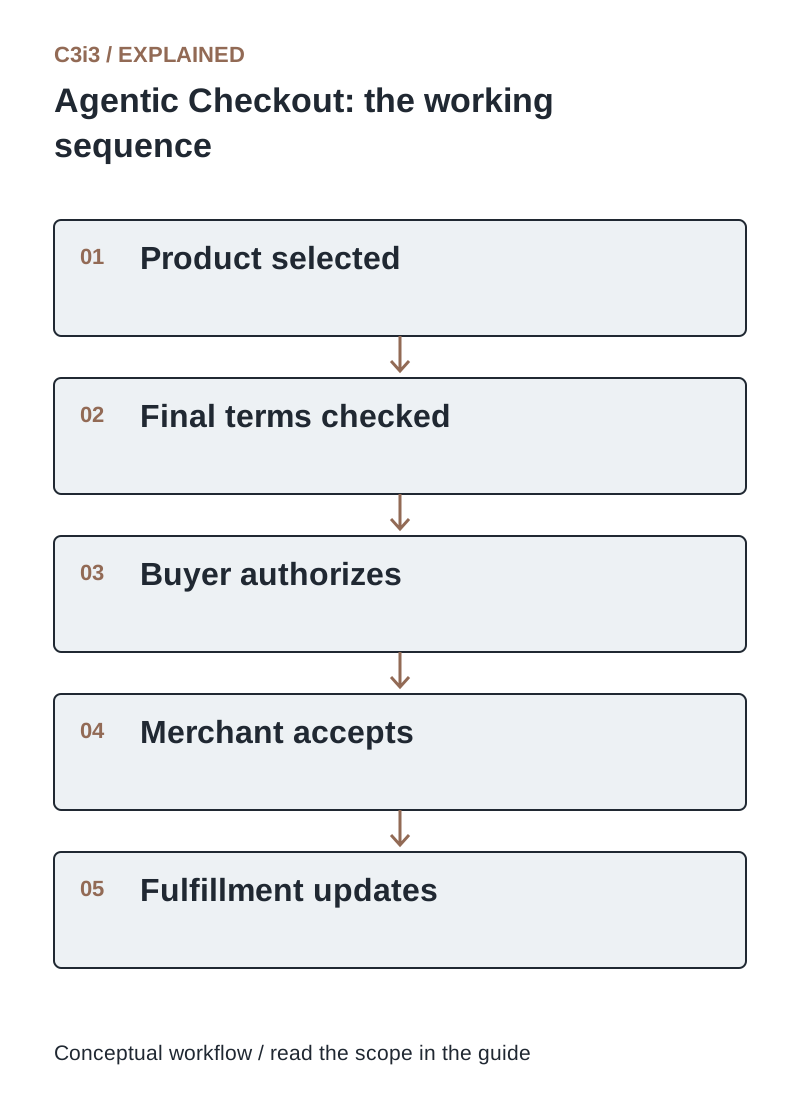
The sequence is: Product selected. Then Final terms checked. Then Buyer authorizes. Then Merchant accepts. Then Fulfillment updates. Each handoff needs the scope and conditions described in this guide.
Can an AI assistant purchase without the buyer reviewing the order?
That depends on the supported authorization model and platform. Do not infer unlimited purchasing authority from a chat message or stored payment method. The selected integration must define what the customer approved and how that approval relates to the final transaction.
For example, UCP’s checkout documentation describes a trusted user interface for finalization unless a supported mandates extension changes the authorization path. A business project should follow its actual platform contract and approved implementation. Test changed totals, ambiguous instructions and expired sessions. The buyer needs an understandable outcome when the requested action cannot be completed under the existing approval.
What happens when checkout times out or receives the same request twice?
A timeout creates uncertainty: the client may not know whether the merchant accepted the order. The recovery path should look up the original transaction before attempting another purchase. Use stable request identifiers and the duplicate-prevention mechanisms defined by the integration.
Test repeated submissions, delayed payment responses and an interrupted return to the shopping interface. Keep the merchant order ID and payment reference connected, with sensitive payment details handled by the appropriate provider. A retry that creates a second order is a business defect even if both API calls technically succeeded. Give support staff a documented investigation path.
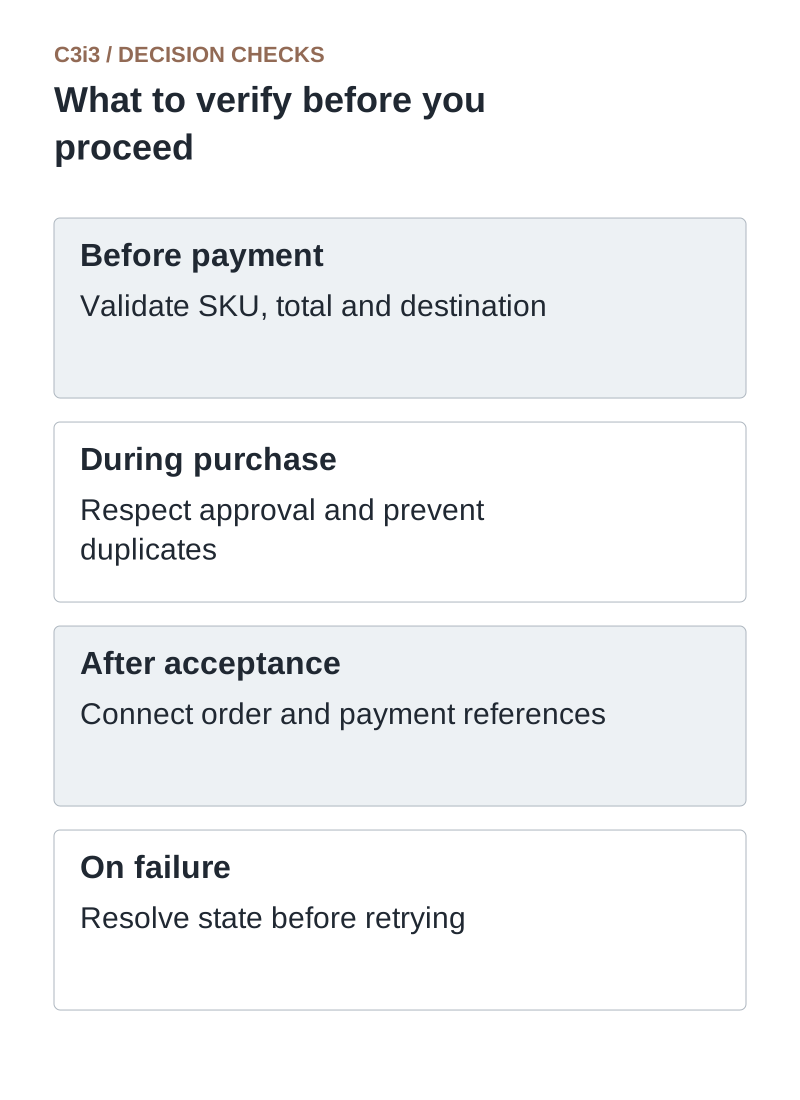
Before payment: Validate SKU, total and destination. During purchase: Respect approval and prevent duplicates. After acceptance: Connect order and payment references. On failure: Resolve state before retrying.
Who handles confirmation, shipping updates, cancellations and returns?
The merchant needs a defined post-purchase process for every accepted order. Confirm what was purchased and provide an order reference. Connect fulfillment updates to the same record, and show where buyers can request help. A channel integration should not create orders that the support team cannot find.
Google’s UCP implementation overview includes order lifecycle responsibilities for its native checkout path. Scope those responsibilities alongside the purchase flow. Test a partial fulfillment, an unavailable item after acceptance and a cancellation request using the provider’s supported procedures. Successful payment is only one part of a successful customer experience.
Which acceptance tests prove the checkout is ready?
Use a matrix of ordinary purchases and exceptions. Include a changed price, unsupported destination, insufficient inventory, declined payment, repeated final submission and interrupted session. For each case, verify the buyer-facing message and merchant-side record.
Measure accepted orders, duplicate orders, unresolved payment states, cancellation handling and support resolution. Establish the release decision before testing. If the team cannot reconcile a transaction, hold that path while resolving the defect. A polished conversation can make an incomplete checkout feel convincing, which is precisely why independent order verification matters.
Which transaction failures need different recovery paths?
Use these distinctions when reviewing your own workflow.
| Observed condition | Check first | Recovery objective |
|---|---|---|
| No response after purchase | Existing order and payment references | Resolve state before retrying |
| Price or stock changed | Current merchant offer | Obtain required review of changed terms |
| Unsupported request | Documented channel limitations | Return the buyer to a supported route |
How would this work in a practical example?
Illustrative example: A buyer approves a replacement component, but the final request times out. The agent checks the existing transaction using its stable reference and finds an accepted order. It shows that order instead of initiating a second payment. The test passes only when the customer receives the right status and the merchant has exactly one corresponding order.
Key takeaways
- Before payment: Validate SKU, total and destination.
- During purchase: Respect approval and prevent duplicates.
- After acceptance: Connect order and payment references.
- On failure: Resolve state before retrying.
Frequently asked questions
Is payment authorization the same as order confirmation?
No. Payment and order systems can have different states. Confirm the merchant accepted the order and that the associated payment state is consistent.
Can the assistant silently substitute a product?
The buying flow should follow the customer’s supported approval and merchant rules. Material changes need the required review rather than an assumed substitution.
What should the buyer see after a failure?
A clear status and safe next step, such as checking an existing order or continuing through the merchant’s supported checkout. Avoid an ambiguous instruction to pay again.
Sources and editorial method
Primary documentation checked November 20, 2026. Linked vendor materials establish stated capabilities and announcements; they do not establish independently tested performance at your business. The workflows, comparisons and illustrative examples are C3i3 editorial analysis.
- Universal Commerce Protocol: official documentation
The open standard and its documented capabilities. Platform support must be checked separately.
- Google: UCP implementation overview
Platform integration paths and approval requirements. Feature support is distinct from the full open specification.
- UCP: checkout capability specification
Checkout state, authorization and supported transaction behavior; use the version selected for an integration.
Plan a clear buying journey for your product catalog.

C3i3 helps product businesses connect clear websites, useful content and practical customer workflows. Explore ecommerce development and discuss the customer task you want to improve.