








































In this article
Your sales team receives the same part numbers and reorder requests every week. Customers want an easier way to buy, yet the catalog also contains configurable products, negotiated prices and orders that need review. B2B ecommerce works when the website reflects those distinctions. This guide explains how to choose the first buying workflow and connect it to the people who actually fulfill the order.
How is B2B ecommerce different from a consumer online store?
Business buyers may purchase on behalf of a company, ship to several locations and work under account-specific prices or approval rules. They often know a part number and need a fast reorder, rather than a lifestyle browsing experience. The website must recognize the buying organization and the user’s authority.
Map the company, purchasing location, contacts, price rules and payment terms before choosing features. Shopify’s B2B feature documentation illustrates these as separate capabilities. Treat it as an example of platform structure, not a recommendation that every distributor needs the same platform or plan.
Which products should offer checkout, a configurator or an RFQ?
Offer direct checkout when the item, selling price, fulfillment conditions and buyer eligibility can be established reliably. Use a configurator when buyers need guided choices governed by maintained compatibility rules. Use an RFQ when engineering review, drawings or project-specific terms determine the offer.
A single business may need all three routes. Label them clearly on product pages so customers know whether they are ordering, preparing a configuration or requesting a quotation. Do not make a quote submission look like an accepted order. Route uncertain cases to the appropriate sales or technical owner with the information already collected.
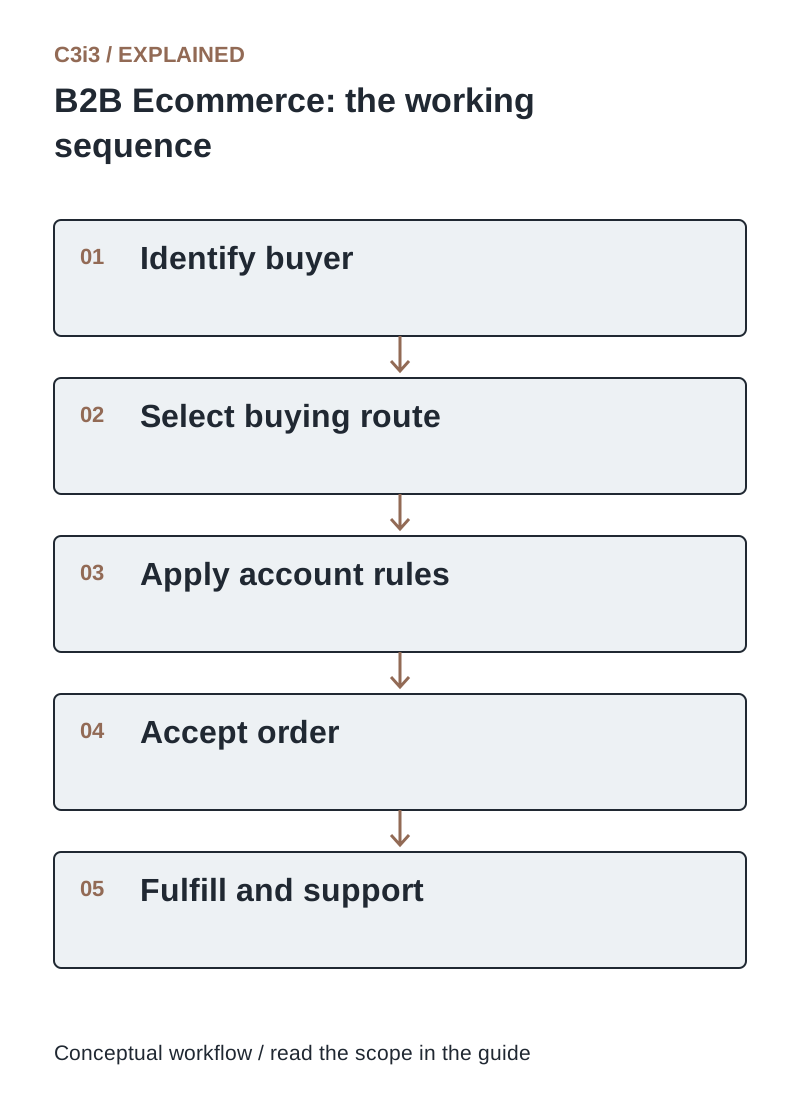
The sequence is: Identify buyer. Then Select buying route. Then Apply account rules. Then Accept order. Then Fulfill and support. Each handoff needs the scope and conditions described in this guide.
What data must be ready before customers can order?
Prepare product identifiers, descriptions, units of measure, pack quantities, supported substitutions and availability rules. Connect approved account pricing and payment terms to the correct company location. A price per carton should never appear as though it were a price per individual component.
Document which system owns each fact: the product catalog, enterprise resource planning system, warehouse system or commerce platform. Decide how conflicts are resolved and how stale data is identified. Begin with a small clean catalog rather than importing every incomplete legacy record. Test one product from search through fulfillment before multiplying the pattern.
How should online orders connect to sales, finance and fulfillment?
Define the order states and handoffs together. An online submission might be accepted immediately or held for review, depending on the business rules. The customer-facing wording must match that state. Sales needs visibility without manually rekeying every routine order.
Finance should validate how payment terms, credit review and tax treatment are applied. Fulfillment should confirm units, shipping locations and special handling. Test a revised order, an unavailable item and a duplicate submission. If an integration fails, the team needs a visible queue and a recovery owner. Silent failures turn convenience for the buyer into hidden work for staff.
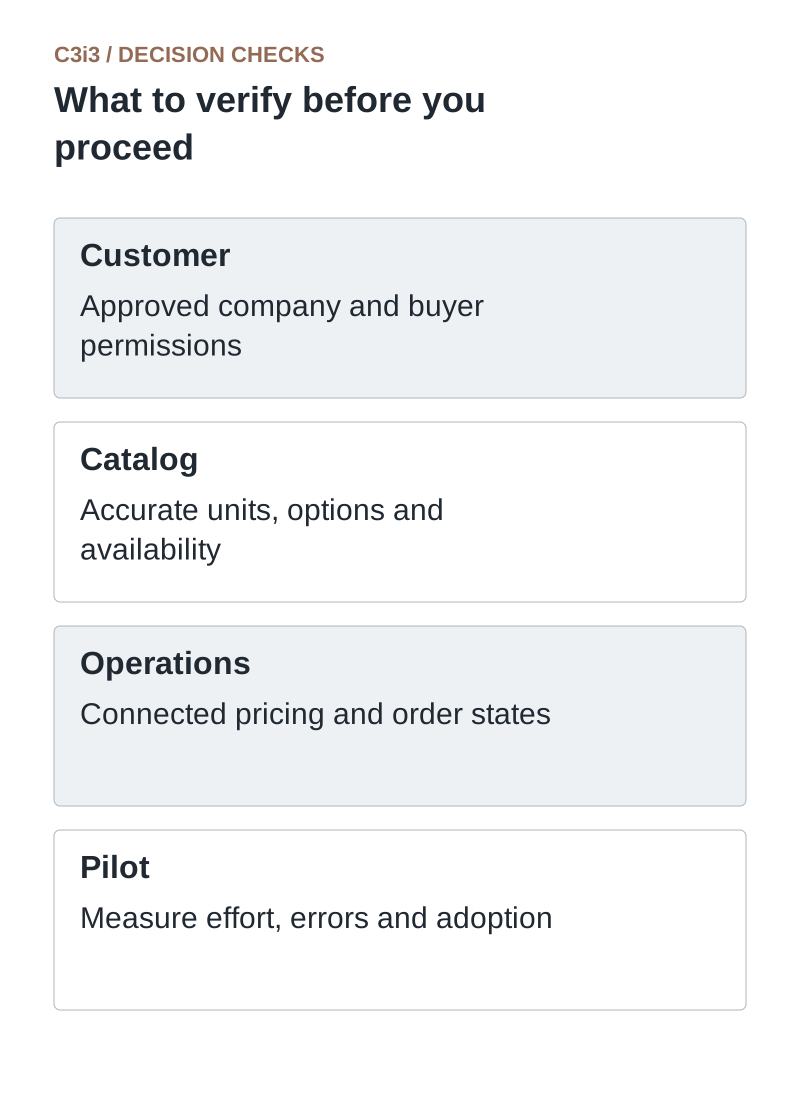
Customer: Approved company and buyer permissions. Catalog: Accurate units, options and availability. Operations: Connected pricing and order states. Pilot: Measure effort, errors and adoption.
What should an initial B2B ecommerce release include?
Start with approved buyers, a focused catalog, account access, clear product search, order review and a dependable confirmation process. Add saved lists or order-history reordering when those directly support the chosen task. Include a straightforward way to reach a person when the order falls outside the supported path.
Invite a small customer group and observe real attempts with their permission. Note where they leave the portal, email sales or misunderstand a unit. Correct those points before adding more features. A successful first release makes a particular buying job easier; it does not require replacing every sales conversation.
How do you measure whether B2B ecommerce reduces customer effort?
Measure completed eligible orders, ordering errors, time to accepted order, support contacts and staff handling time. Compare the same customer task before and after launch where possible. Track adoption among invited accounts rather than using all website visitors as the denominator.
Retain a feedback loop with sales. An online order that requires three clarification emails may need better product or account data. Review gross margin and fulfillment quality alongside online revenue. Moving an existing order online is useful when it improves the process, but it should not automatically be reported as incremental business growth.
How should manufacturers compare B2B ecommerce platforms?
Compare platforms against the customer tasks and account rules you have documented. Ask each provider to demonstrate one real pricing rule, one company-location permission and one exception that matters to your business. Use the same scenarios for every option so a polished generic demo does not dominate the comparison.
Review product-data ownership, integrations, exports, support responsibilities and the effort required to change commercial rules. Confirm current plan restrictions directly with the provider. Do not assume that a feature label includes your particular contract-pricing or approval model. A platform is a fit when its supported behavior meets the scoped requirements at an acceptable operating cost.
How do you expand B2B ordering after the first release?
Expand by a proven buying pattern rather than importing every customer and product at once. If standard-part reordering works, add another comparable product family or account group. Reassess when a new group introduces different tax, payment, shipping or approval requirements.
Keep sales involved in the rollout and preserve a recovery route for unsupported orders. Review customer effort and operational correction work at each stage. Update onboarding, support instructions and ownership as the scope grows. A sequence of clearly accepted releases is easier to operate than a large launch whose outstanding exceptions are hidden in individual employees’ inboxes.
Which buying route fits each product?
Use these distinctions when reviewing your own workflow.
| Product situation | Primary route | Handoff requirement |
|---|---|---|
| Known item with current terms | Direct order | Accepted order and fulfillment reference |
| Rule-governed options | Configurator | Approved configuration and rule version |
| Project-specific requirements | RFQ | Requirements, review owner and request reference |
How would this work in a practical example?
Illustrative example: A distributor begins with 150 routinely reordered parts for ten existing accounts. Standard replacement items support ordering, engineered assemblies use an RFQ and option-heavy equipment uses a configurator. The team evaluates accepted-order time and clarification requests by route. This reveals whether the website is simplifying work without pretending every catalog item has become a standard retail purchase.
Key takeaways
- Customer: Approved company and buyer permissions.
- Catalog: Accurate units, options and availability.
- Operations: Connected pricing and order states.
- Pilot: Measure effort, errors and adoption.
Frequently asked questions
Can B2B ecommerce work with negotiated pricing?
Yes, when the platform and integrations can apply the correct account or location pricing securely. Verify support for your actual pricing rules before committing.
Do we have to replace the ERP?
Not necessarily. Define the data and order connections first. The existing ERP may remain the operational authority while a commerce layer supports buyers.
Should every product have a Buy button?
No. Custom products and uncertain applications may need configuration or technical quotation rather than an immediate purchase.
Sources and editorial method
Primary documentation checked November 20, 2026. Linked vendor materials establish stated capabilities and announcements; they do not establish independently tested performance at your business. The workflows, comparisons and illustrative examples are C3i3 editorial analysis.
- Shopify: B2B feature overview
A concrete example of business-account commerce capabilities. Verify current plan and implementation limits.
- Shopify: companies, locations and customers
An implementation example for separating the company, location and purchasing contact.
Build a better ordering route for your business customers.

C3i3 helps product businesses connect clear websites, useful content and practical customer workflows. Explore ecommerce development and discuss the customer task you want to improve.