








































In this article
A buyer chooses a base unit, voltage, mounting arrangement and accessory kit. Every option looks available on its own, yet the combination may be unsupported. A useful configurator makes those relationships understandable before the customer asks for a quote or places an order.
When is a configurator more useful than ordinary product filters?
Use filters to narrow existing products by independent attributes. Use a configurator when selections change which later choices are valid or create a specific buildable combination. The distinction is about product logic, not whether the interface contains an animated model.
Start with the decision sequence a product specialist already follows. Identify required inputs, conditional options and cases that require review. A small rules-based form can be more useful than an elaborate visual tool when the buyer mainly needs to establish compatibility. Keep engineering authority with the maintained product rules and responsible specialists.
Who should own equipment compatibility rules?
Assign a product or engineering owner who can approve the rules and their revisions. Record the source for each relationship: a controlled specification, approved bill of materials or documented application rule. Do not create compatibility claims by guessing from product descriptions.
Version the rule set and preserve the version used for a saved configuration. When an option is discontinued or a limitation changes, determine whether old saved configurations need review. Give commercial teams a clear way to request changes without directly overriding engineering logic. A configurator is a maintained product system, not a one-time website decoration.
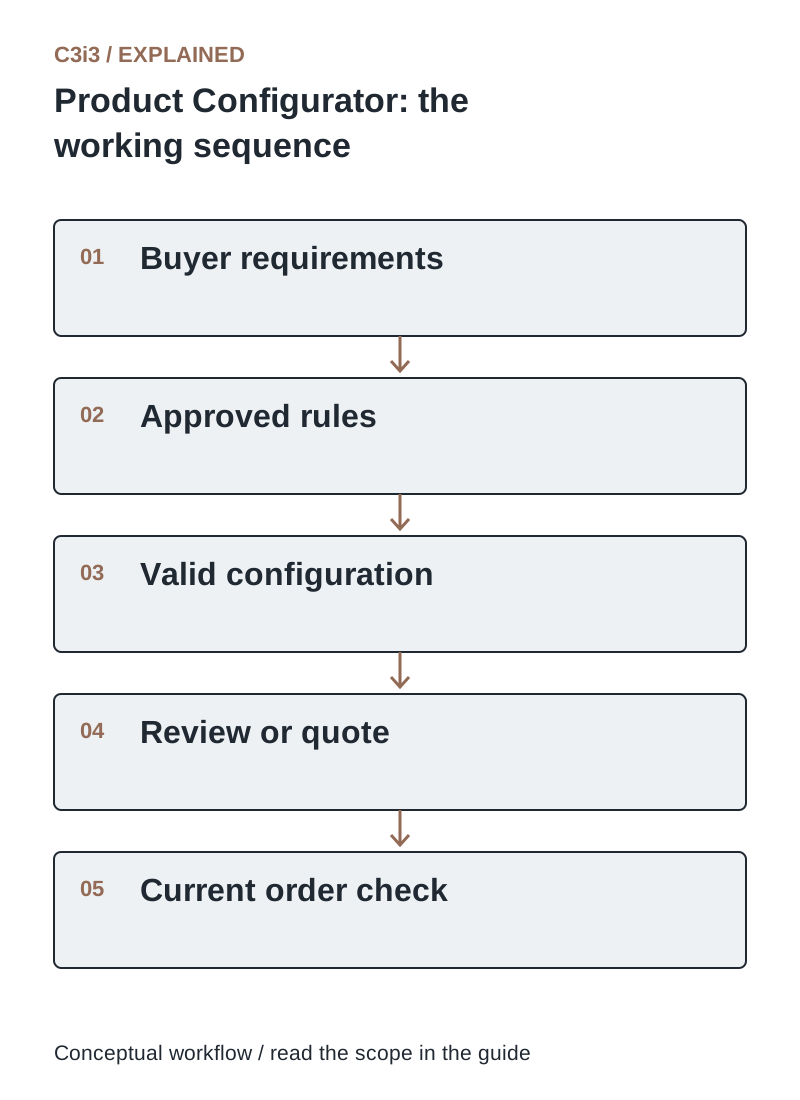
The sequence is: Buyer requirements. Then Approved rules. Then Valid configuration. Then Review or quote. Then Current order check. Each handoff needs the scope and conditions described in this guide.
How should the interface explain an incompatible selection?
Tell the buyer what conflicts and provide a supported next step. For example, explain that a chosen enclosure is unavailable with a particular connector, then show valid alternatives or an application-review route. Avoid a generic “invalid selection” message that forces the buyer to restart.
Keep units visible and state whether a choice is required or optional. Let buyers move backward without losing unrelated answers. Provide a readable summary that can be reviewed by someone who did not operate the configurator. An accessible text interface should support the same decisions as any visual preview.
What should a completed configuration contain?
Include the selected base product, option identifiers, quantities, relevant units, rule version and unresolved questions. Give the configuration a stable reference so the buyer and sales team discuss the same result. A screenshot alone is poor handoff data.
Define whether completion creates a quote request, a reviewable draft or an orderable item. Clearly distinguish a budget estimate from a final selling price. Connect the resulting configuration to the appropriate commerce or quotation workflow, with account permissions applied. Keep unnecessary confidential project information out of public share links.
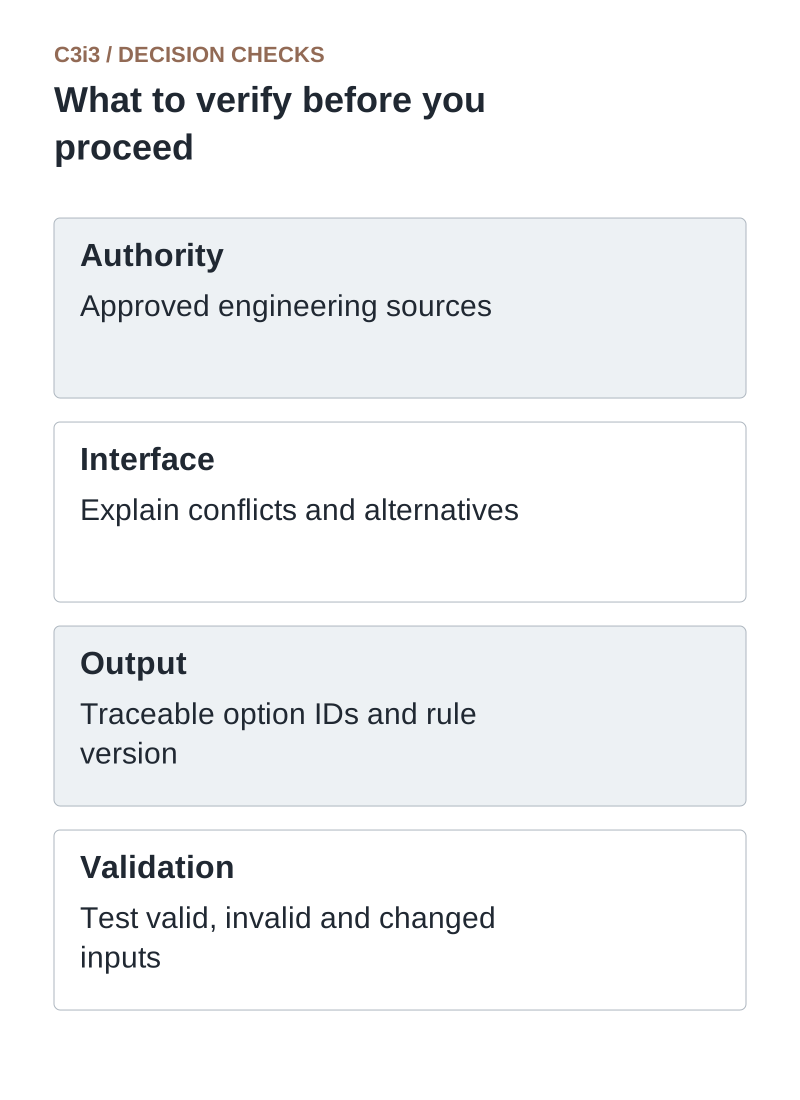
Authority: Approved engineering sources. Interface: Explain conflicts and alternatives. Output: Traceable option IDs and rule version. Validation: Test valid, invalid and changed inputs.
How do you test a configurator before buyers use it?
Build a test matrix with valid combinations, prohibited combinations, boundary values and missing inputs. Ask the product owner to approve expected results independently of the interface implementation. Include changes made after an earlier selection and saved configurations reopened after a rules update.
Check whether sales receives the same option identifiers the buyer reviewed. Test mobile use, keyboard operation and recovery from an interrupted session. A visually correct model does not prove the generated bill of materials is correct. Verify the output against the controlled source that determines whether the product can actually be supplied.
What makes a sensible first configurator project?
Choose a product family with valuable recurring questions and a manageable set of documented rules. Begin with the smallest decision path that reduces clarification work. Avoid launching every product family before the rule-maintenance process has been exercised.
Measure completed usable configurations, clarification requests, rejected combinations and time to quote. Review where buyers abandon the process or request help. If necessary information cannot be expressed reliably in the form, provide a technical review route. The project succeeds when it produces a clearer, supportable buying decision.
When should configuration stop for review?
Use these distinctions when reviewing your own workflow.
| Input state | System behavior | Responsible decision |
|---|---|---|
| Approved combination | Produce a traceable configuration | Buyer reviews supported choices |
| Known incompatibility | Explain the conflict and valid alternatives | Product rules control the selection |
| Unresolved application | Preserve answers and request technical review | Qualified specialist assesses the requirement |
How would this work in a practical example?
Illustrative example: An equipment brand offers three enclosure sizes and two mounting kits. One kit is approved only for the larger enclosures. The configurator explains that restriction when the smaller enclosure is selected and retains the buyer’s other answers. Sales receives the approved option codes and a configuration reference, rather than an ambiguous image labeled “custom unit.”
Key takeaways
- Authority: Approved engineering sources.
- Interface: Explain conflicts and alternatives.
- Output: Traceable option IDs and rule version.
- Validation: Test valid, invalid and changed inputs.
Frequently asked questions
Does a configurator need 3D?
No. Use 3D when it helps buyers understand shape, fit or layout. Text, diagrams and conditional fields may be sufficient for compatibility decisions.
Can AI invent the compatibility rules?
Use approved product documentation and engineering review as the authority. AI may help organize information, but unsupported inferred compatibility should not become a selling rule.
Can a saved configuration become outdated?
Yes. Store its rule version and revalidate products, availability and terms before converting it into a current offer.
Sources and editorial method
Primary documentation checked November 20, 2026. Linked vendor materials establish stated capabilities and announcements; they do not establish independently tested performance at your business. The workflows, comparisons and illustrative examples are C3i3 editorial analysis.
- Shopify: B2B feature overview
A concrete example of business-account commerce capabilities. Verify current plan and implementation limits.
- OWASP: authorization guidance
Least privilege and permission checks for protected resources and account-specific information.
Build a better ordering route for your business customers.

C3i3 helps product businesses connect clear websites, useful content and practical customer workflows. Explore ecommerce development and discuss the customer task you want to improve.