








































In this article
Buying and leasing are ways to fund an operating plan, not evidence that the plan works. A cleaning robot that cannot handle the agreed task will remain a poor fit under either payment structure. Once your site evaluation supports a practical scope, the next question is how to arrange the commitment and responsibilities around that scope. This guide provides purchasing questions for comparing proposals. Product rental, equipment finance, leasing and robotics-as-a-service can package different obligations. Read the actual documents with your finance and purchasing advisers instead of deciding from the label attached to a sales offer.
What is the difference between buying, leasing and a service-based offer?
A purchase generally centers the comparison on an acquired asset and the services needed to operate it. A lease or rental centers it on access to equipment under defined terms. A robotics-as-a-service proposal may combine equipment, software and support, but the name does not tell you precisely what is included. Ask the supplier to map the machine, software, maintenance and operating responsibilities onto the proposal you will actually sign.
Identify every counterparty. The organization selling a robot may not own leased equipment, provide finance or deliver technical service. Ask who receives payments, who handles equipment faults and who controls software access. Have your advisers determine the agreement's financial and contractual treatment; marketing terminology is not enough. Keep the operational scope from the cleaning robot buyers guide unchanged while comparing structures. Otherwise a simpler payment comparison can conceal different equipment or cleaning obligations.
How should you compare cash flow and the full commitment?
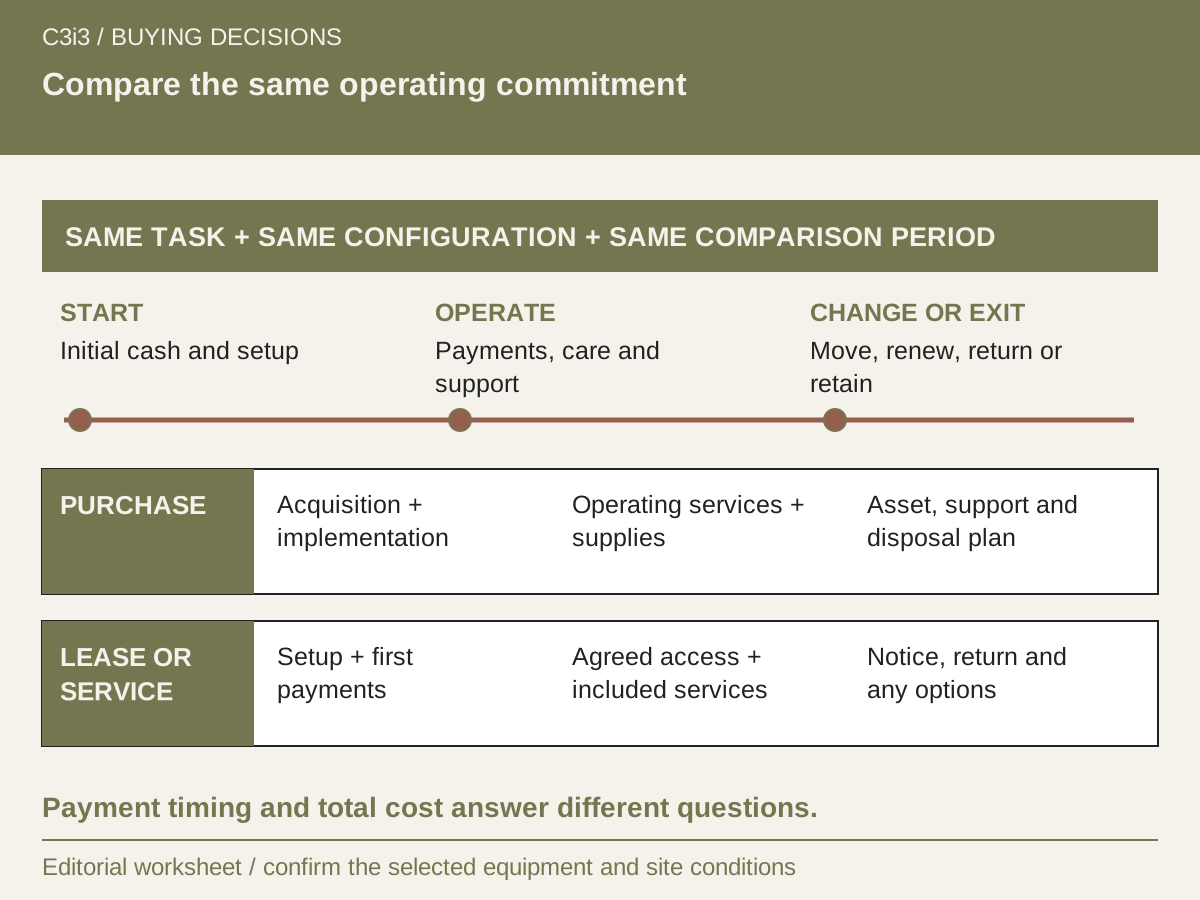
Prepare a schedule that shows initial cash, periodic payments, required services, supplies and identified end-of-term charges. Use a common comparison period and the same expected workload. Ask what is fixed, what can change and which price assumptions expire before your planned decision date. A payment schedule should be clear enough for your finance team to evaluate without reconstructing the sales conversation.
For a purchase, identify the funding cost and any residual-value assumption separately from operating costs. For a lease, identify deposits, payment timing, escalation rules and options at the end. Do not assume an asset will retain a particular resale value or a service plan will keep its opening price. Use documented proposals and finance-approved assumptions. The complete quote guide supplies a common set of cost categories so one structure does not look cheaper merely because it omits a line.
Who carries maintenance, downtime and replacement responsibilities?
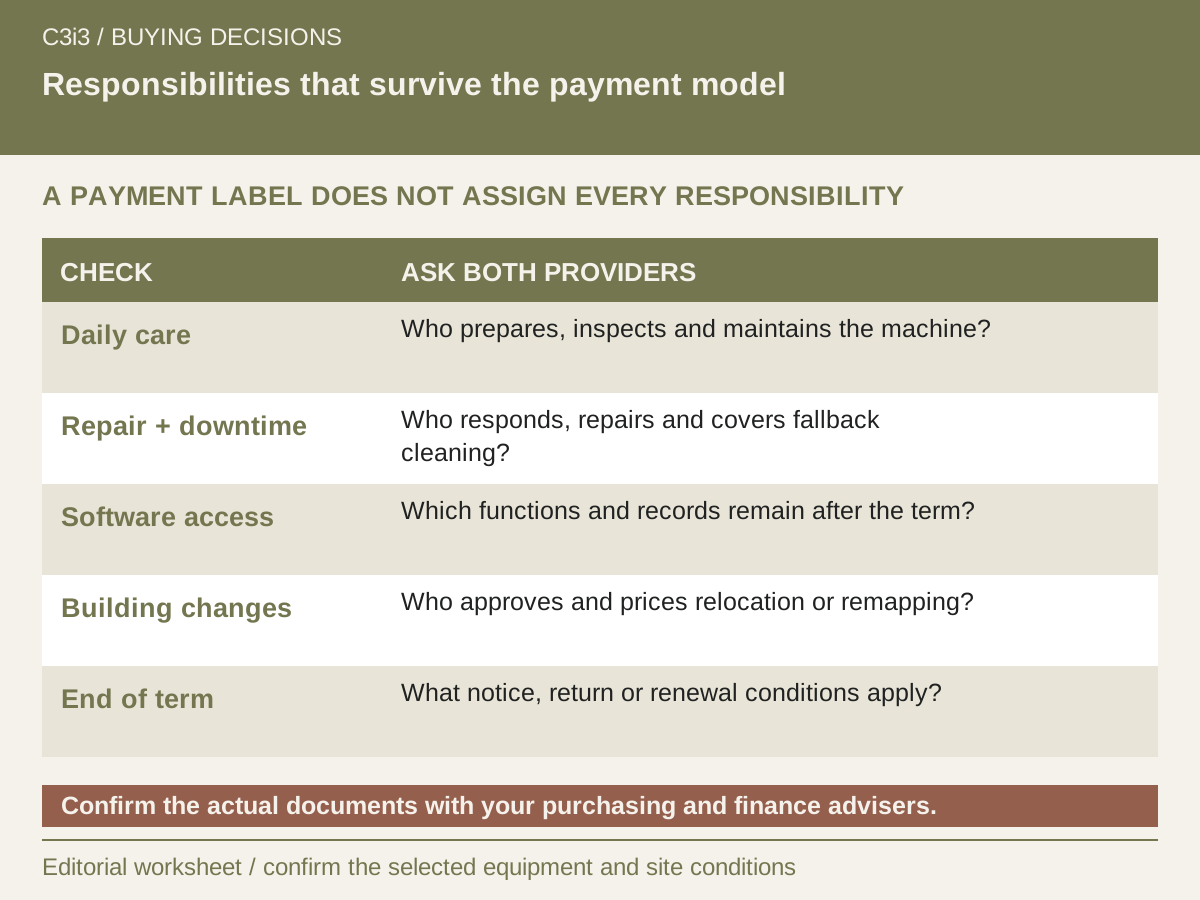
Ownership and support are separate questions. A purchased robot can have a service plan, while a leased robot can still leave routine care or particular repairs with the customer. Ask which parts, travel, labor, consumables and training are included. Ask what happens when a fault persists and whether a replacement machine is available under the proposed terms. Avoid assuming the word “service” means the floor-cleaning outcome is guaranteed.
Identify the fallback operating plan for every option. If your team must clean manually during downtime, record the people and equipment needed to do that. If the provider promises replacement or remote support, ask for the exact scope and escalation procedure. Brain Corp's program guidance reinforces the need for operational ownership; a payment arrangement does not eliminate that need. Compare the responsibilities in writing, then assign your internal tasks to a trained owner and backup.
What happens if your building or cleaning requirements change?
Consider changes you can reasonably anticipate: a tenancy ending, a floor plan being rearranged, a different cleaning contractor or additional locations. Ask whether the equipment can be relocated, whether permission is required and who pays for deployment work at the new site. Confirm that a larger or different task would receive a new assessment rather than inheriting the original performance assumptions.
Also ask how software and hardware changes are handled. An upgrade promise needs a defined scope, timing and commercial condition. A newer model appearing during a lease does not automatically give you a replacement. A purchased asset may remain useful without every new feature, but support and compatibility need attention. Record what is a firm commitment and what is only a possible future option. If operational flexibility is a major reason for leasing, identify the exact written provision that creates that flexibility.
Which end-of-term and exit questions belong in the evaluation?
Ask for the timeline and process for renewal, return, purchase options and notice. Clarify equipment condition requirements, collection arrangements, outstanding repairs and the treatment of accessories. Ask what happens to maps, cleaning records and administrator access if the relationship ends. Your organization should understand what information it needs to keep and what the provider can make available before the final month of an agreement.
Do not assume a short sales summary settles these obligations. Ask the responsible advisers to review the documents and identify material conditions in the comparison worksheet. Keep a copy of the configuration and service schedule beside the commercial agreement so the promised deployment is not separated from its financing. These are procurement questions, not a substitute for professional interpretation of a specific contract. If the offer cannot explain the practical exit process, treat that uncertainty as a purchasing issue that needs resolution before approval.
When might each arrangement fit your operating plan?
A purchase may fit when the task is stable, the organization can fund the initial commitment and the team can manage the asset and required support. An access-based arrangement may fit when cash planning, bundled service or a specifically documented change option matters more. Neither preference should override evidence from the site assessment. An arrangement that funds an unsuitable machine efficiently is still unsuitable.
Document why the preferred structure suits the building and which assumptions could change the answer. Use the ROI and total-cost guide to show operating outcomes separately from the timing of payments. Set a review point for actual use, intervention burden and service quality. If the operational case is uncertain, consider a bounded assessment or trial with clear terms before a broader commitment. Paying in smaller installments should not become a reason to skip validation.
Which contract conditions change the buy-or-lease decision?
| Decision factor | Purchase proposal | Lease or service proposal |
|---|---|---|
| Initial cash | Acquisition and implementation funding | Deposit, setup and first payments |
| Operating support | Separate or bundled service terms | Verify exactly which services are bundled |
| Ownership | Confirm asset and software rights | Confirm owner and permitted use |
| Building changes | Relocation and reassessment expense | Permission, charges and limits |
| Downtime | Repair and manual fallback plan | Replacement and response commitments |
| End of term | Support renewal and disposal plan | Notice, return and any purchase option |
How would this work in a hypothetical building?
Hypothetical example: a tenant expects to occupy an office floor for a limited period. A lease sounds attractive because the initial cash requirement is smaller. Before selecting it, the buyer asks what happens if the tenancy ends or the equipment moves to another building. The proposal turns out to need an additional relocation assessment and a separate agreement about continued service.
The purchase alternative also has costs that extend beyond the machine, including support and a possible later move. Finance compares the full commitments and payment timing using the same operating scope. Facilities confirms whether either option can support the anticipated transition.
The buyer chooses only after those conditions are understood. The exercise does not establish that leasing is always flexible or buying always cheaper. It shows why a building's expected life and changes belong in the comparison alongside the payment amount.
Key takeaways
- Validate the cleaning task before choosing how to fund it.
- Compare written obligations rather than financing labels.
- Separate ownership from service and downtime coverage.
- Check relocation, upgrade and exit conditions explicitly.
- Evaluate total commitment and cash timing as different questions.
Frequently asked questions
Is robotics-as-a-service the same as leasing?
Not necessarily. An offer may bundle equipment access, software, service or other elements in different ways. Compare the actual equipment, payment and responsibility schedules. Ask the provider and your advisers to explain the proposed agreement rather than relying on the product label.
Does leasing include every repair and consumable?
Only if the actual proposal includes them. Routine care, wear items, travel, damage, supplies and replacement equipment can have different treatment. Request an explicit inclusion-and-exclusion schedule and a clear process for handling a fault that interrupts cleaning.
Can I move a leased cleaning robot to another building?
That depends on the agreement, equipment and receiving site. Ask about permission, reassessment, remapping, service coverage and charges. A successful deployment in one building does not establish that a different floor plan or operating environment is suitable.
Sources and editorial method
Prepared from linked primary documentation checked November 20, 2026. Vendor documentation establishes stated features and operating conditions. Comparisons and worksheets are C3i3 editorial analysis; worked examples are hypothetical.
- Brain Corp: deploying a robotics cleaning program
Supplier guidance on program ownership, operator training and usage review. C3i3 procurement worksheets are independent editorial analysis.
- Tennant: robotic floor-cleaning machines
Manufacturer category guidance for scrubbers, sweepers and routine care. Published capabilities do not establish performance at a particular building.
- Pudu Academy: CC1 Operation Guide V6.0
Model-specific operating and deployment context, including environmental limitations and optional workstations. The selected machine needs its own current documentation.
Turn your building requirements into a clear supplier brief.

Describe the floor types, operating window, site constraints and buying stage. C3i3 can help organize the evaluation brief and explain technical offerings clearly. Equipment selection, site assessment and installation remain with qualified suppliers and responsible site personnel.
Explore ai workflow planning or tell us about your project.