









































In this article
The most expensive omission in a cleaning robot quote is often a task nobody agreed to include. A proposal may show a machine and a monthly payment while leaving route preparation, docking work, subscriptions or downtime coverage outside the apparent price. Buyers need a scope they can compare before they need a headline number. This guide shows how to request an itemized commercial cleaning robot quote. It does not supply a universal market price or promise a standard payback period. The right budget depends on a defined configuration, building and service arrangement, which belong in the same proposal.
What must you define before asking for a cleaning robot price?
Send suppliers a brief that identifies eligible zones, floor materials, required cleaning frequency and the available operating window. Include the proposed station location and known access constraints. If those details are not settled, request a preliminary budget with an explicit list of assumptions. Do not compare an initial estimate for an open warehouse against a fully scoped offer for a complicated occupied building.
Ask each bidder to identify exactly what its price covers. A configuration schedule should name the machine, accessories, operating software and included services. Where a task requires an option, include that option in the priced scope. Pudu's CC1 product information, for example, distinguishes optional workstation equipment. That illustrates why “robot included” is not enough to establish an autonomous daily process. Use the main buyers guide to establish the operational brief before comparing commercial details.
Which one-time expenses belong beside the equipment price?
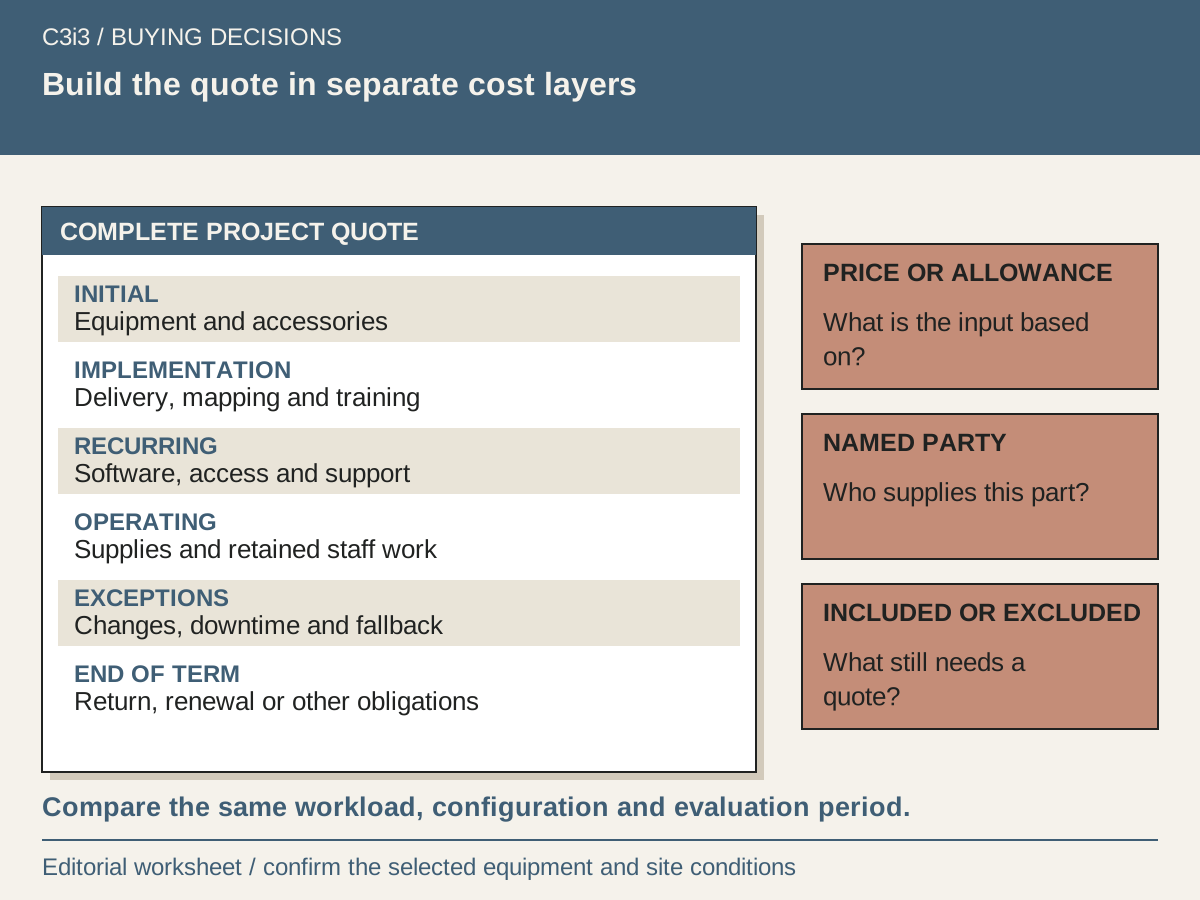
Ask about delivery, unloading, commissioning, site mapping, route configuration and initial training. Include any agreed trial fee and clarify whether it is credited if you proceed. Building preparation may involve another responsible contractor; ask the supplier to identify dependencies rather than assuming its equipment team includes every required site task. Request a named party for each item, a price or estimate and a clear acceptance point.
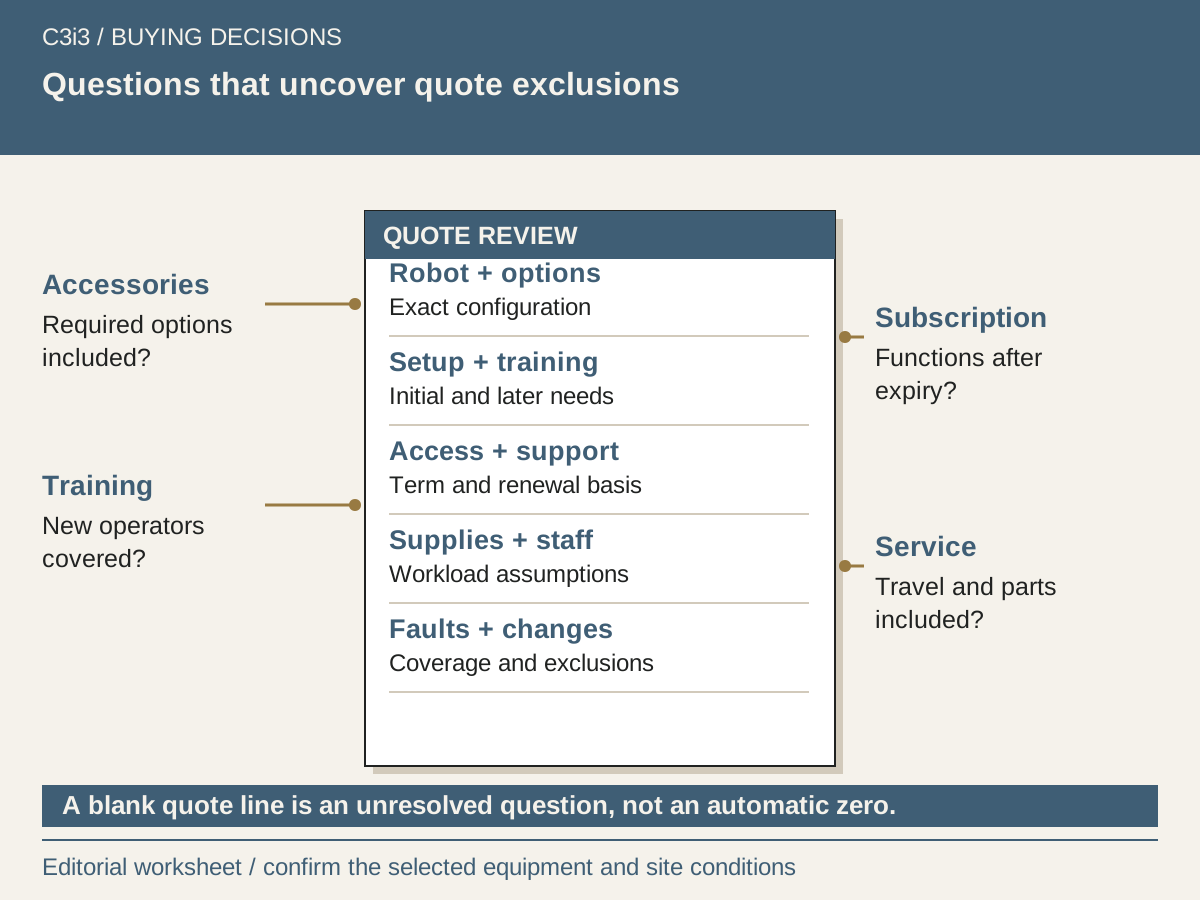
Separate initial staff instruction from later retraining. A deployment can look inexpensive if the first operator learns everything from a visiting specialist but shift changes are left unsupported. Include training materials, administrator access and an agreed handover where relevant. If a supplier says an item is unnecessary, record the reason. A visible zero with a scope note is easier to compare than a blank cell that could mean included, excluded or not yet evaluated. Our site-assessment checklist helps expose these dependencies.
What recurring charges can make apparently similar quotes different?
Separate equipment finance or rental, software access, connectivity, support and preventive maintenance. Some proposals bundle several items while others split them among different organizations. Ask which services are required for the proposed functions, what the initial term includes and how renewal pricing is determined. Confirm whether a quoted recurring amount changes with the number of machines, locations, users or supported services.
Also ask what happens if a subscription lapses or a contract ends. The important question is the practical effect on the workflow: which functions remain, which stop and what information can be retained. Do not assume a cloud dashboard and the cleaning machine have identical access conditions. Compare only the capabilities included in your proposed arrangement. A service bundle may be useful, but its value needs to be understood through actual tasks and responsibilities rather than a short list of feature names.
Which operating costs remain after a robot starts cleaning?
Build a realistic supplies and human-work schedule. Include cleaning materials, brushes, pads, squeegees, filters and other components relevant to the selected method. Ask for expected replacement assumptions and verify how those assumptions change with floor conditions and usage. Include utilities if they materially affect your comparison. A low consumables estimate should be tied to a workload, not presented as a building-independent allowance.
Record preparation, inspection, tank handling, component care and intervention time that the quoted configuration leaves with your team. Tennant's category guidance lists routine care such as sensor checks and tank or debris handling; the current instructions for the chosen model determine the actual duties. Give those duties a staff owner and schedule. Do not value time reassigned to better cleaning as an automatic reduction in wages. See the ROI guide for that distinction.
What costs appear when operations change or something fails?
Ask how the commercial arrangement handles a moved station, a changed floor layout, an additional shift or a second building. A successful initial deployment does not establish that every later change is included. Request the charge basis for remapping, additional training, relocation and new integrations where relevant. If a rate is not yet known, identify who will supply it before approval rather than silently assigning no cost.
Build a fallback allowance for cleaning that must continue during faults or planned service. Ask whether the support agreement includes a replacement machine, delivery, labor, travel and particular parts. Distinguish a promised response from restoration of the cleaning task. Record which costs need preauthorization and who can approve them outside ordinary office hours. A slightly higher support price can be reasonable if it removes an important uncovered responsibility, but the supplier should explain that difference clearly enough for the buyer to evaluate.
How do you turn quotes into a fair buying decision?
Use a common comparison period and describe the same scope for every bidder. Keep cash paid up front, recurring cash commitments and estimated operating expense in separate lines before totaling them. Record taxes, fees and end-of-term conditions only as supported by the actual proposal and advice from your purchasing or finance team. Avoid treating an indicative monthly payment as the entire project cost.
Attach a source to every input: supplier quote, site observation, staff time record or a clearly labeled assumption. Highlight any unresolved item that could change the decision. Ask bidders to revise important exclusions, then compare the revised offers rather than explaining away inconsistent drafts. Review leasing versus buying separately so a financing preference does not hide an operational mismatch. Your final budget should remain understandable if the sales presentation is removed and a colleague reads only the worksheet.
Which costs should appear in a complete cleaning robot quote?
| Cost group | Examples to clarify | Quote question |
|---|---|---|
| Initial equipment | Robot, cleaning assembly and stations | Which exact items are supplied? |
| Implementation | Delivery, mapping and commissioning | Who completes and accepts each task? |
| Recurring access | Software, connectivity and reporting | What is required and how does renewal work? |
| Care and supplies | Parts, consumables and routine staff time | Which workload supports the allowance? |
| Service interruptions | Travel, repairs and fallback cleaning | What is covered and what remains ours? |
| Change and exit | Relocation, retraining and return conditions | What happens when the scope or term changes? |
How would this work in a hypothetical building?
Hypothetical example: a retailer receives one bundled monthly offer and one equipment-purchase proposal. The first looks lower when the team compares only initial cash. The buyer creates a shared scope and discovers that the bundled offer excludes certain consumables while the purchase proposal excludes a reporting subscription and later operator retraining.
The team asks each supplier to price those missing items for the same cleaning zones and comparison period. It then records retained daily care and a fallback plan that apply to both options. These staff tasks do not vanish just because a proposal calls the machine autonomous.
The revised worksheet may favor either bidder. The useful result is that the decision now compares the same work and makes unknowns visible. No example price or savings percentage is needed to expose the difference. The buyer can discuss funding with finance after the operating scope is clear.
Key takeaways
- Compare a complete configuration, not a machine name or payment headline.
- Separate initial, recurring and usage-linked expense.
- Include the human tasks retained by your actual setup.
- Record exclusions, change charges and end-of-term conditions.
- Use the same workload and evaluation period for every bidder.
Frequently asked questions
Can I use a published online price as my project budget?
Use it as an initial reference only when the configuration and terms are clear. A site budget also needs implementation, accessories, support and operating work. Ask the supplier to convert the reference into a proposal for your building before comparing it with another bid.
Should a cleaning robot quote include installation work?
It should identify any required site work and the party responsible, even if another contractor prices that work separately. Ask for explicit dependencies and exclusions. A quote does not need to bundle every task, but the buyer needs the complete scope and expected commitment.
Is the cheapest monthly offer usually the best value?
A lower payment does not establish lower total cost or better operating fit. Compare what is included, the term, support, operating requirements and exit conditions. A payment structure can be evaluated fairly only after the cleaning task and complete configuration are comparable.
Sources and editorial method
Prepared from linked primary documentation checked November 20, 2026. Vendor documentation establishes stated features and operating conditions. Comparisons and worksheets are C3i3 editorial analysis; worked examples are hypothetical.
- Pudu Robotics: PUDU CC1 product information
Manufacturer description of cleaning modes, reporting and separately purchased accessories. Confirm the quoted configuration and current regional support.
- Tennant: robotic floor-cleaning machines
Manufacturer category guidance for scrubbers, sweepers and routine care. Published capabilities do not establish performance at a particular building.
- Pudu Academy: CC1 Operation Guide V6.0
Model-specific operating and deployment context, including environmental limitations and optional workstations. The selected machine needs its own current documentation.
Turn your building requirements into a clear supplier brief.

Describe the floor types, operating window, site constraints and buying stage. C3i3 can help organize the evaluation brief and explain technical offerings clearly. Equipment selection, site assessment and installation remain with qualified suppliers and responsible site personnel.
Explore ai workflow planning or tell us about your project.