









































In this article
A missed call is a business problem, but answering every call is only the beginning of the solution. A useful receptionist must recognize what the caller needs, capture dependable details and deliver the next action your team can actually fulfill. That could be a scheduled consultation, a dispatch request or a callback from the right person. This guide helps small businesses compare services around those outcomes rather than a polished demonstration voice.
Which calls should you ask an AI receptionist to handle?
Begin with a small, representative sample of recent calls, using records your business is authorized to review. Classify the reason for contact, the desired next action and the consequence of an incorrect answer. A business-hours question is different from an existing customer disputing a charge. A prospective customer asking whether you serve a neighborhood is different from asking an agent to approve a repair price. These distinctions tell you where automation can be useful and where it should stop.
Write a short call-purpose inventory before requesting vendor demonstrations. Include new inquiries, existing customer requests, appointment changes, supplier calls, wrong numbers and requests that require a specialist. For each, identify the minimum details a staff member needs and the destination that owns the next step. Review the inventory with the people who answer the phone today. Their exceptions often reveal the important requirements that a generic feature list misses.
Make the first version narrow enough that staff can explain it to a caller. If nobody can describe the supported task and its stopping point in plain language, the supplier brief is not ready.
What should the receptionist be allowed to do?
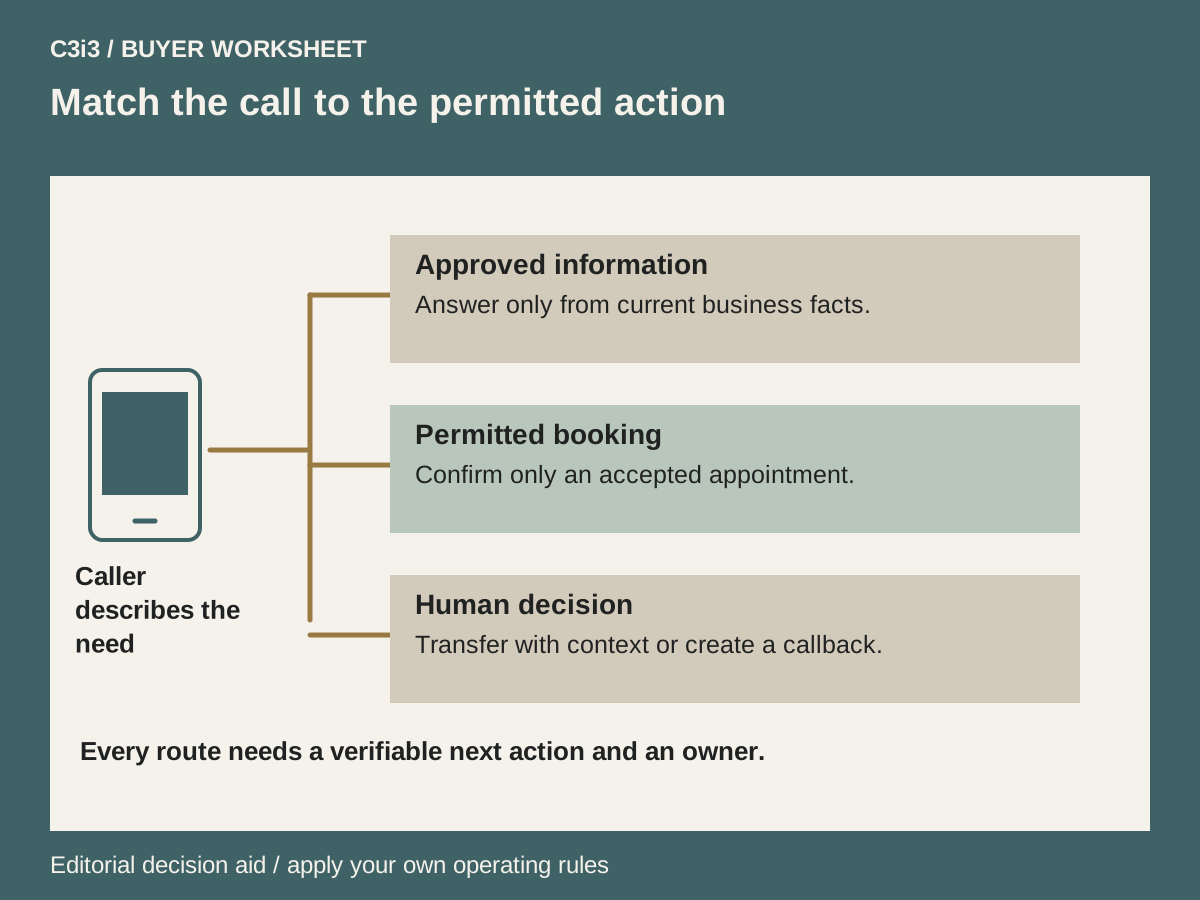
Separate answering a question, taking a request and making a commitment. Explaining your published opening hours is an answer. Recording a preferred appointment time is a request. Confirming an appointment against a live calendar is a commitment. The caller should hear wording that matches the actual result. An unconfirmed request should never be described as a booked visit, and an estimate request should never become an approved quote simply because the voice sounds confident.
Create an approved information sheet with services, coverage areas, opening hours and the exact boundaries of what can be promised. Assign an owner to update it when your operations change. Vendor documentation such as RingCentral: AI Receptionist describes routine answering, routing and scheduling features, but your configuration decides which of those functions is appropriate. Ask the supplier to demonstrate both a permitted action and a deliberately prohibited one. See the demo checklist for practical test cases.
Record an owner and review date for each operational answer. When a service changes, update the receptionist and the public website together so callers do not receive conflicting instructions from different channels.
When does a caller need a person?
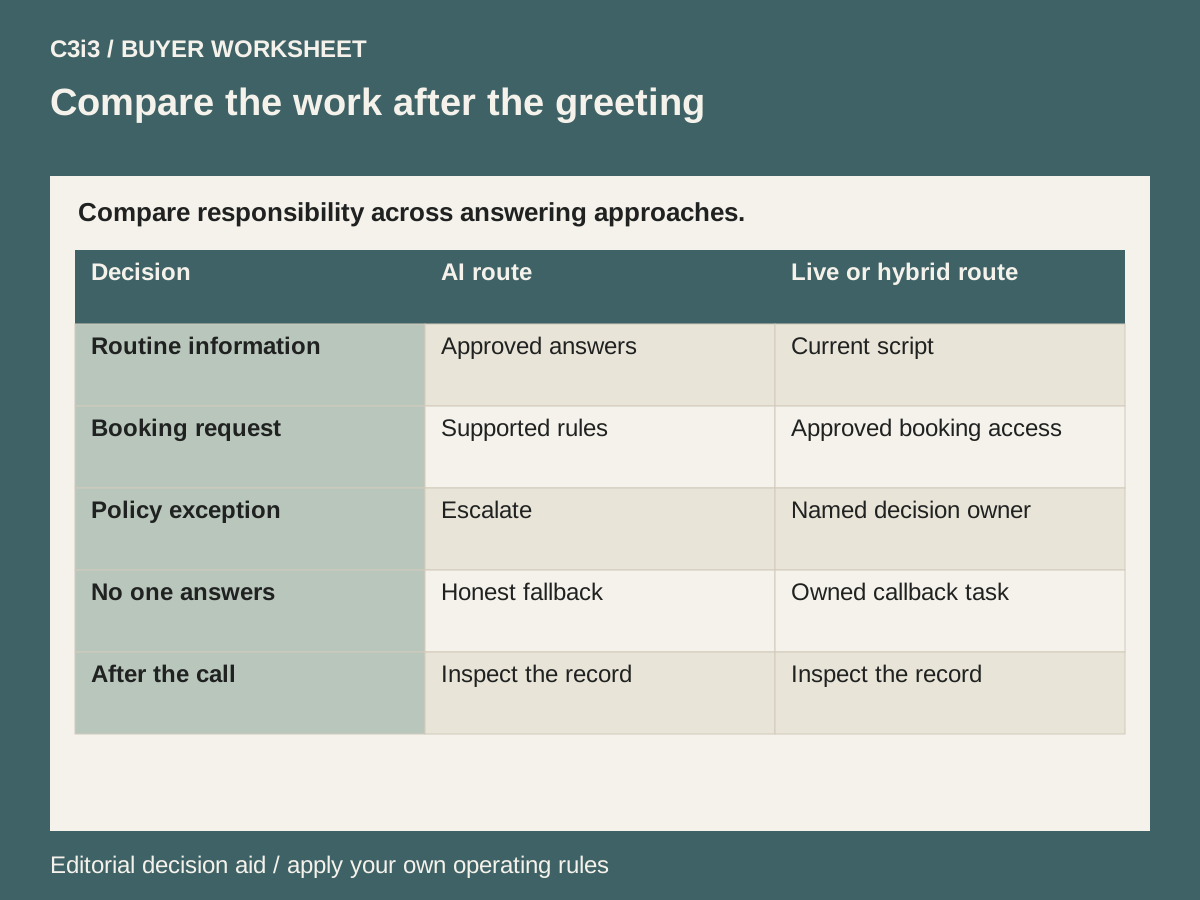
A human handoff is a designed service route, not an admission that the system failed. Define triggers for a caller asking for a person, an unclear request, a complaint, an exception to policy or a decision beyond the receptionist’s authority. Then define who can accept the call at that hour. If nobody is available, the fallback must tell the caller what happens next without inventing a response time your team cannot honor.
Test the full handoff, including no answer at the receiving extension. A successful transfer attempt is not necessarily a connected conversation. Your staff should receive the caller’s verified contact details, reason for calling and any unresolved question so the caller does not start again. Decide how the team will track pending callbacks and close them. The AI versus live answering comparison explains why some call types are better served by a person from the start.
A transfer should leave an observable result: connected to the intended person or waiting for an owned callback. Keep those outcomes distinct in your review so a completed attempt is not mistaken for completed help.
How do you verify calendar and CRM compatibility?
Treat an integration logo as the start of a question. Ask exactly which record is created or updated, which fields are transferred, what identifier prevents duplicates and what happens when the destination is unavailable. Sending a transcript by email can still leave your team with manual work. A usable integration should produce the specific business object your process needs, with ownership and status that someone can follow.
Booking has its own conditions: location, time zone, service duration, staff availability, travel allowance and cancellation rules. Do not assume that reading free time proves a slot was reserved. Run a sample call, inspect the resulting calendar event and locate the corresponding customer record. Check a returning caller as well as a new one. The integration guide provides a field-by-field acceptance worksheet. C3i3’s online booking systems work can help connect the website side of the same customer journey.
Include the person who uses the receiving software in acceptance testing. A sales demonstration may show a record arriving while missing the location, assignment or status that makes it useful to the team.
How should you compare the complete monthly cost?
Compare an expected operating month, a busy month and a quiet month using the same call assumptions for every proposal. A price per call, per conversation or per minute describes a different billing unit. Find out whether a repeat attempt, abandoned call, spam interaction, text follow-up or transfer creates an additional charge. Ask about setup work, integration support, phone forwarding, number ownership and any human answering component.
Price should be compared with a verified outcome as well as a usage total. If a plan captures messages cheaply but staff must re-enter every detail, that administrative work belongs in your decision. If a higher service level removes a handoff that callers actually need, the advertised saving may not improve operations. Use the pricing worksheet to request itemized assumptions and contract terms without relying on an outdated headline rate. Avoid projecting revenue from every answered call; many calls are not new sales opportunities.
Keep commercial assumptions next to the quote. If campaign traffic, average call length or human transfer demand changes, you can revise the comparison without rebuilding it around a different definition of success.
Who will maintain answers and review call quality?
Name a business owner for the approved answers, an administrator for routing and a person responsible for follow-up. These can be the same employee in a small team, but the responsibilities should be explicit. Decide how changed holiday hours, staff departures, new coverage areas and temporarily unavailable services reach the receptionist. Ask whether your team can preview and test changes before they affect callers.
Review outcomes rather than listening only for a pleasant voice. A call can sound natural while carrying the wrong name into the CRM or promising an unavailable appointment. Use a sample of authorized call records to inspect accuracy, handoff completion and unresolved requests. Set appropriate access and retention for recordings and transcripts with your provider, collecting only what the task needs. Your operational review should produce corrected instructions and named follow-up actions, not an unowned pile of call summaries.
Agree on a review cadence that matches your call volume and operational changes. A small team may need a brief shared log more than a complicated dashboard nobody is responsible for reading.
How do you run a useful pilot before moving every call?
Choose a limited initial scope, such as overflow calls during a staffed period or a defined after-hours inquiry route. Keep a documented way to return to your previous answering setup. Before starting, record what success means: accurate contact capture, correct routing, confirmed appointments where permitted and clear handling of exceptions. Separate the test period from a commitment to a long contract.
Include realistic difficult cases alongside straightforward inquiries. Try a caller who changes their mind, an unavailable time slot, an existing contact with an updated phone number and a transfer destination that does not answer. Inspect the records created after each conversation. Give staff a way to flag errors and assign a correction owner. A pilot should tell you whether the configured service fits your work, not merely whether someone can complete a scripted sales demonstration.
A busy period can reveal overlapping calls and missing coverage that a quiet demo will not show. Ask the supplier how concurrency and overflow are handled, then test the permitted scope safely.
What should you collect before requesting proposals?
Prepare a concise requirements brief covering business type, call purposes, coverage hours, approximate usage, supported languages, locations, phone system and the software records you need. Distinguish essential outcomes from preferences. Asking three providers to respond to the same brief makes omissions visible and keeps your selection from becoming a comparison of unrelated packages. Request the implementation owner, support route and exit conditions as well as the service features.
For a vendor introduction, share business contact information only with permission and explain which provider will receive it. A useful shortlist should tell you why each candidate matches the stated needs and which questions remain open. Keep paid placements separate from an editorial assessment. C3i3 can help clarify requirements, website conversion paths and marketing automation; a receptionist supplier must substantiate its own call handling and integration performance.
Keep unresolved requirements visible when you narrow the shortlist. The most useful proposal explains its limits and implementation responsibilities clearly enough that your employees can decide whether they can operate it.
Which service approach fits your call mix?
| Call situation | Useful starting approach | Proof to request |
|---|---|---|
| Repeated hours or coverage questions | AI answering with approved information | Correct answer when a caller changes the wording |
| Straightforward appointment request | AI with verified booking permissions | Actual calendar event and correct confirmation |
| Complaint requiring an exception | Staff or live answering route | A reachable decision owner and fallback |
| Existing customer with an unresolved issue | Context-aware human handoff | Summary and outstanding action reach the team |
| Mixed routine and complex calls | Hybrid route with explicit boundaries | Escalation works when the first person is unavailable |
| Low call volume and simple requests | Compare minimal scope before adding features | Usage terms and administrative workload remain proportionate |
Illustrative example: an appointment-based service business
Consider a hypothetical service company whose owner works away from the phone. Its aim is to capture new inquiries and offer assessment appointments, while an administrator handles complaints and changes to confirmed work. The company starts with one location, a published service area and a limited appointment type. It excludes firm quotes and dispatch promises from the receptionist’s authority.
During a pilot, the team tests a new caller, a returning customer, an out-of-area request and a caller asking for a person. Staff inspect the calendar and customer record after each call, then deliberately make the transfer destination unavailable. The resulting checklist tells them whether the system leaves a clear callback task instead of implying a connection happened. This is an evaluation example, not a customer result or a claim about any named product.
Key takeaways
- Start with call purposes and allowed commitments, then compare providers.
- Verify human handoffs, booking results and destination records.
- Evaluate a complete operating month and a limited, reversible pilot.
Frequently asked questions
Can an AI receptionist replace every front-desk task?
Do not assume that it can. Select a defined set of supported call tasks and retain a person for judgment, exceptions and unresolved requests. Your operational test determines whether the configured scope works.
Should I keep my existing business number?
Ask your phone provider and receptionist supplier about forwarding, portability and exit conditions. Verify the exact call path before changing a number customers already use.
What information should I send to get a useful quote?
Send your call types, coverage hours, estimated usage, locations, phone setup, calendar or CRM requirements and human escalation needs. Ask every supplier to respond to the same brief.
Sources and editorial method
Prepared from linked primary documentation checked November 20, 2026. Vendor documentation establishes stated features and operating conditions. Comparisons and worksheets are C3i3 editorial analysis; worked examples are hypothetical.
- RingCentral: AI Receptionist
Official description of call answering, routing and scheduling capabilities. Confirm the selected plan and supported workflow.
- Jobber Help Center: Receptionist powered by Jobber AI
Current product operation, configuration and conversation billing definitions. Older cached help pages may show different terms.
- Smith.ai: integrations directory
A directory of integration categories and supported products. A listing does not establish every required action or field mapping.
Plan a clearer call-handling and customer follow-up workflow.

Tell us your call types, approximate volume, booking system and the handoffs you need. C3i3 can help clarify the website, content and workflow requirements before you select a provider.
Explore marketing automation or tell us about your project.