








































In this article
A vendor demonstration usually follows the easiest path through a product. Your business needs to see what happens when a caller changes the request, asks for a person or selects an unavailable appointment. A structured demo makes those outcomes comparable across providers. Use this checklist to test the configured service against your actual operating rules and inspect the work created after each call.
What should you prepare before the demonstration?
Write a one-page business brief containing the services you offer, current opening hours, coverage area, permitted appointment types and boundaries on what a receptionist may promise. Include the destinations for new inquiries, existing customer issues and callers requesting a person. Make the details consistent with your website so the test does not begin with contradictory instructions. Identify who may correct the brief when the team finds an error.
Prepare a small set of representative scenarios using fictional test details instead of copying unnecessary personal information from customer records. Tell each vendor which calendar or CRM action is expected, but do not rehearse every caller phrase in advance. A useful demo should show whether the configuration handles different wording within its approved scope. Begin with the buyer’s guide if you still need to decide which tasks belong in that scope.
Which straightforward calls should establish the baseline?
Test a new caller asking about a service, a coverage-area question, an opening-hours question and a request for a callback. Change the order of the caller’s details and include a correction to a name or phone number. Check whether the receptionist confirms critical contact information and distinguishes facts in its instructions from information it does not have. A clear admission of uncertainty is preferable to an invented answer.
Inspect the delivered record after the call. It should capture the caller’s purpose and the next action without changing the meaning. Note unsupported promises, missing details and unnecessary questions as separate findings. Repeat a scenario with different phrasing to see whether the result remains within your business rules. Voice quality matters to the caller experience, but it should have its own score rather than compensating for an incorrect destination or lost request.
How do you test human requests and difficult situations?
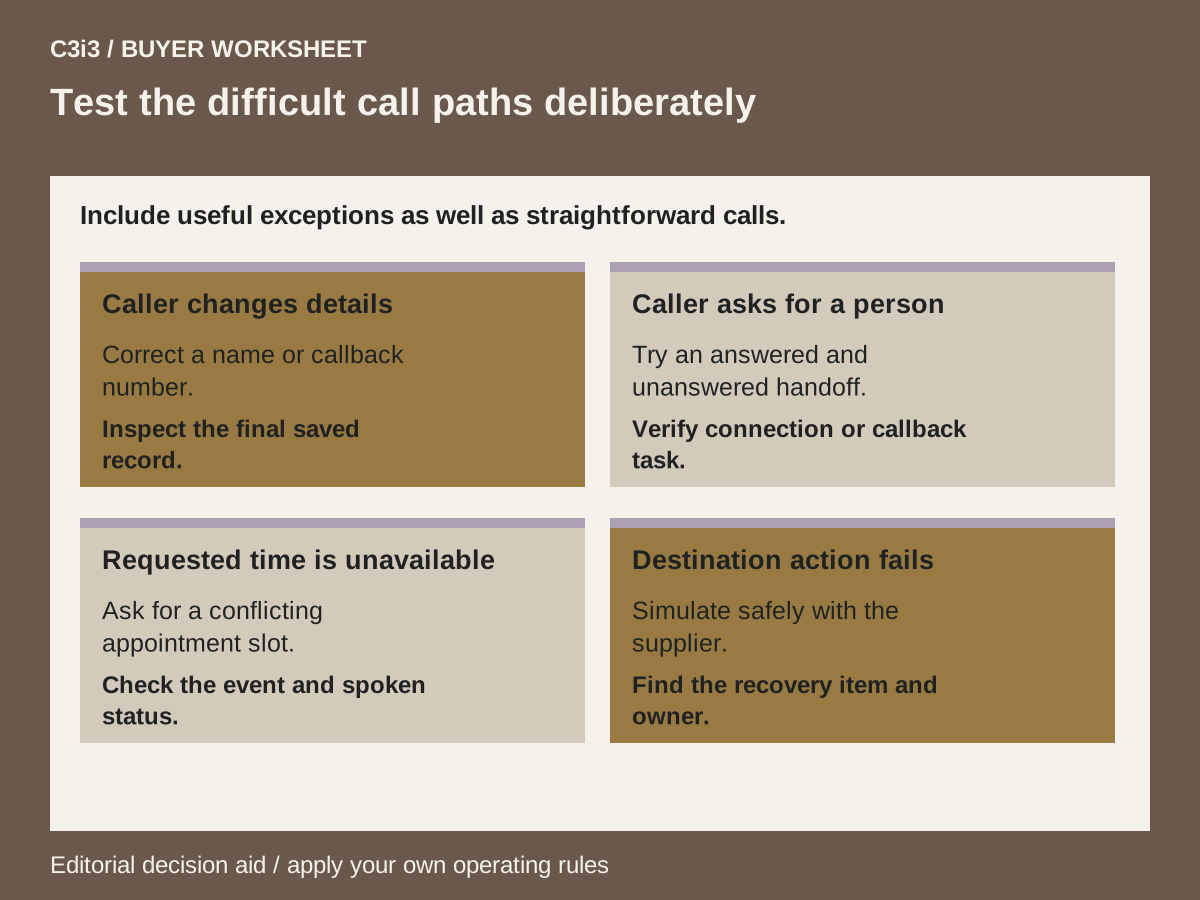
Ask directly for a person, then try an ambiguous request and a question outside the approved information. Include a complaint that requires a policy exception. The correct behavior depends on your instructions, but it should stay within the receptionist’s authority. An agent must not claim a manager approved a solution or a technician is on the way simply to keep the conversation moving.
Test the receiving destination too. Have the intended staff member answer one test and decline another. Record whether the caller receives a clear fallback and whether the team receives an owned callback task with context. For after-hours service, test the actual after-hours route rather than assuming daytime behavior applies. The AI versus live answering guide can help you decide which difficult cases should bypass automation and reach an available person sooner.
What should you inspect after a booking or CRM action?
Give the provider an allowed appointment request and inspect the saved event, not only the spoken confirmation. Verify date, time zone, location, appointment type and the contact information that reached the destination. Then request an unavailable slot, a change of time and a returning-customer update. Ask the provider to demonstrate supported actions rather than treating every calendar operation as automatically available.
For CRM behavior, compare the captured details with the resulting contact, task, owner and status. Look for duplicate records and unsupported changes to existing information. A directory listing or integration logo is insufficient evidence for your specific workflow. Use the integration acceptance worksheet to record destination references and observed outcomes. If a feature requires a different plan or custom work, mark that condition on the scorecard and request it in the proposal.
Which failure cases should be included in a safe test?
Ask the supplier to simulate a destination failure in a controlled environment: a calendar rejects an action, a CRM connection is unavailable or a transfer destination cannot take the call. You are evaluating the recovery route, not trying to disrupt a production service. The caller should hear wording that reflects what actually happened. Staff need a preserved request and a visible action they can recover.
Find out how administrators see a failure and who acts on it. Ask whether a retry can create duplicate appointments or tasks and how completed recovery is recorded. Confirm the route for an interruption affecting the answering service itself. A practical rollback plan should identify the authorized person who changes call routing and the previous destination that will receive calls. Include that transition in a limited pilot before relying on the service for all incoming traffic.
How should you decide whether the demo passed?
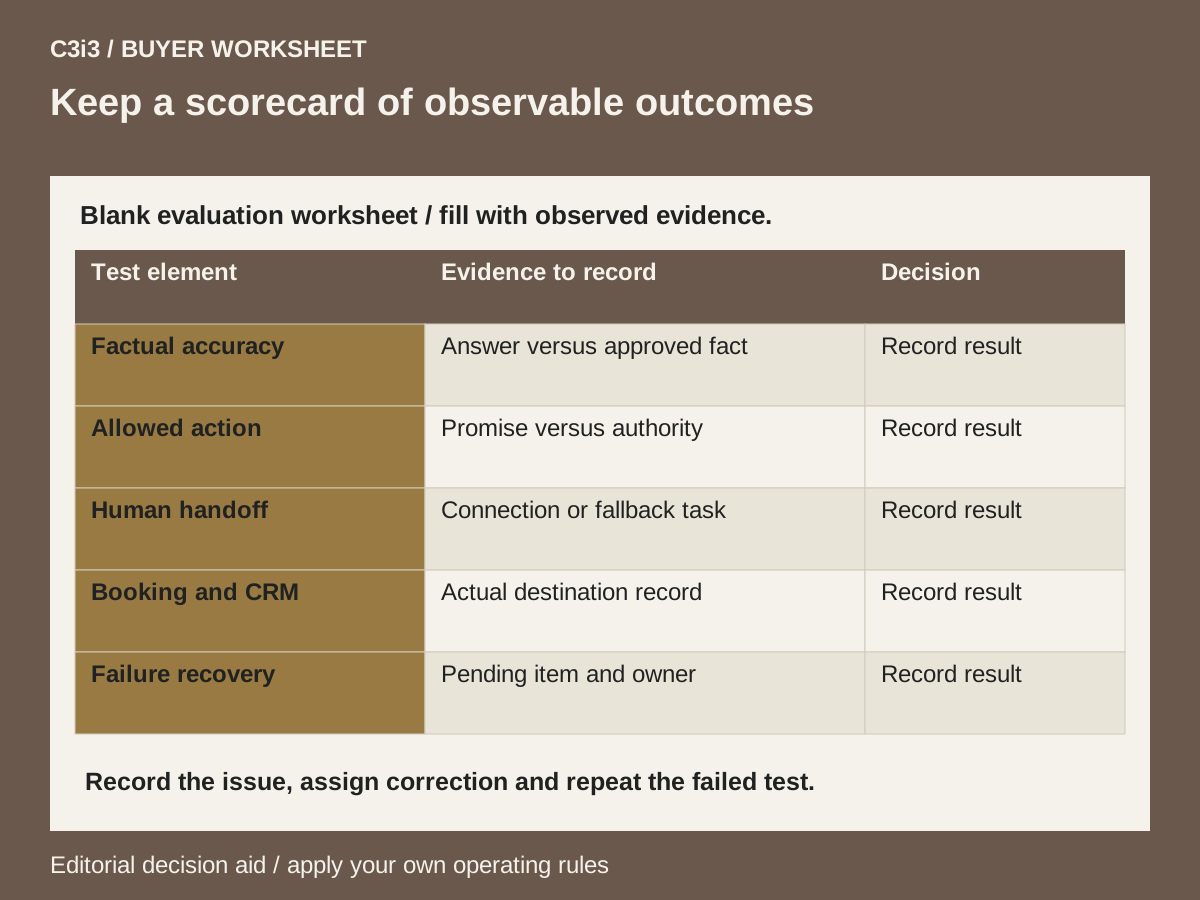
Use written acceptance criteria for the essential outcomes rather than an overall impression. For each scenario, record the expected action, what the caller heard, what record was created and the observed result. Classify findings by consequence: an unauthorized commitment or lost request deserves different attention from a preferred greeting style. Give each open issue an owner and require a repeat of the failed scenario after correction.
Separate the product decision from the commercial commitment. A successful demo should lead to a dated scope, a limited pilot and a quote that includes the demonstrated features. Review usage and setup pricing using the expected call mix. Decide which unresolved issues prevent launch and which can be managed within an explicitly narrower scope. Keep your test register so future changes to routing, staff or business rules can be checked against the same essential cases.
What should the demo scorecard capture?
| Scenario | Pass evidence | Finding that needs correction |
|---|---|---|
| Caller corrects contact details | Final record contains the confirmed correction | Original incorrect value remains in the task |
| Caller asks an unsupported question | Clear limitation and appropriate next step | Invented price, availability or promise |
| Caller requests a person | Reachable handoff or honest fallback | Repeated intake with no usable escape route |
| Requested slot is unavailable | Only permitted alternatives or a pending request | Spoken confirmation without an accepted event |
| Returning caller contacts the business | Correct record or reviewed ambiguous match | Unrelated record overwritten or duplicate created |
| CRM or transfer fails | Preserved request, visible issue and named owner | Inquiry disappears behind a success message |
| Configuration is corrected | Failed scenario passes on a repeat test | Vendor reports a fix without showing the result |
Illustrative example: a convincing voice fails the operational test
Imagine a hypothetical company testing a receptionist for appointment requests. The first demonstration sounds natural, but the team finds that the event was saved in the wrong time zone. In another test, an unanswered transfer produces a completed-call label without a callback task. Those findings matter even though the spoken conversation was pleasant.
The company records both issues, narrows the initial pilot to message capture and asks the supplier to correct the booking and handoff configuration. Staff repeat the failed scenarios and inspect the destination records before enabling the additional actions. The point is to let observed behavior determine scope. This is an illustrative test scenario, not a report about a named product or a measured customer outcome.
Key takeaways
- Test the same scenarios across providers using approved business information.
- Inspect the caller experience and downstream records separately.
- Retest corrections and keep a reversible pilot scope.
Frequently asked questions
Should I tell the provider which difficult calls I will test?
Share the operating requirements and permitted actions, then vary the wording naturally. The aim is fair acceptance testing, not surprising a system with tasks you never asked it to support.
Can a demo use my real calendar and CRM?
Use a safe test setup where possible and agree on permissions, fictional records and cleanup. Do not let evaluation calls unintentionally book real staff or alter customer data.
What should happen when a demo fails?
Record the observed behavior, assign the correction and repeat the scenario. Restrict the pilot if an essential result remains unverified rather than assuming a future fix will work.
Sources and editorial method
Prepared from linked primary documentation checked November 20, 2026. Vendor documentation establishes stated features and operating conditions. Comparisons and worksheets are C3i3 editorial analysis; worked examples are hypothetical.
- RingCentral: AI Receptionist
Official description of call answering, routing and scheduling capabilities. Confirm the selected plan and supported workflow.
- Jobber Help Center: Receptionist powered by Jobber AI
Current product operation, configuration and conversation billing definitions. Older cached help pages may show different terms.
- Smith.ai: integrations directory
A directory of integration categories and supported products. A listing does not establish every required action or field mapping.
Plan a clearer call-handling and customer follow-up workflow.

Tell us your call types, approximate volume, booking system and the handoffs you need. C3i3 can help clarify the website, content and workflow requirements before you select a provider.
Explore marketing automation or tell us about your project.