









































In this article
An AI receptionist’s advertised monthly fee is only useful when you understand what it buys. Two plans can answer the same number of calls and produce different bills because one counts minutes while another counts conversations. Setup work and follow-up labor can also change the economics. This guide gives small businesses a consistent way to request and compare quotes without treating a vendor’s starting price as the final operating cost.
Are you paying per call, conversation or minute?
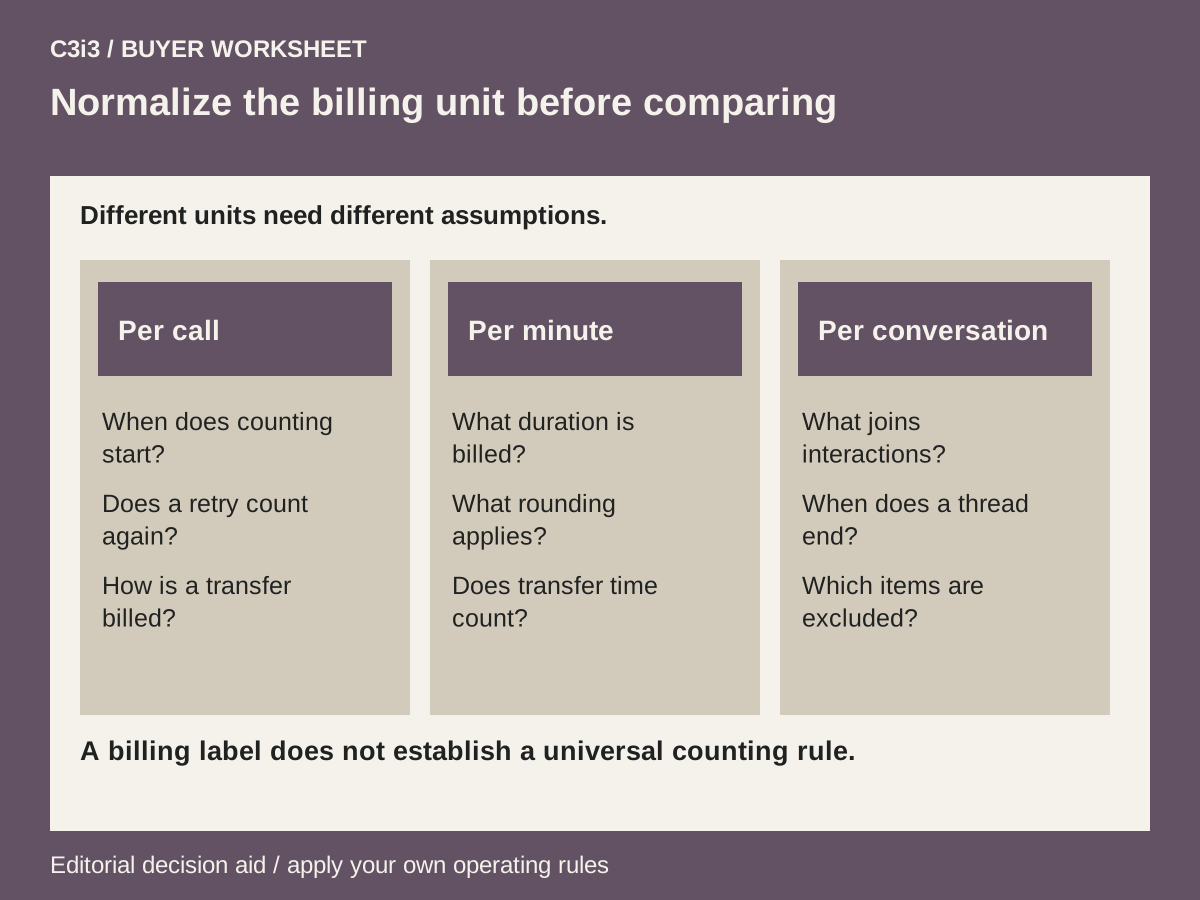
Read the billing definition before multiplying a published rate by your call count. A call may mean an answered connection, while a conversation may combine certain interactions under conditions defined by the supplier. A minute-based plan depends on duration and rounding. Ask when counting begins, how a transferred call is measured and whether a return call starts another unit. These details matter more than the label printed above a pricing card.
Request sample billing for a short inquiry, a long appointment discussion, a caller who hangs up and tries again and an unwanted sales call. Include text follow-ups if you intend to use them. Jobber’s current Receptionist documentation defines its conversation allowance and exclusions; other providers use different units. That is a reason to compare the definitions, not a reason to assume one provider’s counting rule applies everywhere. The buyer’s guide helps you define which calls belong in the service scope.
Which usage assumptions belong in your quote?
Use a recent, representative period from your phone records to estimate the volume the receptionist would actually receive. Keep answered office calls, voicemail, overflow, after-hours traffic and spam separate. If you are planning a new campaign, describe the additional demand as an assumption rather than pretending it is already measured. For minute-based plans, use an appropriate duration sample instead of dividing all phone minutes by all calls.
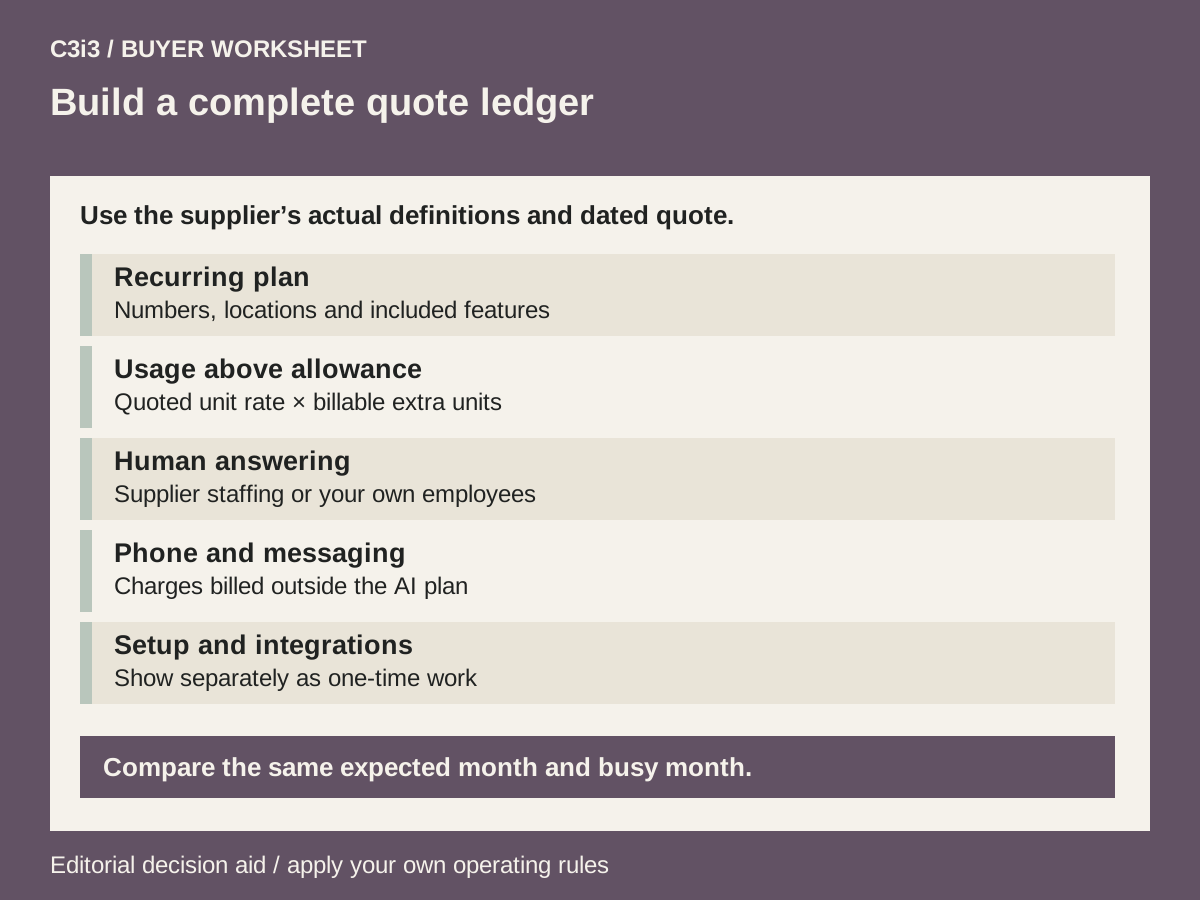
Ask each vendor to price the same expected month and a clearly defined busy-month scenario. Record included units, extra-unit rates, rounding, any allowance resets and whether unused capacity carries forward. A lower base fee can become more expensive at your busy level, while a larger package can waste budget if most calls remain with staff. You do not need a forecast with false precision; you need a visible set of assumptions that can be revised when real usage arrives.
What implementation costs should you separate from the subscription?
List one-time onboarding, call-flow design, knowledge preparation, calendar configuration, CRM field mapping and staff training as separate lines. Establish which work the supplier performs and which work your employees must complete. A self-service package can be appropriate when the workflow is simple and someone on the team can maintain it. A complex multistep booking or routing process needs a clearer implementation scope.
Ask how revisions are charged after launch. Changes to opening hours should be distinguished from a new integration or an additional location. Confirm whether a test environment and acceptance period are included. Smith.ai’s pricing page illustrates that implementation support and custom work can differ by tier; it is not a universal market tariff. Keep your comparison grounded in the actual proposal. For integration acceptance criteria, use the calendar and CRM guide before approving a setup charge.
Which human and telephone charges sit outside the AI fee?
Check whether human answering is included, optional or provided through a separate arrangement. Ask what starts that charge: a transfer attempt, connected time, a live agent taking the call or a separate subscription. An AI system forwarding callers to your own employees is different from a supplier staffing those calls. The response should describe coverage hours and the fallback when nobody can accept the handoff.
Review telephone costs with the party that controls the number and call routing. Forwarding, additional numbers, outbound messages and other network services may be billed separately depending on the arrangement. Ask who owns or can port the published business number when you leave. Include internal administration too: who reads messages, corrects records and follows up? The AI versus live answering comparison can help you avoid paying for a human service component that duplicates a route your team already covers.
Which contract details affect the real commitment?
Compare minimum term, renewal, notice period, cancellation method and the ability to change tiers. Ask whether a trial becomes a paid subscription automatically and who must disable forwarding at the end. Written scope should identify which business locations and numbers are covered, what support is available and how the provider reports outages. The cheapest first month does not tell you whether leaving or reducing the service will be straightforward.
Plan for access to your own information. Establish whether you can export call outcomes, contacts and configured instructions in a usable format. Review recording, transcript retention and user access with the supplier, particularly where your calls contain sensitive details. A request for clarification is more useful than a broad promise of compliance. Put unresolved contract questions beside the price comparison so a low headline fee cannot conceal an unsuitable operating arrangement.
How do you compare cost with a useful business outcome?
Choose an outcome your team can verify, such as a qualified callback task delivered with the correct contact details or an appointment correctly saved to the calendar. Count spam, existing customer support and supplier calls separately from new sales inquiries. If you choose to calculate cost per qualified inquiry, use accepted inquiries as the denominator and disclose your definition. An answered call is not automatically a lead, and a lead is not automatically a sale.
Use the pilot to record the staff work that remains. A low bill may coexist with heavy re-entry and correction, while a more capable integration may reduce those tasks without changing call volume. Do not assume all employee time saved turns into cash savings. Identify what the team will do with the capacity and whether that change matters to the business. The demo checklist helps verify the operational result before you rely on it in an ROI calculation.
What should an itemized AI receptionist proposal include?
| Cost line | Ask the supplier | Keep separate in your comparison |
|---|---|---|
| Base subscription | Which numbers, locations and features are included? | Recurring plan fee |
| Usage allowance | What exactly is one billable unit? | Included quantity and reset rules |
| Additional usage | What rate and rounding apply after the allowance? | Expected and busy-month overage |
| Setup and integration | Which deliverables and revisions are included? | One-time work and ongoing maintenance |
| Human handling | Who receives transfers and when does billing begin? | Supplier staffing versus your employees |
| Phone and messaging | Which services are billed by another provider? | Network charges and number ownership |
| Exit and export | What notice, export and routing changes are required? | Transition work and contract commitment |
Illustrative quote comparison without invented market prices
Imagine a hypothetical business comparing a call-based plan with a minute-based plan. It supplies both vendors with the same authorized phone sample: expected answered calls, estimated duration, after-hours share, transfer share and excluded call types. Each vendor returns a dated quote with the relevant allowance and unit definition. The business uses those quoted rates rather than substituting numbers from a comparison blog.
For each option, calculate recurring plan fee plus billable overage plus any separate human or phone charges. Show one-time setup beside that monthly total rather than hiding it. Then record the remaining staff work and check whether each option delivers the same outcome. If one only emails a message while another creates an owned callback task, the company must resolve that scope difference before calling either option cheaper.
Key takeaways
- Normalize billing units before comparing rates.
- Price the same expected and busy-month scenarios.
- Separate implementation, human answering, phone costs and exit terms.
Frequently asked questions
Is an unlimited plan always better value?
Only if its included scope and terms match your use. Ask about excluded features, locations, human services and any applicable fair-use conditions rather than assuming the word covers every cost.
Can I calculate savings from the number of answered calls?
That alone is insufficient. Separate call purposes, verify the resulting action and measure the staff work still required. Revenue or cash savings need their own evidence.
Why are prices different across review sites?
Plans and billing definitions change. Use a dated official quote and current vendor documentation for your purchase, then confirm which region and package the numbers apply to.
Sources and editorial method
Prepared from linked primary documentation checked November 20, 2026. Vendor documentation establishes stated features and operating conditions. Comparisons and worksheets are C3i3 editorial analysis; worked examples are hypothetical.
- Jobber Help Center: Receptionist powered by Jobber AI
Current product operation, configuration and conversation billing definitions. Older cached help pages may show different terms.
- Smith.ai: AI Receptionist plans and pricing
A vendor example of usage allowances, setup differences and plan-specific features. Obtain a dated proposal for current terms.
Plan a clearer call-handling and customer follow-up workflow.

Tell us your call types, approximate volume, booking system and the handoffs you need. C3i3 can help clarify the website, content and workflow requirements before you select a provider.
Explore marketing automation or tell us about your project.