









































In this article
Choosing between an AI receptionist and a live answering service starts with the work a caller needs done. Repeating opening hours, changing a complex booking and resolving a complaint place different demands on the person or system answering. A useful comparison explains those differences and the responsibilities left with your team. This guide helps you design a call route that fits the conversation instead of choosing a category from its headline price.
Which caller needs favor a person from the beginning?
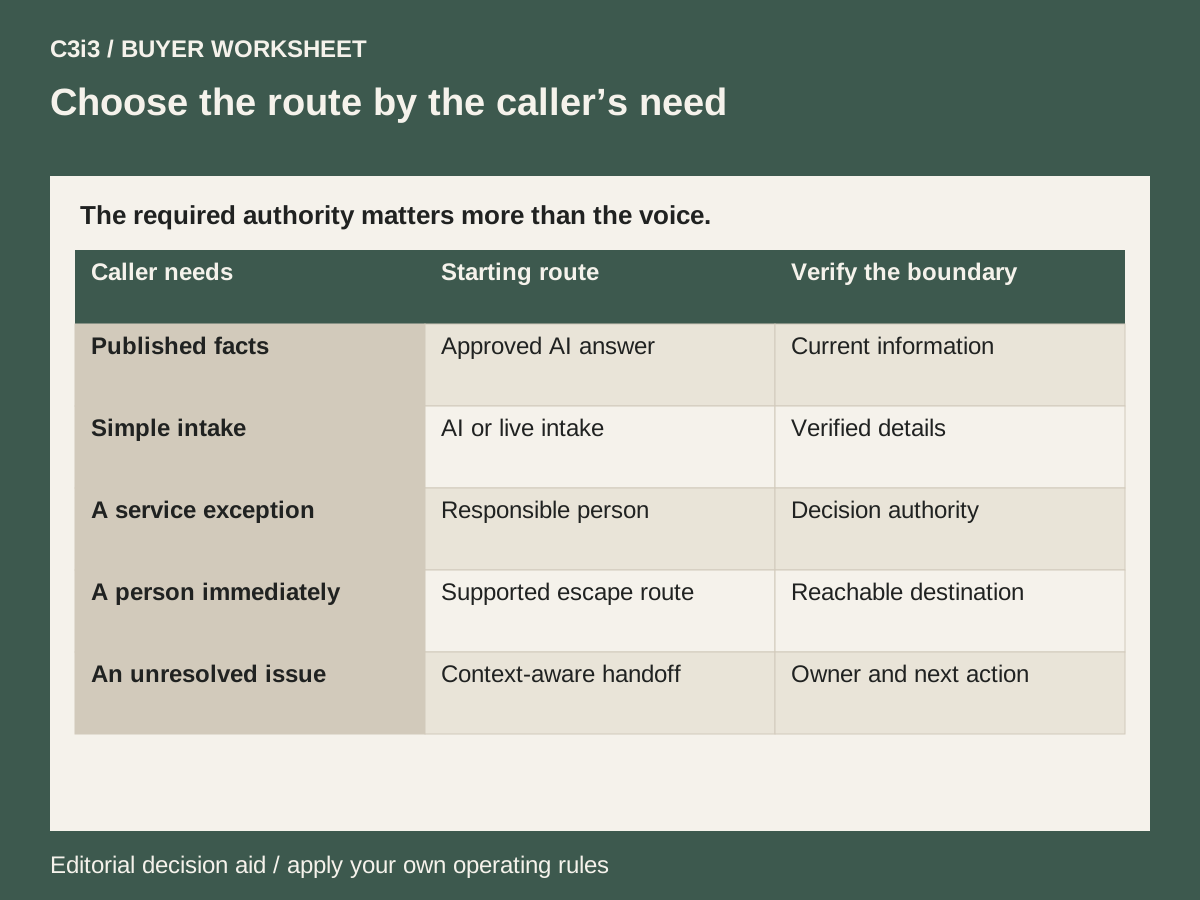
Start with the effect of misunderstanding the call. A simple request for an address usually has a stable answer. A frustrated existing customer may need someone to understand the history, negotiate a next step or decide whether an exception is appropriate. If the receptionist is not authorized to make that decision, a fluent response does not solve the problem. Give those callers a clear route to the responsible person.
Include accessibility and communication preferences in the discussion. Some callers want a person, have difficulty with the configured interaction or need extra clarification. Define how they can request an alternative without completing a long intake first. Do not assume that a live answering service has specialist authority either: its staff may still be limited to your script. Ask each provider which decisions it can make, what it records and where responsibility moves after the call.
Which repeatable tasks can fit an AI answering route?
AI can be considered for tasks with approved information, clear inputs and a verifiable result. Examples include explaining published hours, recording an inquiry, collecting a service address or offering a supported booking route. The qualification is important: a capability in a product demonstration still needs to work with your actual business rules. Avoid allowing the receptionist to improvise prices, coverage or promises when the approved information is incomplete.
Build a boundary around each automated task. For a service-area check, decide what happens with an ambiguous address. For booking, decide which appointment types can be confirmed and when staff must review the request. RingCentral’s product overview describes answering, routing and scheduling functions as one vendor example. The buying decision should focus on your permitted scope and test results. The AI receptionist buyer’s guide provides the broader requirements framework.
What does a live answering service actually include?
Request a description of the live agent’s work beyond answering politely. Can the agent follow a branching intake, look up approved information, schedule within your rules and recognize a returning caller? Which actions require the agent to contact your employees? Coverage hours, language availability, training arrangements and how instruction changes are handled should be written into the proposal. A human voice is not a substitute for a defined service scope.
Ask to inspect the message or task the live service delivers after a sample call. The receiving employee should know who called, how to reply, what was requested and what remains unresolved. If your team must manually read every transcript to determine urgency, the handoff needs improvement. Compare the same scenarios with the AI option and include the remaining internal work. Use the full cost comparison to distinguish supplier staffing from transfers to people already on your payroll.
How do you design a hybrid handoff that works?
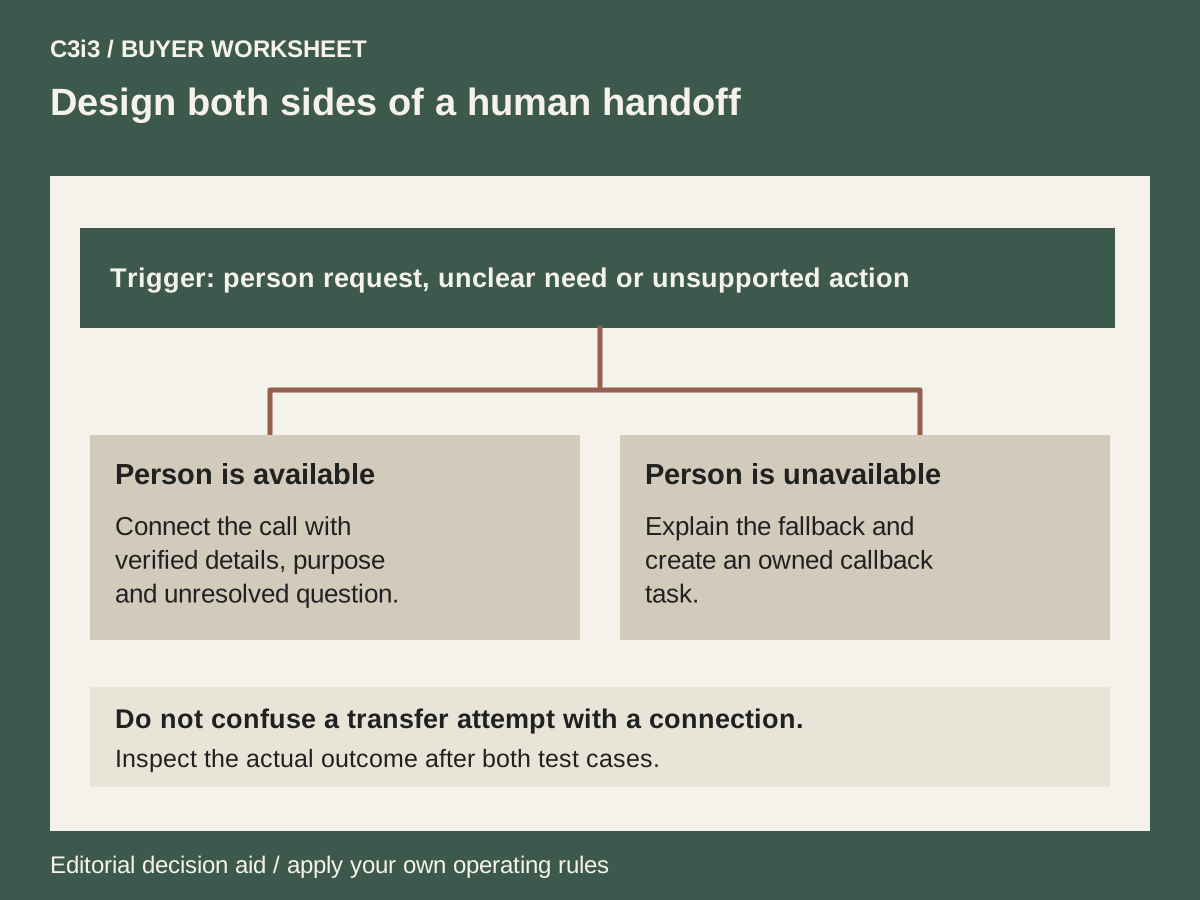
Write the trigger, destination and fallback as three separate decisions. A trigger might be a direct request for a person, an unsupported topic or repeated misunderstanding. The destination could be your staff during opening hours and an appropriately scoped answering service outside them. The fallback must explain what the caller can do if the next person is unavailable. A handoff route that only works when an owner happens to answer is difficult to rely on.
Preserve context without passing unnecessary detail. Agree on the summary, verified callback information and any request already collected. Ensure that the receiving person can see the same task status that the caller hears. Test failed transfers as deliberately as successful ones. For example, ask the receiving person to decline a test call and inspect the resulting callback task. The demo checklist includes these exception tests so a hybrid proposal is evaluated as a complete route.
Who owns the caller’s request after the conversation?
An answering service can complete its contracted action while the customer still waits for help. Your business needs an owner for each unresolved request and a practical way to see whether it was completed. Define statuses such as awaiting callback, appointment requested and appointment confirmed. Do not let a vendor dashboard’s answered-call total become the only measure of service quality. The important question is whether the correct next person can act.
Review a small, authorized sample of outcomes from each call type. Check the captured contact information, the promise made and the delivered task. Correct failures in the instructions, integration or staffing route, depending on the cause. Protect access to call records and avoid collecting sensitive information that is not needed for the task. If CRM ownership is part of the design, the integration guide explains why field mapping and duplicate handling belong in acceptance testing.
How do you make a fair final comparison?
Give every candidate the same brief and set of test calls. Include routine inquiries, a realistic exception, a returning customer, a person request and a receiving team that does not answer. Score factual accuracy and follow-through separately from voice preference. Ask the person who will manage callbacks to inspect the records; they can often identify practical problems that a procurement-only demonstration overlooks.
Then choose the smallest arrangement that meets the essential requirements. It may be AI for overflow, live answering for a specialist intake or a hybrid covering distinct hours and call purposes. Document which requests remain outside scope and how callers reach an alternative. Start with a limited pilot before moving more traffic. A carefully bounded solution is easier to maintain than an ambitious promise that your team cannot consistently deliver.
Compare the operating responsibility, not only the answering method
| Decision | AI answering | Live answering | Hybrid requirement |
|---|---|---|---|
| Approved routine information | Test configured answers | Test script and updates | Keep one approved information source |
| Sensitive or disputed exception | Route within defined authority | Verify agent authority | Name the responsible decision maker |
| Caller requests a person | Provide a supported escape route | Verify availability | Test the transfer and no-answer path |
| Booking changes | Test supported actions and rules | Verify access and procedure | Keep status consistent across systems |
| After-hours coverage | Check configured availability | Check staffing scope | Specify who owns follow-up next day |
| Unresolved request | Create a clear next action | Deliver structured intake | Assign an owner and completion status |
Illustrative example: routine bookings and difficult existing-customer calls
A hypothetical equipment service company receives both new assessment requests and calls about unresolved repairs. It considers an AI route for routine information and new appointment requests, while existing-customer complaints go to the service coordinator. That division follows the authority needed for the task rather than an assumption that every new call should be automated.
In its comparison, each candidate receives the same call scenarios. The team checks whether a returning customer gets routed correctly and whether an unanswered transfer produces a traceable callback task. It also tests a caller who asks for a person immediately. The company chooses its scope from the demonstrated outcomes and staff coverage. This scenario illustrates a method; it reports no customer result or independent performance measurement.
Key takeaways
- Compare call types and decision authority before comparing answering methods.
- A hybrid route needs an explicit trigger, destination and fallback.
- Measure the next action and its owner after the call.
Frequently asked questions
Is a hybrid service automatically better than AI alone?
No. It adds another service boundary to manage. It helps when callers need a reachable human for defined situations and the added handoff is clear and dependable.
Can a live answering agent make exceptions for my business?
Only within the authority and instructions you give the provider. Verify who can approve a price change, reschedule work or make a promise before presenting that action as available.
What is the most important test call?
A failed handoff is especially revealing. Ask for a person when the destination does not answer and inspect what the caller hears and which follow-up task reaches your team.
Sources and editorial method
Prepared from linked primary documentation checked November 20, 2026. Vendor documentation establishes stated features and operating conditions. Comparisons and worksheets are C3i3 editorial analysis; worked examples are hypothetical.
- RingCentral: AI Receptionist
Official description of call answering, routing and scheduling capabilities. Confirm the selected plan and supported workflow.
- Smith.ai: AI Receptionist plans and pricing
A vendor example of usage allowances, setup differences and plan-specific features. Obtain a dated proposal for current terms.
- Jobber Help Center: Receptionist powered by Jobber AI
Current product operation, configuration and conversation billing definitions. Older cached help pages may show different terms.
Plan a clearer call-handling and customer follow-up workflow.

Tell us your call types, approximate volume, booking system and the handoffs you need. C3i3 can help clarify the website, content and workflow requirements before you select a provider.
Explore marketing automation or tell us about your project.