









































In this article
A PIM subscription quote does not describe the full work of making a manufacturer’s catalog dependable. Most buying decisions also involve data cleanup, field definitions, integrations, approval rules and staff time. A useful estimate explains those work packages and their assumptions. It should make competing proposals comparable without pretending that every catalog can be priced from a SKU count alone.
Which costs belong in a complete PIM budget?
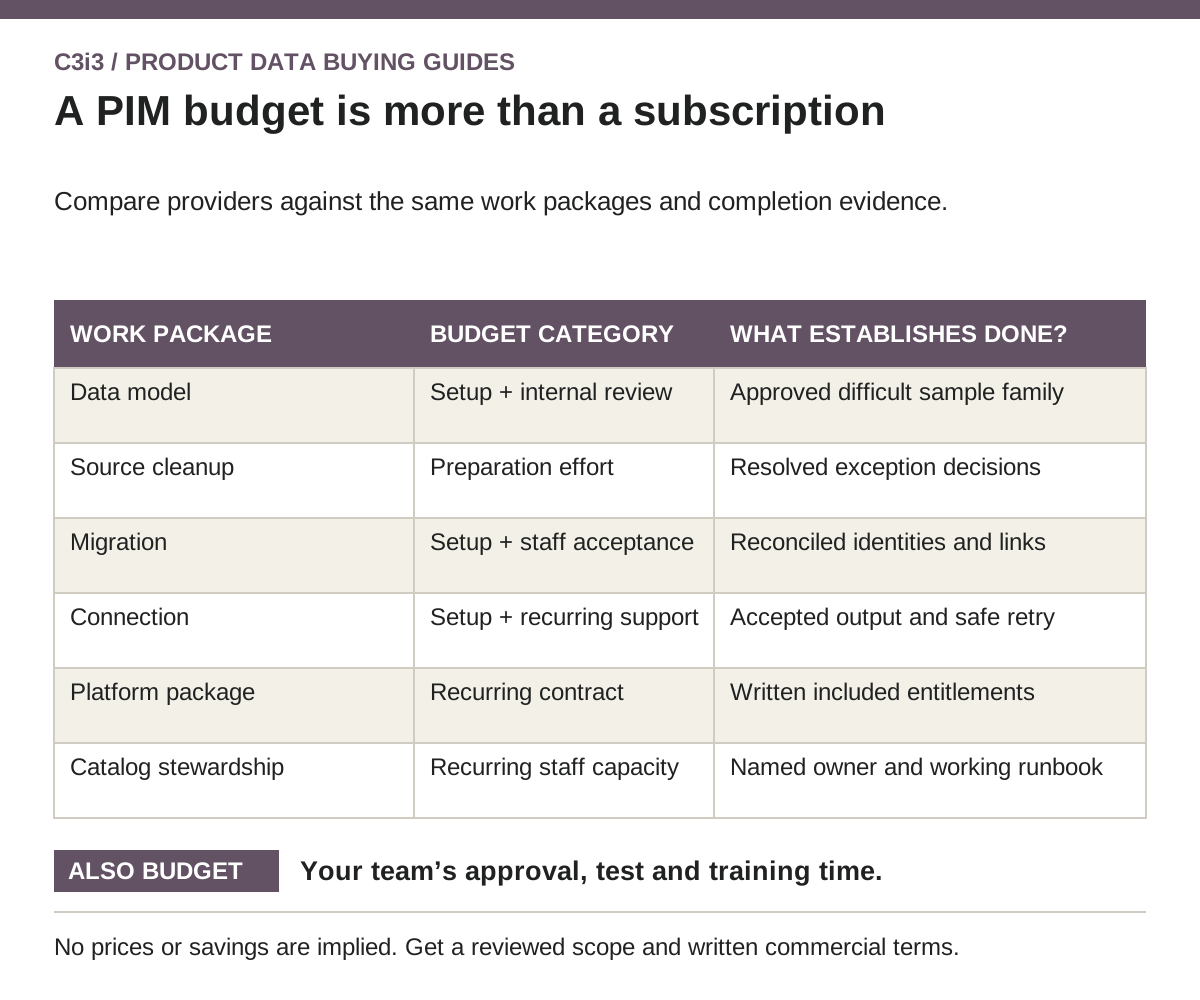
Build the budget around the outcome you need: approved product information arriving correctly at a defined destination. Include platform licensing, configuration, data preparation, integration development, testing, training and ongoing stewardship. Some providers bundle these items and others separate them. Either approach can be workable if the proposal explains who performs each task and what establishes completion. Request the commercial basis for each recurring charge as well as the implementation fee.
Include internal staff time that will not appear on the vendor invoice. Product specialists may need to resolve missing units, consolidate duplicate attributes or approve technical claims. Your IT team may need to provide source access and test environments. Treat these as planned project responsibilities rather than free capacity. The manufacturer PIM buyer’s guide helps define the business problem, while the ownership guide prevents the budget from funding several teams to maintain the same field in different systems.
Why is SKU count a poor standalone pricing measure?
The work per record depends on how the records relate and how much their data must change. A large collection of clean, uniform items may be simpler than a smaller set of products with inherited specifications, many asset roles and inconsistent supplier formats. Count product families, variation rules, languages, channels and required transformations alongside sellable items. Include inactive products if they must remain available for support or replacement guidance.
Ask providers to examine difficult samples before estimating. A source spreadsheet that appears consistent can contain numbers stored as text, mixed measurement units or two names for one concept. A migration may also need engineering decisions about which inherited values are valid for each variant. The data migration guide outlines this preparation. Quote the cleanup activities separately so you can decide whether internal teams should resolve the data first or the implementation partner should perform a defined remediation package.
What makes a PIM integration more expensive?
Cost increases when the business requires more behavior, not merely more logos on an architecture slide. A connection may need custom field mapping, variant relationships, media transfer, controlled publication, scheduled updates and reconciliation. Add explicit requirements for rejected records, duplicate events, retries and recovery. The supplier should identify which capabilities are provided by a standard connector and which require configuration or custom work.
Pimcore’s endpoint documentation provides an example of adapter and access configuration that sits behind an integration. A generic API statement is not a priced scope. Require a connection inventory showing source, destination, data direction, ownership, frequency and responsible support party. If product data also feeds a manufacturer RFQ workflow, specify what information is copied into an inquiry and how the recipient can identify the requested item after a catalog revision.
Which ongoing costs can change after launch?
Ask what governs platform and related service charges: package, usage, contributors, destinations, optional modules, storage or other contracted measures. Do not assume that another vendor uses the same pricing basis. Get the specific terms in the proposal and ask how a realistic expansion would be priced. Your team should understand which changes require a higher tier or a separate implementation statement before the first contract is signed.
Budget for catalog stewardship and connection maintenance. Someone must handle new supplier formats, new attributes, rejected exports and staff changes. A connector that works today may need review after either system changes its interface. Separate operational support from enhancement work and identify how incidents are triaged. An open-core or self-managed option can shift costs toward hosting, engineering and upgrades rather than remove them. Pimcore’s modular platform documentation is one reason to clarify exactly which components a proposal includes.
How do you compare PIM implementation proposals fairly?
Give each provider the same scope pack: representative source files, product relationships, field ownership, target output and acceptance tests. Ask for work packages with assumptions, deliverables, exclusions and change-control rules. A proposal that assumes clean data should not be compared directly with one that includes substantial cleanup. Likewise, a connector installation is different from a verified downstream publishing workflow.
Request an allowance or pricing method for unresolved exceptions rather than hiding them in vague contingency. Identify decisions that must be made before implementation can begin and who supplies them. Include a sample handover package showing mapping documentation, administrator instructions and recovery procedures. Use the vendor demo guide to turn important requirements into proof. The lower initial fee may be a sensible choice or an incomplete scope; the evidence in the proposal should let you distinguish those cases.
What is a sensible first phase for controlling cost?
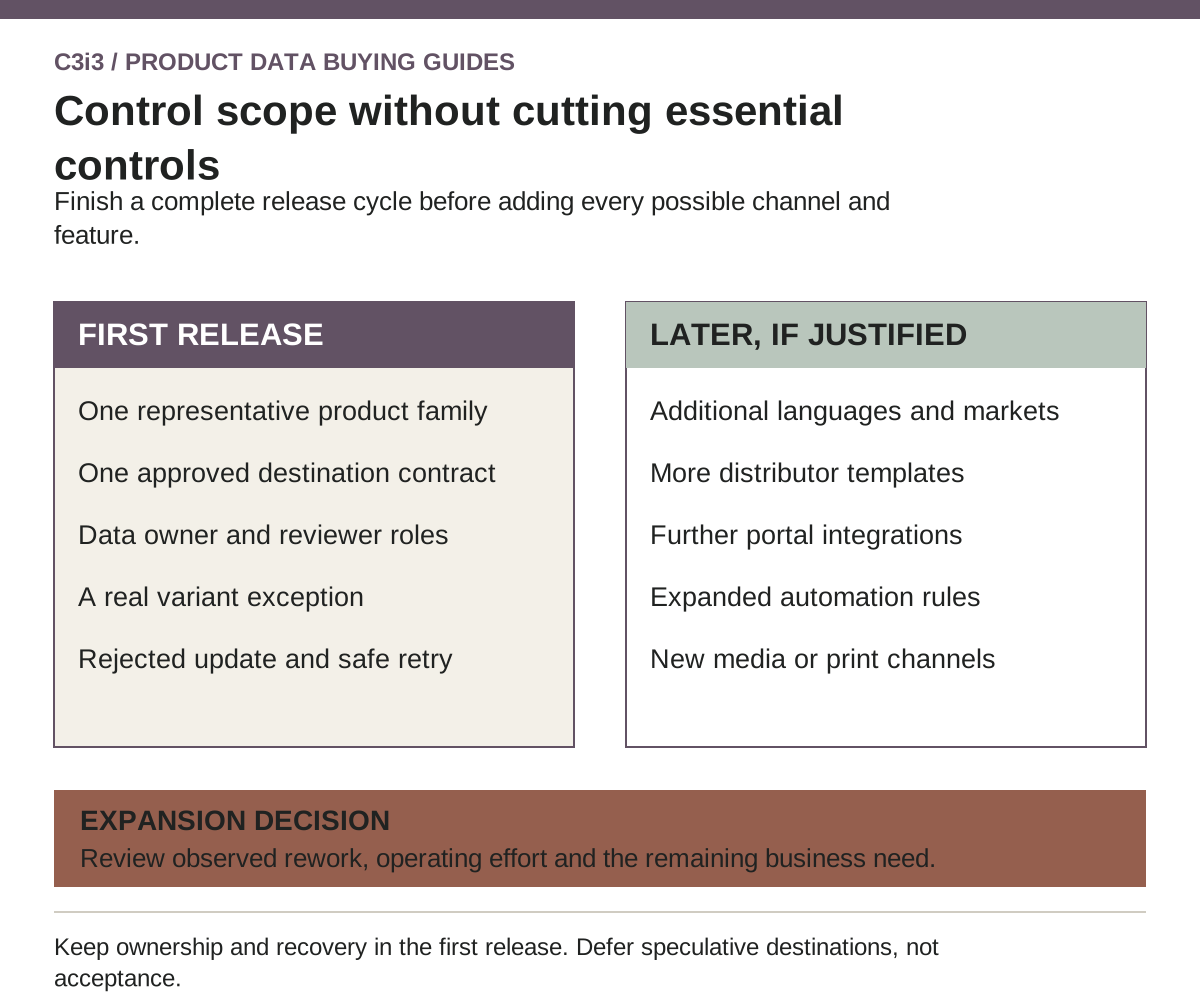
Select one product family and one destination that expose the main data and approval problems. Define a finished phase as a working release cycle, not only a successful import. Include at least one variant exception, an image change and a rejected destination record. This provides evidence about the data model, team workload and support process before you extend the project to more channels or locales.
Do not remove essential recovery and ownership work merely to make phase one look cheaper. Instead postpone speculative features and additional destinations whose value is still uncertain. Establish a stop-or-expand review based on observed outcomes and the remaining backlog. C3i3 can help align the scope with ecommerce development and technical content, while implementation estimates should come from providers who have reviewed your source data. No universal cost range can replace that assessment.
A quote ledger that separates the work you are buying
| Work package | What the quote should identify | Evidence of completion |
|---|---|---|
| Platform and modules | Contracted package, usage basis and exclusions | Written entitlement and recurring charge schedule |
| Data model | Families, attributes, options and variant structure | Approved model using difficult sample products |
| Cleanup and migration | Included sources, exceptions and remediation owner | Reconciled identities and exception report |
| Integrations | Direction, mapping, schedule and support scope | Accepted destination output plus retry test |
| Workflow and access | Editors, reviewers and publication conditions | A permitted edit and a blocked unauthorized change |
| Handover and ongoing support | Training, incidents, upgrades and enhancements | Named owner, runbook and support boundaries |
A hypothetical quote comparison exposes different assumptions
A hypothetical manufacturer receives two PIM proposals. One includes platform setup and a standard store connector. The other includes attribute cleanup, a distributor mapping and monitored retries. Comparing only the total fee makes the first proposal appear less expensive, but the proposals are not yet describing the same result.
The manufacturer supplies a shared scope pack and asks both teams to price a representative family through one accepted distributor output. Each provider must identify who resolves missing specifications and who maintains the connection. The manufacturer can then compare included work, internal effort and recurring responsibilities without assuming either original proposal was misleading. The decision uses clarified scope rather than an invented industry-average implementation price.
Key takeaways
- Compare complete workflow outcomes rather than platform fees alone.
- Include product relationships, data quality and channels alongside SKU count.
- Price failure handling and integration support explicitly.
- Treat internal product and engineering time as a project input.
- Use a bounded end-to-end phase to establish evidence before expansion.
Frequently asked questions
Can a PIM vendor give us a reliable fixed price?
A bounded, reviewed scope can support a fixed-price proposal, but the assumptions and change process matter. Provide representative data and acceptance tests. Unresolved catalog decisions can become exclusions or changes even when the headline fee is fixed.
Does an existing connector eliminate implementation work?
It may reduce development effort, but mapping, identity, credentials, permissions, error handling and destination acceptance still need confirmation. Ask the provider to specify the connector version and demonstrate your exact workflow rather than assuming logo compatibility is sufficient.
How should we estimate ROI before getting quotes?
Establish the current workload, rework and release delays, then identify which activities the proposed workflow could change. Distinguish staff capacity from cash savings and include recurring operating costs. Treat untested benefits as assumptions to validate, not guaranteed returns.
Sources and editorial method
Prepared from linked primary documentation checked November 20, 2026. Vendor documentation establishes stated features and operating conditions. Comparisons and worksheets are C3i3 editorial analysis; worked examples are hypothetical.
- Pimcore: Datahub basic principle
Endpoint configuration separates exposed data, permissions and adapter-specific behavior.
- Akeneo: catalog structure concepts
Vendor documentation for attributes, families, categories and family variants; implementation behavior depends on the selected edition.
- Akeneo: import your data
Current file-import behavior and catalog structure dependencies; verify the version used in a project.
- Pimcore: platform overview
Documents overlapping PIM, asset management and commerce capabilities; modules are not a universal required architecture.
- Shopify: product CSV import and export
A commerce-platform example of product transfer fields, dependencies and update semantics.
Map your product information before choosing another platform.

Tell us about your catalog, variants, selling channels and current systems. C3i3 can help clarify the website, content and product-data requirements so your implementation brief addresses a defined business task.
Explore ecommerce development or tell us about your project.