









































In this article
When a product exists in three systems, the most important question is not which system should contain it. Each may need a copy. The important question is which system may approve a change to each field and what every other system should do with that change. A clear ownership contract prevents a useful catalog project from becoming a cycle of overwritten corrections.
Why is the usual PIM-versus-ERP comparison incomplete?
Software categories describe typical roles, not strict boundaries. An ERP may contain detailed product attributes and images. A PIM platform may include digital assets or commerce modules. Microsoft’s product information overview and Pimcore’s platform overview show why a buyer should examine actual capabilities before drawing a tidy three-box architecture. Having overlapping storage is not automatically a problem; having conflicting writers is.
Review one product change from request to release. Identify every place that value is entered and every process that can overwrite it. A field named description may mean a short operational label in one system and an approved buyer explanation in another. Treat those as separate fields if their purposes differ. The manufacturer PIM buyer’s guide explains when the coordination problem may justify another platform. A diagram should describe your chosen responsibilities, not force them into a vendor’s preferred product category.
Which system should create product and variant identifiers?
Choose a stable identity strategy before mapping descriptive content. A sellable variant needs to remain identifiable when its title, category or presentation changes. Your ERP, PLM or another master system may issue the business identifier. The integration must preserve the relationship between that identifier and each destination’s technical record key. Do not rely on a product title as a durable matching key.
Akeneo documents the distinction between business identifiers and a technical UUID. That is a useful reminder to maintain a cross-reference rather than assuming every system uses the same key. Record who can create, merge, retire or correct identities and how those actions reach the other systems. Include variant-level examples because a parent model identifier is not always a sellable item identifier. See the PIM migration guide for reconciliation practices that protect those relationships during import.
Where should stock, prices and lifecycle status originate?
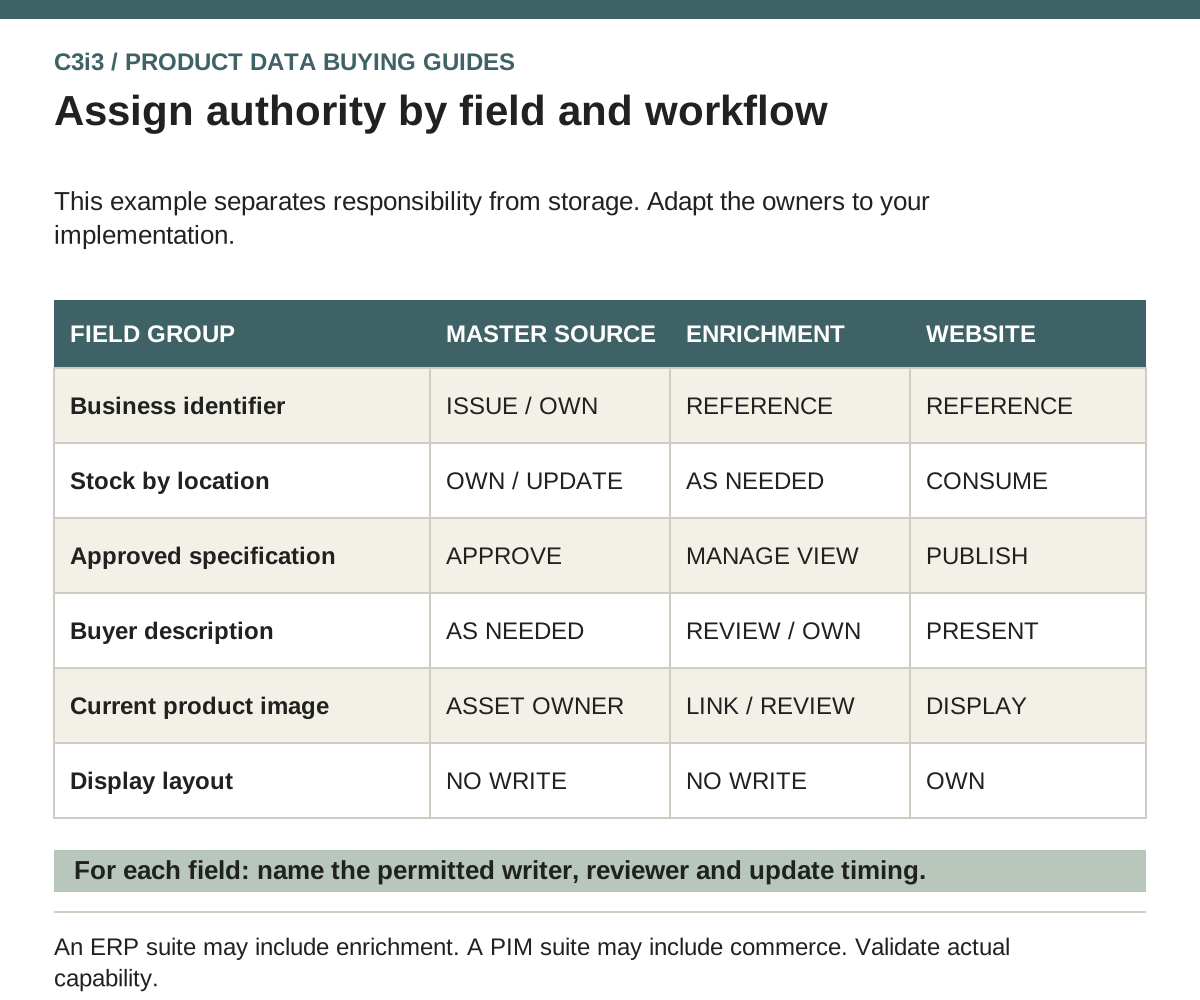
Map operational fields to the system that can maintain them responsibly. Stock by location may belong to an ERP, warehouse system or commerce inventory service. Customer-specific pricing may come from a commercial pricing engine rather than the same place as a public list price. Lifecycle status can involve product management and operational controls. Describe the source and effective timing for each instead of declaring all prices or all availability to be PIM responsibilities.
Shopify’s separate inventory CSV workflow illustrates why a product description update and a location inventory update are different tasks. Design connections so that a slower enrichment export cannot overwrite a fresher operational value. If the current failure is stale stock in a shopping channel, address the inventory-to-feed route directly. Adding a descriptive repository will not by itself make that route timely or reliable.
Who owns technical specifications and buyer-facing explanations?
Separate approval of a product fact from editing how the fact is explained. Engineering may approve an operating rating or dimensional value. Product marketing can turn that approved information into a selection guide without changing the underlying claim. The PIM may be the working environment for enrichment, but its stored value still needs a business owner and a source of evidence. Record units and applicability as well as the number itself.
Define field scope for language, market and channel. A translated installation warning should not inherit an approval simply because the English description was approved. An ecommerce title may be tailored for navigation while the official manufacturer part number remains constant. Attach permitted editing rules to those distinctions. A product configurator may also need compatibility logic that should not be inferred from a descriptive attribute alone. Ask technical stakeholders where those rules are validated and how the presentation layer receives an approved result.
What should happen when two systems disagree?
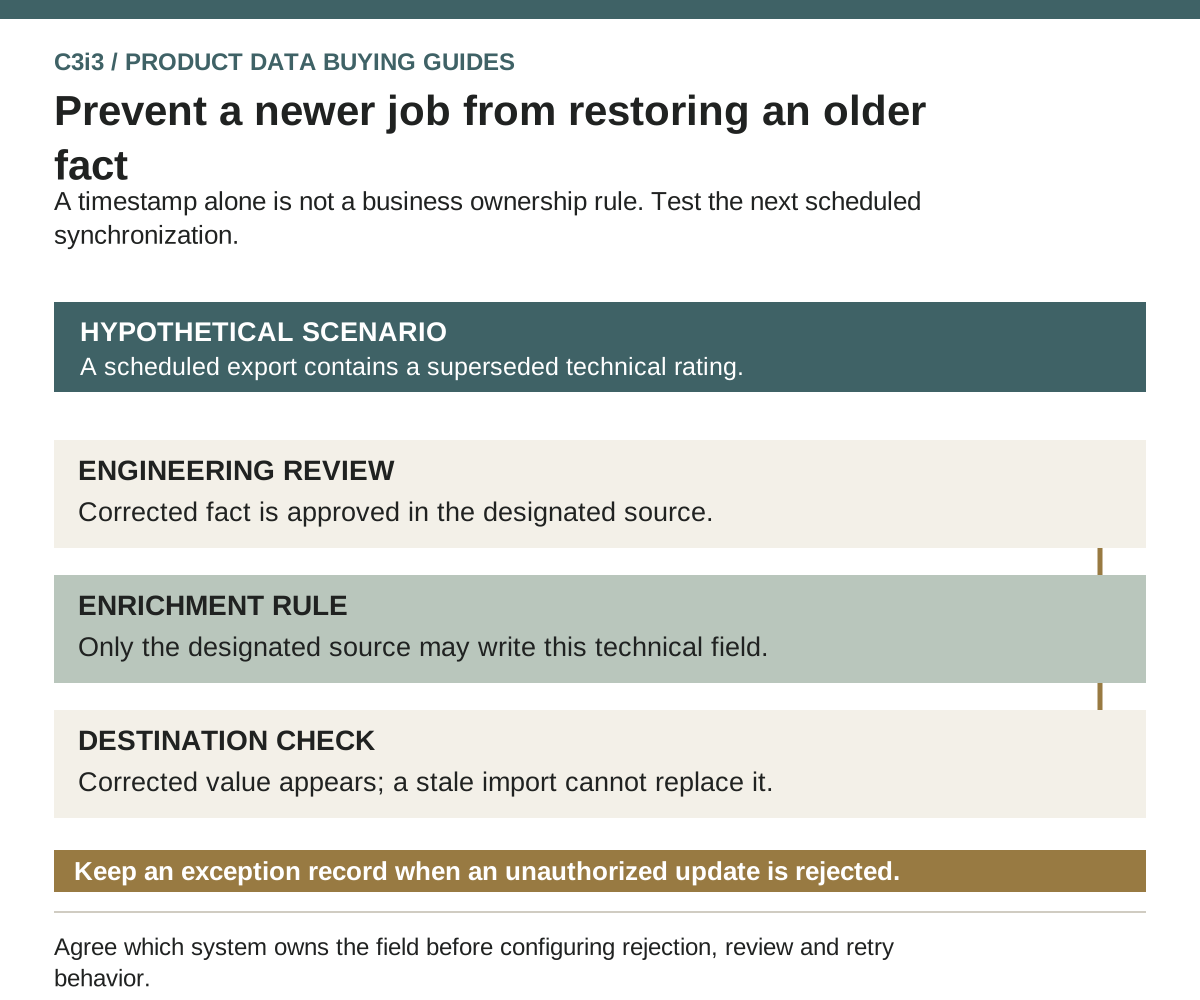
Write a conflict policy for each connection: reject an unauthorized writer, keep the authoritative source value or hold the change for review. Last-update-wins is a technical rule, not necessarily a business rule. A fresh timestamp on an old spreadsheet can otherwise replace a correct value. Make deliberate deletion different from an omitted field, and define what the receiving system does when a product is inactive or an asset is withdrawn.
Run a practical conflict drill before launch. Ask a user to edit a protected field in the destination, then run the next synchronization. The outcome should match the agreed policy and leave evidence that a responsible person can interpret. Test a failed job and a safe retry as well. Use an incident record that names the affected product identifiers, destination and corrective action. A support team should not need to inspect the entire catalog to determine whether one rejected record blocked a release.
What belongs in a product data ownership contract?
For each field group, record the business definition, authoritative source, allowed writer, reviewer, destination mapping and expected update timing. Include the identity cross-reference and deletion behavior. This document should be short enough for product management, marketing and integration staff to use together. A large schema with no owner is less useful than a smaller approved agreement that resolves real publishing decisions.
Ask the implementation provider to demonstrate that contract in the proposed system, then include it in acceptance and support handover. The PIM vendor demo checklist helps turn each rule into an observable test, while the implementation cost guide explains the effort created by unclear ownership. C3i3 can help connect these decisions to the buyer’s website experience through ecommerce development. Your operational team should approve the transaction and inventory responsibilities before that website connection goes live.
A starting ownership matrix to adapt with your team
| Information group | Possible authoritative owner | What to establish before syncing |
|---|---|---|
| Business product and variant identity | ERP, PLM or another designated master | Stable keys, creation rules and cross-system references |
| Stock by warehouse or location | Operational inventory system | Timing, available quantity definition and overwrite protection |
| Engineering-approved specifications | Engineering-controlled source | Approval evidence, units and applicable variants |
| Buyer descriptions and translations | Designated enrichment workflow | Reviewer, locale and channel scope |
| Approved media and documents | DAM or a defined asset repository | Asset revision, usage rights and product relationships |
| Storefront presentation | Commerce or website platform | Which presentation edits remain local and which return upstream |
A hypothetical conflict between a corrected rating and a scheduled import
A hypothetical equipment manufacturer corrects a rating after engineering review. Marketing updates the approved value in its enrichment workflow, but a nightly ERP export still contains the older value. The project team has not decided whether that field is an ERP master field or a PIM-managed technical field. Both systems appear to work correctly while the catalog keeps reverting.
The remedy is to assign authority and then change the integration mapping. In this example, engineering’s controlled source becomes authoritative and the ERP field is either updated from that source or excluded from the enrichment import. A test proves that the scheduled job cannot reintroduce the superseded rating. The result is an agreed ownership decision, not evidence that one product category is inherently a better master than another.
Key takeaways
- Assign a permitted writer to each field group rather than every field to one platform.
- Preserve product and variant identity independently of labels and titles.
- Protect operational values from slower descriptive-content updates.
- Test conflicts, deletions and retries before accepting a connection.
- Keep the ownership contract with the support and acceptance documents.
Frequently asked questions
Should the PIM be the single source of truth?
It can be the authoritative source for designated enrichment fields, but other systems may remain authoritative for inventory, transactions or engineering records. Use a field-level agreement so the phrase has a precise operational meaning.
Can we synchronize everything in both directions?
Only where both directions serve a defined business need and conflict rules are explicit. Bidirectional writes without ownership can create loops and overwrites. Ask the implementation team to prove each intended update path and its failure behavior.
Does the ecommerce site need every ERP field?
No. Publish the fields required for the buying task, transaction and customer support. Restrict internal costs, supplier data and other operational records that the public experience does not need. Validate destination access rather than assuming a connector filters correctly.
Sources and editorial method
Prepared from linked primary documentation checked November 20, 2026. Vendor documentation establishes stated features and operating conditions. Comparisons and worksheets are C3i3 editorial analysis; worked examples are hypothetical.
- Microsoft: product information overview
ERP suites can already contain product information, variants and distribution functions; inspect existing capabilities before adding a PIM.
- Microsoft: product identifiers
An ERP implementation example for consistent product and variant identification across business processes.
- Akeneo: product identifiers
Distinguishes business identifiers from the immutable technical UUID.
- Pimcore: platform overview
Documents overlapping PIM, asset management and commerce capabilities; modules are not a universal required architecture.
- Shopify: inventory CSV updates
A separate inventory workflow illustrates why product enrichment and stock updates need distinct ownership.
- Pimcore: Datahub basic principle
Endpoint configuration separates exposed data, permissions and adapter-specific behavior.
Map your product information before choosing another platform.

Tell us about your catalog, variants, selling channels and current systems. C3i3 can help clarify the website, content and product-data requirements so your implementation brief addresses a defined business task.
Explore ecommerce development or tell us about your project.