









































In this article
A polished PIM demonstration can make every platform look capable. The most useful demo starts with a product family your team finds difficult and ends with an accepted output in a destination you actually use. Buying decisions improve when suppliers demonstrate the work you need done instead of touring menus and promising that a later integration will connect everything.
What should you send vendors before the demonstration?
Prepare a small but demanding catalog sample with a product model, several sellable variants, an accessory relationship, an approved specification and an imperfect source record. Include a real destination template and an asset manifest. Remove confidential commercial details that are not needed for evaluation. Tell suppliers which decisions are already approved and which are still open so a demo does not disguise unresolved business questions as product limitations.
State the buying task and success conditions in plain language. For example, a product specialist must correct a shared dimension, a reviewer must approve it and the website must receive the correct values without changing an exception on one variant. The PIM buyer’s guide helps choose the first workflow, while the migration guide identifies sample exceptions. Give every shortlisted provider the same brief and time to explain its preparation, required configuration and any custom development.
How should the demo prove product identity and variant modeling?
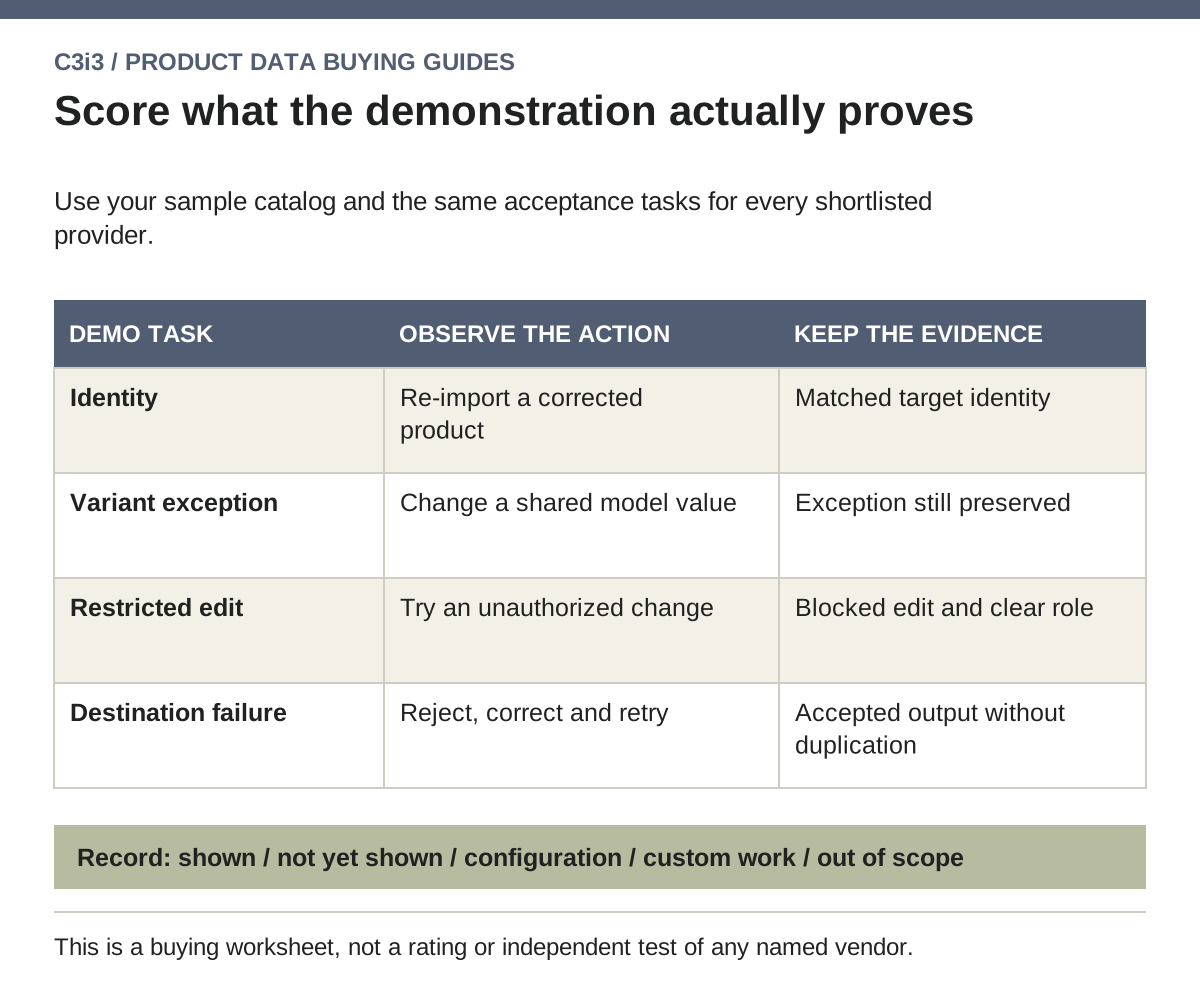
Ask the presenter to import or create your sample family and explain each identity. Distinguish the business product number, model identity, sellable variant identity and platform record key. Change a product title and verify that the identity remains stable. Then correct an imported record and show how a second import matches the existing target rather than creating a duplicate.
Demonstrate a common attribute change and a legitimate variant exception. The selected model should preserve both. Akeneo’s catalog model is one documented example of families and variant structures, not the only valid implementation. Ask how the proposed configuration handles your specific relationships, including invalid option combinations and discontinued variants. If the answer is custom development, record it as scoped implementation work rather than treating it as a standard capability already proven by the demo.
Which permissions and approval tests matter to catalog teams?
Test the actual roles that will maintain the catalog. An editor may be allowed to improve a description but not approve a technical rating. A regional contributor may work in one locale without publishing another market’s claim. The review process should make those responsibilities understandable to the people doing the work, especially when one person fills several roles in a smaller organization.
Ask the presenter to attempt a disallowed change and show the result. Then review an approved correction and inspect its history, publication condition and retraction process. A completeness indicator is useful only if the team understands what it measures. A nonempty field can still contain the wrong value. The data ownership guide helps define what permissions should protect. Evaluate whether reviewers can see the source evidence needed for a decision instead of merely advancing a record through a visually attractive status screen.
What should a publishing demonstration show beyond a connector logo?
Ask for the mapped output in a real destination or an agreed test environment. Inspect identifiers, units, variant values, asset roles and channel-specific fields. Show one value that should be withheld because it is unfinished or unauthorized for that channel. Establish how the integration reports acceptance, rejection and delayed processing. An export file or API response alone may not prove the customer-facing result.
Request a controlled failure and recovery demonstration. Reject an invalid value, correct it and retry without duplicating products or losing a newer change. Pimcore’s endpoint documentation illustrates that an API configuration defines exposed data and permissions. Ask the supplier to explain the corresponding boundaries in its proposed connection. If the recipient is an ecommerce platform, use its current requirements, such as Shopify’s documented transfer fields, as the receiving contract rather than assuming all product schemas match.
How should you compare observed features with planned work?
Use a scorecard with separate states: demonstrated using the sample, supported but not demonstrated, requires configuration, requires custom work and not supported in the proposed scope. Add a note describing the evidence and the person responsible for closing each gap. Avoid a numeric score that makes an untested promise look equivalent to a working result. Weight requirements according to the actual purchasing risk rather than giving every feature an equal point.
Ask for a written response after the demonstration so unclear answers can be corrected. Keep pricing, package limitations and implementation assumptions alongside the capability evidence. The PIM implementation cost guide explains why a lower platform fee may include less delivery work. A provider can still be a good choice when some tasks require configuration or custom work, provided the proposal identifies that work and the team accepts its cost and support responsibility.
What should be agreed before you select an implementation partner?
Request named responsibilities for migration, mappings, credentials, monitoring, staff training and ongoing changes. Confirm who responds when a source is available but a destination rejects the update. Ask for the handover documents your administrators will use: approved data dictionary, connection inventory, role definitions, release steps and recovery runbook. Technical documentation should be understandable to the people who will operate the workflow after the project team leaves.
Include a final acceptance session in which your staff complete the important tasks with the supplier observing. Confirm how approved data and media can be exported in a useful form and how an exit or later migration would preserve relationships. Akeneo’s export profile documentation is a reminder to inspect hierarchy and media options rather than checking only whether an export button exists. C3i3 can help clarify the buyer-facing catalog experience and technical content requirements while your technical stakeholders evaluate the platform and operating model.
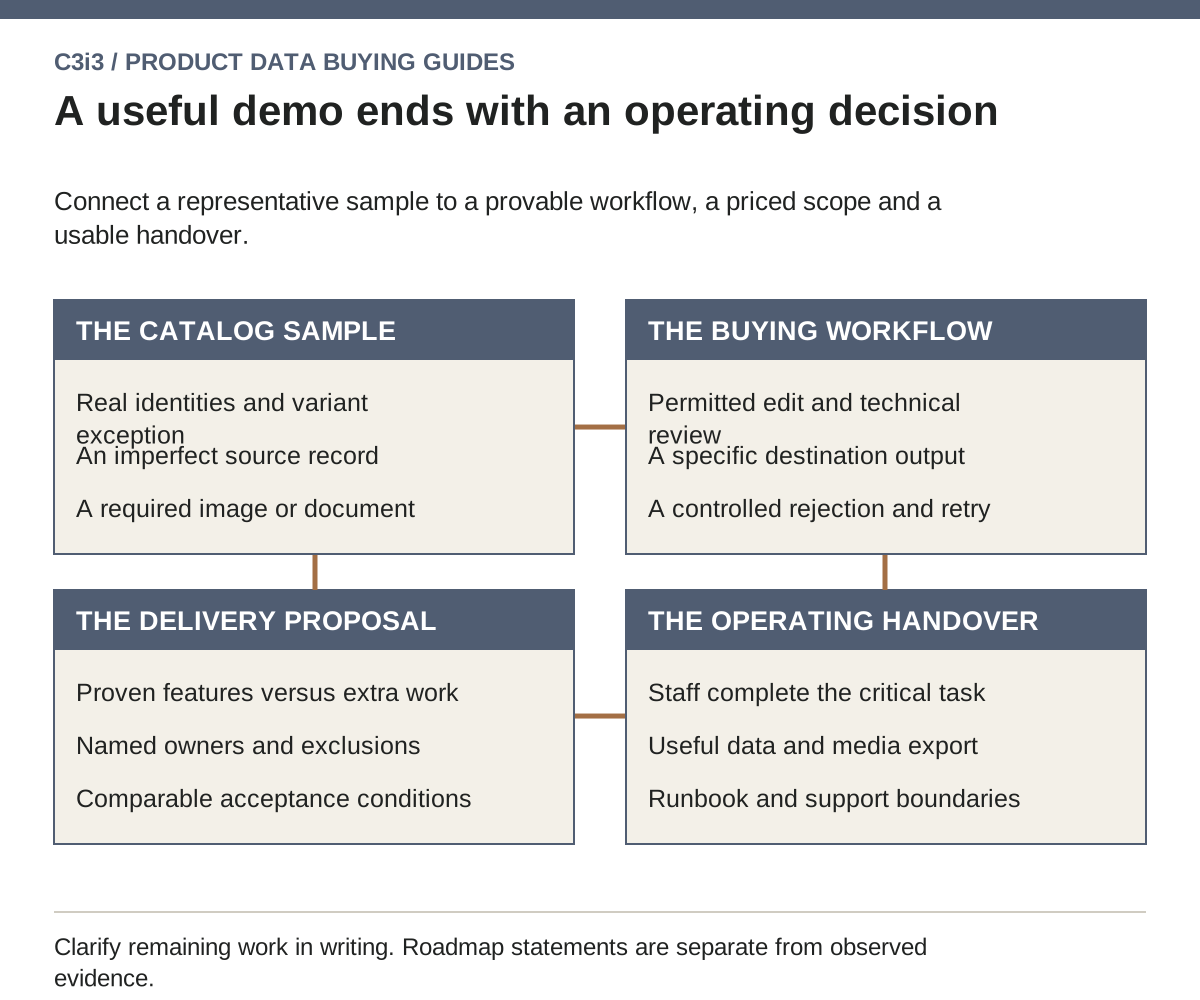
A PIM demo scorecard based on evidence rather than promises
| Test | Ask the vendor to show | Record before deciding |
|---|---|---|
| Identity and re-import | Update an existing sample without duplication | Business key, record key and matching behavior |
| Model and variants | Change a shared value while preserving an exception | Standard behavior versus configuration or custom work |
| Approval and permissions | Block an unauthorized edit and approve a valid one | Role scope, reviewer evidence and release condition |
| Destination output | Inspect the actual accepted catalog result | Mapped fields, asset roles and rejected updates |
| Failure recovery | Correct a rejection and retry safely | Error owner, retry evidence and support boundary |
| Handover and exit | Have staff run a task and inspect a useful export | Runbook, administrator readiness and portable relationships |
A hypothetical demo comparison changes the shortlist
A hypothetical manufacturer gives two shortlisted vendors the same catalog family and distributor file. One demo presents an attractive product screen but leaves variant exceptions and rejected exports for a later technical meeting. The other completes the sample workflow and identifies a required mapping configuration, including its implementation owner and acceptance test.
The manufacturer does not automatically award the project to the second vendor. It asks the first to close the same evidence gaps and requests comparable proposals from both. The decision then considers demonstrated behavior, remaining work, internal operating effort and support responsibility. This illustrative comparison shows how a shared brief improves buying evidence without claiming that any named vendor performed better in an independent test.
Key takeaways
- Give all shortlisted vendors the same representative catalog scenario.
- Test identity, variant exceptions and restricted edits with real sample data.
- Inspect destination acceptance and a failed-update recovery.
- Separate demonstrations, configuration needs and roadmap statements.
- Include staff-led acceptance, handover and useful export evidence.
Frequently asked questions
Should we ask vendors to use our own product data?
Yes, a carefully limited and appropriately sanitized sample makes the demonstration more relevant. Include difficult product relationships and a real destination requirement. Confirm the evaluation’s data handling terms before sharing nonpublic files.
Is a generic PIM feature checklist enough?
It helps create an initial shortlist, but it does not establish that the proposed configuration handles your workflow. Translate important requirements into observable tasks and keep evidence, assumptions and implementation gaps with the comparison.
How many vendors should we evaluate?
Choose a manageable shortlist based on your requirements and team capacity rather than an arbitrary industry rule. The goal is enough credible alternatives to compare tradeoffs while leaving time to inspect the evidence from each demonstration.
Sources and editorial method
Prepared from linked primary documentation checked November 20, 2026. Vendor documentation establishes stated features and operating conditions. Comparisons and worksheets are C3i3 editorial analysis; worked examples are hypothetical.
- Akeneo: catalog structure concepts
Vendor documentation for attributes, families, categories and family variants; implementation behavior depends on the selected edition.
- Akeneo: product identifiers
Distinguishes business identifiers from the immutable technical UUID.
- Pimcore: Datahub basic principle
Endpoint configuration separates exposed data, permissions and adapter-specific behavior.
- Shopify: product CSV import and export
A commerce-platform example of product transfer fields, dependencies and update semantics.
- Akeneo: product and product model exports
Export profile options and the need to preserve catalog hierarchy.
- Microsoft: product information overview
ERP suites can already contain product information, variants and distribution functions; inspect existing capabilities before adding a PIM.
Map your product information before choosing another platform.

Tell us about your catalog, variants, selling channels and current systems. C3i3 can help clarify the website, content and product-data requirements so your implementation brief addresses a defined business task.
Explore ecommerce development or tell us about your project.