








































In this article
Does rank and rent work? A useful answer starts with a particular website, a defined service and a real business prepared to receive inquiries. A search position cannot tell you whether that combination is helping anyone. Neither can a dashboard that adds phone clicks to submitted forms and calls the total customers.
This 2027 planning guide helps a business owner or marketing team evaluate an existing independent SEO asset or a small, controlled test. It uses documentation checked in November 2026, not predictions about future search features. For the model itself, begin with our rank and rent SEO guide.
What would “rank and rent works” mean for this website?
It means the asset contributes identifiable, useful customer opportunities to a real provider within a defined service scope. Write that proposition before reviewing results so success does not quietly change from accepted requests to traffic whenever the inquiry evidence disappoints.
Turn the claim into an observable hypothesis
Consider a hypothetical San Jose HVAC assessment site. Its receiving business confirms residential installation assessments in specified parts of its existing territory. It is not accepting every equipment type, commercial request or urgent repair. The test hypothesis could be: “This site helps homeowners seeking a supported installation assessment reach the receiving office, where suitable requests can progress to a confirmed assessment conversation.”
Record the actual coverage, supported customer task, receiving office and meaning of the next step. Explain coverage on the service page. Adding Oakland or San Francisco pages would require verified service relevance and useful local differences, rather than cloned copy with another city name. Our HVAC lead website guide develops those service distinctions.
Choose the decision before choosing a target
Ask what the next review must resolve. An existing site with search activity may need to establish whether its requests fit the business. A technically incomplete site needs to resolve readiness first. A provider with no assessment capacity cannot meaningfully test whether the site supplies usable assessment opportunities.
Write an observation window with a start date, review date and scope that will remain stable unless operations require a change. For example, a team might choose a twelve-week review window for this hypothetical test. That is an editorial example, not a recommended waiting period or a time-to-results promise. Record why the chosen window is useful for this business and what evidence would still be insufficient at its end.
Keep the construction task separate. If the offer or receiving route has not been established, use the local lead website build guide before treating the project as an effectiveness test.
Which evidence shows progress beyond search visibility?
Use an evidence ladder: reachable and indexed pages, relevant discovery, actual requests, provider fit and confirmed next steps. Each step supports a different claim. Evidence at an earlier step does not establish that a later one happened.
Match each claim to its source
| Evidence step | Question to answer | Useful record |
|---|---|---|
| Reachable and indexed | Can the intended page be accessed, and what is its observed search status? | Live page check and dated indexing inspection |
| Relevant discovery | Is the page appearing for searches related to its supported customer task? | Search Console query and page observations |
| Actual requests | Did a real request arrive through a working route? | Deduplicated receipt record, excluding tests |
| Provider fit | Does the request match the approved service and area? | Reviewed operational status with unresolved cases retained |
| Confirmed next steps | Did the provider and customer establish the specified next action? | Office confirmation linked to the request reference |
Google’s Search Console performance documentation explains impressions, clicks, queries and page reporting. These observations help investigate discovery. They do not identify a customer’s suitability or confirm an appointment. Also distinguish an accessible page from an indexed page and an indexed page from a page receiving relevant visits.
Keep configured events in their proper place
A successful form event can help observe website behavior. A phone-link click shows an interaction with a link. Neither replaces receipt evidence. Google Analytics lets an operator mark an important action as a key event; that reporting choice does not independently validate the customer request.
Retain operational detail in an appropriately restricted inquiry system. Keep names, email addresses, phone numbers and free-text inquiry content out of Analytics event values and page URLs, consistent with Google’s guidance on personally identifiable information. For route-level evidence, use our call attribution and routing guide. For classification definitions, use the inquiry qualification guide rather than inventing a second classification system for this review.
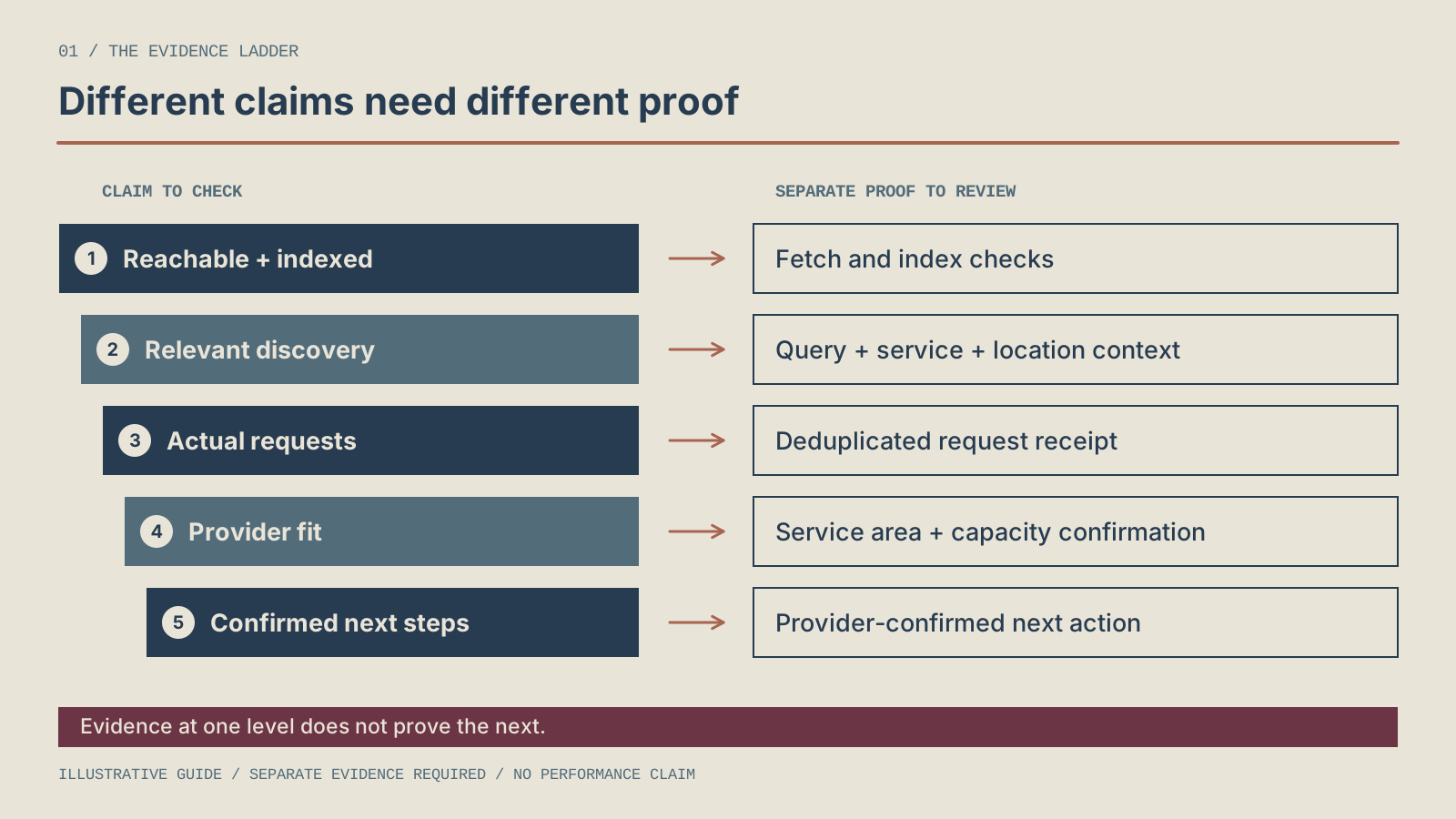
<p>Check a different record at each evidence step: page and indexing checks, relevant search observations, deduplicated request receipt, provider fit review and a confirmed next action.</p>
How can you compare the test with the provider’s existing inquiries?
Compare a stable, clearly labeled test with the provider’s normal inquiry sources over a documented period. Use the comparison to identify plausible contribution and operating differences. An ordinary before-and-after comparison cannot isolate the website’s causal effect.
Establish what was already happening
Before changing the independent asset, summarize the provider’s existing company-site inquiries for the same service and area, where records allow it. Include raw request counts, reviewed fit, confirmed next steps and unknown outcomes. Record whether the company site is agency-managed, whether its content changed and whether its office uses the same response process.
Keep source uncertainty visible. A customer may have seen both websites, received a referral or returned directly after an earlier search. An attributable request is useful evidence about a route, but it does not establish that the person would otherwise never have contacted the provider. Ask about prior contact where appropriate and retain an “unknown source” category instead of forcing every request into the new asset’s column.
Document the changes that could explain a difference
For the San Jose example, note a hot spell, a change in installation assessment availability, a revised phone destination and any separate advertising activity. HVAC seasonality should be interpreted using the provider’s actual service history and local conditions, not an assumed national calendar.
Compare equivalent service categories wherever possible. Installation assessment requests this period should not be judged against last period’s total repair calls. A prior-year comparison can add context if the offer and record quality are comparable. It still cannot remove differences in weather, staffing or other acquisition activity.
If the dedicated site improves while total suitable inquiries stay flat, investigate whether inquiries shifted between routes. If both improve, inspect shared conditions before assigning the entire change to the test. The resulting conclusion might be “the independent site supplied documented assessment requests during this window” while the incremental contribution remains uncertain. For the strategic choice between improving the provider’s own website and using a separate asset, read rank and rent versus local SEO.
How should you read a small lead-generation funnel?
Read raw counts, explicit denominators and unresolved outcomes together. A percentage describes the particular records included in its calculation. It does not establish an expected future rate, especially when only a few requests have been observed.
A hypothetical example with named denominators
The following invented review belongs to the San Jose assessment scenario. It is not a client result, forecast or benchmark. Suppose the period contains 2,000 search impressions and 80 search clicks. The inquiry system separately records 10 unique requests after removing test submissions and duplicates. Of those 10, seven fit the approved offer, two do not fit and one remains unresolved. Four of the seven suitable requests have a confirmed assessment conversation.
| Calculation | Hypothetical result | What it describes |
|---|---|---|
| 80 search clicks ÷ 2,000 search impressions | 4% | Search click-through rate for that report scope |
| 7 suitable requests ÷ 10 unique requests | 70% | Observed fit among all received requests, with one unresolved |
| 4 confirmed conversations ÷ 7 suitable requests | About 57% | Observed next-step progression among suitable requests |
Keep the counts beside the rates. One additional suitable request would materially change this small sample. A confirmed conversation remains a conversation, not completed installation work.
Do not divide incompatible totals
The 10 received requests cannot automatically be divided by the 80 Search Console clicks and called an organic conversion rate. Requests might include direct visitors or repeat visits, and the reporting systems observe different things. A defensible session-based rate needs an aligned analytics population, a defined event and a stated attribution method.
For the decision review, distinguish the early search ratio from the operational ratios. Strong click-through with poor fit suggests a different investigation from suitable requests that rarely reach a conversation. Do not multiply these percentages into a future customer forecast. The useful output is a diagnosed stage and a question the next review can answer.
Why might visibility fail to produce useful provider opportunities?
The constraint may be discovery relevance, the contact experience, the provider match or current receiving capacity. Locate the earliest unsupported step in the evidence ladder before changing the whole website. Different failures require different actions.
Visibility without requests
First inspect which queries and pages produced the exposure. An installation assessment site may attract equipment research rather than people ready to discuss service. Check whether the landing page explains the supported request, actual area and next step. Then verify the live contact route. An informative page can attract relevant research while a broken form independently prevents response.
If there are few relevant clicks, the request sample cannot yet evaluate the offer well. Review the search and content problem rather than declaring that customers rejected the provider. Google’s Search Essentials make clear that satisfying requirements does not guarantee crawling, indexing or serving. Publication alone does not settle the discovery question.
Requests without acceptance
Separate unsupported service requests from suitable requests the office cannot currently handle. In the hypothetical assessment test, repeated urgent repair calls could indicate misleading content or an overly broad contact label. Suitable assessment requests that remain unacknowledged could instead indicate a receiving-process problem. Review actual records and discuss them with the provider before assigning a cause.
A roofing inquiry review may focus on property and service fit, as our exclusive roofing lead guide explains. A commercial cleaning site may need to distinguish recurring service from a one-time request.
No usable inquiry inventory
An existing domain may have no verified request history. Report that plainly: there is an asset to evaluate, but no demonstrated supply of useful inquiries. If no real provider can receive the advertised service, pause that path before interpreting rejection counts. Additional traffic cannot fix unavailable service capacity.
When should you continue, revise or pause the test?
Continue when the route works and the remaining uncertainty can be resolved by further observation. Revise when evidence identifies a specific correctable mismatch. Pause when the offer, receiving capacity or measurement failure prevents a responsible and interpretable test.
Use a decision record with a real tradeoff
| Review field | Record before deciding |
|---|---|
| Hypothesis and window | Service, territory, start date, review date and intended next step |
| Evidence reached | Highest supported step, counts, sources and missing outcomes |
| Alternative explanations | Seasonality, other campaigns, service changes and route interruptions |
| Decision and tradeoff | Continue, revise or pause, plus what that choice leaves unresolved |
| Next accountable action | Owner, bounded change, next review date and evidence needed |
Continuing the same scope preserves a more interpretable comparison, but it also leaves an unresolved weakness in place. Choose it when the offer and route remain useful and the evidence is simply sparse. Revising a service explanation may improve fit, but it creates a new version of the test. Date the change and keep earlier observations identifiable.
Pausing can prevent additional unsupported requests while the provider restores capacity or the operator repairs delivery. It also interrupts observation. State the condition for restarting rather than leaving the project indefinitely labeled “under review.”
Write the conclusion at the strength of the evidence
A useful conclusion identifies the asset, period and supported outcome: “The reviewed site produced suitable assessment requests, with confirmed conversations in some cases; broader contribution remains uncertain.” A low-activity review may instead conclude that evidence is insufficient. Both can support an honest next decision.
Use the same discipline for new search experiences. Google’s AI features guidance says established SEO practices remain relevant and supporting-link eligibility depends on indexing and snippet eligibility. An anecdotal appearance in an AI result does not replace request and provider evidence. This 2027 edition is a planning framework, not a prediction of future inclusion.
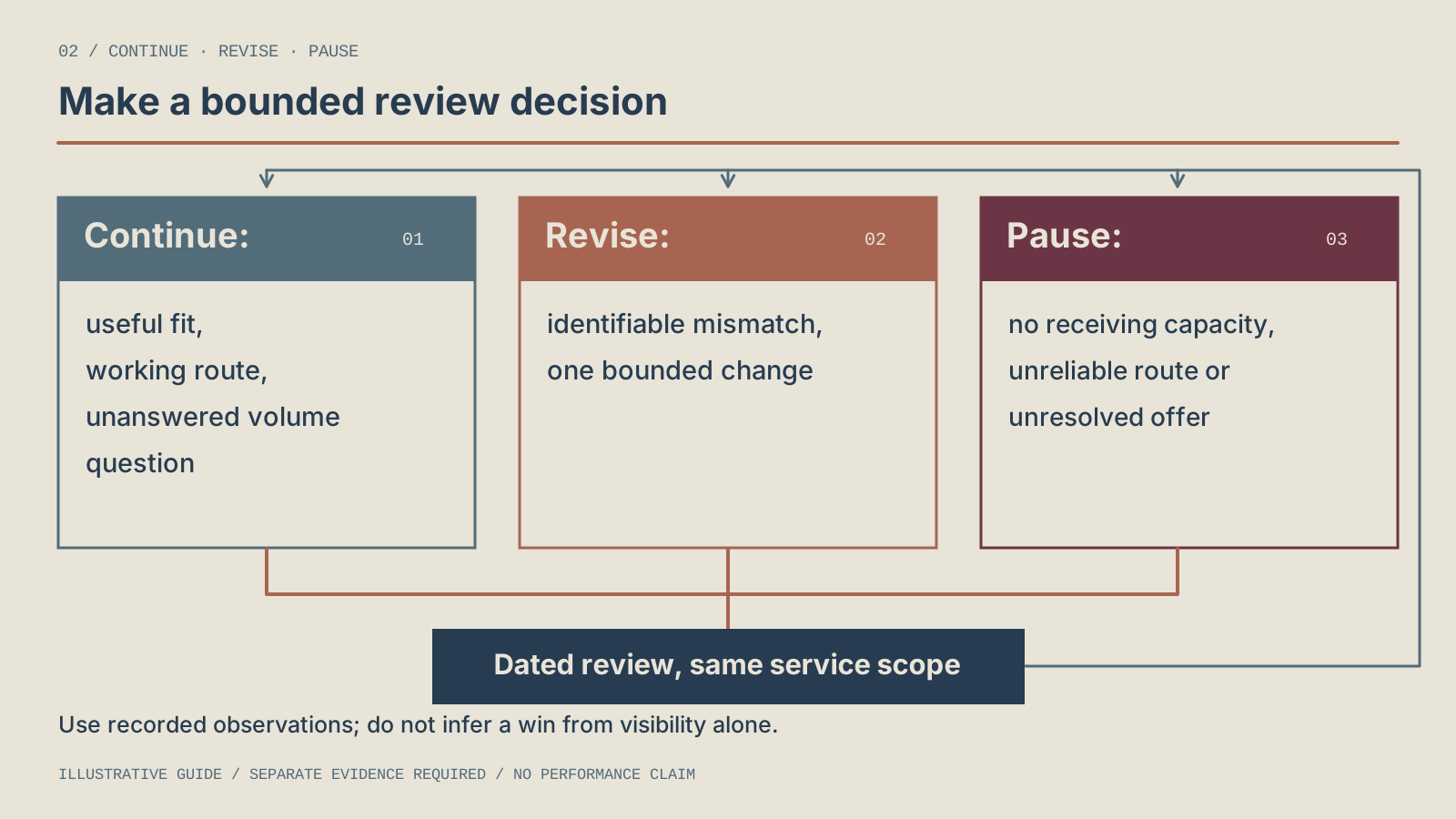
<p>Continue a useful test when evidence is sparse, revise a diagnosed mismatch or pause an unsupported inquiry path. Record the tradeoff, responsible owner and next review date.</p>
What else should you know about evaluating rank and rent?
These questions address review limits and incomplete evidence.
Does an indexed rank and rent site prove the approach works?
No. Indexing supports a discovery-readiness observation. You still need evidence of relevant searches, received requests, service fit and confirmed next steps. Report the stage actually reached rather than treating search eligibility as proof of customer acquisition.
How long should you test an existing asset?
Choose the window around the service, observable activity and decision at hand. Document the dates and relevant operating conditions. There is no universal period in which a site must produce enough evidence, and extending observation does not guarantee a useful result.
Can a site work if the provider declines suitable requests?
It may demonstrate relevant inquiry generation while the receiving arrangement fails to provide the intended next step. Preserve both findings. Check capacity and response records, then decide whether the service path can remain accurate and useful during that constraint.
Should a successful small test expand into more cities?
Only consider expansion after identifying what succeeded and confirming the new territory’s actual service coverage. A few accepted requests do not validate another market. Distinct customer needs and maintainable information should determine the next content scope.
What if provider outcomes are unavailable?
Limit the conclusion to what is documented. Receipt can establish that requests arrived, but missing provider feedback leaves fit or progression unresolved. Agree on an achievable outcome review before making stronger effectiveness claims or expanding the test.

How C3i3 Can Help
C3i3 can help evaluate a defined SEO asset through search research, content review and a practical inquiry-evidence plan. Our Local SEO services can investigate discovery and service relevance. Our Lead Generation Campaigns services can connect that research with a clearer customer journey and review method.
Bring the existing website, supported service and territory, available inquiry records and the decision you need to make. Contact C3i3 to discuss a bounded evaluation. The agency scope can establish what the current evidence supports and what the next test should resolve. The real receiving business supplies capacity decisions, confirms customer next steps and performs the service.