








































In this article
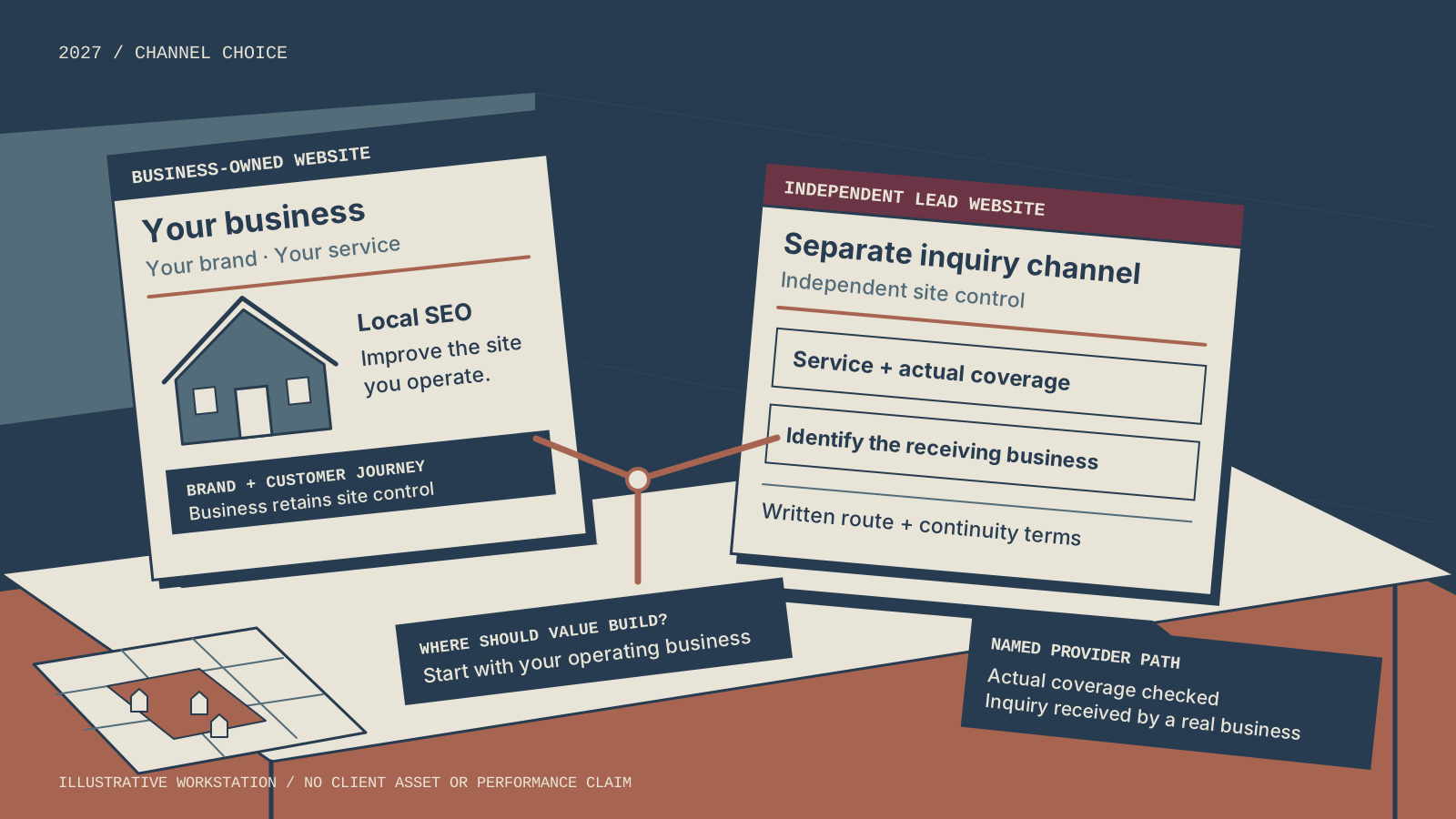
A business owner comparing rank and rent with Local SEO is choosing where to develop the next customer acquisition channel. One route improves the website and local presence of the company already serving customers. The other evaluates a separate website whose operator controls the asset and directs suitable inquiries to a receiving business. Both may involve search engine optimization, yet their relationships with your brand and daily operations differ. This guide helps contractors and service business owners make that choice from their existing website, real coverage and available evidence. It is a 2027 planning edition based on documentation reviewed in November 2026, not a forecast of search rules. Begin with the customer journey your business needs to improve, then decide which asset should support it.
What is the difference between rank and rent and Local SEO?
Local SEO improves how an operating business can be found and understood in local search. Rank and rent describes an arrangement around a separately controlled lead website. SEO can support either website, so the meaningful comparison is which asset the work develops and how customers reach your business.
Follow the asset and the relationship
With agency Local SEO for your company site, the pages explain your business, its services and its actual coverage. Inquiries enter your company’s customer journey. Your team can use the same site when a referral asks who you are, a returning customer needs contact information or a prospect wants to assess your work.
With a separate leased lead channel, another operator may control the site and its inquiry route. Your business receives requests within a defined operating arrangement. The site must explain who receives those requests. A person submitting a form is seeking help with a service need; submission alone does not establish an accepted job or a continuing customer relationship.
The distinction matters even when both proposals mention the same service and city. Ask, “Will this work strengthen our primary business presence or create access to an independently maintained channel?” Our rank and rent SEO lead-generation guide explains the wider model. Here, the task is choosing its role relative to your existing company website.
Neither label settles the quality of the proposal. A company-owned website can contain weak content. A separate site can offer useful information. Judge the specific public journey and the operating responsibilities behind it.
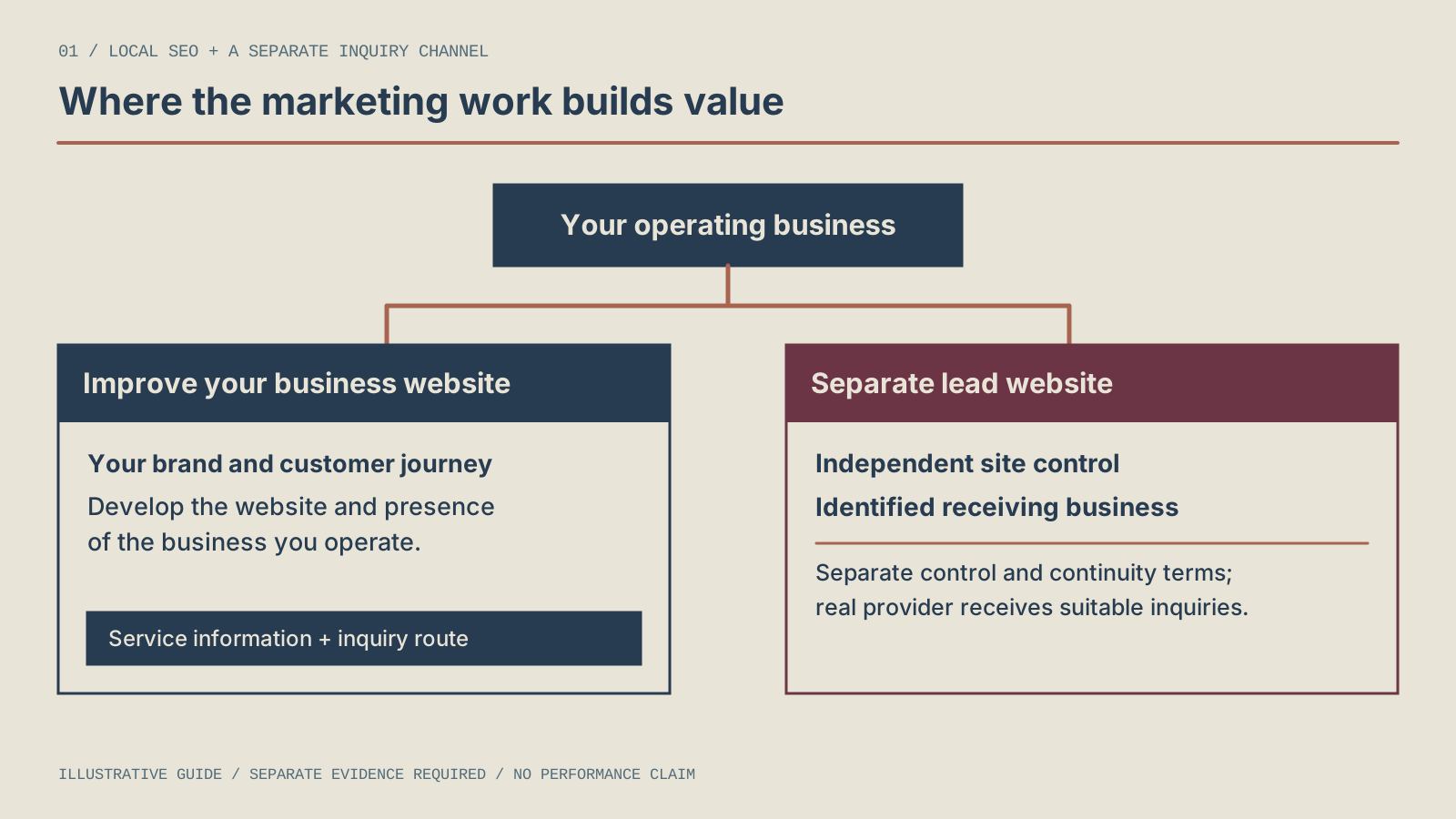
<p>Local SEO develops the operating business’s own website and presence. A separate lead website has independent control and a clearly identified receiving provider. Both require accurate service information and responsive inquiry handling.</p>
When should your existing business website come first?
Your existing website should come first when customers cannot confidently understand your service, verify your business or complete an inquiry there. Resolve those gaps before adding a separate channel that introduces another public explanation and another handoff.
Review one real customer task
Open the page for a service you want to provide. Can a visitor recognize the business, see whether the service fits their need and understand the next step? Try the contact route on a phone. Check whether the office receives enough context to respond. This narrow review often reveals a concrete priority that a general request for “more leads” misses.
A company may already have credible project information and accurate service coverage, yet bury the relevant page. Improving navigation and contextual links can help visitors reach it. Google recommends crawlable links and descriptive anchor text so people and search systems can understand linked destinations. That supports improving the structure customers already use. Google’s link best practices explain the technical foundation.
A hypothetical San Jose HVAC decision
Consider an HVAC company that actually serves homes in San Jose. Its website describes installation but barely explains the repair work its team also accepts. The office receives vague messages because the form asks only for a name and phone number. Before evaluating an independent repair lead site, the owner chooses to clarify supported repair services and improve that company-site inquiry journey.
This example assumes no search volume or outcome. The decision follows an observable mismatch between the existing page and the work the business performs. If that mismatch is later resolved, a separate channel can be assessed on its own purpose. Our dedicated HVAC website guide addresses the service-specific scope once that choice is appropriate.
Also consider the internal workload. Someone must approve service changes and answer inquiries in either model. Improving a known website can make those responsibilities easier to locate when the business currently has fragmented information.
Who should the customer believe they are contacting?
The customer should understand the real business receiving the inquiry and the role of any independent lead website. Website control does not turn a marketing operator into the contractor that performs the work. Make the public explanation match the actual handoff.
Keep the company’s identity coherent
On your operating business website, the brand, service evidence and contact process should describe your company. On an independent lead site, the explanation must distinguish the website operation from the provider. An attractive service name should not leave a homeowner believing they contacted a trade company that does not exist.
For example, review the words immediately above a request form. Do they explain where the inquiry goes? Does the confirmation message agree with that explanation? Can the person answering recognize the service the customer saw? These are practical identity checks, separate from whether a page attracts search visits.
Treat Business Profile ownership as a separate fact
Google explicitly lists lead-generation agents and companies as ineligible for Business Profiles. A real provider’s eligibility must be assessed for its own operation. Google also limits profile management to owners or authorized representatives and says profile website content must be owned and managed by the business owner. A leased lead asset is not automatically an appropriate profile destination. Google’s business eligibility and ownership guidelines set out these distinctions.
Your company’s real profile should remain connected to its real business identity. An agency can have authorized management responsibilities without becoming the business. Our guide to rank and rent and Google Business Profiles examines eligibility in more detail.
For this comparison, the decision is simple: evaluate the independent website’s organic search purpose separately from any legitimate work on your company’s profile. If a proposal treats your existing profile as part of the leased site’s inventory, ask for the scope to be corrected before comparing the options.
Can both websites target the same service and location?
They can address the same broad service and territory only when each has a clear customer purpose and accurate business representation. A second domain is not a sufficient reason to duplicate your company’s pages or create near-identical city pages that send visitors through an unnecessary intermediate step.
Look for a reason a customer would use each site
Ask what the additional website explains or enables that the primary site does not. The answer should describe a useful journey, such as a clearly separated inquiry process with its own editorial purpose. “Another chance to rank for the same phrase” does not explain customer value.
Google’s doorway-abuse policy includes multiple similar websites intended to maximize reach for a query and city-targeted pages or domains that funnel visitors to one destination. That makes a city-clone expansion a poor basis for choosing a separate asset. Assess the proposed pages against the current Google Search spam policies.
A hypothetical Oakland roofing decision
An Oakland roofing business already explains its roof inspection process well. A proposed separate site would repeat that copy under a different domain and route every request to the same office without explaining a distinct role. The owner chooses to improve the original inspection journey instead. The proposal has not identified a useful reason for a second site.
A different proposal could deserve review if it provides a genuinely distinct, clearly explained customer journey and the business can support it. The owner would still need evidence of the site’s purpose and service accuracy. Our roofing lead website guide covers the trade-specific questions after that distinction is established.
Use service differences without inventing territory
A company may receive different requests from homeowners and property managers. Those differences can justify distinct content within the business website before they justify another domain. Choose the structure that makes the customer’s task clear. Actual service coverage determines the locations you can describe, regardless of the structure selected.
What evidence should determine your choice?
Choose from evidence about your current customer journey, the proposed site’s distinct role and your team’s ability to handle the work. Compare both options against the same service need. A visibility screenshot or a broad keyword estimate cannot answer those operating questions alone.
Complete a comparison worksheet
Use one actual service and one confirmed coverage area. Record a specific answer in each column, with a page, test or named person supporting it. Mark unknowns so they become tasks rather than assumptions.
| Decision question | Improve your business site | Evaluate a separate lead site |
|---|---|---|
| What customer task improves? | Identify the existing service or contact gap. | Describe the distinct journey the asset adds. |
| Who controls the public pages? | Confirm your company’s access and approver. | Name the independent controller and update process. |
| Who receives the inquiry? | Test your company’s receiving route. | Verify the identified provider and handoff. |
| What proves service fit? | Compare page promises with current operations. | Compare site promises with the receiving team’s capabilities. |
| What happens during a change? | Identify who updates your site and intake. | Identify who updates the asset and its provider explanation. |
| What result will inform review? | Observe whether suitable visitors can inquire successfully. | Observe whether distinct, suitable requests reach the provider. |
Follow the decision paths
- Existing journey fails: improve your business site first, then reassess the need for another channel.
- Existing journey works and the separate site has a useful purpose: assess that asset’s control, identity and receiving process.
- Both proposals duplicate the same journey: consolidate the plan around the clearest customer destination.
- Essential evidence is missing: resolve the missing page, test or operating answer before choosing.
These paths avoid treating rank and rent Local SEO research as a popularity contest between marketing terms. If a separate site already exists, inspect its actual pages and inquiry behavior. If it is proposed, distinguish those plans from observed results. The companion guide to evaluating whether rank and rent works develops the evidence question further.
Do not select an additional domain solely because AI search is changing. Google says its established SEO practices remain relevant to AI Overviews and AI Mode, with no special optimization required. Its guidance on AI features and websites supports concentrating on accessible, useful content rather than an unsupported 2027 tactic.
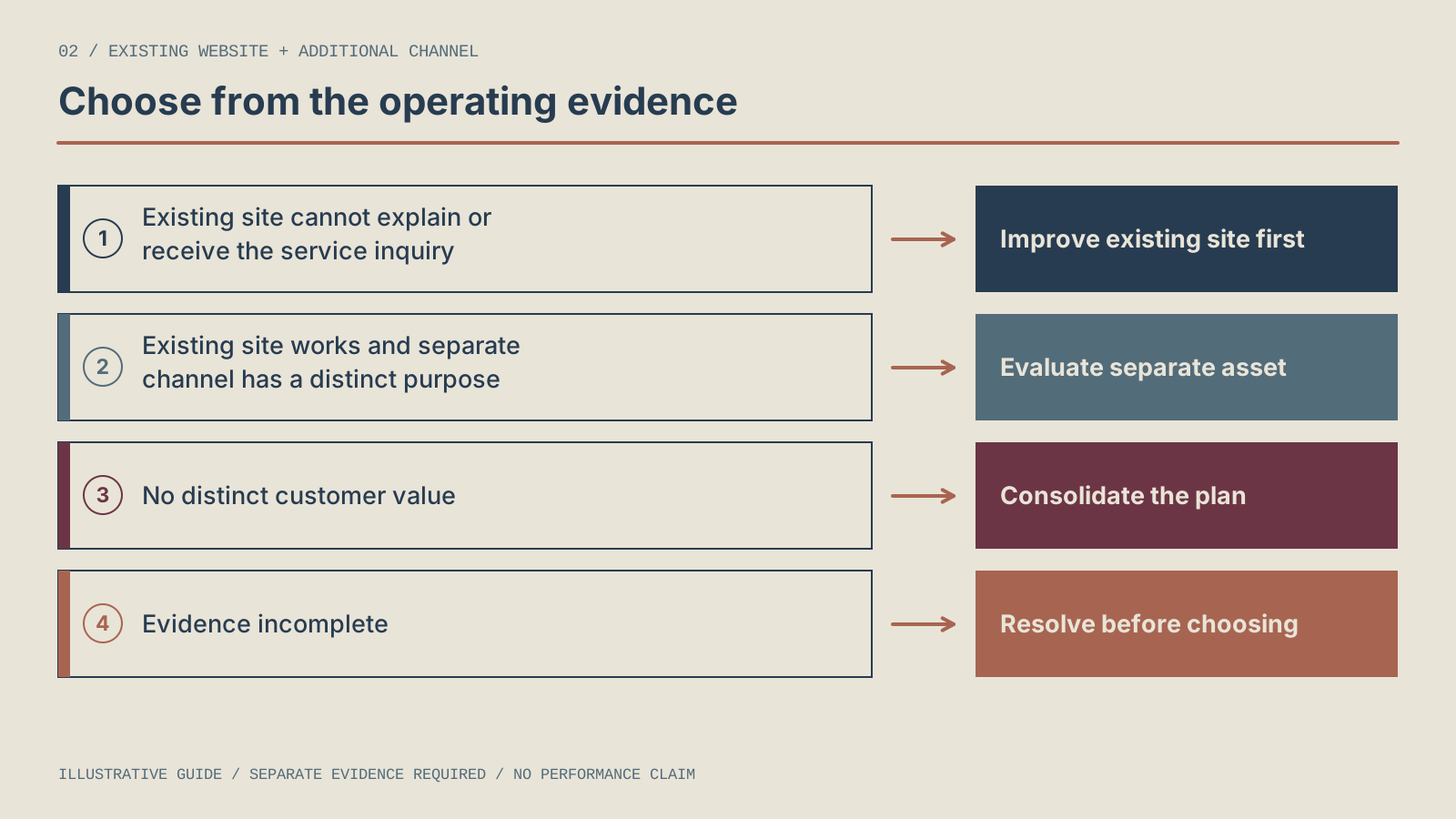
<p>Improve the existing website when its service information or inquiry route fails. Evaluate a separate asset when the core site works and the additional channel offers a distinct useful journey. Consolidate overlapping pages and resolve missing evidence before choosing.</p>
How should continuity and daily responsibilities affect the decision?
Choose the arrangement your business and the website operator can keep accurate through ordinary service and staffing changes. Both routes need maintenance. A separate asset adds coordination between its controller and your receiving team, which should be justified by its useful role.
A hypothetical San Francisco cleaning decision
A cleaning business serving San Francisco has a functioning company website. It considers a separately controlled site focused on a particular cleaning inquiry journey. The owner asks who updates availability, who reviews the public service description and who corrects a failed inquiry route. The team can identify those people and demonstrate the handoff, so evaluating the additional channel is a coherent next step.
If those responsibilities remain unanswered, the owner cannot yet judge the arrangement. The question is operational readiness, not an assumed quantity of cleaning searches. Our cleaning lead website guide addresses the customer categories once the channel’s role is clear.
Consider a routine change such as pausing one service. On the company website, your approver should be able to correct the page and inquiry process. On a separate site, the provider needs a dependable route to notify the operator and confirm the public change. Review open inquiries too, so the customer is not left expecting a response from an unavailable team.
Ask what your business retains when it stops using the separate channel. Its own website and customer communications should remain understandable. For a detailed account-by-account review, use our lead website control and ownership worksheet. Here, continuity determines whether the extra coordination fits your operation.
What else should business owners ask before choosing?
The remaining questions should clarify scope and evidence. Keep the comparison tied to the operating business rather than assuming one model fits every service company.
Is rank and rent another name for Local SEO?
No. Rank and rent describes a website arrangement. Local SEO describes work on local search visibility. A separate lead website can involve SEO while your business also improves its own website.
Can our business use both approaches?
Yes, when each has a useful role and the team can keep both accurate. Define the customer journey for each before committing to parallel content and inquiry handling.
Should we move our Business Profile to the leased site?
Do not assume that is appropriate. Review the real business’s identity, ownership and authoritative destinations against the Google guidelines cited above. Lead-company eligibility remains separate.
Does a new site need to replace our existing website?
No. Evaluate it as an additional channel. Your company website still supports your brand, returning customers and direct inquiries, so its quality remains relevant.
Does this planning edition predict 2027 search changes?
No. It uses current documentation to structure a business decision. Review the applicable guidance again when the actual project is scoped and implemented.

How C3i3 Can Help
C3i3 can assess SEO, content and lead-generation projects against your real business need. Bring your current website, the service and area you want to support and any separate-site proposal. We can help identify the existing journey’s gaps and define which work belongs on which asset.
Explore Local SEO for your operating business or lead-generation campaign planning, then contact C3i3 about your website decision. C3i3 is a digital agency. The work begins with assessment and scope; this guide is not an offer of trade services or existing lead inventory.