








































In this article
A product catalog can be technically online while remaining difficult to interpret. A buyer sees a family name on the website, a different model name in a distributor listing and an older specification in a PDF. An AI answer may combine those details into a recommendation that sounds precise but describes no single product you currently sell.
For product brands, AI search optimization (AIO) begins with that information problem. The agency's useful contribution is to help the website explain product relationships, support important facts and give buyers a clear route from an answer to the right model. More articles will not repair a catalog whose source information contradicts itself.
This guide focuses on the catalog work behind AI search optimization services. It is for teams selling equipment, technology products, components or other ranges where model identity matters. Answer engine optimization (AEO) overlaps this work when buyers need direct, verifiable answers about a product. Neither label means that opening a page to a crawler will make an AI system recommend it.
Why does AI search expose weaknesses in a product catalog?
AI-assisted comparisons can expose a weakness that already exists for human buyers: the website does not clearly identify which product a statement describes. When several pages share vague descriptions or carry incompatible facts, an answer can be difficult to verify even when it links to your domain.
Separate three situations before requesting changes. A model may be absent from public search results. It may be present but described inaccurately. Or the description may be accurate while the suggested application is unsuitable. These call for access investigation, factual reconciliation and clearer suitability boundaries respectively. Treating all three as a demand for more content leaves the actual problem unresolved.
What should your first example contain?
Capture a real buyer question, the observed answer, the date and the pages that could support or contradict it. Identify the exact disputed statement. “AI does not understand our range” is too broad to assign. “The answer attributes Model B's outdoor rating to Model A” creates a tractable catalog task.
Google's AI features guidance connects participation to established search practices and does not prescribe a separate AI schema. The practical lesson is to improve the public product explanation and its access conditions, rather than create a second, conflicting version solely for an assistant. For general terminology, use the existing AI search optimization overview.
How should you separate families, models and variants?
Use the product family to explain the range, the model to define a specific design and the variant to identify a selectable difference within an appropriate group. The exact hierarchy should reflect how the products work and how the business maintains them, not a naming convention invented for search.
An illustrative industrial camera range might have a family overview, separate model pages for distinct sensor designs and variant information for supported connector choices. A mounting bracket sold separately belongs in a compatibility relationship, not automatically in the same variant group. A replacement generation is another relationship again. Write those distinctions down before generating URLs.
Which facts can a family page safely summarize?
A family page can explain shared characteristics and show the differences a buyer should compare. It should make exceptions visible. If one model supports a particular operating condition, label that model rather than allowing a family-level sentence to imply universal support. A comparison table is useful when the column labels identify genuine differences and the values are approved.
Build an initial relationship sheet with family identifier, model identifier, variant identifier, canonical destination, current lifecycle state and source document. Include “not yet resolved” where a relationship is unclear. That row is a decision for the product team, not permission for the agency to guess. The separate product schema guide explains how a verified model can later inform structured data.
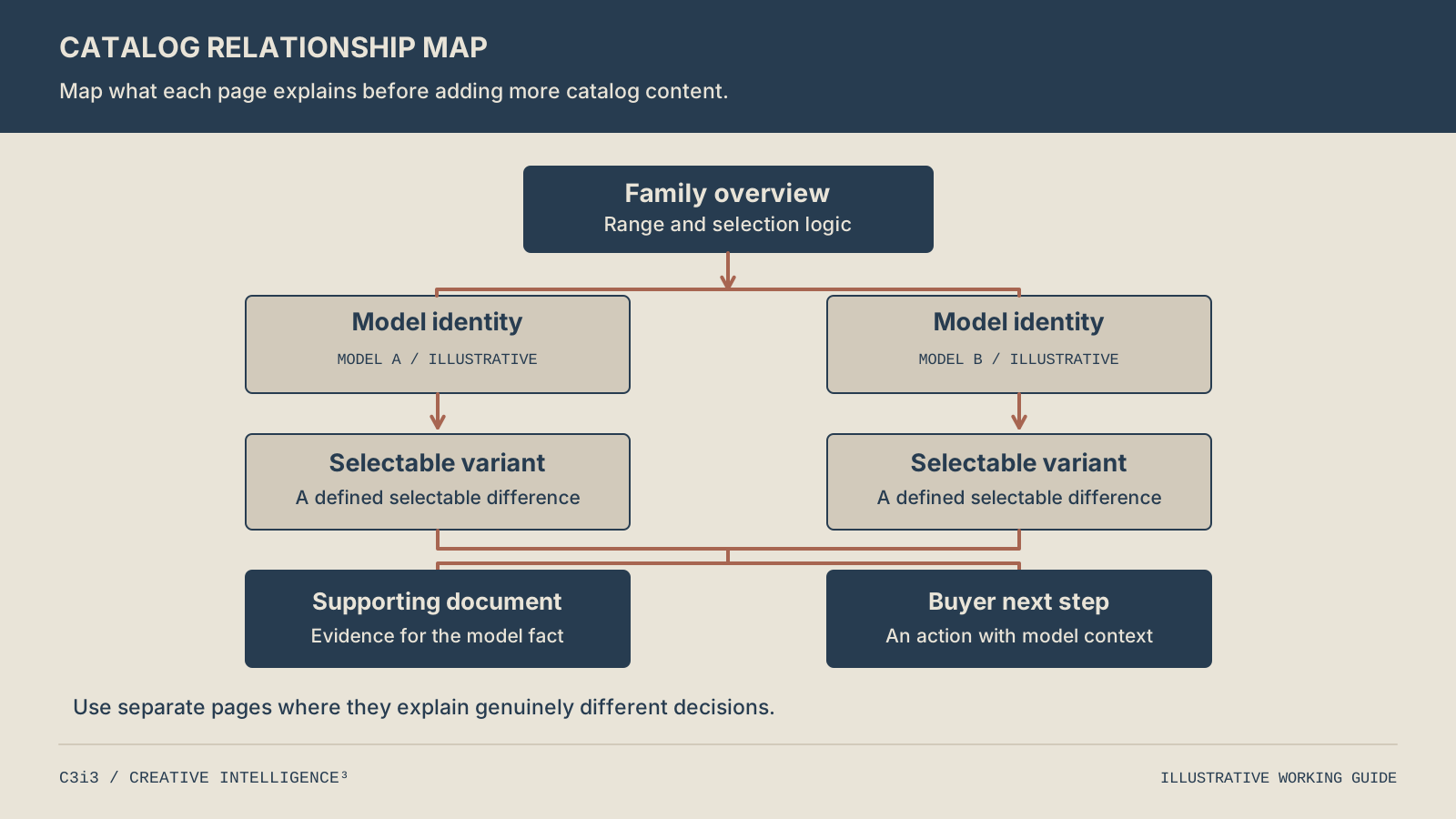
A family explains the range. A model establishes its identity. A variant describes a defined difference. Documents support facts and the next step retains product context.
What should count as the authoritative product information?
The authoritative record should be the business-approved source for a defined fact, with a clear public destination and a way to trace changes. A website page is useful as the public explanation, but the information behind it may originate in a product system, a current datasheet or an approved lifecycle notice.
Choose a source at the field level where necessary. The product system may establish the current model identifier. A technical document may establish an operating limit. A sales operations record may establish which market can request the item. Combining these sources is reasonable when the team knows which one governs each field.
How do you handle disagreement between a page and a PDF?
Record the conflicting statements and ask the accountable product owner to resolve them. Do not select the more attractive number or assume the newest file is correct merely because its upload date is later. A document may have been re-uploaded without a technical revision. Check the document identifier and revision meaning.
For the illustrative camera family, the source sheet might distinguish a shared housing description from model-specific sensor data and a market-specific availability note. The agency can then update explanatory copy without extending a characteristic to the wrong model. Keep the public source readable: a visitor should understand which document applies before opening it. Consistent product facts help a buyer verify a recommendation even when the original AI answer remains outside your control.
Which catalog pages should buyers and crawlers be able to reach?
Make the public pages needed for product evaluation reachable through ordinary navigation and contextual links. A buyer should be able to move from the range overview to a relevant model, then to a supporting document or application explanation without knowing an internal part number first.
Google's ecommerce navigation guidance explains the value of linked paths through categories to products. A search box alone may leave products difficult for crawlers to discover. The same navigation review is useful for a B2B catalog even when the final action is an application inquiry rather than checkout.
Does every filtered combination need its own page?
No. A useful destination needs a defined purpose. Compare a stable model page with a temporary filter state that changes only sorting. The model page may deserve a lasting destination; the filter state may add no independent explanation. Decide how selected variants are reached and represented before creating a large number of near-identical pages.
Test the path as a new visitor. Start at the family page, find a model, identify the appropriate document and check the next action on a phone. Record broken links and missing context separately from crawler restrictions. A page can be accessible to software yet confusing to buyers. The product-page crawler guide covers the separate access decisions in more detail.
What should a model page explain beyond its specifications?
A model page should connect verified specifications to the decisions a buyer needs to make. State what the model is, the relevant use cases, the meaningful constraints and where to find current supporting material. A list of values without context can still leave a buyer uncertain about suitability.
Ask sales and technical staff which questions recur before a useful inquiry. For an illustrative camera, questions might concern integration interfaces, supported accessories or how to identify the correct document revision. Use approved answers, and distinguish a general selection consideration from a confirmed application claim.
How much should you explain on the page itself?
Keep the essential identity and selection boundaries in visible page content. Link to documents for deeper detail, not as a substitute for naming the product or clarifying its status. A document link labeled only “Download” is less useful than one that identifies the model and document type. Do not hide the only important limitation in a decorative graphic.
Write direct answers because readers need them, not because an answer-shaped paragraph guarantees extraction. A helpful opening might identify the intended application and state that integration compatibility requires checking the listed interface. The agency should flag missing information for review rather than fill it with broad claims about performance. When the model genuinely cannot answer a buyer's question, say what information is needed for the next discussion.
How do you keep names and identifiers consistent across the catalog?
Give each product a stable identity and record the legitimate aliases a buyer may encounter. The aim is to connect recognizable names without merging distinct products or erasing the model information needed for selection.
A product might have an official model name, a short sales label and a distributor's stock reference. Explain the relationship where it helps the customer. Do not present a reseller identifier as if it were the manufacturer's model number. When a reference belongs to a bundle, distinguish the included model from the complete bundle.
What belongs in a catalog naming worksheet?
Use columns for approved product name, stable model identifier, permitted short form, public page, matching document identifiers and known incorrect references. Add a reason for each alias. A one-off typo does not necessarily deserve prominent public repetition; a widely used former name may need a clear explanation.
For Korean and English ranges, coordinate the same identity before translating descriptions. The Korean AIO brand-information workflow addresses conflicts between language versions separately. Keep multilingual naming decisions connected to the catalog record so the model page, downloadable files and related social content remain understandable together. Search systems may still choose other sources, but the brand's own sources should offer a consistent route to verification.
How should the catalog distinguish current and discontinued products?
Show lifecycle status where buyers make a selection, and preserve useful historical context when people still need it. A discontinued model can remain relevant for installed equipment, documentation lookup or compatibility checks. Its page should make clear whether it is a current purchase option.
Separate a temporary availability change from permanent retirement. Also distinguish a successor from a direct substitute. An updated product may serve a similar purpose while changing installation, interfaces or supported accessories. A link to the new model should explain that relationship rather than silently redirecting every visitor as if nothing changed.
Which linked surfaces need a lifecycle review?
Check category listings, comparison tables, application articles, downloadable catalogs and prominent media descriptions. A model page can correctly say “discontinued” while an older range introduction continues to recommend it. Create a correction queue that follows the relationship sheet instead of relying on somebody to remember every mention.
Use the discontinued-product correction guide to decide how to handle archived pages and replacement paths. Avoid treating retirement as an automatic deletion instruction. The important question is what the visitor needs from the old URL now. That decision belongs to the product's actual support and sales situation, with the website implementing the chosen public explanation.
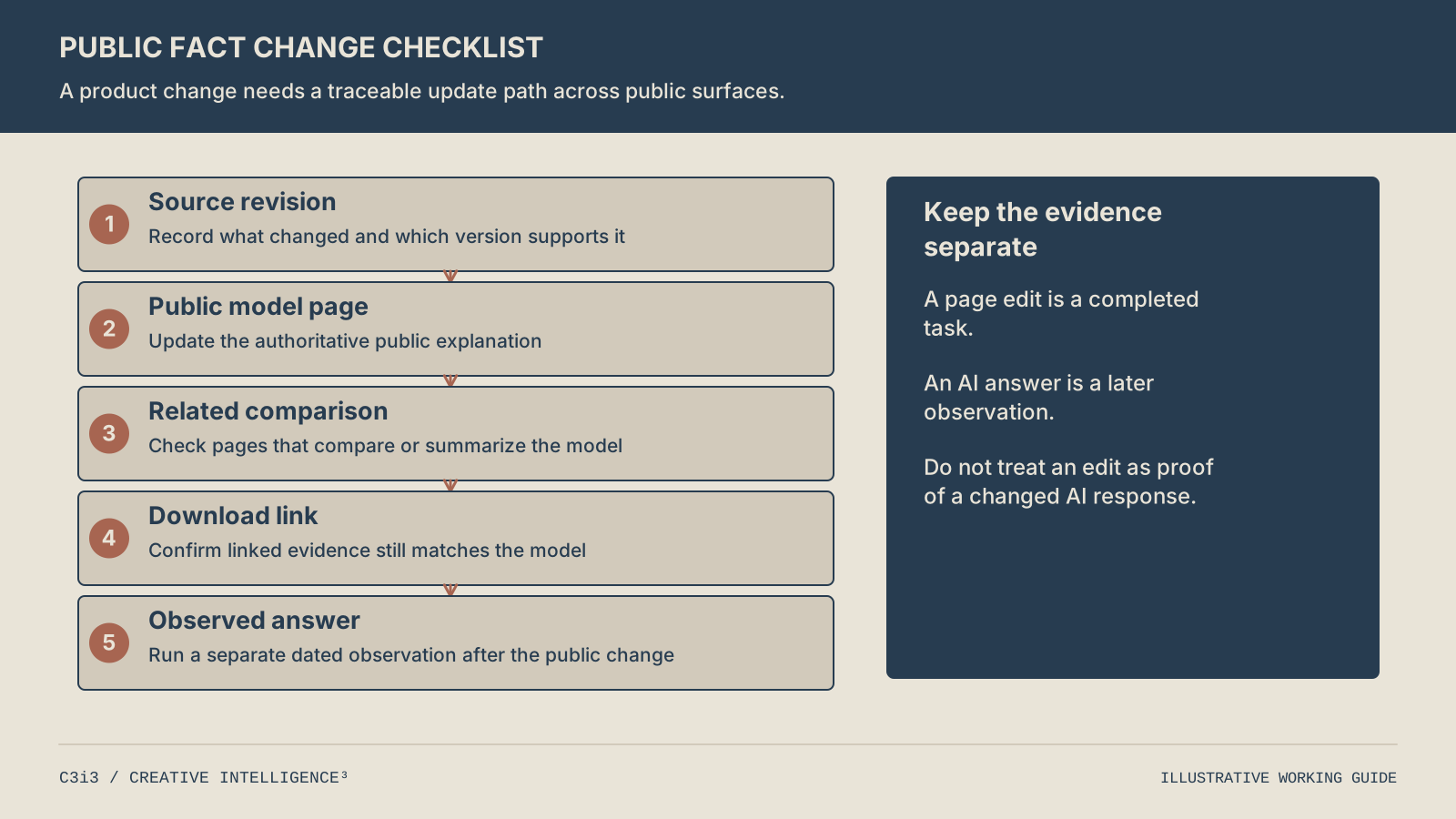
Record the source revision, update the public model explanation, review comparisons and linked downloads, then label any later AI answer check as a separate observation.
What should an agency deliver for a catalog implementation?
A useful catalog engagement should produce a verified content model, a prioritized page map, implemented changes and a record of what was tested. A presentation describing AI trends is not a substitute for repairing the product relationships that made the assignment necessary.
Ask the agency to begin with a limited family and document the before state. The first output might be an inventory linking each public model to its authoritative source and current status. The next output should explain which family, model and supporting pages need changes, with a reason for each. A technical implementation note should identify any access or rendering dependencies.
How do you avoid generating more near-duplicate pages?
Require a reader task for every proposed destination. If two pages answer the same selection question using the same facts, investigate whether one page with clear sections is better. A meaningful variant difference may deserve a distinct destination, but a swapped adjective does not establish a separate purpose.
Keep the acceptance criteria tangible: the correct model is identifiable, the document is current, the next action retains product context and a public page is reachable through the intended path. For broader provider evaluation, refer to the existing AIO agency selection guide and answer engine optimization deliverables guide. This catalog process is the implementation work after the business has defined its product-information problem.
How can you test the approach with one product family?
Choose a family that has meaningful buyer interest, manageable documentation and a product owner who can resolve questions. A small pilot should be representative enough to expose real catalog relationships while remaining practical to inspect thoroughly.
In an illustrative pilot, the team selects one industrial camera family with three models. One model has two connector variants, another has a related accessory and the oldest has been retired. The team maps these relationships, checks the current documents and rewrites the family comparison so the differences are explicit. No performance improvement is assumed in this example.
What evidence should you retain before publication?
Save the original pages, the approved fact sheet, the intended page map and a set of buyer questions. Record which inconsistencies were observed and which changes are hypotheses. For example, a confusing family heading is an observation; expecting a clearer heading to reduce unsuitable inquiries is a hypothesis until follow-up evidence supports it.
After publication, inspect the actual pages and documents rather than a staging screenshot alone. Check mobile navigation, model-specific links and the inquiry destination. Repeat the same AI product questions using a documented sampling method, but do not delay a verified correction simply because an external answer has not yet changed. Expansion should follow a usable workflow and accurate implementation, not a single favorable screenshot.
How do you evaluate catalog accuracy and useful buyer actions?
Evaluate the work in layers: accuracy of the website, accessibility of the intended pages, observed search or AI descriptions and the quality of resulting buyer actions. Each layer answers a different question and should retain its own evidence.
For website accuracy, sample the changed models against approved documents. For accessibility, check the actual response, rendering and applicable controls. For AI observations, record the question, platform, date, cited sources and the exact model described. The product-model visibility audit supplies a repeatable evidence sheet.
Which inquiries indicate that buyers found the right product?
Look for a recognizable model reference and a relevant next question. A request naming the correct interface and application provides different evidence from a general message with no product context. Keep personal information out of public reporting and avoid calling every website visit a lead.
Compare like periods and note launches, campaigns or catalog changes that could affect the result. Where attribution stops, label it. An accurate AI answer is a visibility observation; a product-page visit is engagement evidence; a confirmed suitable inquiry is a business outcome. The existing AI visibility measurement guide covers the broader reporting framework without turning the catalog project into a promise of predictable placement.
What should your team do before expanding to the full catalog?
Resolve the pilot's unanswered product questions, test the published paths and establish a repeatable change process. Scaling an unresolved hierarchy simply produces more pages carrying the same uncertainty.
Use a release sheet with one row for each changed family, model or variant. The row should identify its public URL, source revision, lifecycle state, related document, completed checks and open issues. Keep a separate list of proposals so a suggested correction is not mistaken for an implemented one.
What makes a pilot ready to repeat?
The team can explain the hierarchy without consulting the original writer. A visitor can identify the model and retrieve the relevant evidence. The next person responsible for a lifecycle update can find the affected surfaces. The website team knows which technical decisions are shared across the catalog and which are specific to this family.
Before adding a new batch, review whether the existing page pattern handled exceptions cleanly. If every model required a different workaround, improve the content model rather than multiplying manual patches. A durable process should make future changes easier to verify. That is the main value of a catalog-focused AIO engagement: a public product resource that buyers can understand and the business can maintain as the range changes.
What else should product brands know?
Do we need separate AI-only product pages?
Usually, the first task is to improve the same public product pages customers use. A second version can create another source of inconsistency if it is maintained separately. Create a distinct page only when it answers a different reader task, such as explaining an application or comparing supported models. Do not duplicate a model page simply to put “AI” in its title.
Can a PDF remain the detailed technical source?
Yes. A current PDF can carry detailed technical information while the public model page explains its scope and links to it clearly. Identify the document and revision so visitors can verify that it applies. Review the surrounding page when the document changes. A public summary should not contradict the detailed source or imply that every item in a family has identical characteristics.
Should we add every model number to every page?
No. Use identifiers where they clarify the product being discussed or a genuine relationship. A broad string of model numbers can obscure the actual selection question. Family pages should guide comparison, while model pages should identify their own supported variants and documents. Make the navigation useful rather than treating model names as words that must be repeated everywhere.
Can catalog improvements force an assistant to cite our website?
No. A brand can improve its public information, access settings and buyer experience, but it does not control an external system’s selection or final answer. Record actual observations and their limits. The practical objective is to make the brand’s own information accurate, discoverable where permitted and useful when a person follows a recommendation to verify a product.
Does every technical difference require a new URL?
Not necessarily. Decide whether the difference creates a distinct product identity or a useful selectable state. A single page can explain several variants when visitors can identify the selected option clearly. More substantial designs may need separate model pages. Coordinate the page structure, canonical signals and structured data so they describe the same underlying range.
What should we send an agency before a catalog review?
Send a representative family, current public links, approved source documents and examples of confusing buyer questions. Include known model aliases and discontinued items. You do not need to disclose confidential engineering files for a public content review. Identify where a decision remains unresolved so the agency can request the right input instead of treating incomplete information as a fact.

How C3i3 Can Help
C3i3 can help turn a difficult product range into a clearer public catalog, connecting the content model, website structure and buyer questions. A useful starting brief is one family, its approved documents and a few examples where buyers or AI answers confuse the available models.
Explore AI search optimization services or contact C3i3 about a catalog review. We can scope the information and implementation work around the product problem your team needs to resolve.