








































In this article
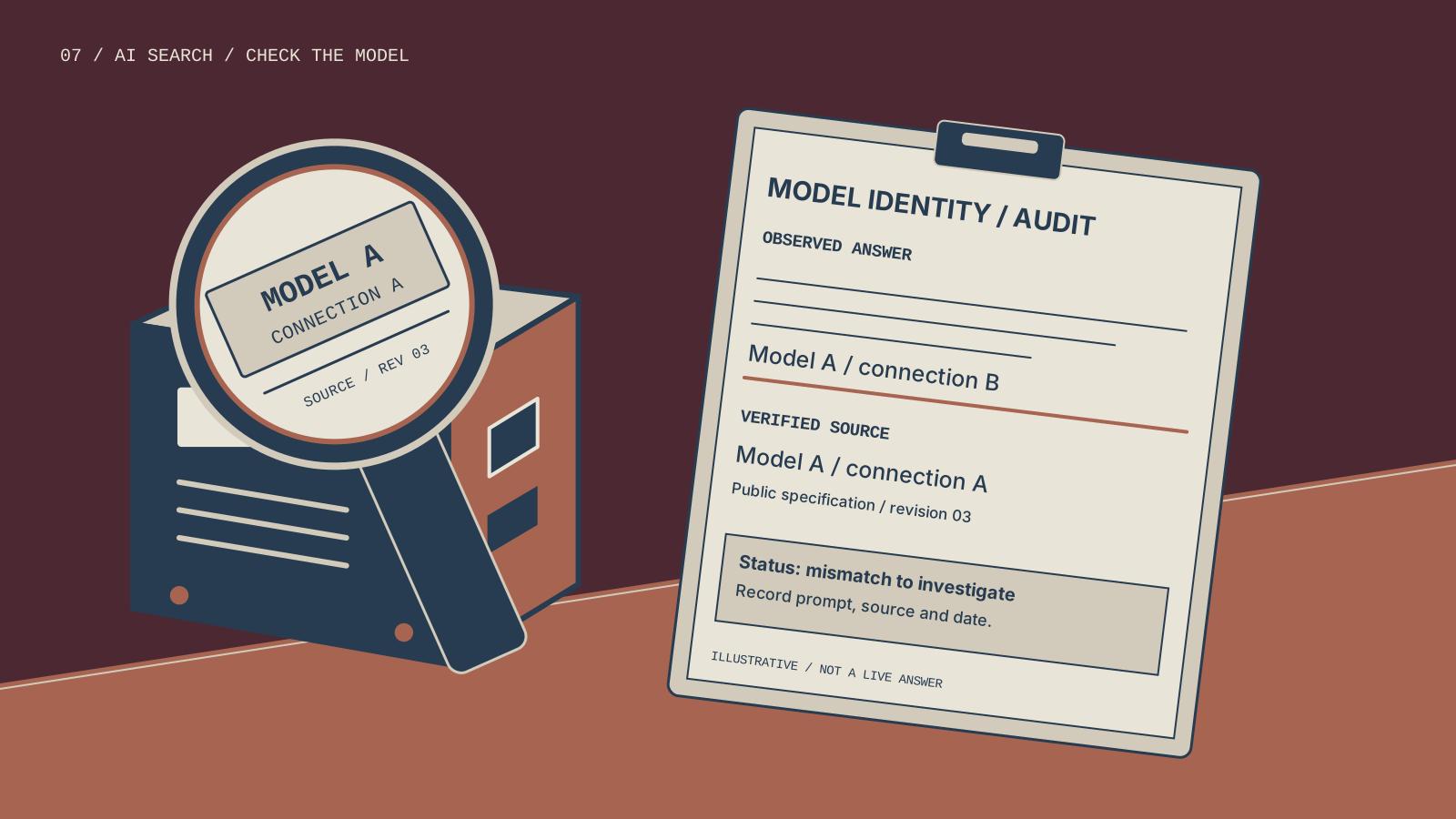
An AI answer mentions your brand and recommends a product. That can look encouraging until somebody notices that the model number belongs to a retired item, the listed feature belongs to another variant or the cited page does not support the suggested application. Visibility without correct identification can send buyers toward the wrong conversation.
A product-focused AI visibility audit examines those individual claims. It asks whether the answer identifies a real model, preserves its selection boundaries and gives a reader a useful source to check. It does not turn a handful of prompts into a market-wide share-of-voice claim.
Use this process alongside the broader product catalog preparation guide. Start with a small, documented question set and a current product record, then investigate the errors you can actually observe.
What should a product-model AI visibility audit actually test?
The audit should test whether an observed answer describes the right product for the question asked. Brand mentions alone do not establish that. Define the model identities and selection boundaries that matter before collecting examples.
Choose three or four kinds of buyer question: identifying a product by its use, comparing known models, checking a meaningful constraint and finding a current alternative to an older item. Keep the wording close to questions the sales or technical team actually receives. A question that gives the answer away by naming every preferred feature tells you little about discovery.
For answer engine optimization (AEO), distinguish discovery from a named-model fact check. An illustrative discovery question asks which gateway suits a wired installation. A factual check asks which connector the named Gateway E supports. The first observes selection; the second examines a particular claim. Report them separately so success on an easy branded check does not imply broad discovery.
Which product facts belong in the reference sheet?
Include approved model names, relevant variants, current status and the source for each tested characteristic. If compatibility requires an application review, preserve that condition. The reference sheet is not a new product specification; it points to the authoritative information needed to judge the answer fairly.
For an illustrative connectivity-device brand, the audit might distinguish a wired gateway from a wireless model with a similar name. The question could ask which model supports the stated connection method. A response that describes the wireless feature while naming the wired model is an identity error even if the brand is mentioned prominently.
Keep scope separate from a general AI visibility reporting program. This exercise is a factual quality check for a catalog, not an estimate of how frequently all buyers encounter your brand.
What evidence should you capture for each observed answer?
Capture enough context for another person to understand and inspect the observation. Record the platform, date, exact prompt, relevant session context, answer text or screenshot, product named and displayed source links.
Store the prompt verbatim. A small change such as adding a market, application or product generation can reasonably change the response. Record whether the answer came from a fresh conversation or a follow-up that depended on earlier messages. Do not combine the two as though they were identical tests.
How should an evidence row be organized?
A practical row contains question ID, observation date, named model, statement under review, reference URL or document revision, assessment and proposed action. Use assessments such as supported, contradicted, not enough evidence or not applicable. Those labels keep uncertainty visible instead of forcing every answer into a simple good-or-bad score.
Preserve the distinction between a source the answer displays and a source you found independently. A linked page may support only part of the answer. Review the exact passage before stating that the assistant cited evidence for the model's full capabilities.
Remove personal information from shared audit material. A synthetic buyer question is usually enough to test a public catalog claim. You do not need to paste a confidential customer drawing into a general assistant to determine whether your public model page describes the right connector. Keep any application-specific technical review in the appropriate business workflow.
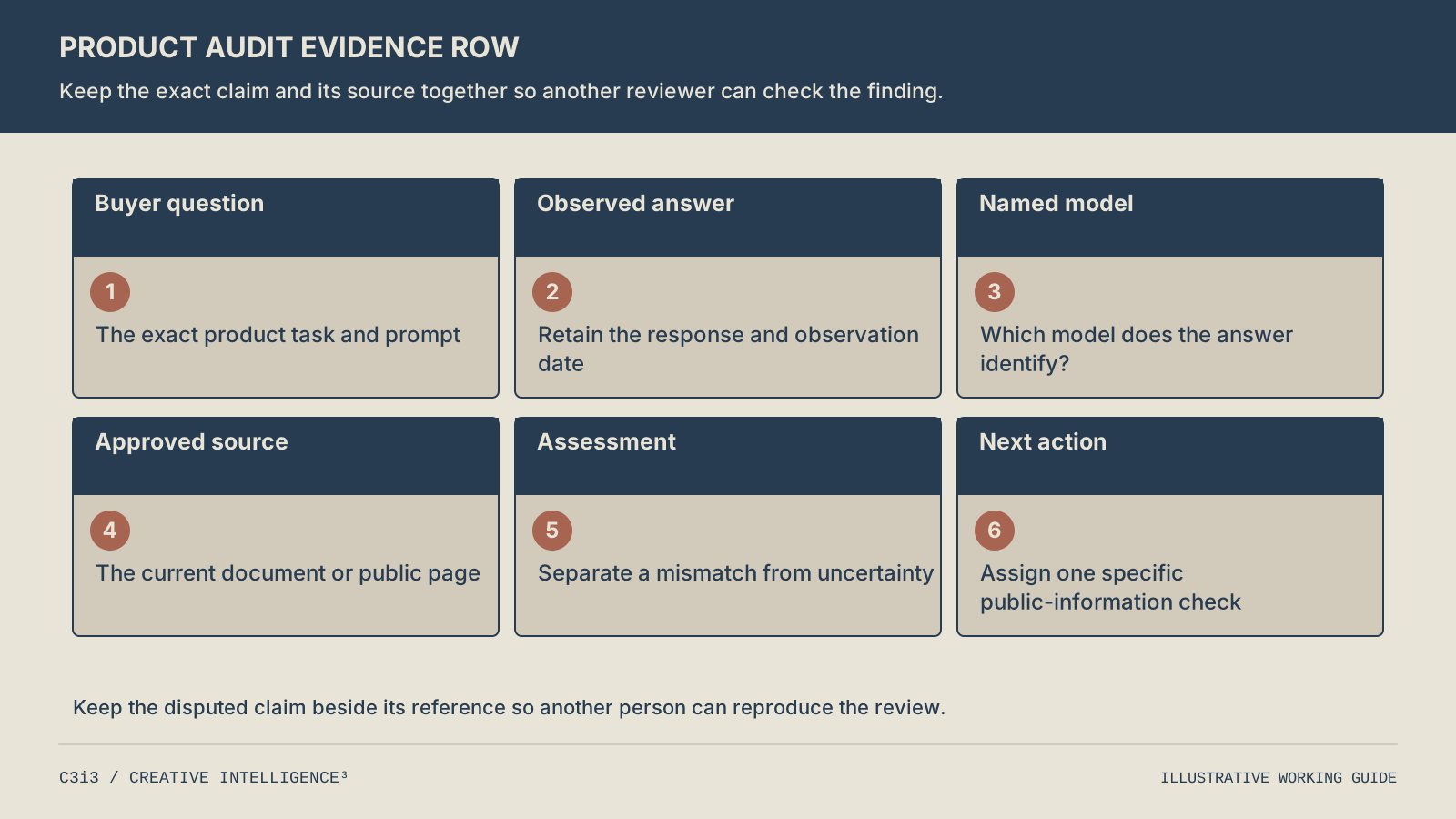
Capture the prompt and response, identify the model and disputed claim, compare an approved source, classify the evidence and assign a specific public-information check.
How do you distinguish a model error from an evidence gap?
A model error is a statement that conflicts with an approved product fact or relationship. An evidence gap means the statement cannot be verified from the available approved information. The next action differs, so record the distinction before asking somebody to rewrite a page.
Use a short classification that reflects the actual problem. Identity errors confuse model or variant names. Attribute errors assign a characteristic to the wrong item. Lifecycle errors describe retired products as current. Suitability errors recommend an application beyond the documented scope. Evidence gaps occur when the explanation offers no usable support.
What does a worked assessment look like?
In an illustrative audit, an answer recommends Gateway W for a wired-only installation and claims it includes a connector documented only for Gateway E. The reviewer records the exact sentence and compares both approved model pages. If Gateway W lacks that connector, the assessment is contradicted and the category is attribute confusion. No customer result is implied by this example.
Now imagine the answer says Gateway E is “the most reliable choice.” The catalog provides no comparative reliability study. The correct label is unsupported, not automatically false. Remove the unsupported superlative from your own material if it appears there, and make the verifiable product facts easier to find.
If the answer accurately describes a model but omits your preferred sales message, that is not necessarily a factual error. Prioritize mistakes that change selection or prevent verification. This keeps the audit focused on product understanding rather than whether an external response repeats brand copy.
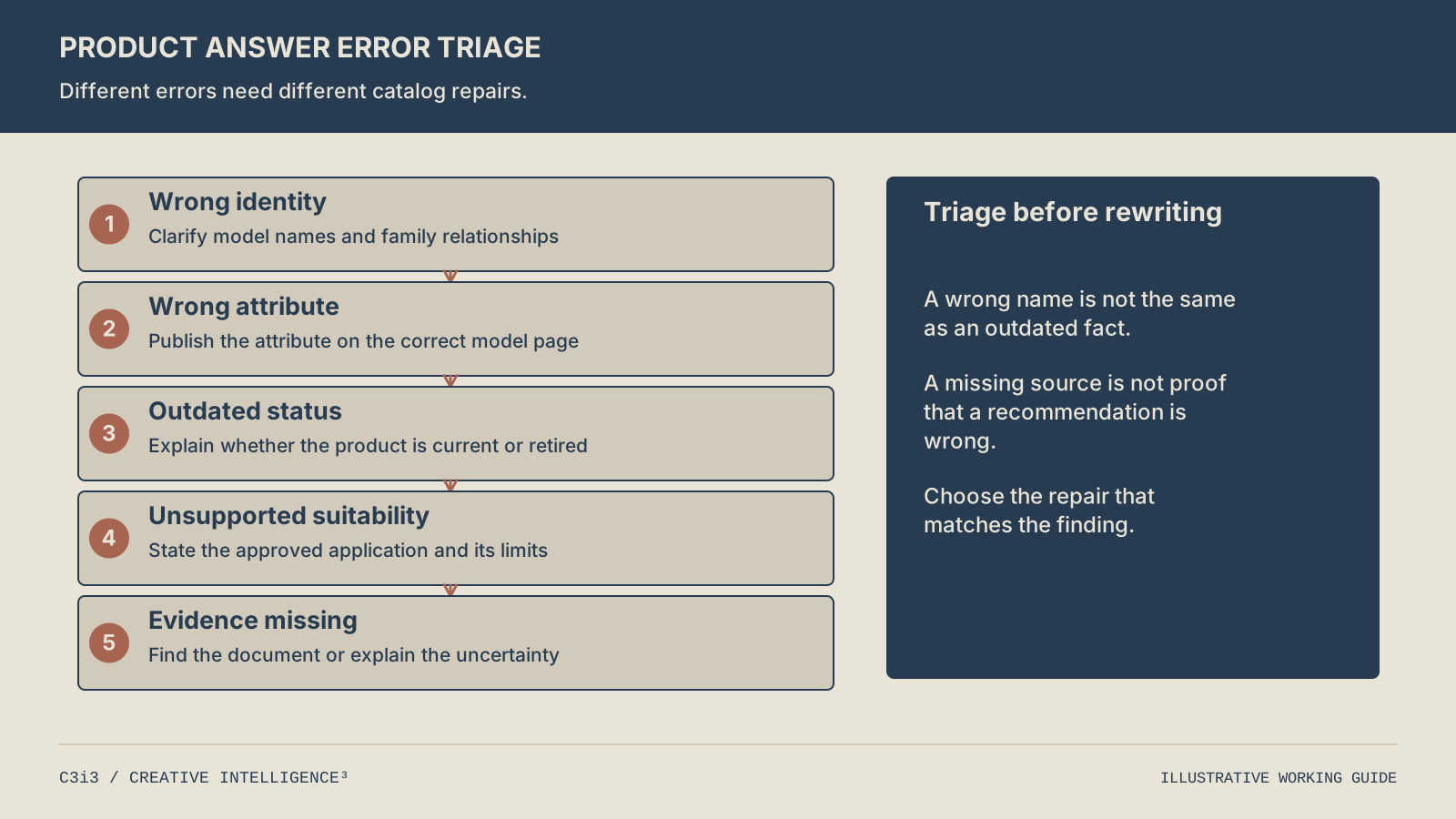
Identity errors need clearer model relationships. Attribute errors need model-specific facts. Lifecycle errors need current status. Suitability claims need approved boundaries. Missing evidence needs a usable source.
Which website changes should follow a product-model finding?
Repair the public information connected to the finding, and keep the action proportional to the evidence. Start with the named model page and the authoritative document, then inspect family comparisons or older content that may carry a conflicting description.
For identity confusion, make the full model name and distinguishing characteristic explicit. For an attribute error, clarify which variants carry the feature and remove broad family wording that implies universal support. For a lifecycle error, use the discontinued-product correction workflow. Do not assume one paragraph will resolve every surface.
What if the brand's own pages are already accurate?
Record that result. The audit may identify an external source, stale observation or system-generated claim that you cannot directly correct. You can review public partner information through the appropriate relationship, but do not describe an unverified external edit as completed work. Keep the current authoritative explanation available for buyers who need to check it.
Google's AI website guidance does not offer a special markup switch that forces a preferred answer. Treat catalog changes as improvements to the underlying source and buyer experience. If structured data contradicts visible text, reconcile it using the product schema parity process.
Finish each action with an observable acceptance check. “Improve the page” is incomplete. “The model name, connector table and linked document now agree on the supported interface” can be checked by a reviewer without interpreting an agency's intention.
How do you repeat an AI visibility check without overstating the result?
Repeat a documented question set after the source changes are published, and report the answers as dated samples. Keep the platform and relevant conditions recognizable. A different answer can be encouraging evidence without establishing a permanent placement or a causal result.
Use separate columns for the website correction and the later observation. The first can be verified through the page and its source record. The second depends on what the external system returned at the time of checking. Do not hold a completed factual correction open indefinitely because the sample still varies.
Can you calculate an accuracy percentage?
You can describe the result of your defined sample if you disclose its size and assessment method. In a hypothetical worksheet, seven supported responses out of ten assessable responses equals seventy percent within that sample. If two other answers could not be assessed, record them separately and explain why they were excluded. Do not present the figure as accuracy across every AI query.
Repeated prompts can be affected by changing systems, sources and context. Preserve unfavorable observations alongside favorable ones. If a question is removed because the reference information was wrong, keep the change note rather than silently improving the score.
For a small team, the most useful output may be an error queue: which selection mistakes persist, what evidence exists and what public repair remains possible. That is often more actionable than a single score with no model-level explanation.
How do you connect the audit to useful buyer inquiries?
Look for whether people arrive with a correct understanding of the product and ask a relevant next question. Keep that business observation separate from visibility samples, since an inquiry may come through several channels and may not disclose its full discovery path.
Ask the sales team to classify recurring confusion in a simple way: wrong generation, wrong variant, unavailable item or application mismatch. Do not burden every inquiry with a long research questionnaire. A few consistent fields can reveal whether the catalog still leaves a critical distinction unclear.
What should be in the review handoff?
Provide the completed website changes, unresolved model questions, dated AI observations and a short description of inquiry patterns. Identify which findings are confirmed and which require more evidence. A decrease in confused inquiries can be useful, but consider changes in campaigns, seasonality and product demand before attributing it to the audit.
If model confusion persists, revisit the actual source path. A family introduction might still use an ambiguous nickname, or a linked PDF might cover several generations without a clear entry point. The next action should follow that evidence rather than automatically commissioning more articles.
Use the catalog architecture pillar for larger relationship problems and the crawler-access guide when a correct public source cannot be reached. This keeps the audit connected to implementation while preserving the narrow purpose of each supporting guide.
What else should product brands know?
Should we test only questions that name our brand?
No. Include branded identification questions and unbranded buyer tasks where your products may reasonably be relevant. Keep the two groups separate in reporting. A branded prompt tests recognition with an explicit cue, while an unbranded prompt gives less guidance. Neither sample should be presented as a complete picture of how the platform treats the brand.
Is a missing citation automatically a wrong answer?
No. An answer can be factually supported by your reference material while lacking a displayed source. Record accuracy and source visibility separately. Conversely, a citation does not prove every statement in an answer is supported. Follow the link and compare the relevant model detail before marking the response as verified.
Can our team correct an assistant’s answer directly?
Your team can correct the public material it controls and use a platform’s available feedback route when appropriate. That does not give the business editorial control over future answers. Keep any feedback submission separate from the verified website correction. Do not promise customers that the assistant will adopt the wording or maintain the same response later.
How many products should a first audit include?
Choose a manageable group with meaningful selection differences and reliable source information. A handful of models can expose family-level naming or attribute problems. An arbitrary large count may hide unresolved reference facts. Expand after reviewers can apply the classification consistently and the website team can implement the resulting corrections.
Should a product expert review every finding?
A person qualified to interpret the product should review disputed suitability or technical claims. A content editor can identify a mismatch, but should not resolve an uncertain specification by guessing. Keep the disputed statement, source and question together so the reviewer can answer the precise issue without reconstructing the entire audit.

How C3i3 Can Help
C3i3 can help structure a product-model audit and turn its findings into specific catalog improvements. Bring a few observed answers, the current model pages and the approved documents that define the important selection differences.
Our AI search optimization work can connect the evidence sheet to content and website changes. Contact C3i3 to discuss the model confusion your team wants to investigate.