








































In this article
A product team wants its current catalog discoverable in AI search, but the website also contains account resources, unpublished documents and archived material. A blanket instruction to “allow AI bots” does not resolve those different situations. It can also confuse search discovery with model-training preferences.
The useful task is to decide which product information is intentionally public, which services may retrieve it and which controls apply to each purpose. Then test the live website. A crawler instruction, an indexing directive and an authentication boundary do different jobs.
This guide explains those decisions for product catalogs. It complements the catalog AIO preparation guide and the model-level visibility audit. Access is an eligibility and retrieval issue, not a guarantee that any assistant will recommend a model.
Which catalog information should be public before you consider crawler access?
Start with the business decision about public information. A current model explanation, a public datasheet and a customer-only document have different intended audiences. Crawler configuration should follow those boundaries rather than determine them by accident.
Create an inventory with public family pages, model pages, selected variants, approved downloads and restricted resources. Record the reason each resource exists and the intended visitor. The inventory should identify actual URLs and response behavior, not merely a list of content-system folders.
What belongs behind authentication?
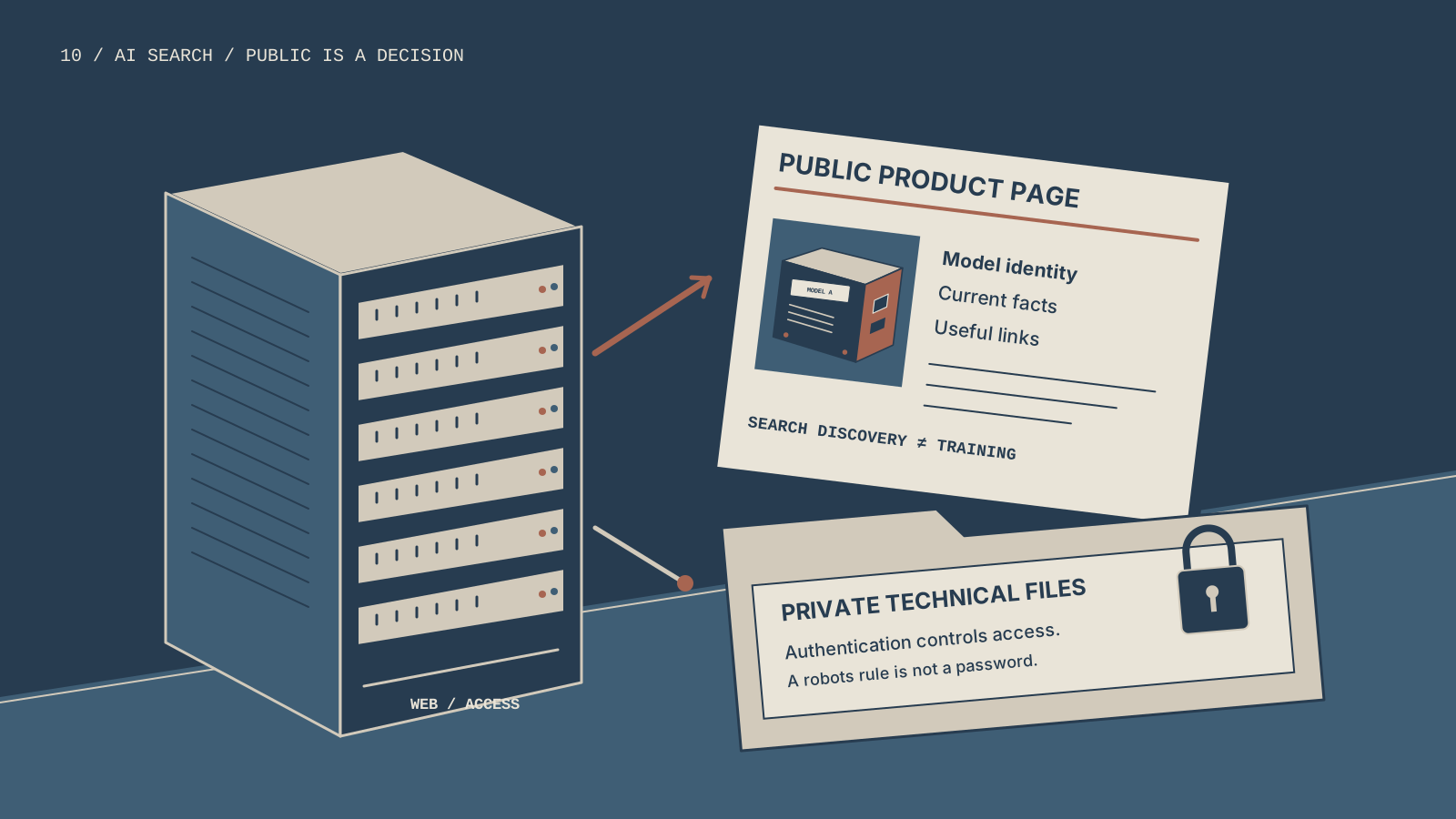
Resources intended only for authorized users need an appropriate access boundary. Do not rely on a robots.txt instruction as a confidentiality measure. Google's robots.txt introduction distinguishes crawler access instructions from methods used to keep information out of search or protect it.
For an illustrative equipment catalog, the public model page may explain supported interfaces and link to an approved datasheet. A customer-specific integration drawing remains restricted. Publishing a clear description of what information can be requested does not require exposing the drawing itself.
Check derivative resources too. A protected page may link to a file that is publicly reachable at its own URL. Conversely, a public page may contain a download link that unexpectedly requires an account. Both situations deserve review because the effective boundary differs from what the page appears to promise. Decide the intended behavior before adjusting bot rules.
How do search discovery, training preferences and user visits differ?
They are separate purposes and may use different controls. A business can want public search discovery while making a different choice about model training. A user-initiated visit is another request type and should not be treated as proof of automatic search crawling.
OpenAI's crawler documentation distinguishes OAI-SearchBot for search, GPTBot for potential training use and ChatGPT-User for certain user actions. The documentation notes that robots.txt rules may not apply to user-initiated actions. Review these purposes independently rather than treating a single user-agent name as the whole service.
Which Google settings need their own review?
Googlebot access and normal indexing controls remain relevant to Search. Google-Extended is a separate usage-control token and does not act as a Search ranking signal. Google's current Search generative AI control in Search Console manages participation in specified generative Search features, with property inheritance available.
Build a control matrix rather than copying a generic robots.txt snippet. List the purpose, intended business choice, applicable setting and person responsible for checking it. The website configuration may need several independent decisions. No setting should be described as universally applying to every AI product or every way a person can request a page.
When a platform changes its documented controls, update the matrix and verify the live implementation. Keep the decision record simple enough that a future website migration does not accidentally reverse it.
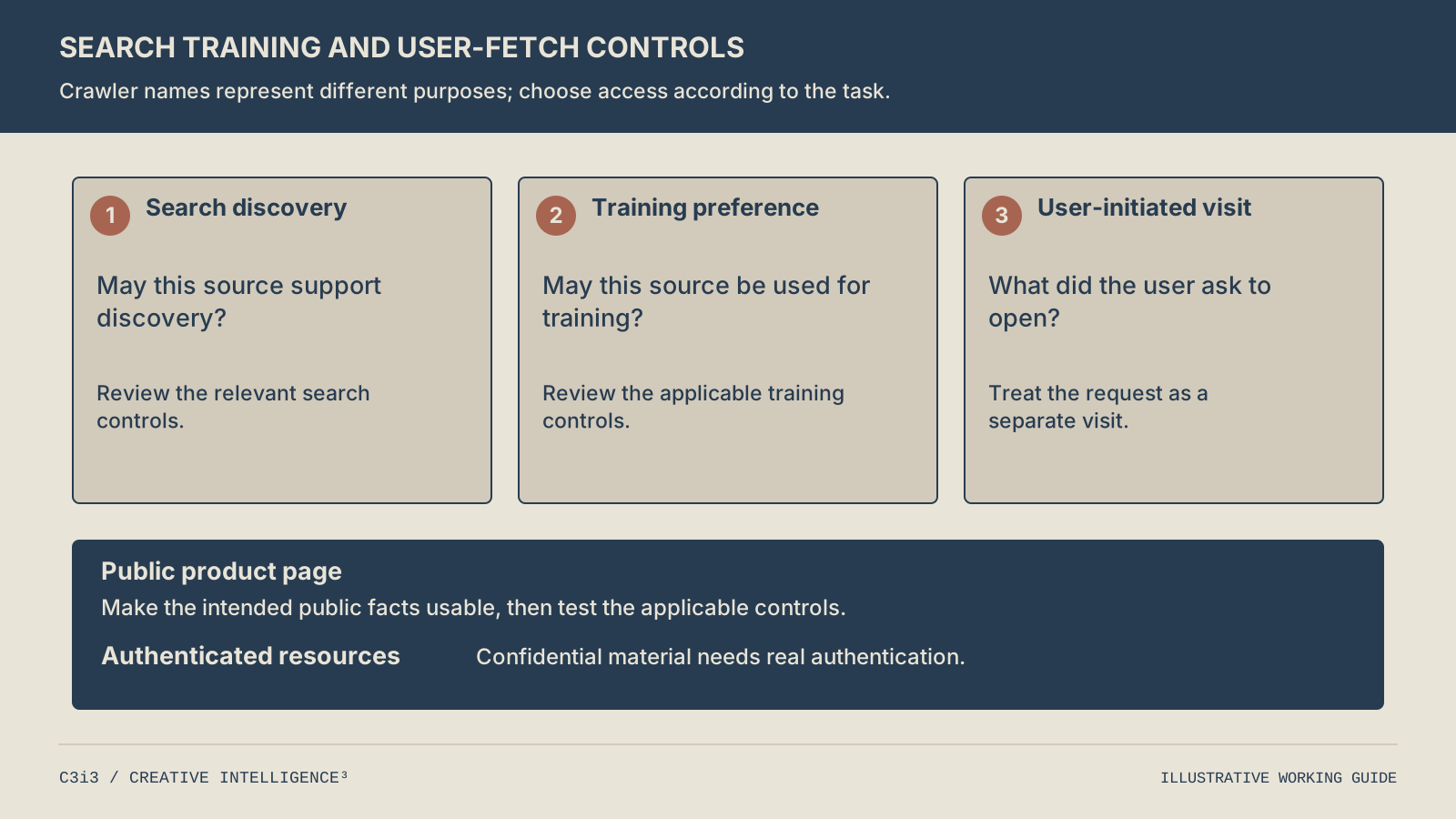
Review search discovery and training preferences independently. A user-initiated visit is a separate request. Keep confidential resources behind authentication rather than relying on crawler instructions.
Why are robots.txt and indexing directives different checks?
Robots.txt generally gives participating crawlers instructions about retrieval. Indexing directives tell supporting search systems how content may appear in their index. They are related controls, but they do not perform the same job or create a private access boundary.
Check both before interpreting a product page's absence. A page may be blocked from retrieval, carry an indexing exclusion or be accessible while the search system has not selected it. The observation “not appearing” does not identify which of those situations applies.
What can go wrong when the controls conflict?
A team may block a page from crawling while expecting a search system to read a newly added indexing instruction on that page. That is a reason to review the combination carefully. The website team should use current platform documentation and verify the actual response rather than assume that adding another rule will resolve it.
In an illustrative catalog migration, a staging restriction is copied into production. Current model pages are linked in navigation but a broad crawler rule still limits access. The appropriate repair is to identify the intended public paths, correct the relevant production setting and test it. Rewriting product descriptions would not address that access issue.
Keep archived and private decisions separate. A useful public archive may remain intentionally accessible with a clear lifecycle explanation. A restricted customer resource needs authentication. A sorting URL may need a different discovery or indexing treatment because it duplicates a useful page. One blanket rule across all three can obscure the business purpose of each resource.
How do you test whether the intended product page can be retrieved?
Test the actual public URL, response behavior and rendered information under the relevant conditions. A control panel that says a page is published is only one piece of evidence. Hosting, security rules, redirects and page rendering can still affect retrieval.
Begin with an ordinary unauthenticated visit. Confirm the response reaches the expected model, shows its identity and provides the intended document links. Record redirects rather than assuming the final page is equivalent to the requested one. Repeat a representative selected variant where selection changes important facts.
What should you inspect in technical logs?
Look for the requested URL, response status, date and relevant security action. Verify request identity using the provider's current published guidance where that matters. A user-agent string alone can be copied by another requester. Do not treat every entry containing a recognizable bot name as authenticated evidence of that provider's visit.
A hypothetical gateway page might work for a signed-in administrator while public requests receive a challenge or incomplete content. The investigation should identify the affected request path and security behavior. Avoid turning off protection across the whole site to resolve one public catalog problem. Have the website team make the narrow change the evidence supports.
Retain the result as a specific observation: the tested URL returned the expected public page under the recorded conditions. That is stronger than “AI access fixed,” which can imply tests of services and use cases the team never inspected.
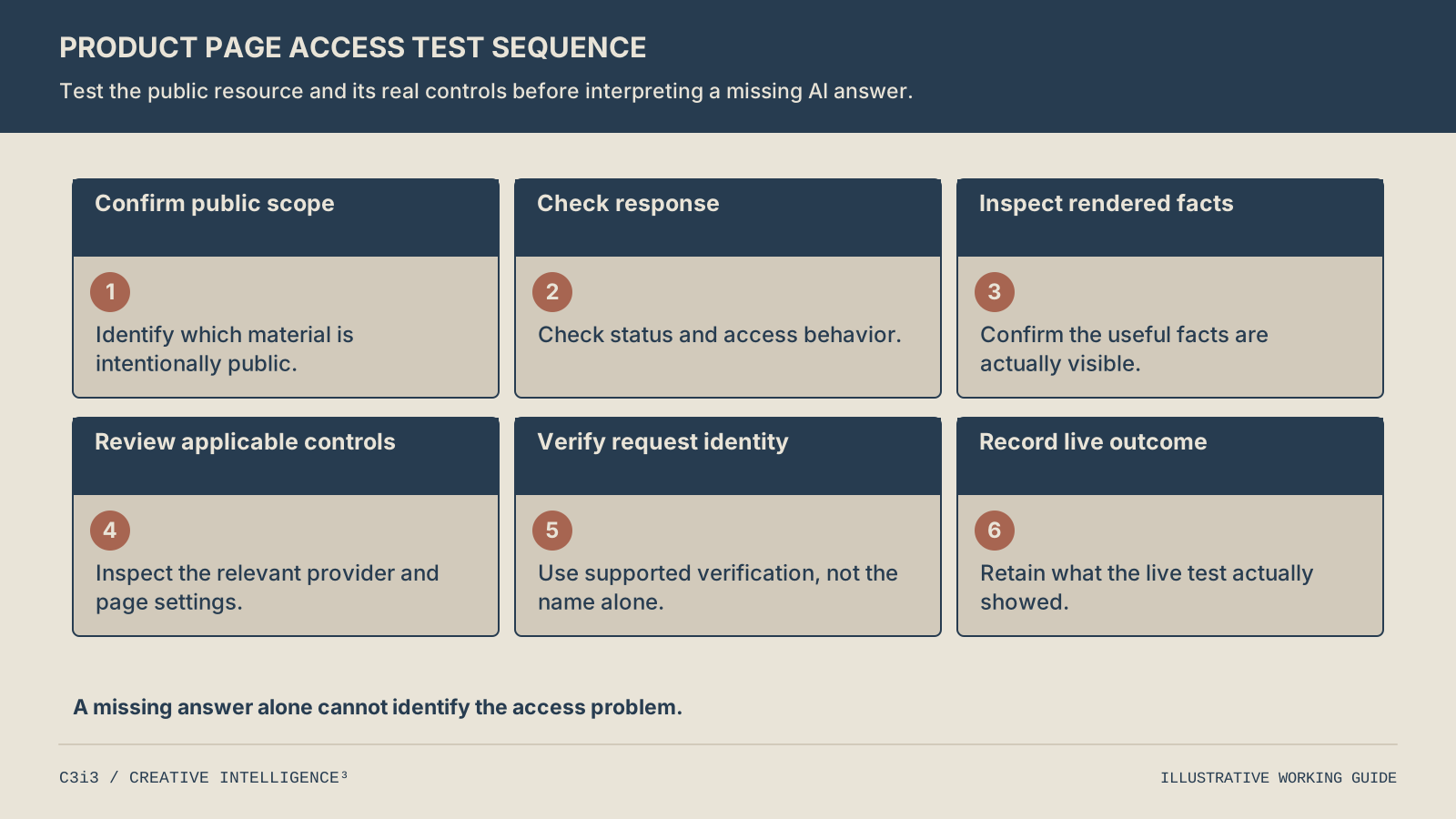
Identify which content is intentionally public, check its response and rendered product facts, review crawler and platform controls, verify bot identity where needed and record the observed result.
How should you handle product documents, variants and rendered content?
Review the complete information path a buyer or supported retriever needs. A reachable model page can still omit its essential facts until an interaction occurs, point to the wrong document or lose the selected variant when opened directly.
Keep the core model identity and current status in readable page content. Documents should be labeled by their purpose and scope. A downloadable technical source may carry detail, but the surrounding page should explain why it applies to the model being evaluated.
What should a representative catalog test include?
Choose a family overview, a current model, a selected variant, a public PDF and an archive where those resources exist. For each, compare the requested destination with the information actually delivered. Check whether an ordinary link reaches the resource or whether the route depends on a site search or a remembered browser state.
Use the product schema parity guide when machine-readable information does not match the visible selection. Use the discontinued-product guide when the destination is intentionally historical. These are content and relationship problems even when access itself is functioning.
A successful retrieval test should not require exposing a restricted drawing or granting a crawler access to every administrative endpoint. Define the public evidence the buyer needs and make that path coherent. When information cannot be public, explain the legitimate inquiry step instead of creating a misleading public substitute for the confidential detail.
What should you record after changing crawler or platform controls?
Record the intended choice, the exact scope of the change and the live checks performed afterward. Separate implementation verification from later indexing, AI visibility and buyer behavior. Those outcomes can occur at different times or remain unobserved.
A useful change record identifies the affected paths or property, the previous observed behavior, the revised setting and the verification date. Include unresolved questions, such as a provider request that has not yet been seen in logs. Do not call an absence of evidence a failed implementation or a successful crawl.
How should you investigate a missing recommendation afterward?
First ask whether there is evidence of an access problem. If the current public page is retrievable and the intended controls are correct, investigate product relevance, factual clarity and the sources shown in the answer. Repeatedly loosening access rules is not a sensible response to every missing mention.
The model-level audit can classify a later answer as correct, contradicted or unsupported using approved information. A page being retrieved does not prove it was used in that response. A citation does not prove that every product statement is accurate. Preserve those distinctions in the handoff.
Review the control matrix after hosting changes, security-rule updates or catalog migrations. These events can affect shared behavior even when product copy is unchanged. A durable access process gives the next team enough evidence to preserve intentional public discovery and private boundaries without depending on somebody's recollection of a one-time fix.
What else should product brands know?
Can we allow AI search discovery while declining training use?
Some providers document separate controls for these purposes. Review the current controls for the particular service rather than assuming one setting applies everywhere. Record the business’s intended choice and verify how the website implements it. Separate search and training preferences from user-initiated requests and from the authentication used to protect restricted resources.
Does robots.txt make confidential catalog files private?
No. A crawler instruction is not an authorization system. If a resource is intended only for approved users, use an appropriate access boundary and check the resource’s own URL. Do not assume that hiding a navigation link or protecting a parent page also protects every file linked from it.
Should we allow every bot that uses an AI-related name?
No. Evaluate the provider, documented purpose and business objective. Verify requests where appropriate and consider the effect on the public service. An unfamiliar name or copied user-agent string does not establish a useful relationship. Keep the decision specific instead of treating all AI-related traffic as either automatically desirable or universally unwanted.
Does allowing a crawler guarantee that a product will appear?
No. Access only addresses part of the path. Search systems still make their own processing and selection decisions, and AI responses may use other sources or vary by question. Report the retrieval test you actually performed. Keep product accuracy, indexing, citations and inquiries as separate observations.
Do we need to change the whole website to test one product family?
Usually, a representative sample can reveal the first issue. Review the intended scope with the website team before changing shared controls, since a broad rule can affect unrelated resources. Start with clear public destinations, capture the current response and choose a narrow repair when the evidence supports it.

How C3i3 Can Help
C3i3 can help connect catalog access decisions with the public information buyers need. Bring a few affected product URLs, the intended public or restricted status and any observed retrieval errors.
Our AI search optimization services can help identify the content and website checks relevant to that situation. Contact C3i3 to discuss a scoped product-page access review.