








































In this article
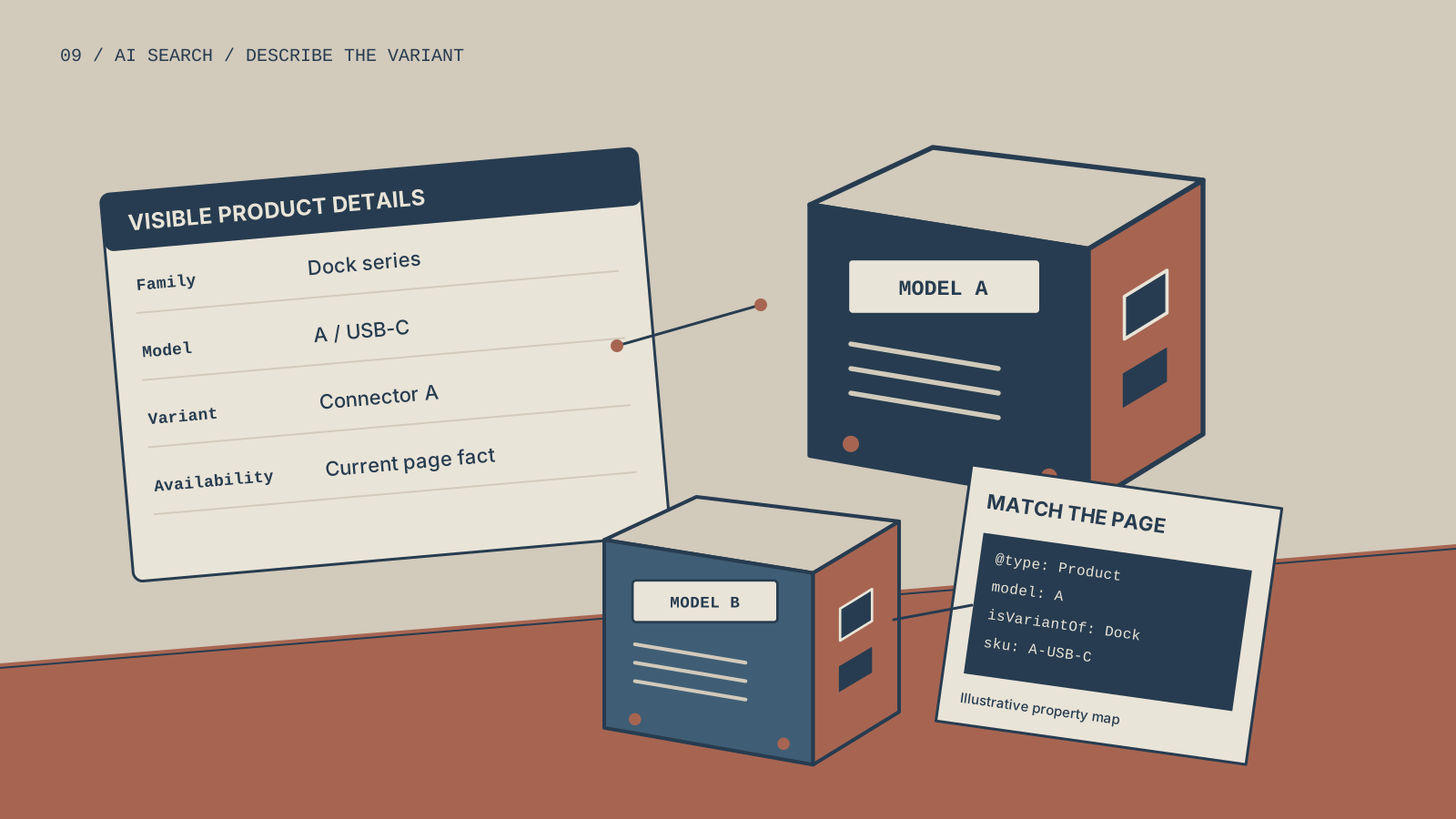
A product page says one thing while its structured data says another. The visible page names a specific model, the machine-readable record carries a generic family title and the selected variant changes without the information staying aligned. Adding more markup does not resolve that disagreement.
Product schema is useful when it accurately describes the product and supports an appropriate documented search feature. It is not a special command that makes an AI assistant recommend your brand. Start with the identity and visible facts, then determine which structured-data representation and feature requirements actually fit the page.
This guide focuses on model, variant and availability consistency. The broader product catalog AIO guide covers the page architecture behind those decisions. Here, the task is to keep the structured record faithful to the product a visitor can evaluate.
What can product schema do for AI search, and what does it not do?
Product schema can express product information in a structured form and support eligibility for documented search features when all applicable requirements are met. It does not give a brand control over an AI answer, establish a product claim or replace visible content.
Distinguish three questions. Does the vocabulary allow the information you want to describe? Does the particular search feature support that representation? Does the page meet that feature's content and technical requirements? A positive answer to the first question does not settle the other two.
Which documentation should guide the decision?
Schema.org Product defines the general vocabulary. Google's product structured-data introduction distinguishes product snippets from merchant listings. Use the documentation for the feature that fits how the page actually works, rather than assuming every catalog page belongs in an online-purchase feature.
A quote-oriented equipment page may explain a product well without offering an immediate purchase. Do not fabricate an offer or a customer review to resemble a different business model. An accurate general description and a particular rich-result eligibility claim are separate decisions.
Google's AI features guidance does not require special AI schema. Treat structured data as one part of a consistent catalog, alongside readable explanations, current documentation and useful links. If a buyer cannot identify the model from the page itself, start there before expanding the machine-readable record.
When should you use ProductGroup and distinct variant identities?
Use a group relationship when products share an underlying identity and vary in defined ways. Keep distinct designs separate when they are different models rather than selectable variants of the same group. The product team's real taxonomy should determine the relationship.
Schema.org ProductGroup provides a way to describe a group and its variants. Google's variant guidance describes supported properties and implementation patterns for its product experiences. Do not assume a general vocabulary property is necessarily a supported variant dimension in every Google feature.
What should the identity map contain?
Record the group identifier, each variant identifier, the dimension that changes and the URL where that selection is understandable. Keep identifiers stable when a description is edited. A temporary internal row number is a poor public identity if an import will assign it to another item later.
Consider an illustrative desk accessory sold in two verified finishes. It may have a genuine shared group and separate identifiers for each finish. A revised version with a different mechanism may be a separate model even if its name resembles the original. Grouping every item under one parent because the website menu calls them a “family” can flatten a distinction buyers need.
Review the identity map before asking a developer to generate markup. The implementation should follow a verified relationship, not invent that relationship by copying one product record into several nearly identical nodes.
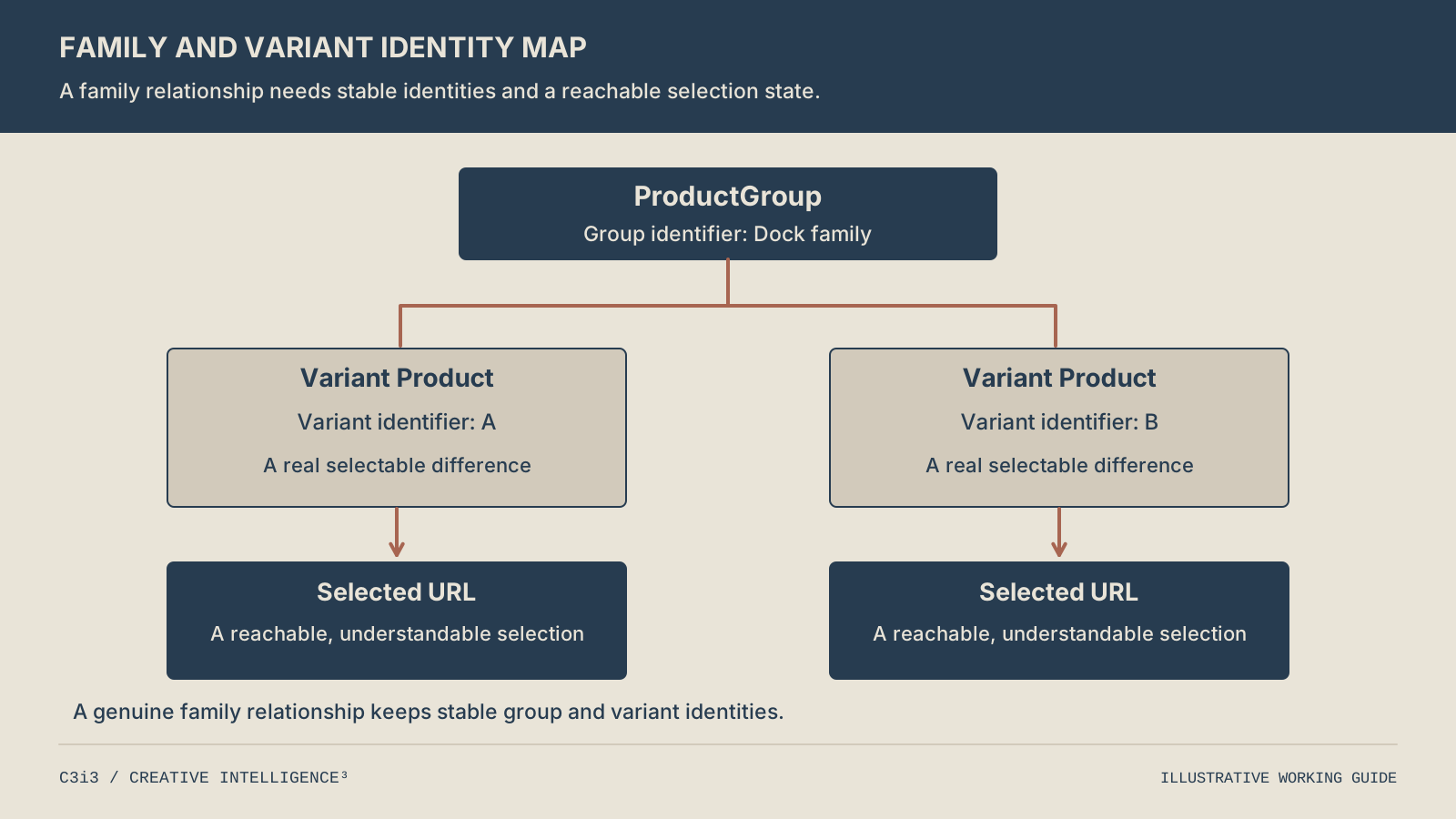
Use a group identity only for a genuine variant relationship. Each variant retains its own identifier, relevant properties and a destination where the selection can be understood.
Which visible facts must agree with the structured record?
The structured record should describe the same product, selected variant and current state that the visitor sees. Compare the generated output with the actual rendered page, not only the values stored in a product administration screen.
Start with model name, brand, stable identifier, variant distinction, relevant description and current availability information where applicable. Check images against the selected item. An image of one configuration should not silently stand for another when the difference changes what the customer receives.
How do you perform a parity check?
Create a small matrix with one row per important field. The columns are approved source, visible page, structured record and outcome. Use exact values for identifiers and plain-language explanations for any legitimate difference. For example, a public title may include a descriptive phrase while the model identifier remains unchanged.
In an illustrative check, the selected page shows the graphite finish but the structured record names the light finish and uses its identifier. The issue is not merely wording. It is a different variant identity. Fix the source mapping and test both selections, rather than manually correcting a single output that the next import will overwrite.
Also inspect template defaults. A field filled from a family-level description can accidentally broaden a model-specific attribute. If the value cannot be confirmed, send it back as an unresolved product-data question. A structured field does not become trustworthy simply because it passes a syntax check.
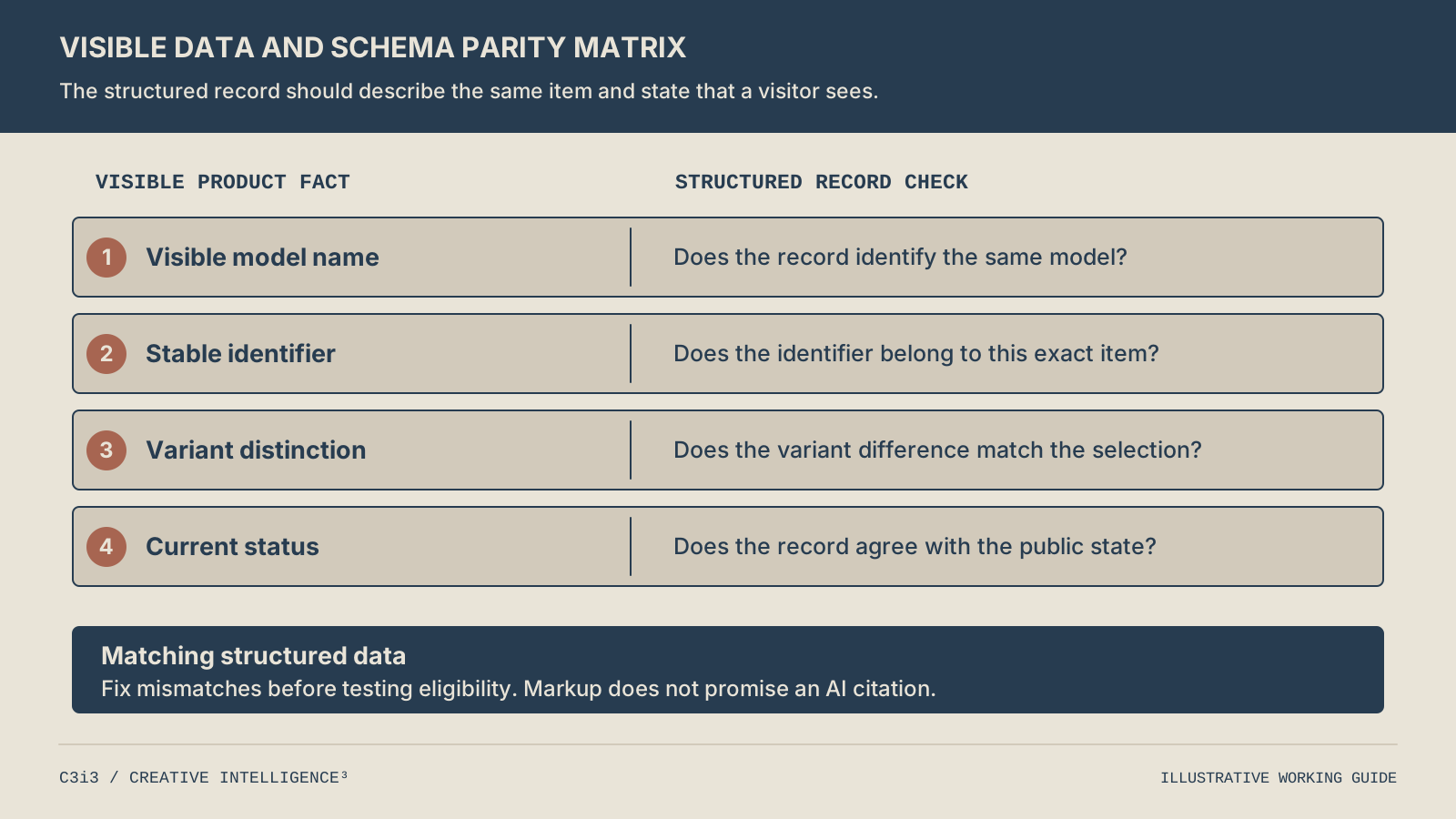
Compare visible model names, identifiers, variant differences and current status with the structured record. Resolve mismatches before testing feature eligibility.
How should availability and lifecycle changes reach the markup?
Availability should follow the actual approved commercial state, while lifecycle information should remain clear in visible content. A temporary absence, a market limitation and a permanently retired model should not all inherit the same generic template value.
Identify the system or responsible team that establishes each state. Then document how the public page and any structured representation receive updates. A nightly import, manual page edit and cached response may create different update moments. The user sees the final combination, so test the live result after a meaningful change.
What if the page is an archive or a quote-only catalog entry?
Do not generate a current purchase representation simply because the template expects one. Keep the archived model's identity and useful documentation, and choose structured information that accurately fits what the page provides. Check feature eligibility separately. The discontinued-product guide covers the URL and visible archive decisions.
For an illustrative catalog entry, the page might explain that the item is retired while a cached data feed still emits a current-availability value. The correction should address the lifecycle-to-template connection and the cache, not merely add another sentence to the page. Record which output was verified after the change.
Keep historical documents distinguishable from current buying information. A datasheet can remain available for existing owners without implying that the product is offered today. That distinction helps both visitors and reviewers interpret the structured record in context.
How do you test variant pages and selected product states?
Test the URL, selected state, visible content and structured output as one connected experience. A variant identifier is useful only when the destination allows a reviewer and visitor to understand which item it describes.
Begin with the intended page pattern: variants selected on one page or variants represented across several pages. Follow the applicable Google variant guidance rather than mixing assumptions from both patterns. Coordinate canonical signals with that structure. The canonicalization documentation explains how preferred URLs are signaled for duplicate or similar pages.
What should a release test include?
Open a selected variant URL in a new session. Check the model label, selected option, relevant image and any next action. Inspect the generated data and confirm that its identifiers match the visible selection. Repeat with another variant and the default page so a successful first result does not conceal a broken mapping elsewhere.
Use appropriate structured-data testing tools to identify syntax and supported-feature issues, then review the result manually against the product source. Passing a tool does not prove a factual claim or guarantee a search display. Save the test date, affected URL and outstanding warning with the release record.
When a JavaScript interaction changes the selection, investigate what the direct URL and initial response provide as well as what happens after clicking. The developer should know which behavior is intended. Avoid an implementation that works only after a visitor recreates a particular sequence from the home page.
What should your agency deliver after a product schema review?
The agency should deliver a product-to-page mapping, documented discrepancies, implemented changes and a verification record. The output should explain which representations are accurate and which feature requirements remain unmet, rather than offering a generic “schema installed” badge.
Prioritize errors that change identity or current state. A mislabeled variant is usually more consequential than an optional descriptive field that is absent. Identify whether the source system, template mapping or cached output caused the mismatch so the repair survives the next catalog update.
How do you keep the work maintainable?
Give the catalog team a compact regression sample: a default page, two variant selections, a temporarily unavailable item and an archived model where those situations exist. Recheck that sample after changes to imports or page templates. It provides a practical warning when a shared update affects different lifecycle states.
Connect the implementation to the product-model audit. If a later AI answer confuses variants, the audit can inspect both visible explanations and structured mappings without assuming either caused the response. For retrieval problems, use the crawler-access guide rather than changing structured data blindly.
Keep the completion statement precise: which pages were updated, which fields were reconciled and which checks passed. An accurate catalog representation is a concrete result. A future search enhancement or AI citation remains a separate observation that must be measured if it occurs.
What else should product brands know?
Does Product schema guarantee that AI answers will cite us?
No. Accurate markup can support documented product features where the page qualifies, but it does not control an external assistant’s answer or source selection. Keep markup aligned with visible facts and use the broader catalog process to improve the information buyers need. Treat citations as dated observations rather than an automatic consequence of adding a type.
Can a page use Schema.org correctly without qualifying for a Google product feature?
Yes. The general vocabulary and a specific search feature’s requirements are different layers. A record may describe a product using valid vocabulary while lacking information required for a particular display. Check the intended feature’s current documentation and the real business model. Do not invent missing commercial or review data simply to resemble an eligible example.
Should every item in a product family become a variant?
No. A marketing family can contain distinct designs as well as genuine variants. Decide which differences represent a selectable variation and which create a separate model identity. Preserve the distinctions that affect selection. Grouping unrelated products together can make the record less faithful to the catalog even when the names share a common prefix.
Should we create identifiers for products that lack them?
Use the business’s existing verified identifiers where available, and follow the requirements for the type of identifier being provided. Do not fabricate a GTIN or reuse another item’s identifier. If a stable internal identifier needs to be established, coordinate that decision with the catalog team so future imports and public pages use it consistently.
How often should we check generated product data?
Check it after relevant source, template or integration changes, and include a manageable sample in ordinary catalog maintenance. A product launch, variant addition or lifecycle transition can affect different mappings. The right review interval depends on how frequently the range changes. Keep a dated sample and issue log so the next check compares an understandable state.

How C3i3 Can Help
C3i3 can help reconcile visible catalog content with the structured records generated by your website. A useful starting sample includes a product family, its variants and one item whose current status is not being represented correctly.
Explore AI search optimization services or contact C3i3 about a catalog-data review. We can identify the content and implementation work needed without treating markup as a shortcut to AI placement.