








































In this article
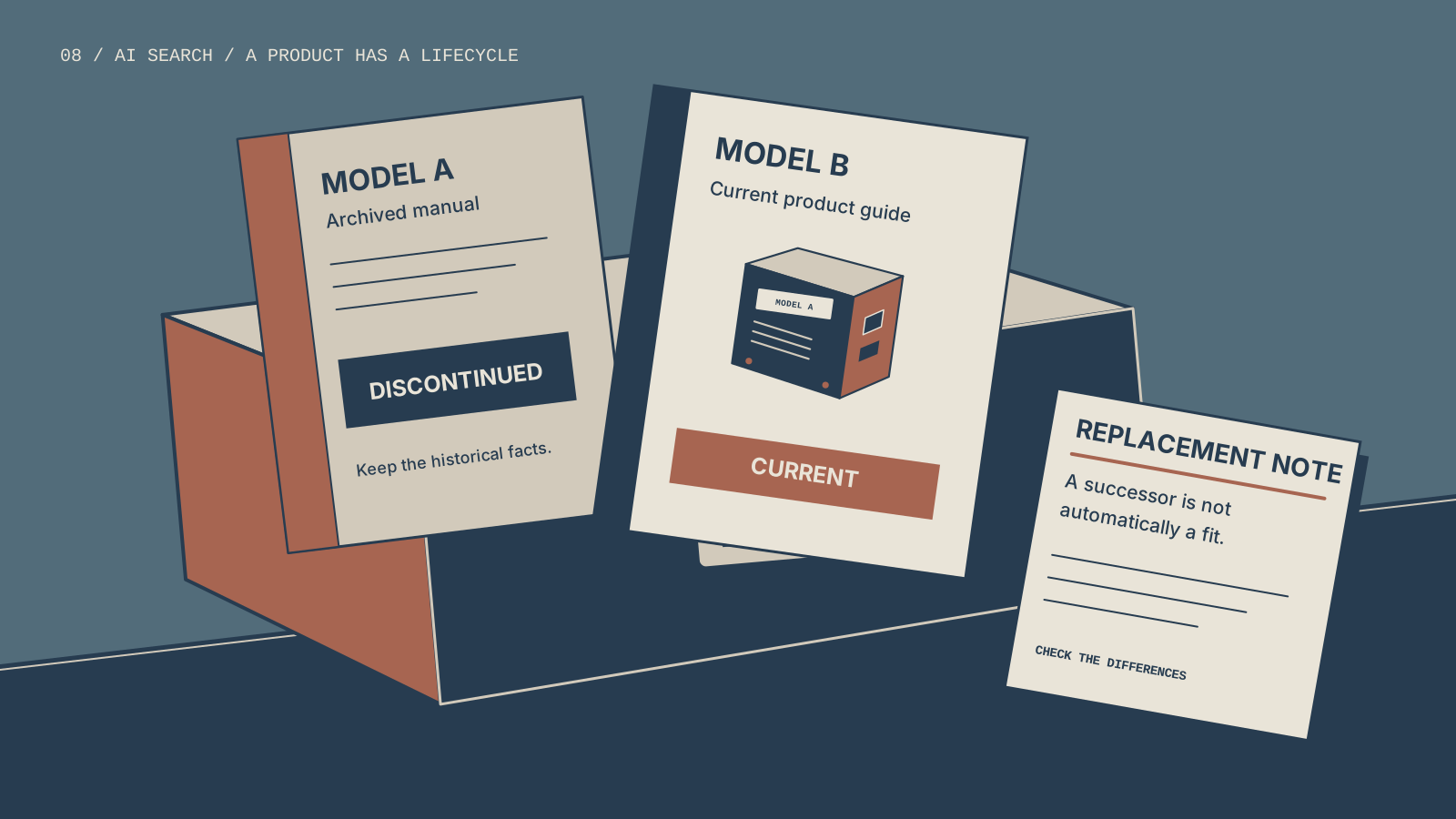
A buyer asks ChatGPT which product to choose and receives a confident description of a model your business stopped selling. The answer may link to an old catalog, repeat a distributor's listing or recommend a new model as an interchangeable substitute when that relationship has never been established.
For a brand, the useful ChatGPT SEO task is to clarify the public product lifecycle. Decide what the old model page should explain, make the current alternatives understandable and reconcile the surfaces that still describe the retired item as a live choice. You can improve those sources without claiming control over an assistant's response.
This guide deals specifically with discontinued products. Use the broader catalog preparation guide for family and model architecture, and keep temporary stock changes separate from permanent retirement.
What should you verify before changing a discontinued product page?
Verify the exact product identity, the actual lifecycle decision and the statement that needs correction. A temporary stock issue, a regional sales restriction and permanent discontinuation are different situations. The website should not turn one into another through a vague label.
Check the model identifier in the observed answer against the product record. Similar names can refer to different generations. Record where the answer appeared, its date and the source links it displayed. Then locate the current approved lifecycle information. A salesperson remembering that an item is “old” is not enough to establish its public status.
Which questions should the product team answer?
Ask whether the item remains available anywhere, whether existing owners still need documentation and whether a named successor is a direct substitute or simply another option. Record any limits on the replacement relationship. A newer device may require a different mounting arrangement or interface even when it serves a similar application.
In an illustrative example, Model R1 is permanently retired while Model R2 is current. R2 offers a different connection method. The accurate public message is that R2 is a later option requiring a compatibility check, not that every R1 installation can replace it without review.
Preserve that distinction in the correction brief. The agency needs an approved statement and a defined buyer task. It should not infer the lifecycle relationship from a product name, an upload date or a general announcement about a newer range.
Should the old product URL remain, redirect or be removed?
Choose the URL behavior according to what the old page still provides and whether a genuinely relevant replacement exists. An old model may deserve a useful archive page when owners need its manual or buyers need to understand its status.
For a retained archive, make the discontinued state prominent and identify the model clearly. Explain the next appropriate action and link to current alternatives with their selection boundaries. The page should still contain meaningful information, rather than display an empty template with a small unavailable notice.
When is a redirect appropriate?
A redirect can be appropriate when the old resource has moved or a clear replacement fulfills substantially the same need. Avoid directing every retired model to the home page or an unrelated current item. That can erase useful context and leave the visitor believing the destination is identical.
Google's crawling-error guidance distinguishes moved content from resources that are gone without a replacement. It also explains why a page that presents an error while returning a success response can be treated as a soft 404. Coordinate the technical behavior with the content decision rather than selecting a response code in isolation.
Use a decision note for each affected model: keep an informative archive, redirect to a relevant destination or return an appropriate missing-resource response. Include the reason and the intended visitor path. A canonical tag is not a general replacement for a lifecycle decision; see Google's canonicalization guidance for its separate purpose.
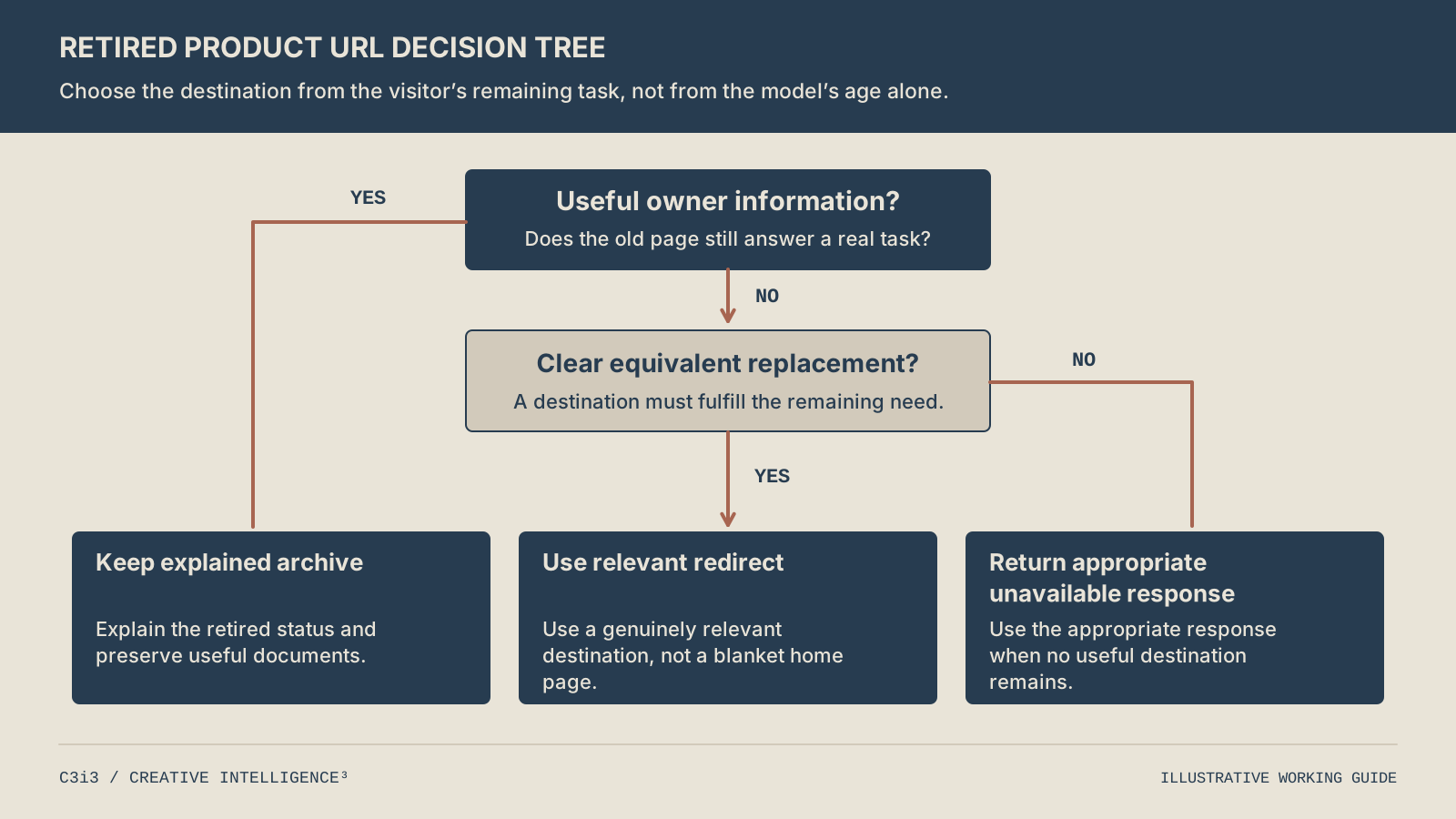
Retain an informative archive when owners still need it. Use a relevant redirect when content has moved or a clear replacement fulfills the need. If no useful content or replacement remains, return an appropriate unavailable response.
What should a useful archived product page explain?
An archived product page should identify the retired model, state its current lifecycle status and help the visitor understand what remains available. It should distinguish historical specifications from the current range without implying a support commitment the business has not confirmed.
Keep useful document links clearly labeled. A manual for the older generation may remain the correct resource for an installed product. Replacing it with a new generation's manual can create a different problem. State which model and revision a file covers, and remove obsolete promotional instructions that no longer describe a possible purchase.
How should you present the current alternative?
Explain why the alternative is relevant and what needs checking. In the illustrative R1 example, the page might link to R2 as the current family option while noting that connection and installation requirements differ. A short comparison of verified differences is more useful than an unqualified “replaced by” statement.
The page's next action should follow its role. An owner looking for documentation needs a different route from a buyer evaluating the current range. Where the business has separate support and sales destinations, label them clearly. Do not promise that either team can resolve every legacy installation.
Keep the archived page's identity stable. The old model title should not silently become the name of its successor while the URL still suggests R1. That obscures the historical record and can make citations harder to interpret. The page can explain a relationship without pretending that two generations are the same product.
Where else should you correct outdated product references?
Follow the retired model's relationships across the public catalog. A corrected model page is only one surface; the family overview, comparison table or downloadable brochure may still present the item as current.
Create a queue that distinguishes brand-controlled surfaces from partner-controlled ones. Start with category listings, buying guides, application pages, internal search results and prominent product links. Then inspect linked files and media descriptions where the old item is still recommended. Record each URL and the precise statement that needs review.
How should you handle distributor or reseller pages?
Give the responsible business contact a concise evidence note through the normal relationship. Identify the exact model, approved lifecycle wording and useful current destination. Do not mark the external page corrected merely because your team requested a change. Some partners may legitimately hold remaining stock, so confirm their situation before describing every listing as wrong.
Update machine-readable product information where the business maintains it, but keep it consistent with the page visitors see. A structured-data value should not advertise current availability while the visible page says the model is retired. The product schema guide explains how to review those relationships without inventing commercial data.
Finish the queue with a verification date and unresolved questions. This is a catalog correction project, not a reason to rewrite every historical article. Preserve content that remains accurate and add context where the lifecycle change affects the reader's decision.
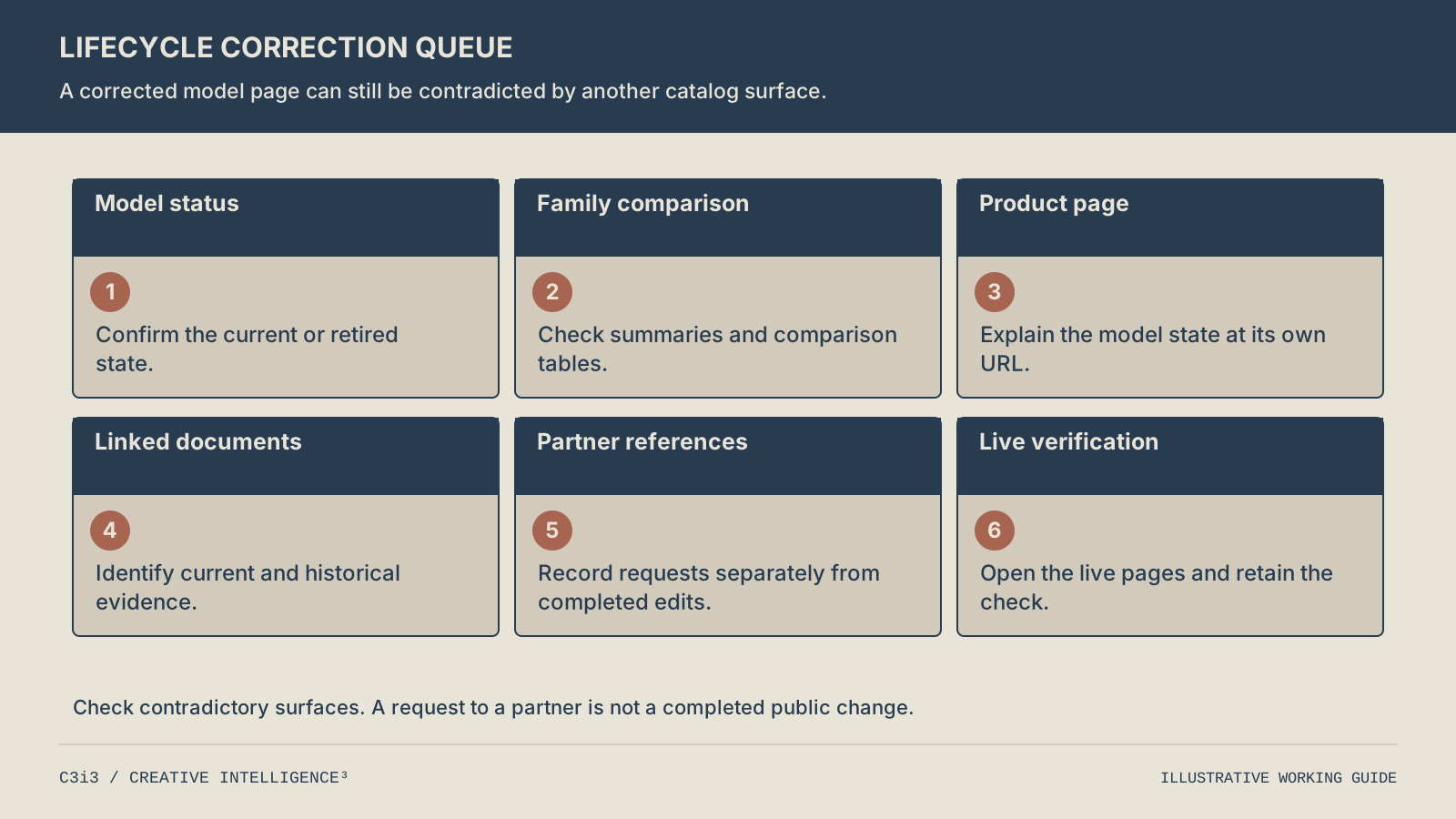
Confirm lifecycle status, inspect family and model explanations, review linked documents, separate partner requests from completed edits and verify the live result.
How do you verify the correction after publication?
Check the actual public response, visible explanation, linked documents and current product paths. A completed edit in a content system is not proof that the change is serving correctly through the live website or its cache.
Open the old URL as a new visitor and follow the intended route. Confirm that the page either provides its archive explanation or reaches the chosen relevant destination. If a resource was removed, confirm the actual response behavior. Test on a phone as well as a desktop so a status label is not hidden behind a collapsed panel or clipped layout.
What should you inspect beyond the page heading?
Review the description used in internal results, the product comparison row, the linked PDF and any structured data generated by the template. An old summary can persist even when the main paragraph changes. Keep the corrected source record available so a reviewer can distinguish a stale surface from a deliberate archive statement.
Access and indexing are separate checks. A search system needs to be able to retrieve a change before it can process it. Do not block the old page in robots.txt simply because you want its old description to disappear. The crawler-controls article explains why access, indexing and usage preferences need different decisions.
Record the result as “archive explanation verified” or “relevant redirect verified,” with the date and destination. That wording says what the team has actually confirmed. It does not imply that every cached search result or AI answer has already been replaced.
What should you do if ChatGPT still describes the old model?
Retain the verified public correction, inspect the new observation and look for the source of the remaining discrepancy. An external answer may continue to vary or rely on material beyond your website. Do not undo an accurate lifecycle explanation merely to chase one sample response.
Repeat the original question with its context recorded. Check whether the answer names the same model and whether it displays sources. If it links to a different old resource, add that resource to the investigation queue. If the current source is accurate but the answer extrapolates beyond it, classify the unsupported statement rather than assuming your page needs another rewrite.
Can feedback or recrawling guarantee a corrected answer?
No. Available feedback and recrawl requests are not editorial control over an assistant. Google's AI features documentation also separates eligibility from guaranteed inclusion. Describe the work as improving public product information and monitoring observed descriptions, not forcing a future response.
Use the product-model audit to retain consistent evidence over time. Include both corrected and persistent examples. If buyers continue to ask for the retired item, review the inquiry path and source referrals when available. They may be arriving from a useful legacy guide, remaining partner stock or an outdated recommendation.
The next decision should follow that evidence. Sometimes a clearer archive introduction is enough. Sometimes a current alternative needs a better explanation. Sometimes the honest completion state is that your sources are correct while an external description remains unresolved.
What else should product brands know?
Should every discontinued product be noindexed?
No. Some archived pages remain useful to owners and buyers who need historical documentation or a clear lifecycle explanation. Decide whether the page still serves a legitimate public task. If it does, improve that explanation. If it no longer provides meaningful information, choose the appropriate removal or replacement behavior with the website team.
Is a successor always a direct replacement?
No. A successor can serve a related purpose while changing interfaces, dimensions or supported conditions. Use the business-approved relationship and explain relevant selection checks. Do not transform a marketing announcement about a newer product into a universal compatibility statement. A current alternative should help the buyer evaluate the next step rather than conceal the difference.
Can an old PDF stay publicly available?
Yes, when the business wants it available and it remains useful for the identified model. Label its scope and revision, and link from an archive explanation that makes the lifecycle state clear. Review any promotional language around the file. Keeping a historical manual available does not require presenting the retired item as a current purchase choice.
Will changing the page immediately change ChatGPT?
No. Publication verifies the brand-controlled source, not the timing or content of a later external answer. Systems may use different sources and observations may vary. Keep a dated record of the correction and subsequent samples. Avoid promising a fixed turnaround for an answer change that your team cannot directly control.
What if a partner still sells remaining inventory?
Confirm the partner’s situation before asking it to remove the listing. Remaining inventory and ongoing production are different facts. Your own page can state the manufacturer’s lifecycle decision while explaining the appropriate route for current availability questions. Keep any external correction request precise, and record a partner’s completed change separately from your request.

How C3i3 Can Help
C3i3 can help organize a lifecycle correction across model pages, range introductions and linked resources. Send the retired model, its approved status and the current alternatives you want buyers to evaluate.
Explore AI search optimization support or contact C3i3 about outdated product information. We can help define the public explanation and the website checks needed to verify it.