








































In this article
A U.S. buyer asks an AI assistant about your Korean brand and receives a familiar but outdated name. Another answer connects your product to the wrong company, while an English page still repeats a description that the Korean site changed months ago. The visible error is in the answer, but the underlying disagreement may be spread across several public sources.
Korean AIO agency support should begin with that evidence trail. AI search optimization (AIO) cannot give a brand direct control over an independent answer. It can help make the information you publish more consistent, specific and current. This guide provides a bilingual correction workflow within our Korean digital marketing framework, focused on resolving conflicting brand information rather than selecting an agency.
What should you record before trying to correct an AI answer?
Capture the exact statement and the context in which it appeared. A paraphrase such as “AI got our brand wrong” is too vague to diagnose or retest. Preserve the platform, date, prompt, response wording and any cited destination available in the interface.
Separate what the answer actually says from your interpretation. “The answer names our former brand” is an observation. “The model has confused every version of our company” is a conclusion that needs more evidence. Begin with a specific discrepancy the team can investigate.
Which differences deserve separate records?
Keep identity, product lifecycle and market arrangements distinct. A former company name, a discontinued product and an outdated U.S. contact route may appear together, but they require different source corrections. One broad rewrite can leave the real cause untouched.
Use a conflict log with the statement, why it is inaccurate or incomplete, current evidence, suspected source and next investigation. Mark a suspected source as unconfirmed until the relationship is supported. The answer may not expose every source it used.
For an illustrative bilingual brand, a log might note that an English answer uses “Example Devices” while the current Korean page identifies “Example Brand.” The team must still establish whether those names represent a rebrand, separate entities or simply different public labels. Fixing the wording before resolving that relationship could introduce another error.
How do you separate the Korean brand, English name and company relationship?
Create a concise identity record that distinguishes the public brand from the organization behind it and from individual products. A translated phrase is not automatically the official English company name. A distributor is not automatically the manufacturer, and a product family is not automatically a separate business.
Use the names the business actually presents publicly and the records that substantiate their relationship. Keep an unresolved relationship visible as a question rather than filling it with a plausible English rendering. Keep the record factual and tied to the public relationship the business can substantiate.
| Identity field | Illustrative entry | What to verify |
|---|---|---|
| Korean brand label | 예시 브랜드 | The current public Korean spelling |
| English brand label | Example Brand | The public English name in current use |
| Company relationship | Brand operated by Example Company | The actual documented relationship |
| Former name | Only if relevant and confirmed | Whether and when the relationship changed |
| Market contact | Current inquiry destination | The route the business actually supports |
These labels are fictional examples, not suggested claims for a real business. Google's Organization structured-data documentation provides a reference for accurately describing an organization on its website. Structured data should match the public facts; it cannot settle an uncertain relationship or compel an AI service to accept it.
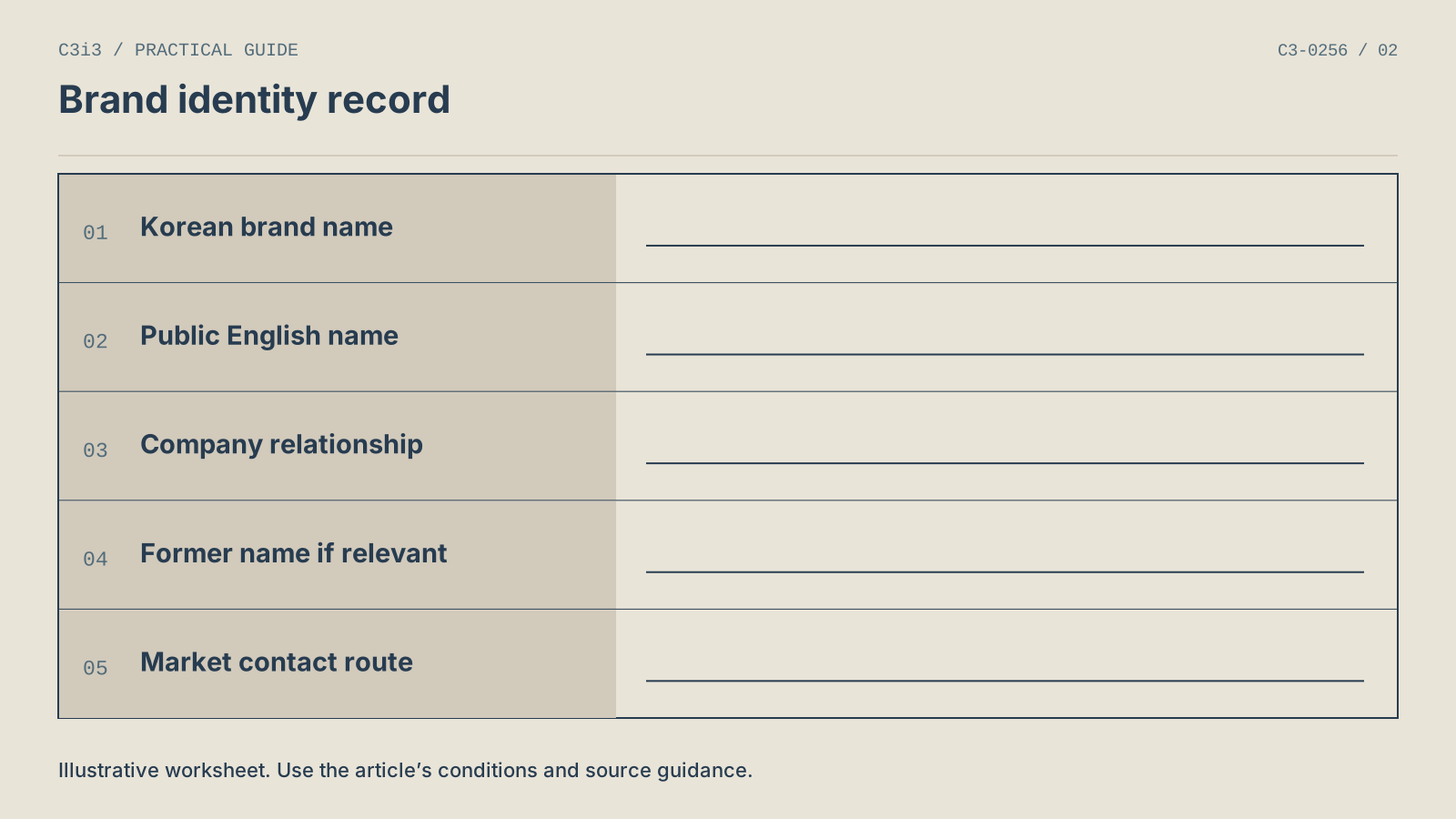
Document the Korean brand name, public English name, accurate company relationship, any relevant former name and actual market contact. Link each field to a current public source and record unresolved differences separately.
Where should you look for the conflicting information?
Start with the public sources you control, then examine identifiable external destinations associated with the disagreement. The purpose is to locate specific statements and understand their role, not to assume every old mention is causing the current answer.
Review the company overview, product introductions, contact pages, downloadable brochures, social profiles and relevant archived material. Compare Korean and English versions by meaning rather than by whether the paragraphs look alike. An old PDF can carry an outdated name even when the main product page is current.
How should you prioritize sources for review?
Prioritize pages that directly identify the business, pages cited in the observed answer and destinations used in the current buyer journey. Keep older or peripheral sources on a separate list. A focused inventory is easier to resolve than an indiscriminate attempt to rewrite the web.
Record the URL, exact statement, language, apparent date or version and whether your team can edit it. Distinguish an outdated fact from a historically accurate statement. A page describing an earlier period may need context rather than deletion.
The Korean-English structure guide helps establish genuine counterpart pages. If two pages are not equivalents, do not force them to use the same introduction. The shared identifying facts should still make their relationship understandable.
Third-party listings or partner pages may require a factual correction request through the relevant owner. Keep the requested change and the observed result separate. A request being sent does not establish that the destination changed.
How should you correct the public information without creating another conflict?
Resolve the fact first, then update the relevant public destinations in a deliberate sequence. Begin with the authoritative company or product explanation and check the connected Korean and English pages. The objective is a clear relationship a reader can understand, not repeated keyword variants.
For a confirmed name change in the illustrative brand, the current overview could state the current public name and explain the former name where that history remains useful. Product pages and important downloads should then use an accurate current relationship. Do not remove a valid model identifier merely because it resembles the older company name.
What does a useful correction record include?
Keep the previous statement, corrected statement, source basis, affected URLs and date verified. Add a note when a destination is still pending. This allows the team to distinguish completed website work from external requests or observations awaiting review.
Review contextual links as well as visible paragraphs. A corrected overview that still sends readers to an unexplained former-brand page can preserve confusion. Where an archived document remains useful, label its role and connect it to the current explanation rather than pretending it is the newest material.
Google's recrawl guidance explains how website owners can request a new crawl after changes and notes that inclusion is not guaranteed. A crawl request is not an instruction to every AI system, and it should not be reported as a corrected answer.
Keep the original evidence log after the update. It becomes the basis for a meaningful recheck and prevents the next review from relying on memory.
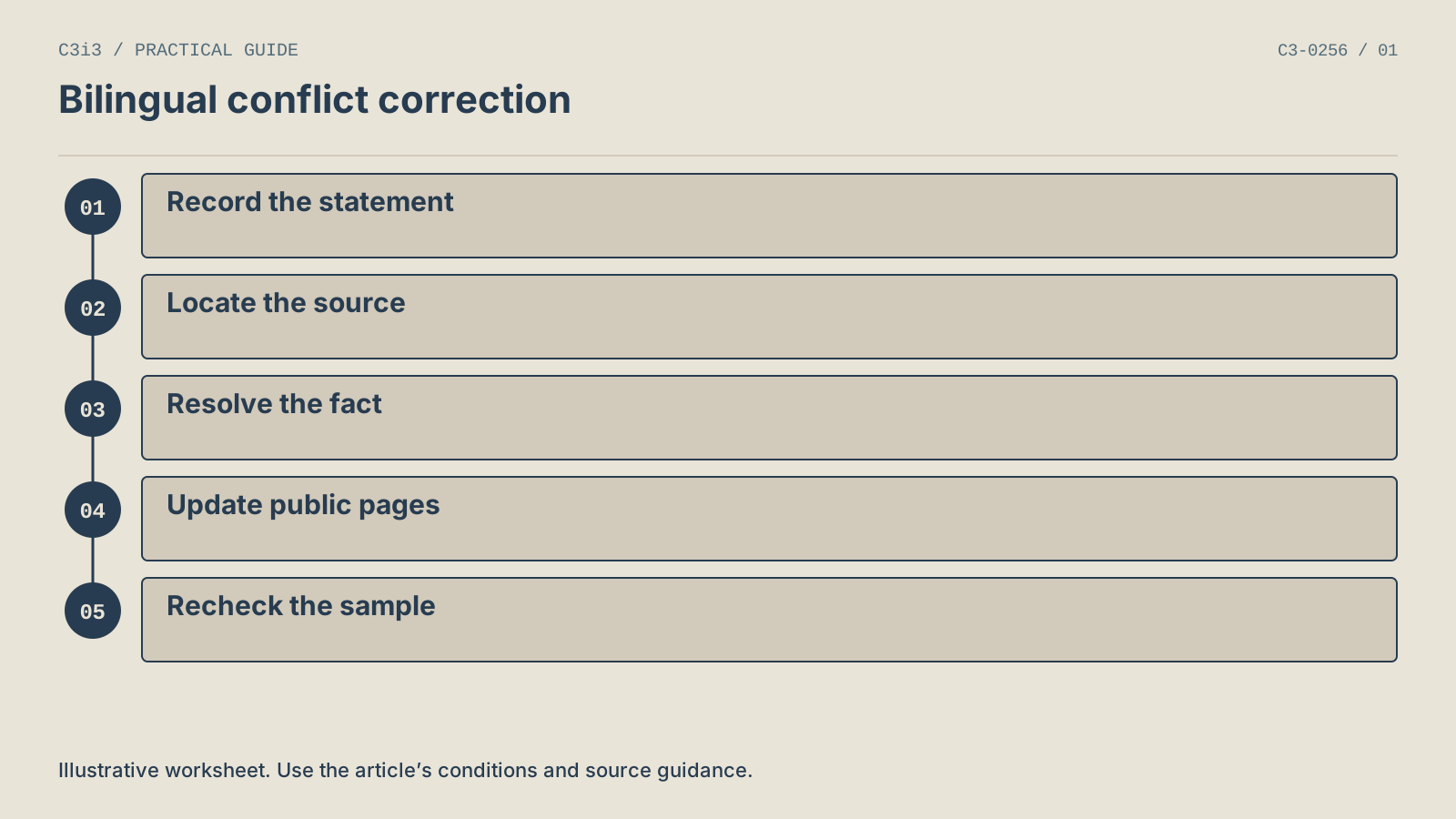
Record the exact conflicting statement and context, find its source, resolve the actual fact, update the relevant public pages and repeat the same observation. The process does not let a brand directly edit an independent AI answer.
How do you tell whether the correction is visible in AI-assisted discovery?
Revisit the defined sample and report exactly what changed. Confirm the public source separately from the AI answer. A source can be correct while a sampled answer remains outdated, and a different answer can appear without proving that your edit caused the change.
Repeat the relevant prompt and record the platform, mode where visible, date and cited destinations. Preserve enough of the earlier observation to compare the actual statement. If the interface or context changed, note that limit rather than presenting the comparison as controlled research.
For answer engine optimization (AEO), test the actual buyer question in Korean and English as separate observations. A brand mention, a cited page, a factually accurate explanation and a human visit referred by an AI service are different signals. A Korean-language answer may expose a source conflict that is absent from the English sample. Neither sample is a measure of keyword search volume or the complete population of buyer conversations.
Which outcomes should remain separate?
Separate a completed source correction, a search indexing observation, an AI-answer mention, an identifiable referral and a qualified inquiry. They describe different parts of the journey. Do not label a single corrected sample as universal brand visibility.
Google's AI-feature documentation supports applying sound website and SEO practices to its AI search experiences. It does not give a brand control over every generated statement. Keep the scope limited to the system and observation actually reviewed.
For a broader product-level problem, use our product-model AI visibility audit. That task examines whether the answer identifies the right model and suitability boundary. This bilingual workflow instead resolves the underlying brand and company information that multiple assets share.
What should your team maintain after the immediate correction?
Maintain the identity record and a short list of destinations affected by important business changes. The aim is to reduce factual drift as new Korean and English material is published. A long policy document is less useful than a current record that the content team can actually consult.
Review the relevant record when the public brand name, company relationship, product naming or market contact arrangement changes. Connect that change to the affected website pages, profiles and current campaign materials. Keep historical context where it helps a buyer understand an older reference.
What should the next campaign receive?
Give the campaign a current source destination, the public naming to use and a list of unresolved questions. Avoid handing over an old brochure as though it represents the complete present offer. A social post can be well written while carrying the same outdated identity problem into a new channel.
The Korean social platform guide explains how to connect a post to a maintained source page. If the company is choosing between Korean-market and U.S.-market discovery, the Naver-versus-Google guide addresses that separate decision.
At the next review, ask whether the record still reflects the actual business and whether the corrected destinations remain accessible. A maintained explanation is a more useful foundation than repeatedly reacting to an isolated answer without checking the sources behind it.
What else should Korean brands ask about conflicting AI-search information?
Keep source corrections, naming relationships and independent answer behavior distinct. These follow-up questions address the situations that commonly complicate an otherwise straightforward correction record.
Can an AIO agency directly edit what an AI assistant says?
No. An agency can improve the sources it is authorized to work on, investigate visible evidence and use available correction channels where appropriate. Independent platforms decide how their systems respond. A useful scope separates the website changes the team can deliver from the sampled answer observations it can report. Avoid treating a correction request as a promise of a particular response.
Should we publish every possible romanization of our brand?
Use genuine, relevant names and explain their relationship where a buyer needs that context. A large list of speculative spellings can make the page less useful and does not establish a stronger identity. Begin with the public Korean and English names the business actually uses, then investigate specific variants that appear in real inquiries or identifiable sources.
What if a distributor uses a different product or company description?
Check whether the description is inaccurate, outdated or simply written for a different commercial role. A distributor and a manufacturer may legitimately describe their roles differently. Document the precise discrepancy and the current evidence before requesting a change. Do not demand identical copy across organizations or imply a relationship that has not been established.
Should old Korean PDFs be deleted to remove outdated facts?
Not automatically. An older document may still serve customers using an earlier product. Review its purpose, current usefulness and relationship to the newer explanation. Clear archival labeling and links to current information may be appropriate. The decision should preserve useful customer context while reducing confusion about which facts apply now.
Does consistent information guarantee an AI citation?
No. Accurate, current sources make the public explanation more coherent for people and discovery systems, but inclusion remains outside the brand's control. Evaluate the work through completed corrections and a documented sample of observations. Keep inquiries and other business outcomes separate from a citation or mention seen in one answer.

How C3i3 Can Help
C3i3 can help investigate conflicting Korean and English brand information, map the relevant public destinations and prepare a focused correction plan. Bring the exact statement you observed, the current brand and company information and the pages you believe are involved. We can organize the evidence and improve the website explanation without promising control over independent AI answers.
Explore C3i3's AI search optimization services or discuss a bilingual brand-information problem.