








































In this article
A Korean brand can run an English website, publish social videos and appear in search without giving a U.S. buyer a coherent path to a decision. The video explains one product name, the website uses another and a search answer points to an older brochure. Each channel looks active, but the customer has to assemble the offer.
Korean digital marketing works better when search engine optimization (SEO), AI search optimization (AIO) and social media optimization (SMO) support the same buyer question. The goal is a connected explanation, from first discovery through product evaluation to a suitable inquiry. This guide shows how to plan that connection for a Korean brand pursuing U.S. growth. It covers campaign structure and execution rather than repeating our Korean agency-selection guide.
Which U.S. buyer should your Korean digital marketing serve first?
Start with a buyer defined by a need and a buying situation. Nationality alone does not identify what someone wants, what language they prefer or how they evaluate a product. A Korean American business owner, an English-speaking purchasing manager and a Korean headquarters researcher may all encounter the same brand while needing different information.
Write a brief that names the person, the task and the next commercial conversation. For an illustrative meeting-room camera brand, the first audience might be U.S. workplace managers replacing equipment in small conference rooms. Their questions concern room fit, installation, connection requirements and what a demonstration can establish. A broad message about Korean innovation is supporting context, not an answer to those questions.
What should your first audience brief contain?
Record the buyer's role, intended use, important constraints, preferred evaluation materials and appropriate contact destination. Add the questions that would make the product unsuitable. A clear boundary helps the campaign attract relevant attention rather than encourage every visitor to inquire.
Use recent sales questions, website inquiries and conversations with actual buyers. Treat an internal assumption as an assumption until you have evidence. If the sales team cannot describe the intended buyer, begin with a small discovery exercise before commissioning a large campaign. The first finished asset should solve a recognizable customer task.
What job should SEO, AIO and SMO each perform?
Assign each discipline a distinct job within one customer journey. SEO helps organize discoverable website information. AIO applies careful attention to how search and AI-assisted discovery encounter, interpret and reference that information. SMO improves the usefulness of social profiles and content for the people using those channels.
These activities share inputs. A clear product explanation can support an indexed page, a concise answer and a demonstration clip. That does not mean the same finished text belongs everywhere. A search visitor may need several paragraphs and a specification link. A short video needs an observable point, an understandable opening and a relevant destination.
Answer engine optimization (AEO) adds a useful question to that plan: can a prospective buyer find and understand a direct, supportable answer to the decision they are trying to make? Treat AEO as an editorial and discovery discipline, not a separate ranking system the brand controls. The existing AEO deliverables guide explains the service scope without requiring another version of the catalog.
Does AI search require a separate version of every page?
No. Creating a second catalog solely for AI systems can multiply conflicting information. Google's AI-feature guidance says established SEO practices remain relevant and does not prescribe special AI markup. That guidance concerns Google's features, not every independent AI service.
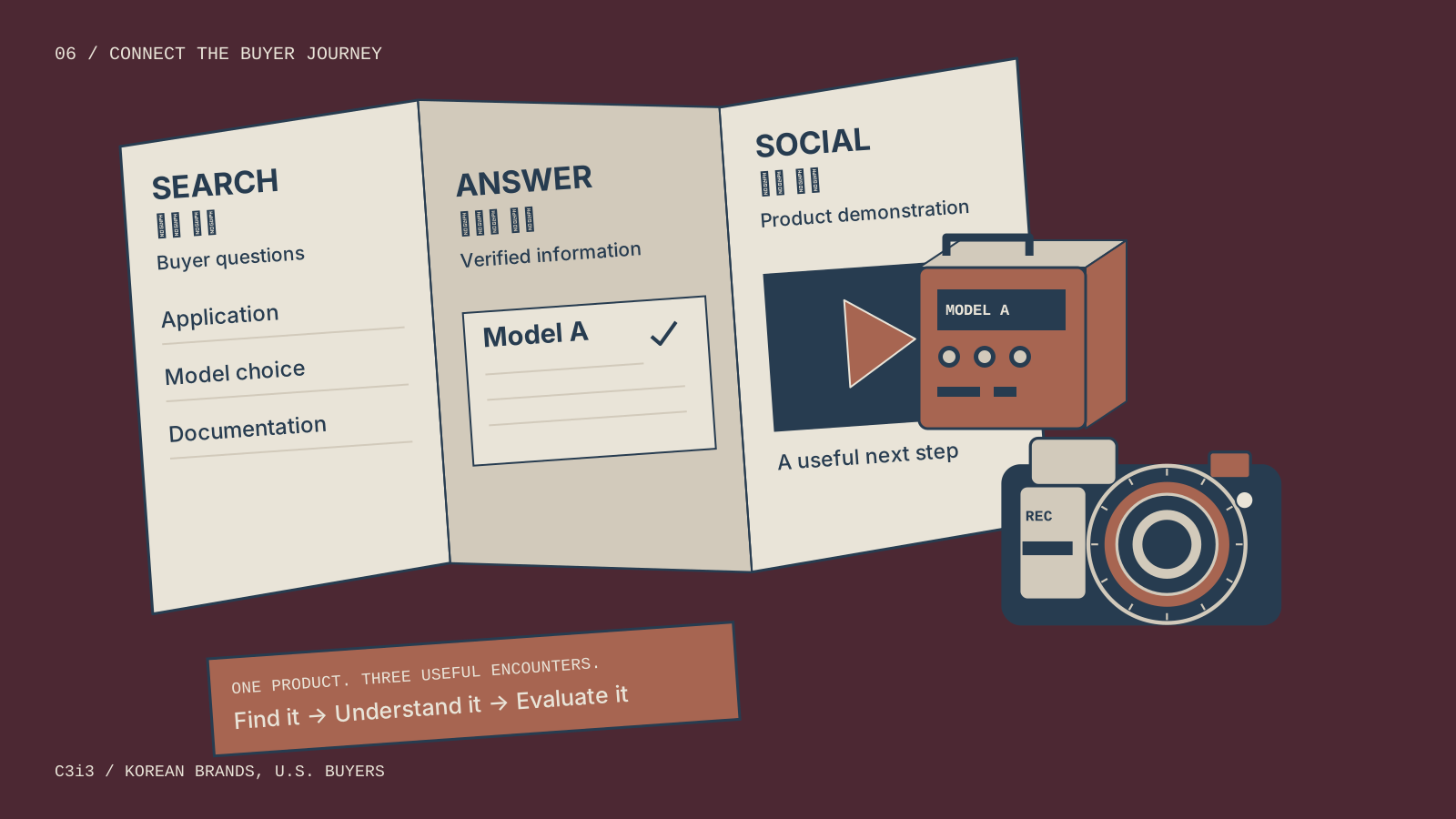
For the illustrative camera campaign, the website explains room suitability and limitations. A video shows a relevant setup question. A short answer identifies the applicable model and links to its current source page. All three refer to the same product identity while serving different moments. This is a coordinated campaign rather than three disconnected publishing assignments.
Which website destination should you prepare before increasing visibility?
Prepare the page that can complete the promise made by the campaign. A product demonstration should lead to the relevant product or application page, while a broader educational post may lead to a comparison or planning guide. Sending every visitor to the homepage creates unnecessary interpretation work.
Review that destination as an unfamiliar U.S. buyer. Can the visitor identify the product, its intended use, important limitations and the next step? Can they distinguish current documentation from an archived document? Can they find the route for the market where they want to buy? These questions matter before the campaign expands.
What belongs in a destination-readiness check?
Check the title, model naming, useful description, supporting material, mobile presentation and action path. Follow every important link. An attractive page can still send a visitor to a download with a different product name or a form that loses the model context.
For our illustrative camera brand, a useful destination might connect a room-selection explanation, supported models and a demonstration request. It should not claim local inventory or U.S. support arrangements unless those arrangements exist. Use SEO services to improve the public information and navigation, with the relevant business facts supplied by the brand. A campaign becomes easier to evaluate when its destination is a defined part of the assignment.
How should Korean and English content support different audiences?
Preserve shared facts while adapting the explanation to the reader's task. Korean and English pages can describe the same product without sharing an identical introduction, sequence or example. Language changes should never silently change the model, available configuration or stated sales arrangement.
Map the pages that genuinely correspond to each other. A Korean corporate introduction is not automatically the equivalent of an English application guide. Labeling unrelated pages as language alternates makes the architecture harder to maintain and gives the visitor a poor language-switch experience.
Should every Korean page be translated immediately?
Translate the pages needed for the selected journey first. An English buyer may need a product-family overview, a specific use-case explanation and a clear inquiry route before they need the full corporate archive. Keep unavailable language versions out of the mapping rather than publishing empty destinations.
Our Korean-English website structure guide develops the URL and page-pairing decisions. At campaign level, keep a simple table: source topic, English buyer purpose, corresponding Korean page, shared facts and next action. The table turns translation from a pile of files into a maintained path. It also makes it easier to see when one language has useful context the other lacks.
How do you turn buyer questions into a connected content plan?
Group questions by the decision they help someone make, then give each substantial question one clear destination. A content plan should explain how the pieces connect, not simply list keywords or publication dates. Different wording does not always justify a different page.
For the camera example, early questions might ask how to evaluate a small meeting room. Later questions may compare installation approaches or ask which information is needed for a demonstration. The product page owns the current model facts, while the planning guide explains the evaluation method. Social content introduces a useful part of that explanation.
| Buyer task | Owned destination | Supporting social asset | Next step |
|---|---|---|---|
| Understand room fit | Room-selection guide | Short setup walkthrough | Read the relevant model page |
| Evaluate a model | Current product page | Focused feature demonstration | Review available documentation |
| Prepare a discussion | Demonstration-request page | What-to-prepare checklist | Send the necessary context |
This is an illustrative planning map, not a record of campaign performance. Its value is that each asset has a reason to exist. If two proposed articles answer the same decision with the same evidence, combine them before drafting. Refer buyers to the Naver-versus-Google guide when the unresolved issue is which market's discovery behavior the campaign should serve.
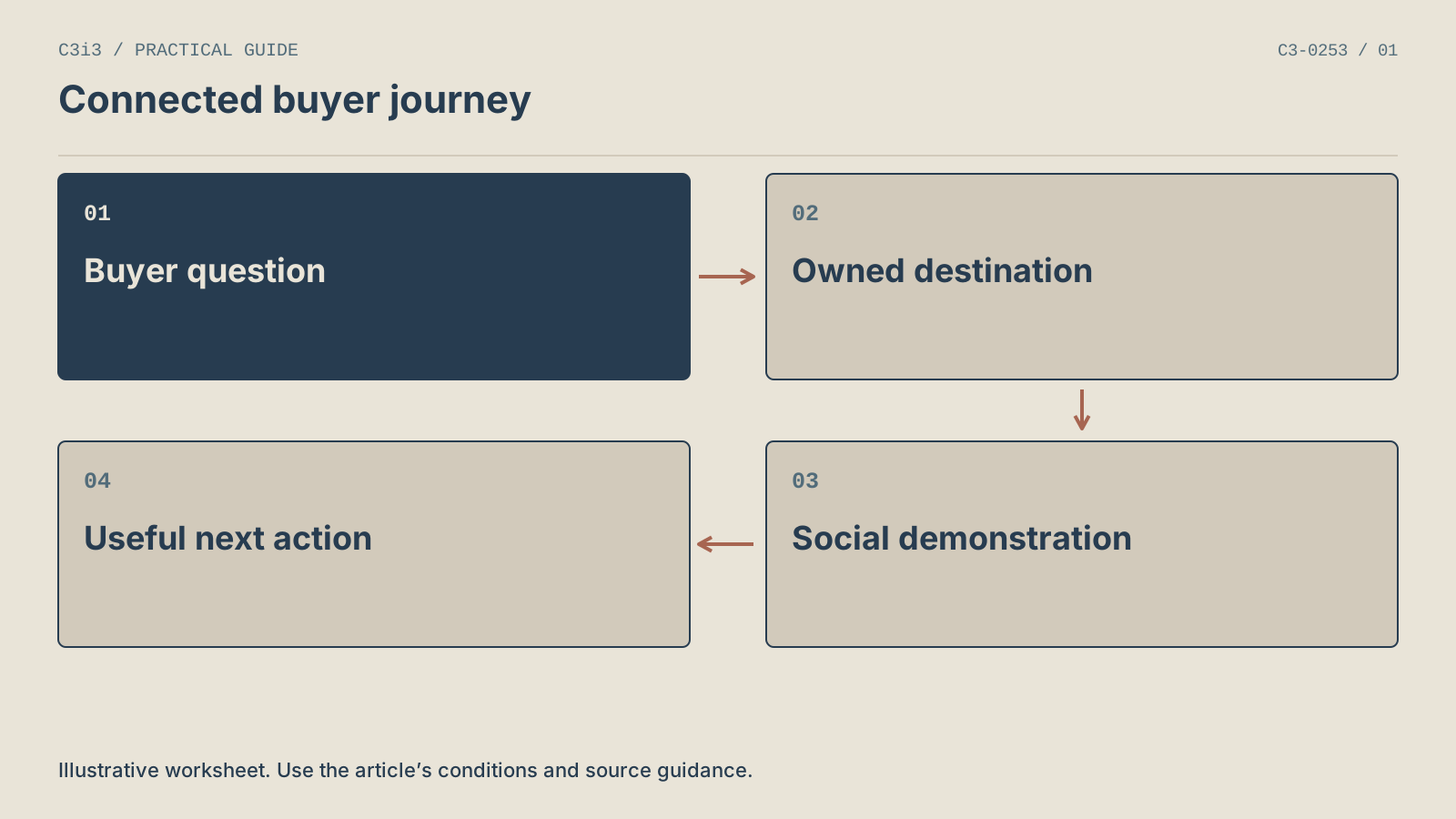
Choose a buyer question, give it a maintained website answer, demonstrate one useful part on social media and connect to an appropriate next action. This is an illustrative campaign map.
How do you keep brand information consistent across channels and AI answers?
Maintain a small record of the public facts that identify the business and connect each campaign asset to the current source. This is a content-maintenance task, not a way to control what an AI system says. A platform may use older material or third-party information after you update your own pages.
Record the Korean brand name, public English name, relevant company relationship, current product names and market-specific contact routes. Include known former names only when the relationship is accurate and useful to a customer. Do not create a long list of speculative spelling variants merely to repeat keywords.
What should you do when sources disagree?
First identify whether the disagreement concerns wording, an entity relationship or an actual business change. A distributor carrying an older model is a different situation from a brand page using an outdated company name. Keep the correction proportional to the underlying problem.
Our bilingual brand-information correction guide explains how to record the conflicting statement, locate its source and verify a published correction. For the campaign team, the practical requirement is that every new asset can trace its key identifying facts to a maintained destination. A clean source makes future changes less dependent on someone's memory.
What does a practical first campaign sequence look like?
Sequence the work by dependency: clarify the audience, finish the destination, create supporting answers, adapt the social content and verify the journey. Publishing dates should follow readiness rather than force unfinished pieces onto the site. A small complete campaign can reveal more than a large disconnected content list.
For the illustrative camera brand, start by reviewing recurring room-selection questions with the team that handles demonstrations. Build or improve the room-selection destination and link it to current model information. Create a focused explanation of the most common setup misunderstanding, then adapt it for the chosen social channel.
What should the team verify before the campaign becomes recurring?
Walk through the journey on a phone and a desktop. Confirm that each promised document opens, each model reference is current and the inquiry destination preserves enough context. Label internal tests and coordinate them with the team receiving the request.
Keep a short launch record: intended buyer, destination URL, supporting content URLs, publication dates and known limits. When something changes, record what changed and why. This is more useful than declaring a campaign complete because every scheduled post went live. The sequence should leave the next person with a visible, understandable path they can maintain.
How should you measure U.S. growth without confusing activity with results?
Measure each stage according to the evidence available there. Search visibility, social engagement, destination visits and qualified inquiries describe different events. They should not be added together into one success total or treated as proof that a particular article caused a sale.
Define a qualified inquiry before reviewing the campaign. For the illustrative camera brand, that might mean a U.S. organization with a relevant room project and enough information to begin an evaluation. A general reaction to a video would not meet that definition. The definition should reflect the actual sales process rather than make the report look stronger.
What should an interpretable campaign review show?
Show the period, the assets that changed, the evidence observed and the next decision. Separate branded and nonbranded search where the reporting supports that distinction. Keep AI-answer samples labeled with their platform, prompt, date and observed source. Treat an identifiable referral as different evidence from a brand mention in a sampled answer.
Read comments and sales questions alongside the numbers. Repeated requests for information that already exists may reveal a navigation problem. A rise in unsuitable inquiries may reveal an overly broad promise. Choose a practical change at the earliest weak stage, then review comparable periods while noting campaigns, seasonality and other changes that limit the comparison.
What should your team put in a reusable Korean digital marketing brief?
Use a brief that connects the intended customer to a maintained source and an observable action. Keep it short enough to use while creating content, but specific enough to prevent each channel from inventing a different campaign. A list of platforms is not a complete brief.
- Name the buyer and the problem they need to resolve.
- Identify the offer, applicable market and current destination.
- List the facts shared by the Korean and English material.
- Assign the main question to one useful website page.
- Choose a social format that can demonstrate part of the answer.
- Define the next action and the evidence you can observe.
- Record what remains uncertain and the next review decision.
For the camera example, the brief would connect a small-room selection question to a current English guide, its Korean counterpart and a focused setup demonstration. It would identify the model-page destination and the information needed for a useful inquiry. It would not turn nationality into an audience assumption or imply unsupported local operations.
The brief can also expose when the assignment is premature. If the destination is missing, finish it. If the offer is unclear, clarify it. If no one can explain why the social format suits the buyer, test that assumption. Connected digital marketing begins with those decisions, not with a requirement to publish everywhere.
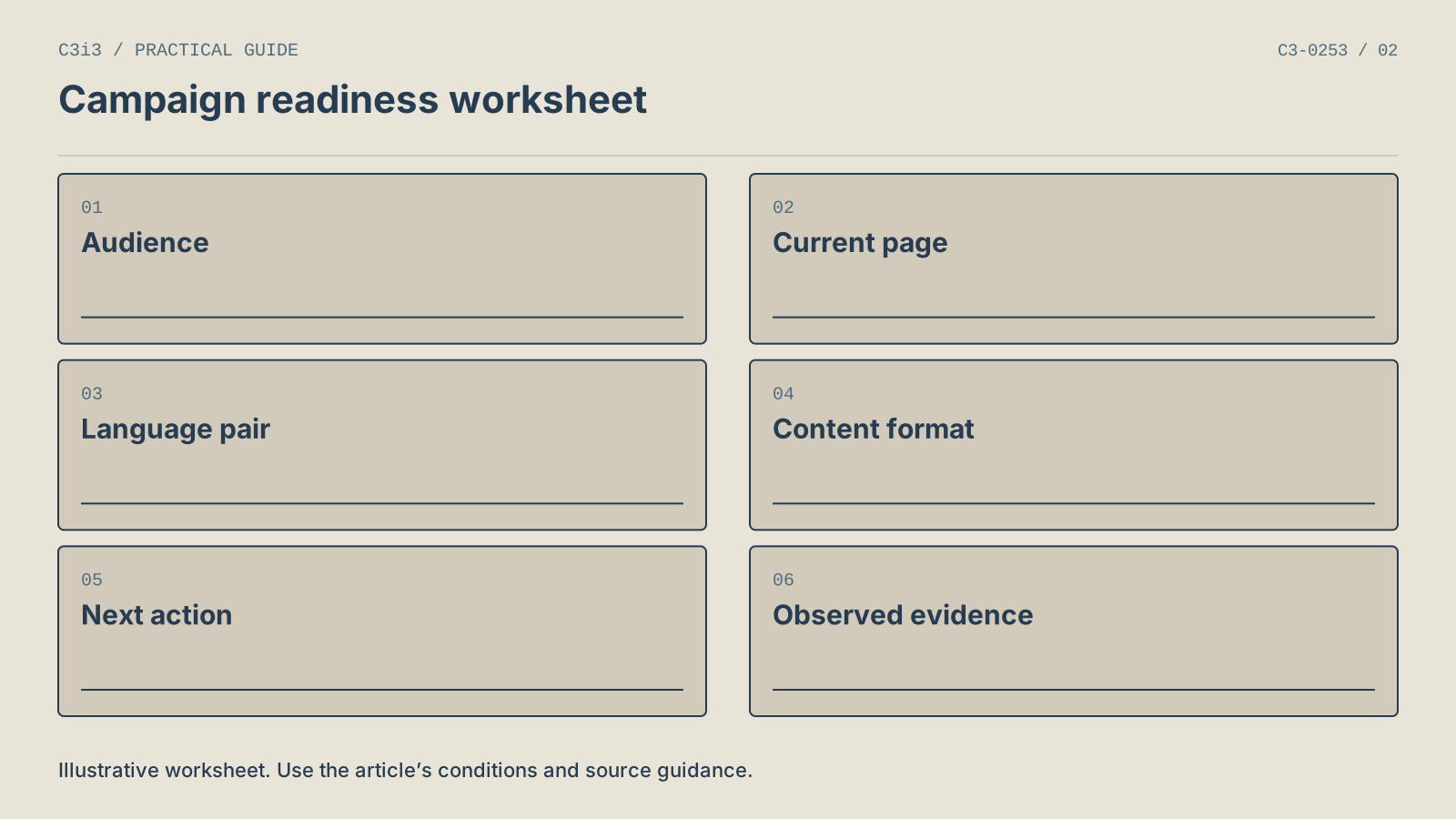
Record the audience, current destination, corresponding language page, suitable format, next action and the evidence available for review. A blank field identifies an unfinished planning decision.
How do you reuse campaign material without publishing duplicate articles?
Reuse the underlying evidence and topic research while giving each published asset a separate purpose. A product page, a selection guide and a short demonstration can share accurate model information without answering the same question in the same way. The website needs a clear owner for each substantial decision.
Before adding an article, compare its proposed question, audience, evidence and next step with the current library. If all four match an existing guide, improve the route to that guide instead of assigning a new title. A city, a language modifier or a different acronym does not automatically create a different customer task.
For the illustrative camera brand, “How do I choose a camera for a small room?” and “Which camera is best for a compact meeting space?” may belong together. A separate guide explaining how to prepare room information for a demonstration can earn its place because it helps the customer perform a different action. The same principle applies to Korean and English pages: equivalent language versions are intentional counterparts, while multiple English articles repeating one selection answer create maintenance confusion.
Keep a brief content ownership register with the main question, canonical destination and related supporting assets. Review that register before commissioning the next campaign. It reduces needless expansion and makes useful internal links easier to choose.
What else should Korean brands ask about SEO, AIO and SMO?
Language choice, destination quality and attribution limits deserve separate decisions. The answers below clarify those boundaries so a campaign can expand without confusing attention with a useful buyer journey.
Should a Korean brand publish all U.S. marketing in English?
Use the language that serves the selected reader. English may be appropriate for a broad U.S. business audience, while a Korean version can serve headquarters researchers or Korean-speaking customers. Do not infer preference solely from heritage. Define which pages need both versions and provide an understandable route between corresponding pages. A focused bilingual journey is usually easier to maintain than an indiscriminate translation of every file.
Can strong social content compensate for a weak product page?
Social content can introduce a useful question, but it cannot reliably complete an evaluation that requires missing website information. If visitors cannot identify the model or find current documentation after clicking, improve that destination. The campaign review should distinguish discovery from the next stage. Keep the strongest social explanation and give it a page that continues the same conversation.
Do Korean brands need to prioritize Naver for U.S. growth?
Not automatically. Choose discovery platforms according to the actual audience, language and market. A Korean headquarters team may use Naver for a different task from a U.S. purchasing team using Google. Review each journey separately and examine actual search results and available performance evidence. A brand's country of origin does not settle which engine should receive the first content effort.
Should an AIO campaign promise that AI assistants will recommend the brand?
No. A brand can improve the quality, accessibility and consistency of its public information, then monitor a defined sample of answers. It cannot guarantee what independent systems will recommend. Keep publication, indexing, a sampled mention and a qualified inquiry as separate observations. An honest scope describes the changes the team can make and the evidence it can review.
When should the brand add another social channel?
Add a channel when it has a defined audience role and the team can create a suitable format without weakening the maintained sources. Before expanding, examine whether the current channel brings relevant attention and whether its destinations work. A second channel should answer a real distribution need, such as a longer demonstration or a business-oriented evaluation discussion, rather than exist only because competitors maintain an account.

How C3i3 Can Help
C3i3 can help connect your Korean brand's website, search content and social material around a defined U.S. buyer journey. Bring one priority offer, the current Korean and English destinations and the questions your prospective buyers ask. We can identify the missing connections and develop an actionable content and implementation plan.
Explore our AI search optimization services and social media optimization services, or talk with C3i3 about the journey you want to improve.
How should a Korean brand adapt the same topic for social media?
Keep the underlying question and product facts consistent, then change the opening, format and level of detail for the channel. A useful adaptation makes sense without requiring the audience to know the Korean campaign that came first. Captions alone cannot fix a demonstration whose context is unclear.
A longer walkthrough can explain the camera's setup sequence. A short clip can show one visible difference between two room arrangements. A business-oriented post can explain the evaluation question and link to a detailed guide. Each should identify what the demonstration does and does not establish.
Which social platform should carry the first test?
Choose a platform where you can observe relevant audience activity and deliver an appropriate format. Use available geography, language and content-performance evidence, while respecting the limits of those reports. YouTube's audience documentation, for example, describes geography and subtitle-language reports and notes that some data may be limited.
The Korean social media platform-selection guide provides a more detailed selection worksheet. Begin with one principal channel and a supporting destination. Test whether the intended audience understands the example and reaches the right page before spreading the same weakness across several accounts. Broader activity is easier to sustain after the first path works.