



































In this article
A Korean business can have strong products, a credible team and a polished Korean website while remaining difficult for U.S. buyers to evaluate. English copy may read like a translated corporate brochure. Application details may be hard to find, or the next sales step may be unclear across time zones.
Korean American businesses already operating in the United States face a related but different challenge: they may need marketing that reflects their actual U.S. customers, not an assumption that every buyer is Korean-speaking. The right agency should understand which situation applies and build the scope around it.
This is broader than web design. Search, AI-assisted discovery, product communication, content, social media and the inquiry process need to support the same offer. Use the following questions to compare providers without accepting a universal claim about the “best” Korean marketing team.
Is your priority Korean American growth or entry into the U.S. market?
Define the commercial situation before choosing channels. A Korean American service business may already have U.S. operations, local references and an established contact process. Its priority may be reaching a broader audience or explaining services more clearly.
A Korean company entering the U.S. may first need to clarify the target buyer, sales arrangements, documentation and how a suitable inquiry will be handled. A U.S. address, local inventory or service capability should be stated only when it actually exists. Do not let a marketing template imply operations the business has not established.
The distinction affects the first scope. A local professional service may need accurate coverage and consultation information. A manufacturer may need application pages, English technical review and a clear route to a distributor or sales contact. A consumer brand may need product positioning and a coordinated content and partnership plan.
Practical tip: Write one sentence describing the first customer you want and the transaction you want to support. For example, “We want U.S. equipment manufacturers to request an application review for this product family.” That sentence gives the agency a more useful brief than “We need American exposure.”
How should a Korean SEO agency research U.S. buyers?
It should learn how the intended buyers describe their problem, compare options and prepare a purchase. Korean terminology, internal product names and U.S. search language may not align directly.
Combine interviews with the staff who understand the product and the people who handle U.S. inquiries. Review actual questions, public documentation and available search data. The agency should distinguish measured phrases from editorial suggestions and specialized questions with little reported volume.
For a B2B product, map technical users, procurement and commercial approvers separately. For a local service, map the decision from need to consultation. For a consumer brand, identify the use case, purchase concerns and information needed on the product page.
Ask the provider to show how its recommendations differ for manufacturing, logistics, construction and data-center supply. If every plan is the same broad list of keywords, it has not yet learned enough about the buying process.
Read the focused Korean manufacturing SEO guide and logistics inquiry guide for examples of how those briefs differ.
What should bilingual Korean and English marketing support include?
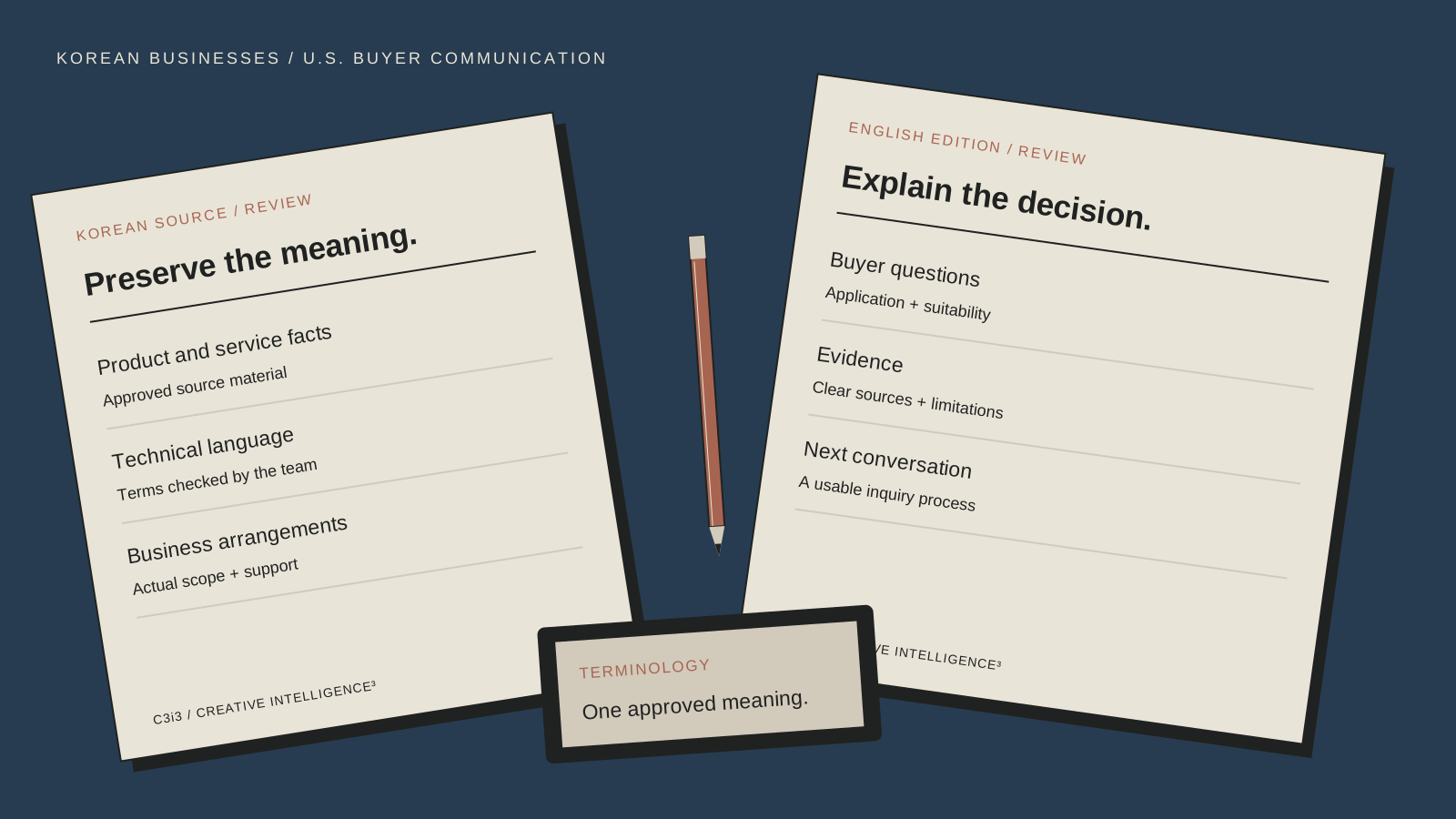
It should preserve meaning while making the English explanation natural and useful to the intended buyer. Translation, technical review and market adaptation are related tasks, but they are not identical.
A literal translation may retain a claim without explaining why it matters. A writer may need to reorganize the page around application, suitability, documentation and next steps. A technical reviewer should confirm that the revised wording does not broaden a specification or imply an unverified capability.
Agree who approves product names, measurements, qualifications and commercial arrangements. Keep a shared terminology list for recurring concepts. Record the source document and version when an important claim depends on a datasheet or approved specification.
The same care applies to Korean American businesses. A bilingual agency should not assume that Korean heritage determines the language or expectations of every customer. Build the page around the actual audience and offer.
Practical tip: Ask for a sample rewrite of one product or service section, accompanied by the questions the writer needed to resolve. The quality of those questions can reveal how carefully the team handles meaning.
What should a Korean company’s website explain to U.S. buyers?
Explain the offer, applications, evidence, sales arrangements and next step. A buyer should not have to infer what the company sells from a corporate history page or a series of broad quality claims.
For a manufacturer, useful information can include supported product families, production capabilities, approved documentation and the information needed for a quote. For a construction-related company, clarify whether the offer is design, fabrication, installation, equipment or another defined scope. For logistics, clarify the services and shipment details required for an inquiry.
State the organization’s role accurately. If a U.S. distributor handles sales or support, explain the arrangement the business is authorized to publish. If meetings are remote or a response crosses time zones, make the process understandable without inventing a local office or immediate availability.
C3i3’s Korean web design and marketing support can be discussed as part of that wider business explanation. A visually attractive page is valuable when the content and contact journey help a suitable buyer move forward.
Try this: Ask an English-speaking colleague unfamiliar with the product to explain the offer after reading the main page. Their unanswered questions are useful editorial feedback.
What technical SEO should a Korean-English website review include?
Review whether each important language version has a clear, accessible URL and whether visitors can reach the version they need. Ask the agency to explain the intended structure before implementing changes.
Google’s multiregional and multilingual site guidance provides a reference for organizing language and regional versions. Its localized-version guidance explains how alternate pages can be identified when appropriate.
Hreflang does not translate content or replace a clear page. If it is used, the implementation should reflect the actual alternate versions and be checked as a complete set. Canonical decisions should be reviewed carefully; pointing every translated page to one language version can conflict with the intended structure.
The review should also cover internal links, important text, metadata, document access and the inquiry path. A buyer arriving at an English application page should not unexpectedly encounter a Korean-only form with no explanation.
Practical tip: Test one complete journey in each supported language, from discovery page through the confirmation message. Include the staff handoff, since a technically successful submission is only the start of the sales process.
How should SEO, AEO and AI-search work fit together?
They should use one coherent set of business facts and page priorities. The agency should explain which activities are shared and which platform-specific checks add work.
Google says established SEO practices apply to its AI features without additional requirements or special AI markup. Other platforms have their own access controls and reporting limits. Read Google’s guidance and ask the provider to identify the official source behind a proposed technical requirement.
For a Korean supplier, the practical content work may be an English application explanation, a verified capability page and a guide to preparing an inquiry. Those pages can help a human buyer and provide clearer public information for search. There is no need to duplicate every page under a separate AI label.
Ask how sampled AI observations will be recorded. A brand mention, a cited URL, a referral and a sales inquiry should remain separate. A keyword’s estimated search volume does not establish the number of buyers using an AI assistant for the same question.
The SEO, AEO and AIO comparison helps define the scope before you approve overlapping packages.
How do you evaluate an agency’s understanding of your industry?
Ask the team to work through one buying scenario from your actual market. It should identify the audience, questions, evidence and next step without inventing capabilities or using the same example for every sector.
For manufacturing, discuss application fit, specifications and quote preparation. For construction, discuss project role, scope boundaries and relevant experience. For logistics, discuss service coverage and shipment information. For data-center suppliers, discuss the interfaces between the product, the wider system and the buyer’s technical review.
The agency does not need to replace your engineers or operations staff. It needs a method for interviewing them, organizing the explanation and obtaining approval for important claims. Ask who performs that review and how document changes are handled.
Read the focused guides for Korean construction companies and data-center suppliers when developing the brief. They address different procurement questions rather than treating all Korean businesses as one audience.
Practical tip: Ask which claim the agency would refuse to publish without further evidence. A thoughtful answer is a useful sign of editorial discipline.
How should website SEO connect with product, social and influencer marketing?
Use the website as a clear destination for the offer, then choose channels that fit the buyer and the stage of the decision. A social post or partnership can introduce a product, but the destination page still needs to answer suitability and purchase questions.
For a B2B supplier, a technical article, product demonstration or sales resource may help evaluation. For a consumer brand, creator content and product use examples may play a larger role. The agency should explain the audience and purpose of each activity before proposing a broad channel package.
Keep claims consistent. A video should not promise availability or performance that the product page cannot substantiate. If a campaign uses a coupon, link or offer, confirm the destination and arrangements before launch. Coordinate the people who manage the website, content and partnership so customers encounter one understandable offer.
Explore C3i3’s influencer campaign support, content marketing and brand positioning where those activities fit the business. The first scope should still follow a clear priority rather than assuming every channel must start together.
How should a Korean marketing agency report U.S. business growth?
Report the completed work, relevant visibility and quality of U.S. inquiries as distinct evidence. Agree on definitions before the campaign starts so the report reflects the business you want.
For a manufacturer, an application discussion or quote request may be more useful than a broad visitor count. For logistics, the inquiry should contain enough shipment information to evaluate. For a local service, the request should match the actual service area and scope.
Review language and market carefully. An increase in traffic from a country does not automatically show U.S. buyer demand. Likewise, English content can attract a global audience. Ask which pages and questions contributed and what the sales team learned from the requests.
If attribution is incomplete, state the limit. Some buyers will use multiple sources, return directly or involve several people before contacting the company. A sampled AI citation should not be presented as proof of the entire sale.
Use the AI-search measurement guide and SEO review checklist to structure the reporting discussion.
What should you agree about scope, communication and ownership?
Agree on the pages, research, writing, implementation, review steps and reporting included. Identify the people responsible on both sides and account for language and time-zone dependencies.
A bilingual project can stall when commercial and technical reviewers give conflicting instructions. Name an owner who resolves those decisions and preserves approved terminology. Make the revision process visible so the website does not drift between versions.
Clarify ownership of the website, content, artwork, accounts and source files. Ask what the handover includes if the relationship ends. Your business should understand the access granted and retain continuity over the channels it depends on.
Set a realistic first phase. A useful starting scope might improve one product family or service, create a supporting evaluation guide and test the English inquiry journey. It should leave the company with concrete improvements and a clearer next decision.
Practical tip: Request a sample monthly report and a sample bilingual approval process. Both should be understandable before you commit to a long production schedule.
How can you shortlist the best Korean SEO and AIO agency for your business?
Compare providers against the same brief. Evaluate their understanding of the U.S. buyer, bilingual accuracy, evidence process, website implementation and reporting method.
Ask each team to explain one existing page: who it serves, what is unclear, which claim needs verification and what should change first. Then review a sample scope and the responsibilities behind the fee.
Be cautious with guaranteed rankings, invented U.S. offices, unsupported client results or large batches of translated pages without a purpose. Google’s spam policies provide a reference for practices that should not underpin the program.
The strongest fit is a team that can communicate with your experts and your buyers, organize the work and explain the evidence. Korean-language capability should support that method rather than substitute for it.
Practical tip: Choose a bounded first phase with defined review points. It gives both teams a concrete basis for deciding how to expand the program across website, SEO, AI search and other marketing channels.
What else should Korean businesses ask about U.S. SEO and marketing?
Do all Korean businesses need a bilingual website?
Choose languages around the audience and operations. Some businesses need Korean and English versions; others primarily serve English-speaking U.S. buyers. The decision should reflect the customer journey and available support.
Can we translate the existing site and stop there?
Translation may be part of the work, but U.S. buyers may need a different explanation of applications, documentation and sales arrangements. Review meaning, structure and the next step as well as language.
Does a U.S. domain prove that we have U.S. operations?
No. State actual sales, service and office arrangements clearly. A domain or page design should not imply a local presence the business has not established.
How can C3i3 help Korean businesses plan U.S. search and marketing?
Share your target buyers, priority products or services and current Korean and English materials. We can help define the website, content, SEO and AI-search work that supports the next business decision.
Explore Korean web design and marketing support, search visibility services or contact C3i3 to discuss a focused starting scope.