



































In this article
A proposal arrives with three packages: SEO, AEO and AIO. Each sounds important, and each appears to include research, content and technical improvements. Before purchasing all three, find out whether the provider is describing different activities or giving the same work three names.
A useful decision starts with your customers and your current website. Can people find the right service? Does the page answer their questions? Can they tell why your business is suitable and how to contact you? These problems help you choose a scope more reliably than the acronym on a proposal.
What do SEO, AEO and AIO actually mean?
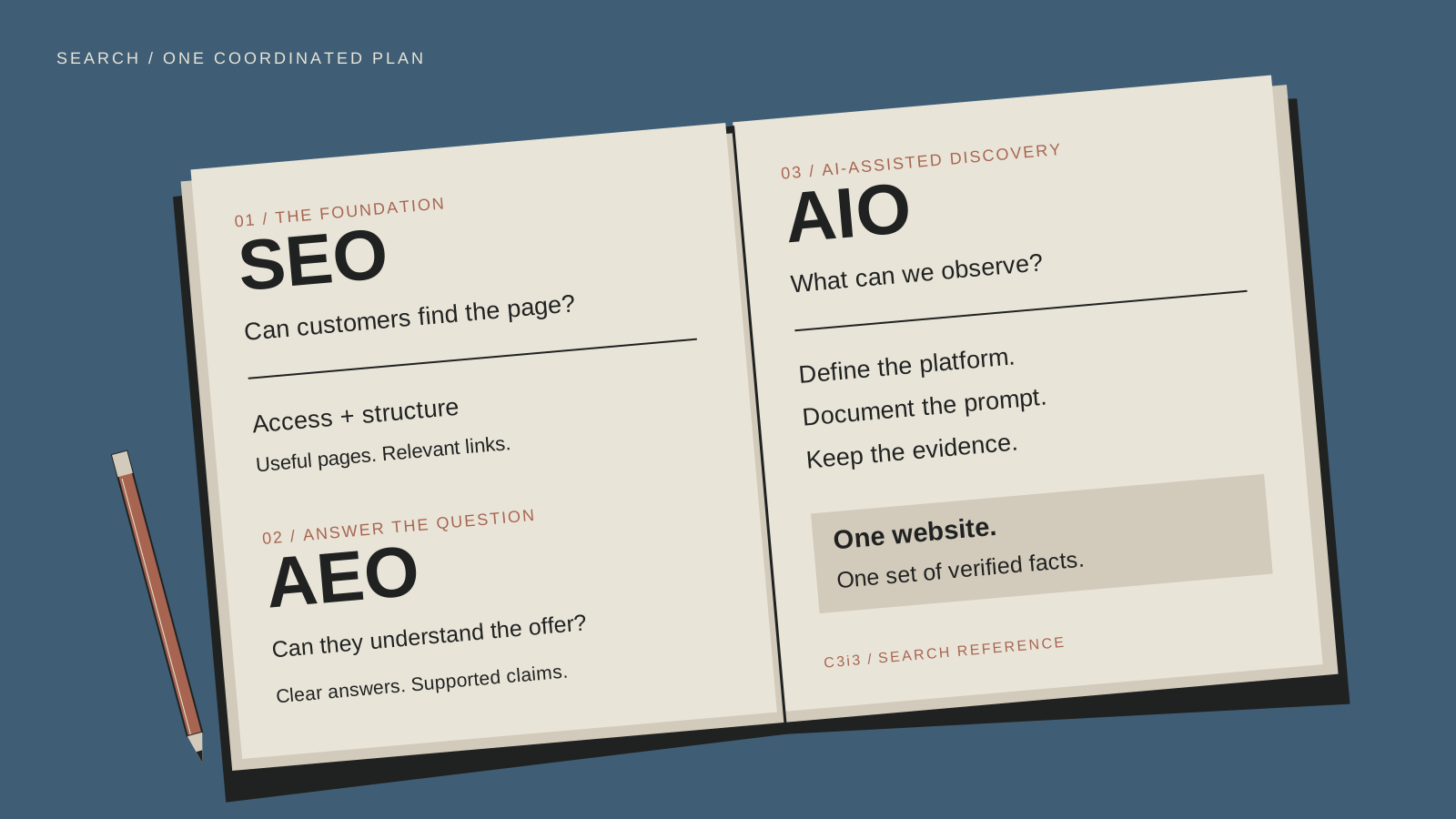
SEO, or search engine optimization, covers the work that helps search engines find, understand and serve useful website content. Technical access, page organization, search intent and relevant internal links can all be part of it.
AEO, or answer engine optimization, emphasizes answering questions clearly. A service page might explain suitability, pricing factors or what happens during an appointment. The answer should be useful to a customer reading it, whether that customer arrived through a search result, a referral or an AI assistant.
AIO is less consistently defined. It can describe AI optimization generally or refer to Google AI Overviews. GEO, another label you may encounter, means generative engine optimization. Ask each provider to identify the platform and activity it means. Creating content with an AI writing tool is a production method; it does not establish a plan for being found in AI-assisted search.
Try this: Ask for one example URL and the exact improvement proposed under each package. If the same page review appears three times, ask how the work and billing are coordinated. Our AI search overview explains the broader foundation.
How do you decide which kind of search work to do first?
Start by identifying where discovery or evaluation breaks down. If an important service page cannot be reached through your navigation or is excluded from indexing unintentionally, fix that foundation. More articles will not resolve the access problem.
If customers reach the page but repeatedly ask what is included, improve the explanation. Add the scope, suitability, process, limitations and next step. If the page makes broad claims without examples, gather evidence before polishing the wording.
If those foundations are sound, a documented AI-search review can show how your offer appears for a sample of relevant questions. That helps identify missing explanations or inconsistent facts. It does not provide a complete measure of everyone using an AI assistant.
For example, an East Bay maintenance company may first need accurate service coverage and a working mobile form. A San Jose software provider may need application-specific pages and implementation answers. Both can benefit from search work, but their first deliverables should look different.
Practical tip: Write down three problems in customer language before requesting proposals. “Prospects cannot tell which service to choose” is easier to scope than “We need more AIO.”
What should a combined SEO, AEO and AIO proposal include?
A combined proposal should show one set of priorities, named responsibilities and a clear definition of completion. Research should lead to page decisions; page decisions should lead to writing and implementation; reporting should explain the observations after those changes.
- Starting point: Your audience, offers, existing URLs and available search data.
- Page plan: What will be improved, consolidated or created, with reasons.
- Evidence: Interviews, specifications, approved examples and fact checking.
- Implementation: Who handles the CMS, development, internal links and contact testing.
- Measurement: The baseline, tools, prompt sample and inquiry-quality review.
- Ownership: Access to accounts, content and source files if the engagement ends.
Ask whether technical implementation is included or merely recommended. A report that tells your developer what to fix is different from a service that implements and tests the correction. Neither arrangement is inherently wrong, but the fee and schedule should reflect the difference.
Use the AIO agency selection guide to compare evidence and responsibilities. C3i3’s SEO services and AEO support can be discussed as connected work rather than isolated labels.
How should you compare results across SEO and AI search?
Keep search visibility, AI-answer observations, website visits and qualified inquiries separate. Each answers a different question. A brand mention is not the same event as a visit, and a visit does not establish that someone became a customer.
Google says its AI-feature traffic is included in overall Web performance reporting in Search Console. A change in overall clicks should therefore not be presented as a separately measured increase in AI Overview clicks. Analytics can identify some referrals from AI services, but missing referral information does not mean no AI-assisted discovery occurred.
For a prompt sample, record the exact question, platform, mode, date, mention and cited URL. Repeat the same set when comparing periods. Keep prompts naming your business separate from prompts that ask for a type of service without naming a provider.
Then review the inquiries. Did they request a relevant service? Are they within your actual market? Were they spam, existing customers or prospective buyers? A modest number of suitable conversations can matter more than a large increase in unrelated visits.
Our AI-search measurement tools guide explains how to assemble those observations without turning incomplete data into certainty.
What is a practical first-month plan for a small business?
Choose one important service and improve its complete path from question to inquiry. That creates a manageable scope and a basis for learning before you expand production.
In the first week, gather the questions your team hears and review the page, links and contact journey. In the second week, write the missing answers and obtain approval for important claims. During the third week, implement the changes, check the page on mobile and test the form. In the fourth week, record what was completed and begin reviewing available search and inquiry data.
This is an illustrative work sequence, not a promise of search results within a month. Approval delays, development requirements and the amount of evidence available will affect the schedule. Assign an owner to each dependency so the work does not stall between the agency and your team.
Practical tip: Keep a before-and-after record of the page and a brief explanation of each change. If results later improve or decline, that record helps you interpret the timing. It also makes the agency’s contribution visible while business outcomes take longer to assess.
What else should small businesses know about SEO, AEO and AIO?
Do we need separate agencies for SEO and AIO?
Only when the skills or responsibilities require it. One coordinated team can handle shared research and implementation. If several providers are involved, agree who owns technical changes, content approval and reporting.
Does using AI to write articles make them AIO content?
No. The writing tool does not determine the page’s usefulness or discoverability. Review the answer, evidence, originality and fit with the customer’s question.
Which should a small business buy first?
Address the largest verified gap first. Technical access, unclear service information and a broken inquiry path usually deserve attention before an ambitious article schedule.
How can C3i3 help you choose the right search scope?
Share your website, the services you want to grow and a few questions from actual prospects. We can help connect search visibility, useful content and website improvements into a clear first scope.
Explore our AIO agency services or contact C3i3 to discuss priorities. If you are comparing providers, use the agency scorecard to keep the conversation specific.