



































In this article
A U.S. buyer needs help moving freight between Korea and the United States. Your website describes global logistics, but it does not explain which services you perform, what information a quote requires or who handles the next conversation. The buyer leaves before sending a useful request.
For Korean shipping and logistics businesses, SEO should connect real shipment needs with accurate service information. A clear lane or service page can help a buyer assess fit, but it must reflect the operations and arrangements your company can actually provide.
What should a logistics company explain before asking for an inquiry?
Explain the service you provide and your role in the shipment process. Broad phrases such as “end-to-end global solutions” can leave a buyer uncertain about which activities are included and which depend on other parties.
Describe the services your company is authorized and equipped to offer, using approved terminology. If a partner performs part of the work, explain the public arrangement accurately. Do not turn an aspirational service area into a current operational claim.
Clarify which shipment types and customer situations fit the offer. A business inquiry about recurring commercial freight may require a different process from a personal shipment. State important limits so a visitor can choose the appropriate route before submitting a form.
Practical tip: Ask operations and sales to approve a one-paragraph service description together. If they interpret it differently, resolve the scope before building more pages or campaigns.
The Korean SEO and AI-search agency guide explains how to scope the wider website and U.S. market-entry work.
When should you create Korea-U.S. shipping lane or service pages?
Create a separate page when it explains a distinct service or set of buyer questions with accurate, useful detail. A lane page should help someone evaluate an actual shipment need rather than repeat a list of destinations.
Useful information can include the service scope, shipment information required, coordination process and how availability or timing is confirmed. State only arrangements your team can verify. Do not publish a fixed transit or delivery promise without the company’s current approval and relevant conditions.
A service page and a lane page can complement each other. One explains the logistics activity; the other explains how an actual route or market is handled when there is enough distinct information to justify it. Link them where the reader needs the next answer.
Avoid mass-producing destination pages that differ only by place name. Google’s spam policies provide a reference for doorway and scaled-content concerns. The practical editorial test is whether each page helps a buyer make a different decision.
Try this: Write the reason for each proposed lane page before production. If the operations team cannot identify useful differences, improve a broader service page instead.
Which shipment details should a freight inquiry form request?
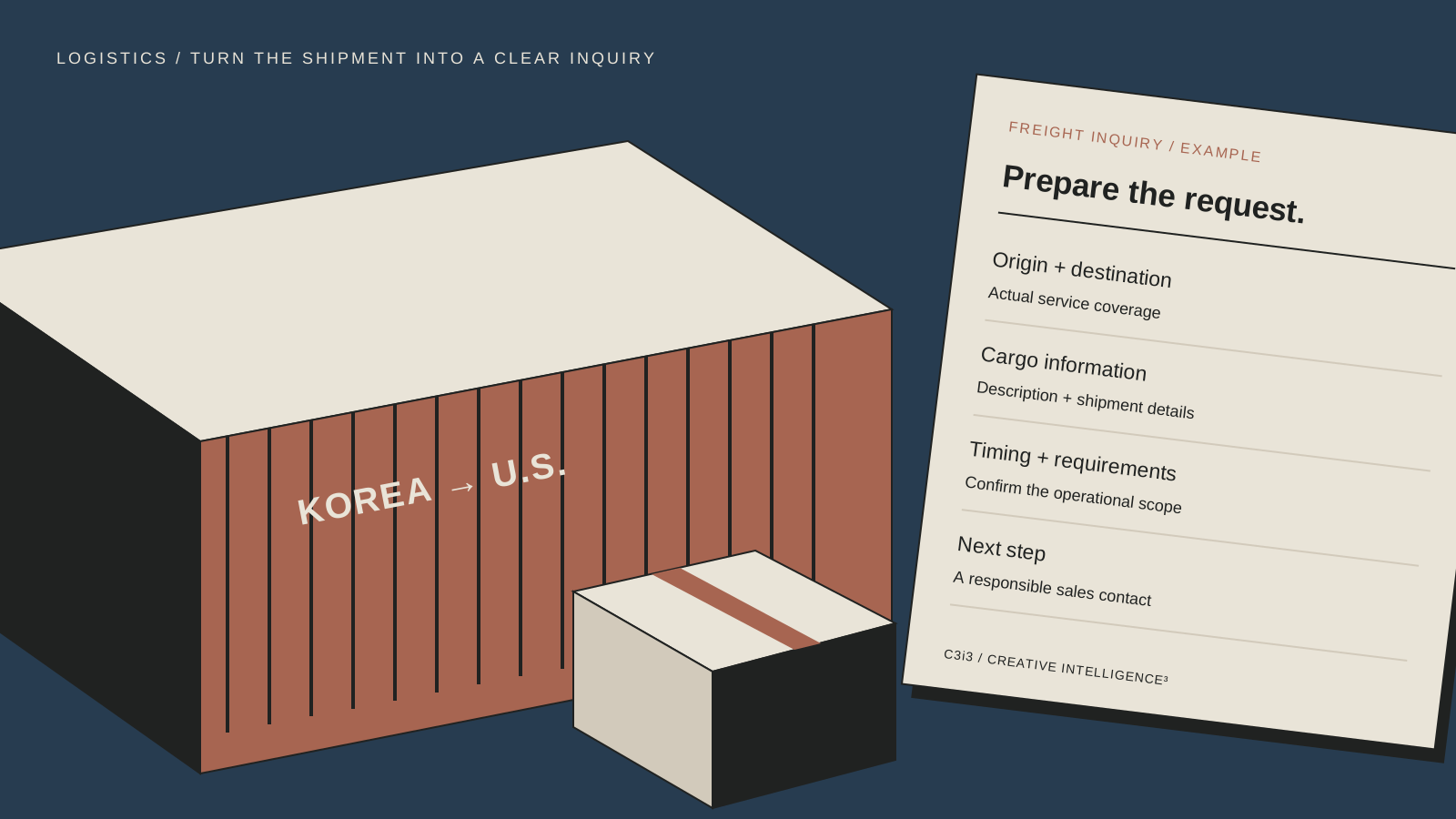
Ask for the details your team needs to assess and route the request. Depending on the service, that may include origin and destination, cargo description, dimensions or weight, quantity, timing and the type of support requested.
Explain the measurement units and avoid making the buyer guess what a field means. If information is not yet known, provide a practical way to describe the request or ask a question. An early prospect may need guidance before it can submit a complete shipment specification.
Do not treat the initial form as a final service commitment or a substitute for your operational review. The team should confirm the facts and applicable arrangements through the actual quoting process. Keep public marketing statements aligned with that process.
Test the form and notification in English, including the confirmation message. Make clear which team will respond and what happens next. If the handoff spans Korea and the United States, assign ownership so the inquiry is not lost between offices or partners.
Practical tip: Review incomplete inquiries with sales. If a particular field repeatedly causes confusion, improve the explanation instead of simply adding more required fields.
What evidence helps U.S. logistics buyers evaluate your company?
Provide accurate service descriptions, relevant experience and the public documentation your business has approved. Important qualifications and operational claims should be checked by the responsible team before publication.
An authorized case example can describe the shipment situation, your role, the coordination challenge and the outcome the company can substantiate. Avoid exposing confidential customer or cargo details. If an example is hypothetical, label it clearly.
Show the next process rather than relying only on broad reliability claims. A buyer may need to know how a request is assessed, what information is confirmed and who communicates during the engagement. Explain actual arrangements without promising that every shipment follows an identical path.
Google’s people-first content guidance is a useful editorial reference for answering those questions. The goal is understandable information that helps the reader evaluate the offer.
Practical tip: Review every phrase that implies a qualification, guaranteed time or physical location. Confirm the wording and conditions with the people responsible for that claim before promoting the page.
How should Korean-English logistics content support SEO and AI search?
Use the terminology your intended buyers use while preserving operational meaning. Agree on recurring service terms with sales and operations so the English page does not imply a different scope from the Korean source.
If both languages are supported, organize the versions clearly and make the next step usable in the selected language. Google’s multilingual site guidance and localized-version guidance provide technical references for that structure.
Answer substantial customer questions directly: what information is needed for a quote, how the service is assessed and which requests fall outside scope. Link deeper explanations to the relevant service or lane page. Google’s link guidance supports clear connections between those pages.
AI-assisted search adds another reason to keep public facts consistent, but it does not create a guarantee of recommendation. Ask an agency to explain the platform-specific checks and the limits of its sampled monitoring.
Practical tip: Start with the services that already generate suitable inquiries. Improve their explanation and inquiry route before expanding into routes or shipment types the business has not prioritized.
How can you tell whether logistics SEO is generating useful freight opportunities?
Define a suitable request with the sales and operations teams. The definition may include a supported service, relevant route, workable shipment details and a reachable business contact, depending on the offer.
Keep broad inquiries, quote requests and qualified opportunities separate. A message that says only “price?” requires different follow-up from a request with enough information for an operational review. Neither should automatically be counted as booked freight.
Use available search and referral information to understand discovery, then review the content of the inquiries. If the website attracts requests outside the service scope, clarify the page. If suitable buyers leave essential information out, improve the guidance beside the form.
Longer commercial relationships may involve several conversations and channels. Preserve what is observable without assigning every opportunity to SEO or an AI answer. Use the SEO performance checklist and AI-search measurement guide to structure the review.
Practical tip: End each reporting discussion with one operationally approved page change or process improvement. That keeps the program connected to better inquiries rather than a larger volume of poorly matched traffic.
What else should Korean logistics companies explain to U.S. buyers?
Should we publish fixed freight prices on the website?
Publish only pricing your business has approved with the conditions needed to interpret it. If a quote depends on shipment details, explain those factors and provide a clear inquiry route.
Can a lane page promise a delivery time?
Only the responsible team can approve the actual promise and conditions. Marketing copy should reflect the service offered, not invent a universal timeline.
Should every port or city have a separate page?
Only when the page provides distinct, accurate information and serves a real buyer need. A long list of near-identical pages is not a substitute for clear service coverage.
How can C3i3 help Korean logistics businesses improve U.S. inquiries?
Bring your priority services, approved coverage and the shipment information your team needs to assess a request. We can help connect the English explanation, supporting content and inquiry process.
Explore B2B content marketing, Korean business marketing support or contact C3i3 to discuss the scope.