








































In this article
A Korean-English website can look bilingual while giving buyers an inconsistent journey. The language switch opens the other homepage instead of the same product, an English guide has no corresponding Korean context and an old translated URL remains easier to find than the current page.
Korean SEO needs a clear relationship between language, audience and page purpose. This is a website-structure decision before it becomes a translation task. The following workflow helps a Korean brand map useful counterparts, organize stable URLs and check the public result. It expands the language architecture within our Korean digital marketing plan, rather than repeating the broader question of how to select an agency.
How do you separate language from the market a page serves?
Define language and market as separate fields. Korean describes a language, while Korea and the United States describe markets with potentially different offers or purchasing arrangements. A Korean-speaking reader in the United States does not necessarily need the same page as a buyer purchasing in Korea.
Begin with the destination's practical job. Does the reader need to understand a product, confirm local availability or prepare an application discussion? Which language makes that task usable? An English product guide for U.S. buyers may need a different contact destination from a Korean corporate introduction, even though both refer to the same organization.
What should your audience map record?
Use four fields: audience task, language, market and next action. Add an existing URL only after those fields are clear. This prevents the current navigation from becoming an unquestioned blueprint for the new version.
Consider an illustrative software provider with Korean documentation and an English U.S. evaluation guide. The guide may explain a workflow in terms familiar to U.S. operations teams, while the documentation preserves detailed product terminology. Those pages can be linked without pretending they are translations of each other. The decision should follow the reader's task, not a requirement that every menu item have an identical twin.
Review Google's multilingual and multiregional guidance for the distinction between language versions and region-specific content. The editorial map remains your business decision.
Which URL structure should a Korean-English website use?
Choose a URL pattern that the team can maintain consistently and that fits the existing site. Separate language directories on one domain can make relationships easy to understand, but they are not a universal requirement or a reason to migrate a working website without a concrete need.
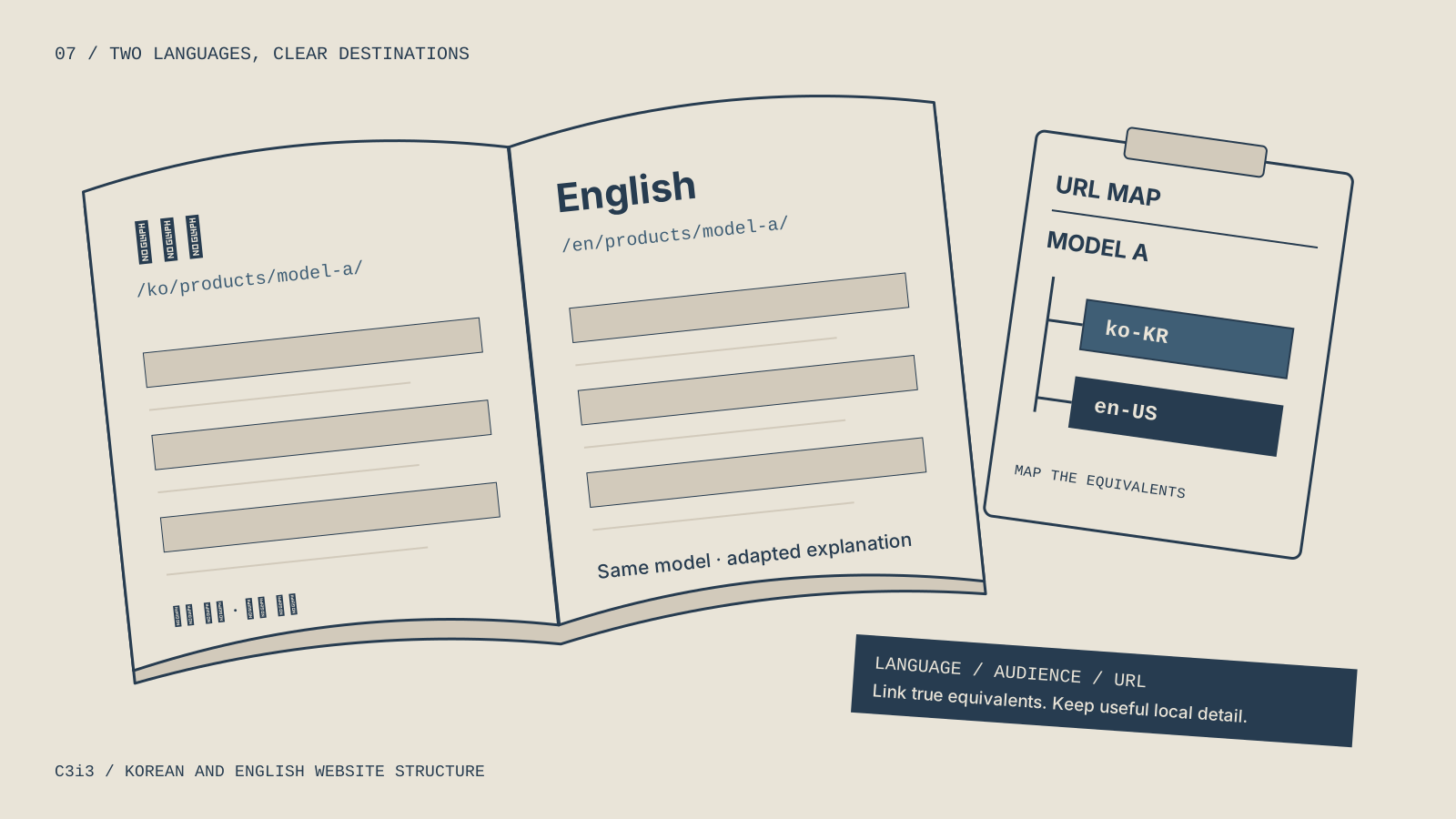
An illustrative structure might use example.com/ko/products/model-a/ and example.com/en/products/model-a/. Another established site might retain English content at the root and Korean content under /ko/. What matters operationally is that people can identify, link to and maintain the intended version.
Should translated URLs use identical words?
Not necessarily. The URL labels can differ while the pages remain corresponding versions. Keep a page map that records the relationship rather than relying on a naming assumption. A developer should not have to guess an English destination by replacing a language folder.
Before changing existing addresses, inventory indexed pages, valuable links, current redirects and internal navigation. A redesign or migration has a different scope from adding a language version. Preserve established URLs when there is no compelling reason to move them, and plan any approved migration carefully.
For a first bilingual product family, consistency is more useful than an elaborate taxonomy. Select a pattern, document it and test a complete example. Then expand the structure after the team can maintain the pair. Avoid generating large numbers of translated URLs whose content has not been reviewed.
How do you decide which Korean and English pages are genuine counterparts?
Pair pages that describe substantially the same subject and perform a comparable reader task. Shared branding or a matching navigation label is insufficient. A language switch should not surprise the reader by changing from a product explanation to an unrelated corporate overview.
Build the map around the page's meaning. For an illustrative device catalog, a Korean page and an English page for the same model can be counterparts even when the English page includes a different use-case introduction. A Korean product family and an English page for only one model are a different relationship.
| Korean source | English destination | Relationship | Action |
|---|---|---|---|
| Model A overview | Model A overview | Corresponding subject | Review as a language pair |
| Company introduction | Installation planning guide | Different reader task | Use an ordinary contextual link |
| Archived Model B page | Current Model C page | Different lifecycle and identity | Explain the relationship explicitly |
What if only one language has a useful page?
Keep the page if it serves a real audience. Do not invent a counterpart or publish a placeholder translation merely to complete the spreadsheet. Mark the missing language version as a separate editorial decision and provide a helpful alternative if the visitor changes languages.
The bilingual brand-information guide addresses factual disagreements within a pair. Page mapping comes first: the team must know which documents it is actually comparing.
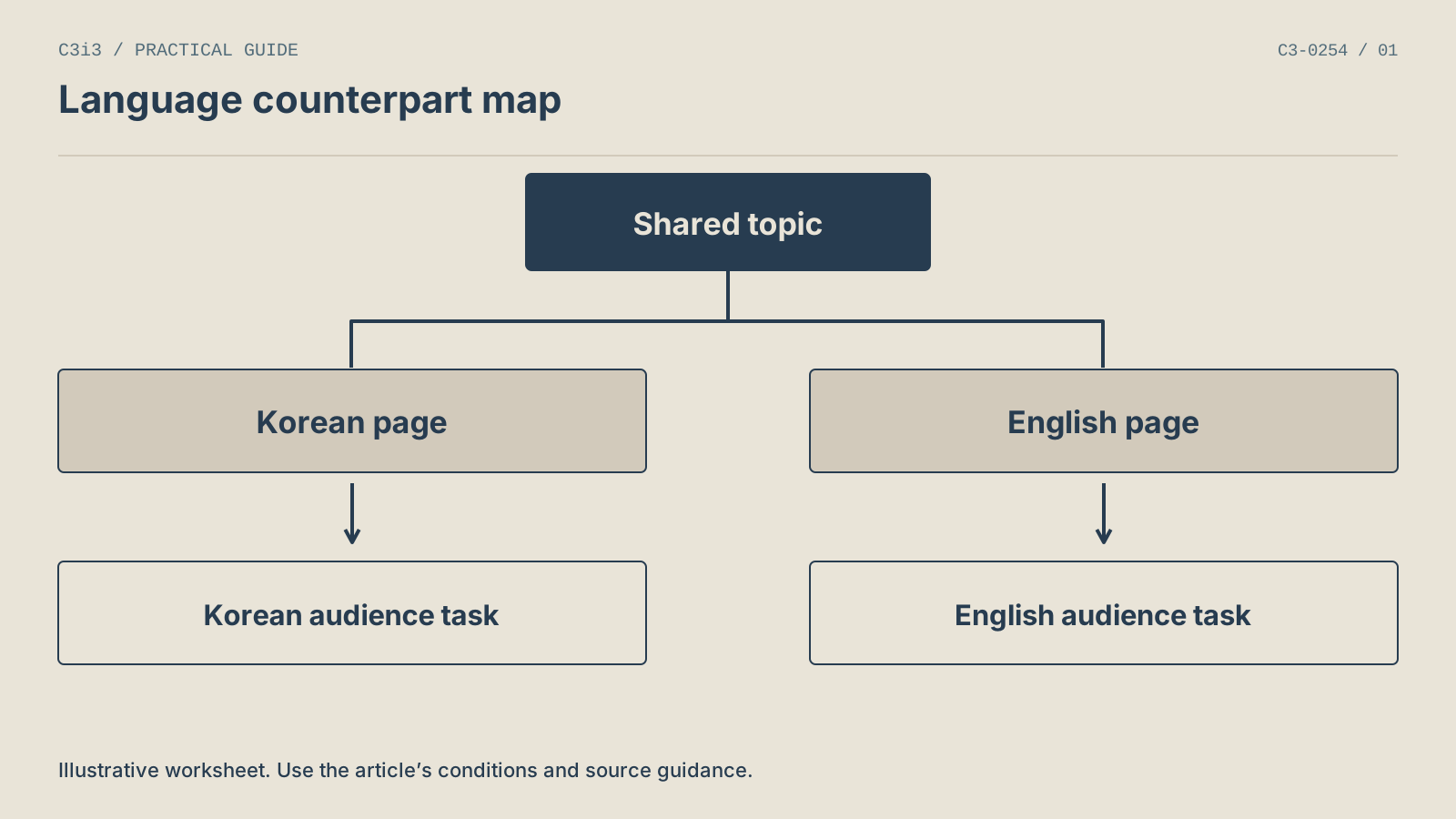
Match pages by their shared subject and purpose. Keep core facts consistent while adapting examples, supporting context and next steps for each intended audience. Not every page requires a counterpart.
What should you check in canonical and hreflang relationships?
Check that each signal describes the intended page relationship and does not contradict another part of the implementation. Canonicalization and language-alternate annotations have different jobs. A Korean translation should not automatically point its canonical at the English version simply because English is commercially important.
Google's canonical documentation explains how to indicate a preferred URL among duplicate or very similar pages. Its localized-version guidance explains language and region alternates. Have the technical team review both against the actual content rather than applying one blanket template to every URL.
Which language codes belong in the page map?
Record the intended language first, then add a region only when the version genuinely targets that region. Do not equate a Korean-language page automatically with Korea if it is intended for Korean-speaking customers across markets. The technical implementation should use supported language and region syntax.
For a straightforward pair of translated pages, review the self-reference, corresponding alternate and return relationship. Check the actual final URLs, including redirects and the preferred hostname. A correct-looking annotation that points to a missing or unrelated destination does not establish a useful pair.
Keep the implementation in one maintained system where possible. Avoid several independently edited copies of the page map drifting across templates, sitemaps and documentation. This is a verification task for the existing architecture, not an invitation to add annotations without understanding their scope.
How do you verify a bilingual release before expanding the structure?
Verify a small complete group of pages before applying the pattern across the site. Check content, technical relationships and reader actions separately. A page can pass a technical inspection while still directing the buyer to the wrong language or product.
- Open each intended public URL and record any redirect.
- Read the title, main content and important product identifiers.
- Compare shared facts with the corresponding language version.
- Review canonical and language-alternate targets.
- Follow the language switch and contextual links.
- Test the intended next action with a coordinated, labeled internal check.
Record the observation and the correction, not just a pass or fail. “English guide links to retired Korean PDF” gives the next person a task they can resolve. “Bilingual SEO complete” hides what was actually examined.
Which outcome should you review after publication?
Review whether the intended language pages are discoverable and whether visitors reach useful destinations. Search evidence and website behavior can identify further questions, but a short period of data cannot prove the language structure caused an inquiry. Compare the same destinations over understandable periods and record other changes.
Use the Naver and Google priority guide when the next decision is engine-specific. Use the U.S.-buyer social platform guide when social posts need to link into the new architecture.
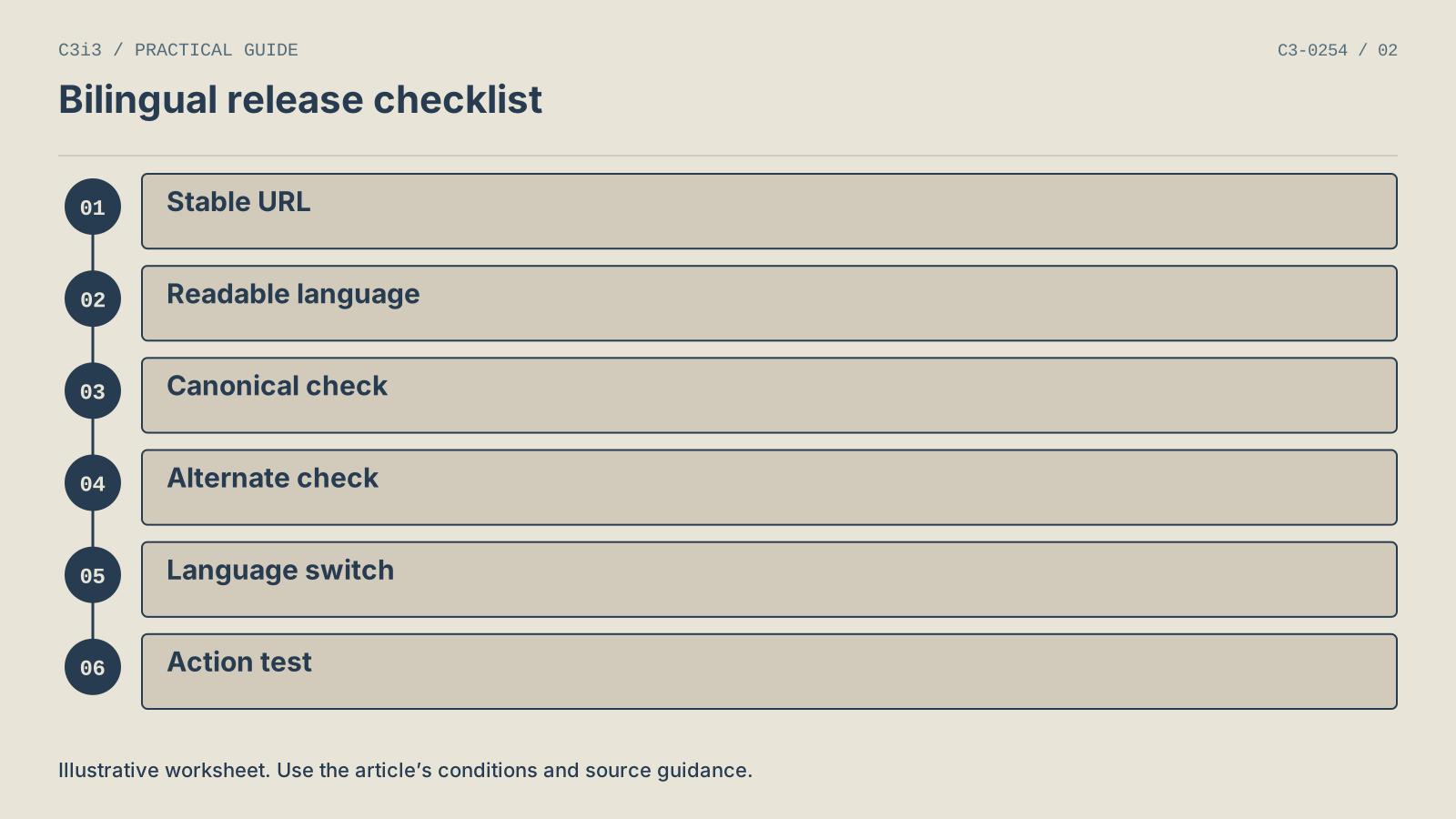
Open each URL, confirm its language and current facts, review canonical and alternate relationships, follow the language switch and test the intended action. This checklist is an editorial aid, not a ranking formula.
What else should teams ask about Korean-English website structure?
Translation, canonicalization and language navigation solve different problems. Keep those distinctions clear when deciding which versions to publish and how a buyer should move between them.
Is a bilingual site automatically duplicate content?
A genuine translation serves a different language audience. The useful question is whether each page has a clear purpose and the intended relationships are implemented accurately. Do not solve language management by deleting useful translations or pointing every canonical to one language. Review duplicate URLs within each language separately from the relationship between corresponding Korean and English versions.
Can one URL change language according to the visitor?
That design can create discovery and maintenance challenges when the visible version depends on settings or location. Review the current technical approach before relying on it for important content. Stable language-specific destinations make page mapping and sharing easier. A person should be able to send a colleague the exact version they intend that colleague to read.
Should every English page target the United States?
No. English is used in many markets. Add U.S.-specific arrangements only where they apply to the intended page and actual offer. A general English product explanation and a U.S. purchasing page can have different roles. Keep the distinction visible in the planning map rather than assuming the language folder defines every market relationship.
Does hreflang repair a weak translation?
No. A technical annotation does not correct unclear terminology, missing context or inaccurate facts. Have a suitable reviewer examine the actual page. A technically connected pair can still fail the buyer if an English phrase broadens a product capability or the Korean version omits a significant limitation. Content review and relationship checks are complementary tasks.
How should you handle a page that has no translation?
Decide whether the missing version is necessary for the selected journey. If it is, assign the work and keep the destination unpublished until it is useful. If it is not, preserve the original page and provide an understandable navigation choice. Do not label an unrelated page as its translation simply to avoid an empty cell in the page map.

How C3i3 Can Help
C3i3 can help map your Korean and English website content, identify mismatched destinations and organize a focused bilingual SEO implementation plan. Bring a priority product or service journey and the current URLs. We can review the content relationships and reader path alongside the technical structure.
Explore our SEO services or ask C3i3 to review one Korean-English page journey.