








































In this article
A Korean business preparing an English website often hears two different instructions: focus on Google to reach overseas buyers, or prioritize Naver because the company comes from Korea. Neither statement is a complete strategy. The first useful question is who needs to discover the offer and what that person is trying to do.
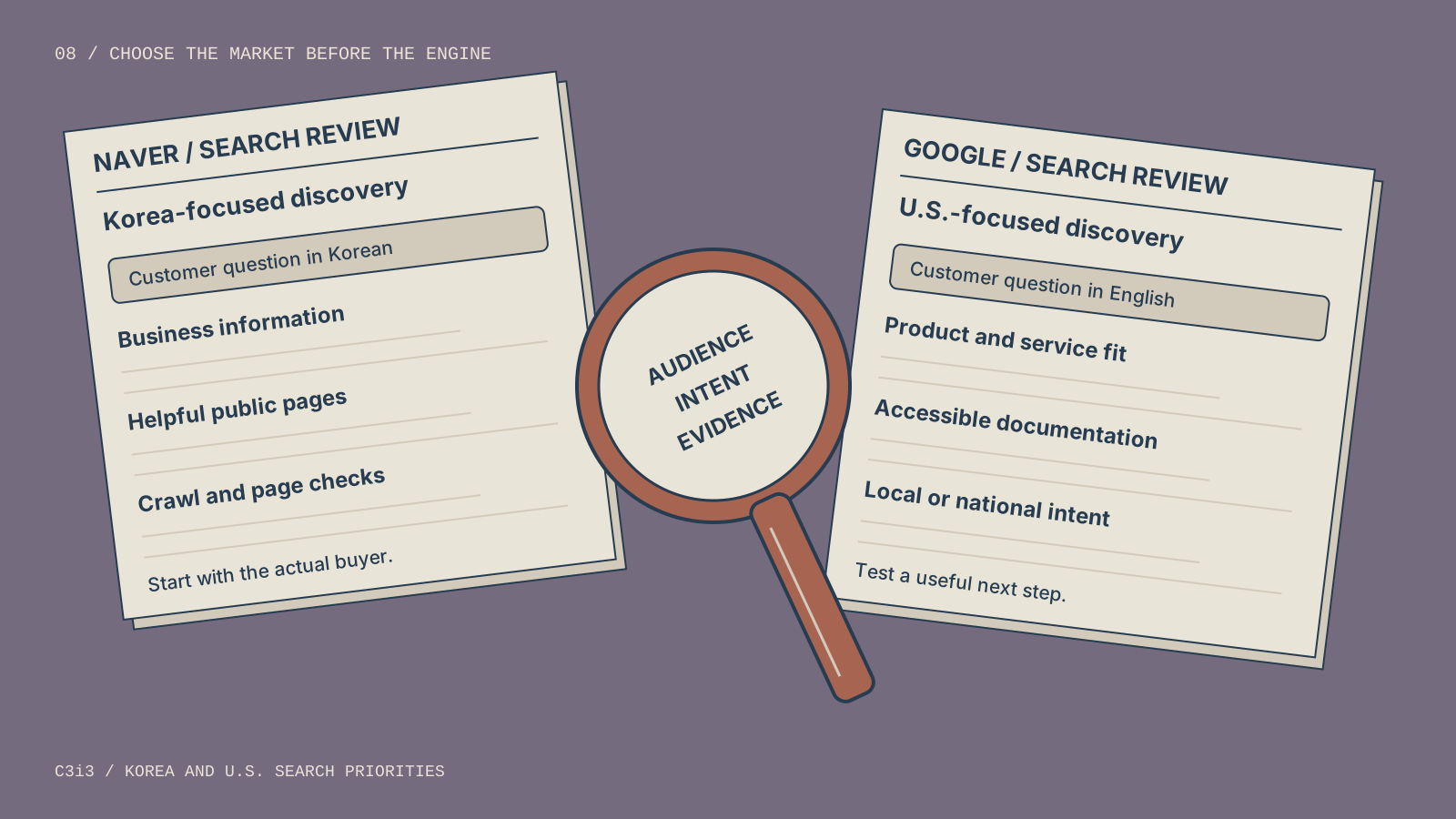
Naver SEO and Google SEO should be compared through the intended market, language, search task and destination. This guide provides a practical decision method without assuming that ethnicity determines search behavior. It supports the wider Korean SEO, AIO and SMO plan, with a specific focus on where to begin search work.
Which buyer task should determine your search-engine priority?
Use the task that brings the buyer toward your actual offer. A person researching a company, evaluating a product and finding a local supplier may use different queries and expect different kinds of results. The engine decision should follow that situation rather than the location of your headquarters.
Start with a short task statement. An illustrative Korean industrial sensor brand might want U.S. equipment teams to compare available sensor families. A different campaign might help Korean engineers find installation instructions. These are separate journeys even when they involve the same manufacturer.
How should you describe the audience without stereotyping it?
Name the role, language needed for the task, intended market and useful next action. “Korean people” is too broad to select a discovery channel. “Korean-speaking engineers looking for the current installation guide” is a task a team can investigate.
Look for evidence in sales conversations, current website behavior and available search reports. Record uncertainty rather than fill it with assumptions. If the team has no reliable source for platform preference, compare actual results for a small query set before committing to a broad publishing program.
The existing Korean manufacturing buyer guide can help define a B2B evaluation task. Keep that industry question separate from deciding which engine can introduce the relevant reader to it.
How do you compare Naver and Google results for a real opportunity?
Inspect a small, documented set of searches on both engines using the language and context relevant to the buyer. Note what appears, what the results help someone do and which destination your business can credibly provide. Do not treat one search as a permanent view of the market.
Create a query set with several tasks: finding the brand, understanding the product category, evaluating a use case and preparing the next action. Use meaningful Korean and English wording rather than assuming a literal translation reflects how buyers describe the problem.
| Field | What to record | Why it matters |
|---|---|---|
| Buyer task | What the reader wants to resolve | Keeps relevance ahead of raw volume |
| Language and market | The intended search context | Separates translation from market choice |
| Observed results | Useful result types and destination examples | Shows what the query appears to require |
| Current offer | The page your brand could support | Prevents an unrelated traffic chase |
What if the result pages suggest different kinds of content?
Evaluate each environment on its own terms. Do not assume the same page or posting pattern will receive identical treatment. Record the difference and decide whether the expected visitor still matches your business goal. A result that attracts readers to a general discussion may serve a different purpose from a detailed supplier page.
Use observations to shape the assignment, not to copy competitors' headings. An original answer should contribute evidence, a useful example or a practical decision method the reader can use.
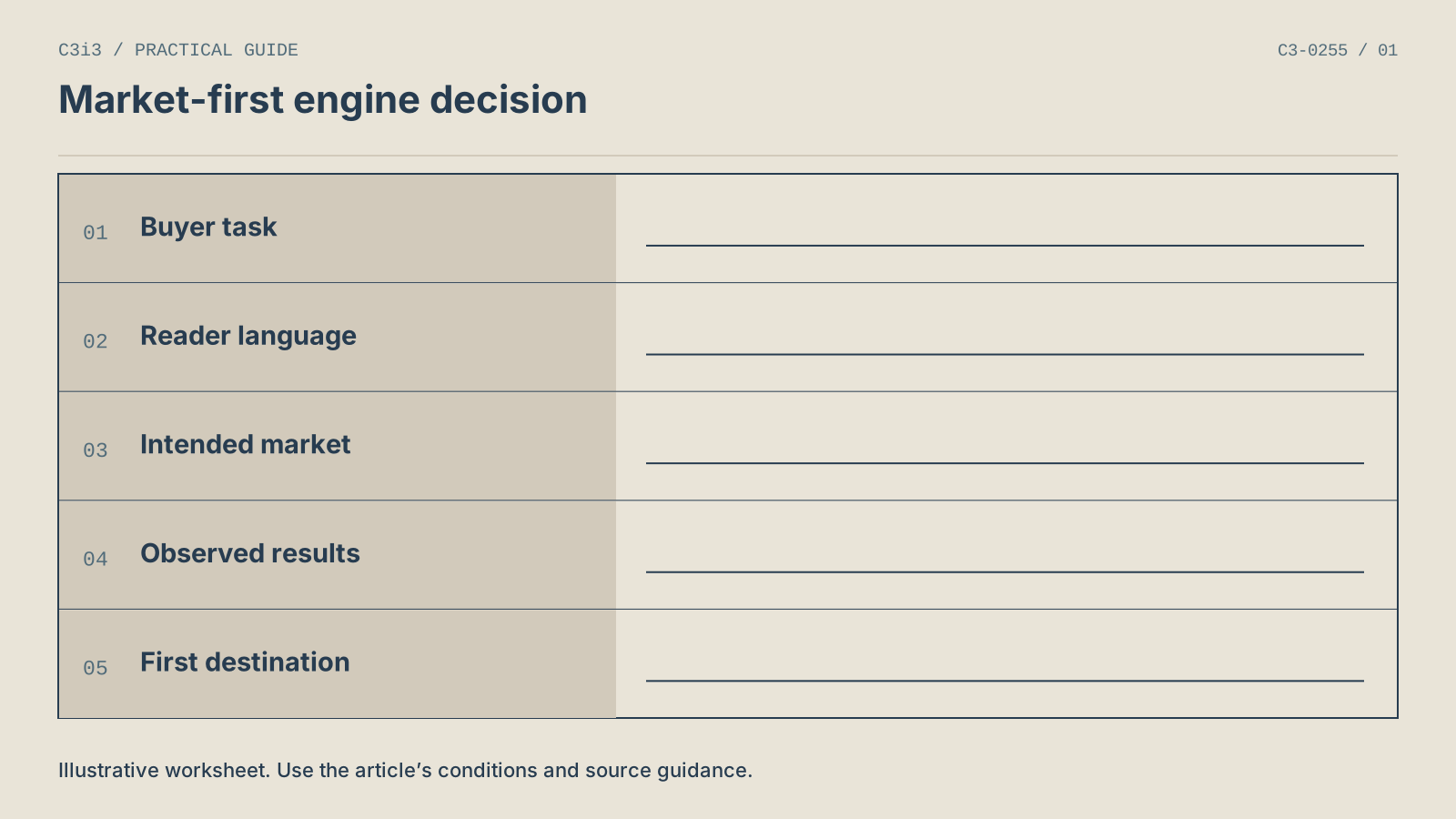
Define the buyer task, language and market. Inspect relevant results on both engines, then choose the destination and engine that fit the observed journey. Do not infer platform choice from ethnicity.
Which technical checks belong to each engine?
Check each engine's discovery and inspection systems separately. A page being available to one search service does not prove that another has fetched, indexed or chosen to show it. Keep the public website coherent while using engine-specific tools to understand what each system reports.
Naver's official SEO introduction describes steps for helping its search system understand website content, including site registration and ownership verification. Its URL inspection guide covers crawl, index and page-information checks. These are appropriate references for the website work, rather than an unsupported claim that a particular posting formula will rank.
What should you inspect on the shared website?
Begin with a reachable page, understandable main content, descriptive titles and working links. Confirm that the correct product and language version is public. A technical team should investigate access restrictions, redirects or rendering problems that keep important material from being examined.
For Google, review the applicable documentation and Search Console guidance. For Naver, use Search Advisor observations for that engine. Do not copy a diagnosis from one dashboard into the other without checking it.
Our Korean-English architecture guide explains the common page mapping. That maintained structure can support both investigations while leaving engine-specific findings distinct.
When should Google, Naver or both receive the first content effort?
Choose the first effort according to the strongest defined audience opportunity and the readiness of the destination. Use both when they serve genuinely different customer journeys that the business can maintain. Do not divide the work automatically just to appear active on two platforms.
For the illustrative sensor brand pursuing U.S. equipment teams, an English application overview may be the first useful destination to investigate in Google. That is an editorial recommendation based on the stated audience, not a claim that every U.S. buyer uses one engine. A Korean installation-information journey might justify a separate Naver investigation around the relevant Korean page.
What would a practical priority note look like?
Write the audience task, the destination, the engine being investigated and the reason it comes first. Add the observation that would cause the team to reconsider. This makes the choice reviewable instead of turning it into a permanent rule.
An example note could read: “Start with English sensor-family evaluation pages for U.S. buyers. Examine category and use-case queries in Google and review incoming application questions. Maintain the Korean documentation journey separately and investigate Naver discovery for those pages.” The note defines two roles without pretending they are the same assignment.
If neither journey has a usable destination, improve the website first. Additional publishing cannot make an unclear offer easier to evaluate merely by appearing in more places.
Which assumptions make a Naver-versus-Google strategy weaker?
The weakest assumptions confuse brand origin with buyer behavior, technical submission with visibility or a search engine with a guaranteed acquisition channel. These shortcuts can produce content that is active but disconnected from the offer.
Do not assume an English translation captures U.S. search language. Compare the term with the buyer's actual question and the page's evidence. Likewise, do not assume every Korean-language inquiry reflects Korea-based demand. The reader's market and transaction may be elsewhere.
Does submitting a URL mean that it will appear in results?
No. Naver's crawl-request guidance distinguishes a request from guaranteed search exposure. Treat submission as an operational step, not proof of visibility. Keep a dated record of the status that the relevant tool actually reports.
Another mistake is to create several articles for nearly identical questions because each phrase appears on a research list. Compare the intended answer before assigning a new URL. A strong selection guide can cover useful wording variations while separate installation or documentation tasks receive their own pages.
Finally, keep AI-answer work in proportion. A sampled answer mentioning a product is different evidence from a search visit or a useful inquiry. The Korean AIO brand-information guide explains how to investigate inconsistent public facts without promising that a brand can control independent AI outputs.
How should you measure Naver and Google performance separately?
Keep each engine's technical observations and search evidence separate, then connect identifiable website activity to the intended business journey. An aggregate traffic total can hide whether the selected market is finding the relevant page or whether unrelated attention accounts for the change.
Record the destination, language, review period and known changes. Review crawl and index observations independently from search appearances, website visits and confirmed inquiries. The tools may use different definitions and may not expose equivalent data, so do not force a direct numeric comparison where the underlying measures differ.
What should the campaign review decide?
Decide whether to improve the destination, refine the audience question, continue the test or investigate a specific technical problem. A useful report ends with a reasoned action, not a conclusion that one engine is universally better.
For the illustrative sensor brand, suitable U.S. application questions would be more relevant to the stated goal than a large number of general brand visits from another market. That does not make the other audience unimportant; it means it belongs to a different journey and reporting category.
Keep the social channel test labeled separately as well. A buyer may encounter several sources before contacting the company. Use the evidence you have, acknowledge unknown paths and avoid assigning the full outcome to whichever platform was easiest to count.
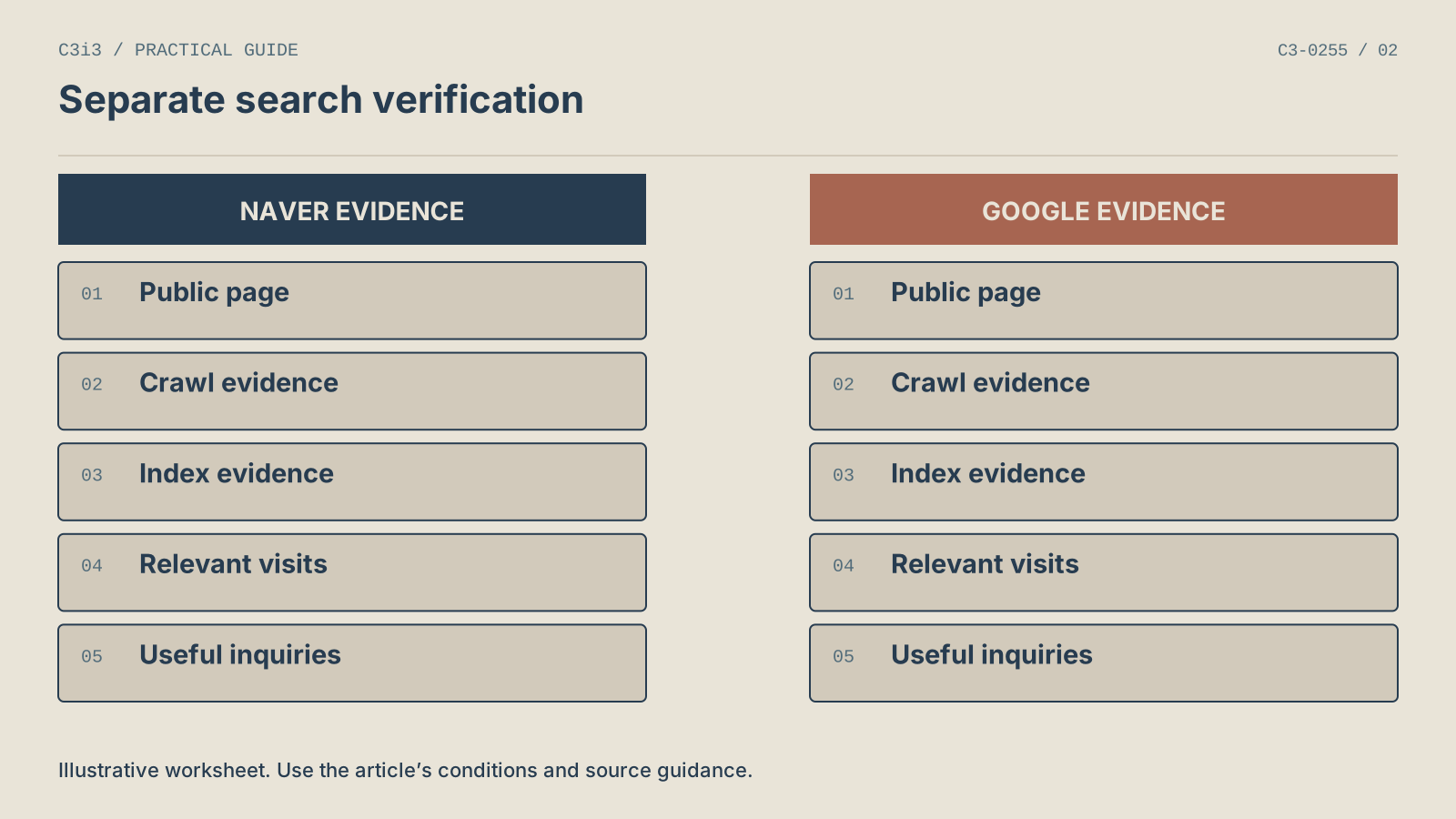
Review the same public destination through each engine’s available tools. Keep crawl observations, index observations, relevant visits and useful inquiries distinct; a successful submission does not guarantee visibility.
What else should Korean businesses ask about Naver and Google SEO?
Engine priority should remain a documented audience decision. The questions below address common boundaries around business location, shared websites, language versions and the limits of an initial test.
Is Naver SEO only relevant to companies located in Korea?
Use audience need rather than company location as the deciding factor. A company outside Korea may have a valid Korean-language discovery journey, while a Korea-based business may prioritize overseas buyers. Investigate the actual tasks and results before assigning work. Country of incorporation does not automatically establish which search engine can serve the desired reader.
Can one website support both search engines?
A maintained website can provide useful content for several discovery systems, subject to their own access and indexing decisions. Keep the public facts and navigation coherent, then inspect engine-specific observations separately. You do not need to invent conflicting versions of the offer merely to describe the work as two SEO campaigns. Language and market-specific differences should reflect real reader needs.
Should we publish a Naver-focused article for every English page?
Not automatically. Identify the task a Korean-language page would serve and whether it genuinely corresponds to the English page. Some material needs a paired explanation, some needs market adaptation and some does not justify another destination. A page map and a clear content purpose are more useful than mechanically doubling the library.
How many queries should the initial comparison include?
Use a manageable sample covering the buyer's main stages, rather than treating a large query count as research quality. Include brand discovery, a product or service category, a use case and a next-step question where relevant. Record wording and context so another reviewer can repeat the exercise and understand its limits.
Should a short test decide the permanent engine strategy?
A short test can expose a broken destination or an obvious audience mismatch, but it rarely settles a long-term acquisition strategy. Review enough ordinary activity to interpret the journey and note other changes. Revisit the priority when the offer, market or audience evidence changes. A documented decision is easier to improve than a rule based on nationality.

How C3i3 Can Help
C3i3 can help turn a broad “Naver or Google?” question into a defined audience, query sample and website assignment. Bring the market you want to reach, the current Korean and English destinations and examples of useful inquiries. We can review where the discovery journey breaks and connect the findings to practical SEO work.
Explore our SEO services or discuss your Korean brand's search priorities with C3i3.