








































In this article
Starting an affiliate program is a business decision before it is a software installation. Your brand is inviting other people to recommend products under an agreed commission arrangement. That creates work around product selection, commercial terms, content, customer experience and payment records. A signup form cannot settle those decisions for you.
This guide explains how to start an affiliate program as the brand selling the product. It is for owners and ecommerce teams preparing to work with creators, publishers or an affiliate marketing agency. A portable power supplier, workshop equipment brand or connected-home business can use the same planning sequence while adapting the economics and product information to its customers.
Begin with a small program your team can support and evaluate. The goal is a defensible launch decision, followed by evidence about eligible sales and contribution. If you need help defining the work, explore C3i3's affiliate marketing agency services for brands.
What is an affiliate program and when should a brand start one?
An affiliate program lets approved partners earn an agreed reward for qualifying referrals, often completed product sales. It fits a brand when the product can be explained credibly, the customer can buy through a usable destination and the economics can support the full arrangement.
Which business problem should the program solve?
Choose a concrete problem such as reaching buyers who need a demonstration before purchasing, supporting a specialist product launch or developing a publisher channel beyond paid advertising. That purpose changes which partners you need and what evidence matters. A tutorial explaining a workshop accessory has a different job from a limited-time discount shared with an existing bargain audience.
Record the intended customer, product group, market and next action in one paragraph. Avoid treating a large potential audience as a launch plan. A brand may receive many applications while gaining few partners who understand its products or reach plausible buyers.
When should the brand fix its store first?
Delay broad recruitment when stock is unreliable, shipping coverage is unclear, product claims are unsupported or a mobile shopper cannot complete checkout. Sending more visitors into those conditions creates more unanswered questions. A narrow pilot can still be useful for testing a specific assumption, provided the limitations and spending cap are explicit. The program should amplify an offer the business can deliver, with a clear owner for each dependency.
Which products should you include in the first affiliate offer?
Start with products whose buyer fit, margin, availability and support requirements you understand. A small eligible selection makes it easier to prepare accurate materials and learn whether partner recommendations help customers buy.
How do you choose between a hero product and the entire catalog?
A hero product gives a partner one clear story. A selected collection can work when buyers need to choose compatible accessories or configurations. Opening the entire catalog may be appropriate later, but it also exposes slow-moving, low-margin or difficult-to-support items before you know how the channel behaves.
Consider a portable power brand. A campaign centered on a specific use case needs the correct capacity information, compatible charging accessories, realistic operating conditions and delivery limitations. A generic catalog link leaves the partner and customer to reconstruct that information. Choose products for which your team can answer those questions consistently.
What belongs in the product eligibility sheet?
List the SKU or collection, customer use case, available market, current stock owner, approved landing page and any commission exclusions. Add the process for replacing a discontinued item or pausing an offer. If a product has unusually high return or support costs, account for those separately instead of assuming the rest of the catalog behaves the same way.
The result should be a maintainable source of product facts. Someone must approve changes and notify partners when a recommendation becomes inaccurate.
How do you know whether affiliate commissions fit your margins?
Calculate what remains from an eligible order after discounts and variable costs, then determine what contribution the business must retain. The remaining amount is a constraint on commission spending, not an automatic recommended rate.
Use the actual commission base in the calculation. An arrangement based on net eligible product revenue behaves differently from one based on a subtotal that includes items the brand did not intend to reward. Define how discounts, tax, shipping, bundles and refunded items affect that base before discussing a headline percentage.
What does a useful hypothetical calculation look like?
Suppose eligible revenue after a discount is $200. Product cost is $100, fulfillment is $10, payment fees are $6 and an estimated return/support reserve is $8. That leaves $76 before affiliate commission. If the brand requires $40 contribution from the order, $36 remains before allocating fixed program expenses. Dividing $36 by $200 gives an 18% arithmetic ceiling under those assumptions. It is not a recommended commission rate.
An agency retainer, platform charges, product samples and commissioned videos still need funding. Different products may require different limits. Work through the affiliate commission-rate worksheet before approving an offer, and use the brand budget guide to account for the wider program.
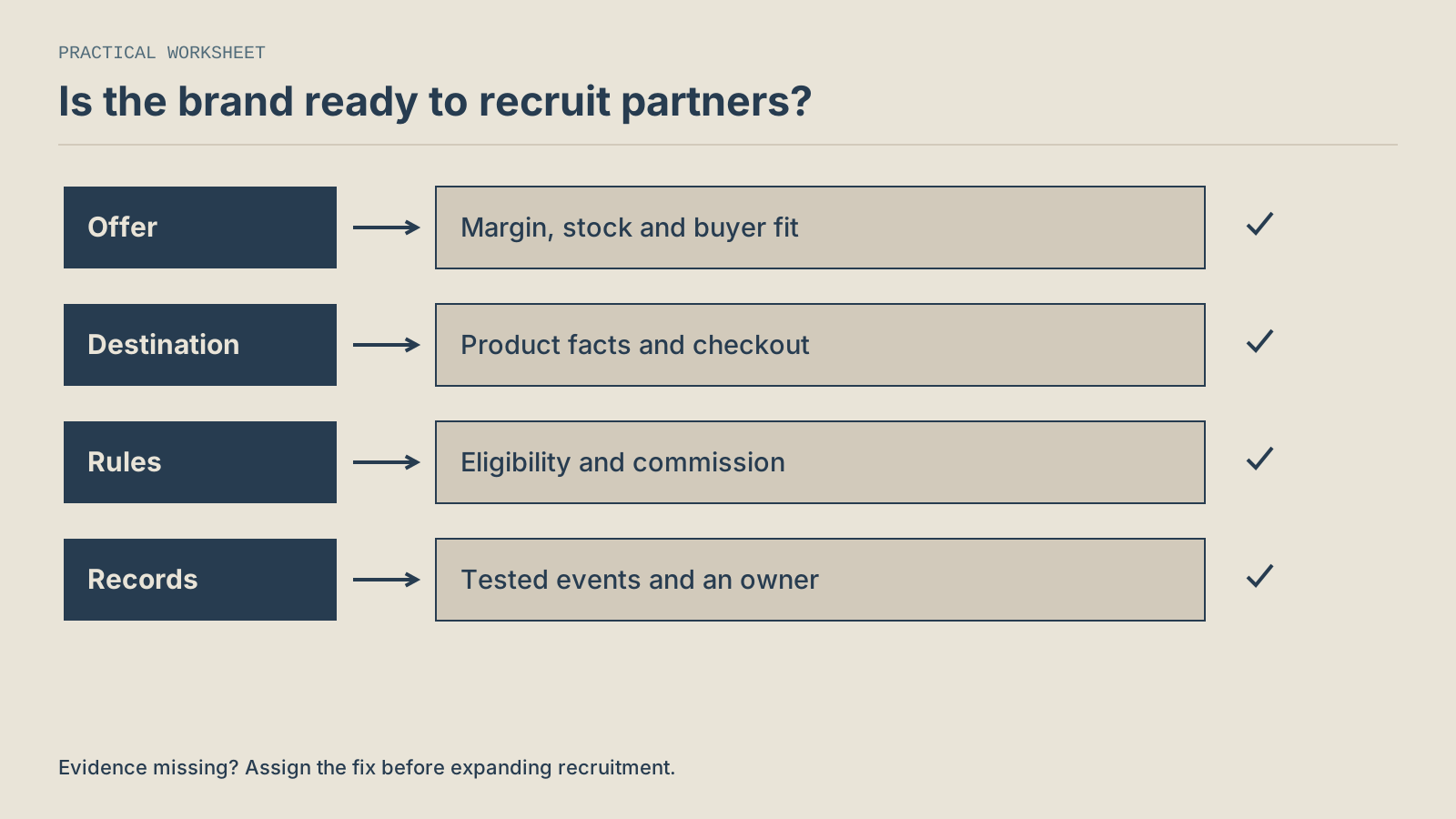
Check contribution margin, stock and buyer fit; product facts and checkout; eligibility and commission rules; then tested events and an accountable owner. Missing evidence needs an assigned fix.
Which partner model fits the way your customers buy?
Choose partners based on the information and confidence a customer needs before purchasing. Creators, specialist publishers and other referral partners can contribute different forms of explanation and reach. Their value depends on their actual audience and work.
Should you start with creators or specialist publishers?
A creator may demonstrate a product in use and answer practical questions in video. A specialist publisher may provide a detailed tutorial or comparison that readers revisit while researching. Neither format is automatically better. A complex maker tool might benefit from a careful demonstration, while a compatible accessory might fit naturally in a maintained instructional article.
Review real examples of the partner's work, audience geography, relevant subject knowledge and ability to explain limitations. For the narrower recruitment process, use our existing guide to recruiting creators who fit your products. This launch plan determines what those partners will be invited into.
Does joining a program require someone to publish?
Do not assume that an approved affiliate account obligates the partner to produce a video or publish by a deadline. Commission participation and commissioned creative work are different arrangements. If you need specific deliverables, agree on the brief, review boundaries, compensation, schedule and usage rights separately. The affiliate versus influencer marketing comparison helps distinguish those choices.
What rules must the brand settle before partners apply?
Publish understandable participation rules covering eligible products, qualifying actions, attribution, approval, payment and permitted promotion. A prospective partner should be able to decide whether the arrangement fits before investing time in it.
Which commercial terms cause avoidable disputes?
Document the referral window, how credit is assigned when several partners or channels are involved, how returns change the reward and when an order becomes eligible for payment. Define whether self-referrals, existing customers, repeat purchases, discount-code distribution or paid search activity are allowed. Get appropriate legal and financial review for the actual arrangement.
A clear rule also needs a practical example. If a product is returned, explain how its commission is handled. If an offer ends, explain whether older published content needs an update and who supplies that notice. Avoid relying on a private chat as the only record of a commercial exception.
Who approves product claims and disclosures?
The brand should supply supportable product information and explain how commercial relationships should be disclosed. The FTC's endorsement guidance addresses material connections and truthful endorsements. A partner should never be asked to claim personal experience they do not have. Include a route for checking uncertain statements, especially where technical conditions change what a product can do.
What should your product pages explain before affiliate traffic arrives?
The destination should continue the promise made in the recommendation and give the shopper enough information to choose and buy. Product identity, suitability, price, availability, delivery and the next action should be easy to understand on a phone.
How do you match the page to the partner's explanation?
Link to the product or collection that actually answers the content's question. If a partner demonstrates a particular configuration, make that configuration easy to identify. Explain any required accessories and preserve an accurate relationship between the content, discount and destination. A click to a generic homepage may require the shopper to repeat the research.
For a technical product, include the constraints that materially affect suitability. A buyer comparing a 3D printer may need to understand supported materials, usable dimensions and what is included. A shopper evaluating backup power needs accurate specifications and operating conditions. Use verified product inputs rather than asking a copywriter to infer capabilities from a photograph.
What should the team check beyond the product description?
Check shipping coverage, stock variations, code behavior, payment options and the path through checkout. A good explanation cannot compensate for a promotion that does not apply to the item shown. Use the affiliate traffic conversion diagnostic to separate destination problems from partner fit and reporting issues.
How do you choose software and verify the measurement path?
Select software after defining the required partner workflow and commercial rules. Then verify that links, destinations, eligible orders and report states behave as expected. A dashboard that loads successfully is not sufficient launch evidence.
What capabilities should you compare?
Compare supported storefronts, recruitment controls, commission rules, product eligibility, return handling, partner access, data export and payment responsibilities. Record what requires a separate app, implementation or manual review. Keep brand ownership of the account and agree how an agency's access will be removed or transferred when necessary.
Shopify's merchant Collabs documentation provides one concrete example of recruitment, offers and affiliate records within a platform. Its program configuration guidance distinguishes open-access and invite arrangements. Those are platform-specific options, not requirements for every brand. Check current eligibility and plan restrictions before selecting a workflow.
Which checks belong in the launch record?
Use the provider's supported testing method to check a partner link, destination, discount if applicable and expected transaction state. Note the device, date, expected result, observed result and issue owner. Compare analytics with contractual affiliate records without expecting them to be identical. Our guide to link and coupon reporting differences explains that narrower problem.
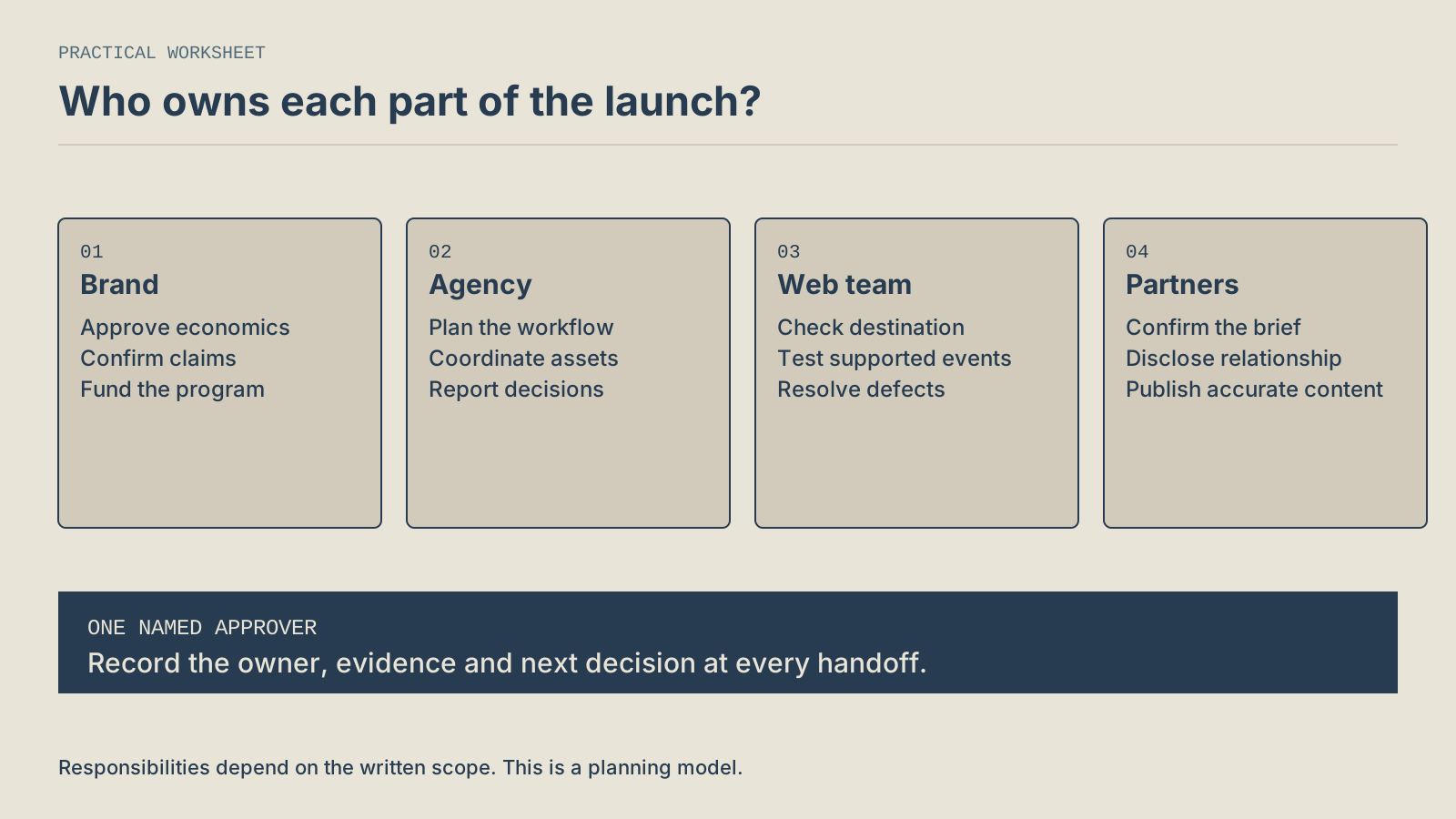
The brand approves economics and claims; the agency coordinates the workflow; the web team checks destinations and supported events; partners follow the brief and disclose relationships. Record a named approver at each handoff.
What should an affiliate marketing agency handle for your brand?
An agency should own the defined work and deliver evidence you can inspect. A useful scope separates strategy, partner operations, content, website changes, measurement and finance responsibilities rather than bundling them into an undefined promise to grow sales.
Which tasks can you delegate and which decisions stay with the brand?
The agency may research suitable partners, prepare materials, coordinate onboarding, review destinations and maintain a reporting process. The brand still needs accountable people to approve product claims, inventory, commercial terms and spending. Payment execution, legal drafting and storefront development require explicit scope rather than assumptions.
Ask for a responsibility map with named roles, required inputs, delivery dates and approval points. Define access permissions and the process for escalating a broken offer or disputed report. If the same person must approve every update, include their availability in the launch schedule.
What evidence should monthly reporting contain?
Look for completed work, active partners, current offers, observed customer activity, confirmed order states, costs and open decisions. A count of invitations sent says little about program operation by itself. The monthly affiliate management guide turns this into a review agenda. This also gives the agency and brand a shared record of what to improve next.
How do you launch a controlled pilot without opening the whole catalog?
Limit the first launch to a clear product offer, relevant partners and a defined budget. Set review conditions before the program starts so expansion depends on evidence rather than the excitement of new signups.
What should happen in the preparation and activation stages?
First approve the product sheet, economics, terms and destination. Then configure the supported workflow, verify the measurement path and prepare partner materials. Invite a group small enough for the team to support individually. Let the product's learning and production requirements determine the schedule instead of promising an arbitrary turnaround.
During activation, resolve questions that stop people from using the offer. Technical uncertainty, delayed samples, missing rights or unavailable stock can explain inactivity. Keep a decision log with the issue, evidence, owner and next action. If paid deliverables are involved, track their acceptance separately from attributed orders.
What are reasonable pause conditions?
Pause recruitment or an affected offer when a product becomes unavailable, claims need correction, the destination breaks or spending exceeds the agreed limit. A pause protects the usefulness of the pilot; it is not proof the channel cannot work. Define who can make that decision and how partners are informed. Resume only when the dependency is fixed and the change has been checked.
How do you decide whether the program is ready to expand?
Expand when the evidence supports a repeatable offer and the team can support additional partners without weakening delivery or economics. Evaluate completed orders and contribution alongside content quality, partner activity and operational workload.
Which outcomes belong in the review?
Separate invited, approved, active and order-producing partners. Separate visits, placed orders, eligible orders, returns and paid commissions. Review the same period and definition when comparing reports. Where attribution is uncertain, state what the records establish and what remains unresolved.
Calculate program contribution using the agreed cost boundary. A gross sales total can look healthy while samples, discounts, returns and fixed work consume the available margin. Conversely, an early content asset may still be useful even when the initial sales sample is too small for a reliable conclusion. Record that as an observation rather than inventing a revenue forecast.
What should you improve before adding more partners?
Identify the most consequential unresolved issue: weak product fit, unclear content, an unsuitable destination or an unsupported workflow. Assign one next action and its evidence requirement. Expansion may mean adding compatible products or improving support for existing partners rather than sending more invitations. The right next step follows the constraint you can actually demonstrate.
What should be on your affiliate launch-readiness checklist?
Use a readiness sheet with evidence and an owner for every decision. Mark an item ready, needs work or not applicable, and explain why. A missing dependency should have a next action before launch approval.
| Decision | Evidence to record | Accountable role |
|---|---|---|
| Offer and margin | Eligible products, commission base, cost assumptions and spending limit | Brand commercial lead |
| Customer destination | Correct product page, stock, delivery details and checked mobile checkout | Ecommerce owner |
| Partner materials | Approved facts, usable assets, disclosure guidance and support route | Content and product leads |
| Terms and records | Qualifying actions, return rules, approvals and supported test results | Program and finance owners |
| Pilot review | Review period, success definitions, pause conditions and next decision | Brand sponsor and agency lead |
Keep this sheet alongside the current offer and partner brief. Review it when a product, commission rule or platform workflow changes, not only when the first partner joins.
What else do brands ask before starting an affiliate program?
Can a new brand start without an established creator network?
Yes, but it still needs a credible offer, useful product information and a way to support partners. Begin with a focused audience and relevant partner research rather than buying a large contact list. Be clear about what you can supply and what participation involves. A network can develop over time; access to one does not remove the need for product fit or sound economics.
Do you have to offer both a discount and a commission?
No. A customer discount and a partner commission solve different problems, and both affect the order's economics. Choose them deliberately. If a discount is offered, specify eligible items, dates and interaction with other promotions. Calculate contribution after the discount before deciding what commission remains affordable. A larger combined incentive is not automatically a better program.
Does sending a free product guarantee a review?
No. Gifting a product and buying defined content are different arrangements. If publication is required, settle the deliverables and terms explicitly. Also preserve the partner's ability to describe their actual experience honestly. A product sample can create a material connection requiring appropriate disclosure even when the brand did not pay a separate production fee.
How soon should you expect meaningful sales evidence?
That depends on the product, buying cycle, partner activity and amount of usable data. Set a review plan around the actual customer journey and order-validation process. Early visits can help diagnose usability, but a small number of transactions may not support a reliable profitability conclusion. Avoid approving expansion solely because a dashboard shows the first attributed order.
Can an agency guarantee that affiliates will produce sales?
An agency can commit to defined work, responsibilities and reporting. It cannot responsibly guarantee how independent audiences will respond or remove every dependency in product suitability, stock and checkout. Ask for inspectable deliverables and clear decision rules. Brand-side approvals and resources also affect execution, so those commitments belong in the same written scope.

How C3i3 Can Help
C3i3 helps product brands connect affiliate planning with the content and website work the program needs. We can scope a readiness review, organize partner requirements, develop clear product explanations and plan how available records will be reviewed. Related SEO, video and conversion work can be included when it addresses a documented gap.
Bring your product range, intended customers, storefront and current program questions. We will help identify the first useful engagement and the responsibilities your team needs to retain. Explore our affiliate marketing services for brands or discuss your program with C3i3.