






































In this article
You are launching a product and want creators involved. One person suggests an affiliate program. Another recommends influencer marketing. Both use social content and may involve the same creator, so the distinction can feel like terminology rather than a real business decision.
The difference becomes practical when you ask what must happen. Do you need a specific video completed for launch? Do you want partners who can introduce the product through their own publishing? Do you need permission to reuse an asset? Affiliate participation, commissioned content and a combined arrangement can answer different parts of the brief. Choose the model after defining the task.
What is the actual difference between affiliate and influencer marketing?
Affiliate marketing is an arrangement in which a partner can receive compensation for qualifying actions under the program's rules. The action might be a transaction or another expressly defined event. The important point is that the program must define what qualifies, how attribution works and when the action is validated.
Influencer marketing describes working with a creator's content, audience relationship and publishing presence. A commissioned campaign may specify a video, post or other asset alongside review and publication responsibilities. The audience still decides whether to pay attention, click or buy. Paying for a deliverable does not purchase a guaranteed audience reaction.
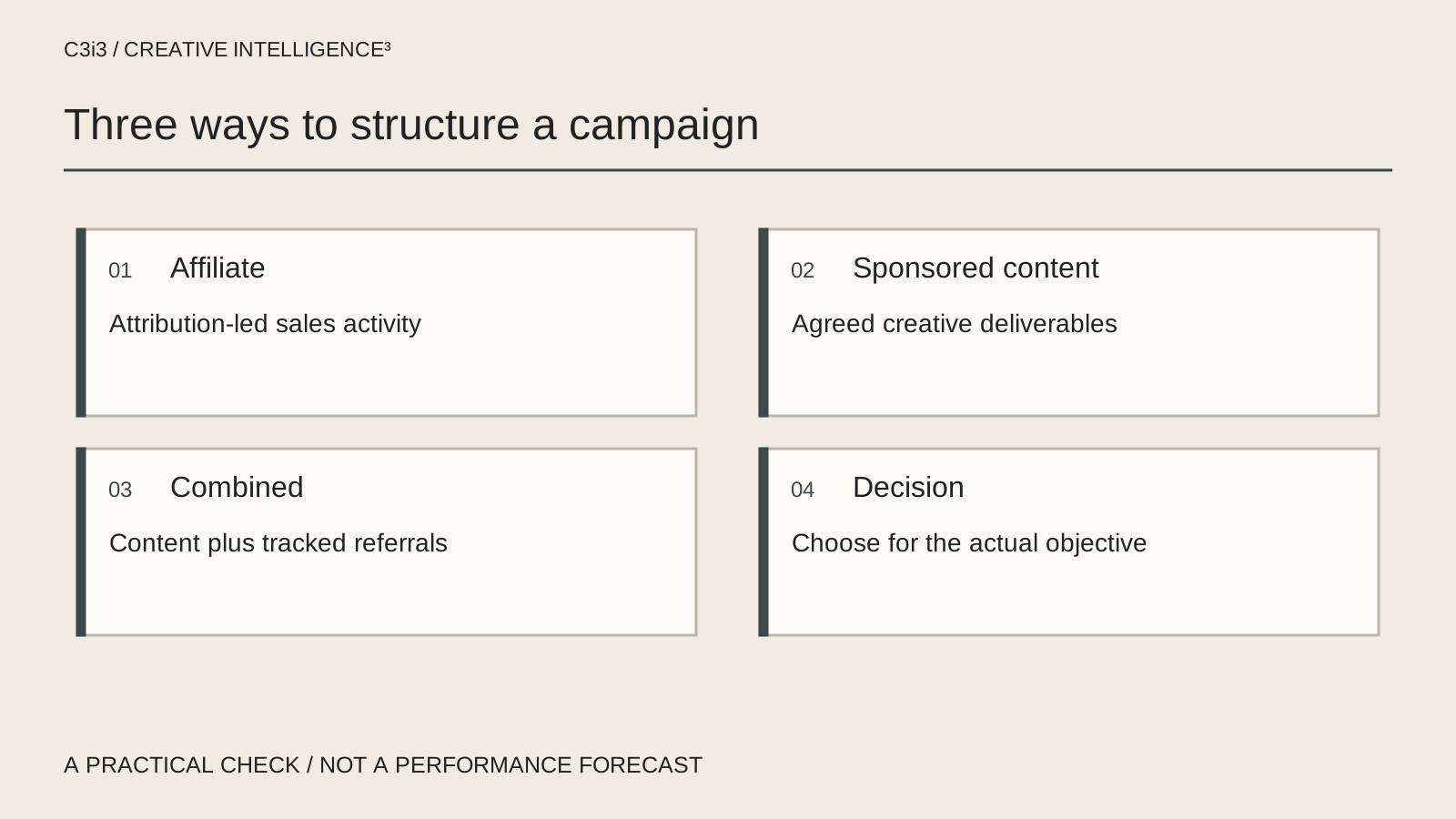
The same person can participate in both. A creator might produce an agreed video and separately use an affiliate link for eligible purchases. That does not mean the content fee and the affiliate terms are interchangeable. Treat them as distinct parts of the commercial brief so the creator and brand can understand what each obligation covers.
Which model fits the launch task you need completed?
Start with the work that cannot be left uncertain. If the launch requires an approved demonstration ready on a particular date, discuss that production and publishing commitment directly. Simply opening an affiliate program does not tell a creator that they owe your business a film, edit or scheduled post.
If the product already has clear information, a functioning customer journey and a defined program, affiliate recruitment may help suitable publishers decide whether it fits their audience. The business still needs to support questions, maintain the destination and review program activity. Performance-based terms do not remove those operational responsibilities.
| Launch requirement | Arrangement to examine | What must be defined |
|---|---|---|
| A specific video or post | Commissioned creator campaign | Deliverable, review and publishing responsibilities |
| Partner-led product referrals | Affiliate program | Qualifying action, attribution and program access |
| A video plus eligible referrals | Combined arrangement | Separate content obligations and affiliate terms |
| An asset for brand advertising | Content license or production agreement | Approved uses, duration and permissions |
| A specialist product explanation | Creator with relevant expertise | Evidence, demonstration and claim review |
Use the table to identify questions for the brief. It is not a recommendation to hire every type of partner. A small launch can be easier to evaluate when the team chooses one clear objective and supports it properly.
How much creative control and reuse permission do you need?
A creator's public post is not automatically an asset your company can use everywhere. If the campaign needs brand advertising, a website placement, edited versions or a longer usage period, discuss those uses before production. Rights and approval responsibilities should be understandable to the people who actually place the content.
Keep factual review separate from a demand for praise. A brand can provide accurate product information and identify unsupported claims without writing an untrue personal experience for the creator. An effective brief explains the customer task, required facts and any boundaries while allowing a credible presentation suited to the channel.
Affiliate terms alone may not provide the review process or usage rights your launch team expects. Conversely, commissioning a video does not necessarily establish an affiliate tracking arrangement. Write a content schedule and a rights schedule where needed, then check that the agreement covers both. Avoid discovering missing permission when the paid-media team is ready to publish.
What should you measure for each campaign model?
Choose measures that match the responsibility. For a production assignment, record whether the approved deliverable was completed and placed as agreed. For audience response, review the platform's actual available engagement and traffic evidence. For affiliate activity, review qualifying actions and their status inside the program.
These layers should remain visible in the campaign report. A well-made video may answer a useful customer question without producing an immediate attributed sale. A strong affiliate result does not automatically tell you whether the brand owns the creative rights it wants. Combining those observations into one score can conceal the work that needs attention.
Define who supplies each report and when it becomes meaningful. A newly placed video may still be gathering audience response, while an order can remain subject to validation. Do not compare a provisional affiliate total with a final production record as if both have the same certainty. Explain the reporting period and outstanding questions alongside the result.

What changes when you combine an influencer campaign with affiliate links?
A combined arrangement needs a clear division between the agreed content work and the performance-based element. Specify the creative deliverable, the destination or product placement and the method used to identify eligible actions. Make sure the creator knows which account or platform holds the authoritative affiliate report.
The platform can also limit what is possible. For example, a planned shopping tag on YouTube depends on channel and program eligibility, and TikTok Shop has its own creator account requirements. A commercial brief should not assume that an existing social account has every shopping feature available.
Explain the commercial relationship clearly to viewers. The FTC's influencer guidance emphasizes clear disclosure with the endorsement. A tracking link is not a substitute for helping people understand that relationship. Resolve the disclosure wording, placement and review responsibility before production so the final content does not depend on a rushed administrative fix.
How do you write a brief that avoids disappointment?
Write the launch decision in plain language. Identify the customer, product, useful content question, required deliverable and intended next step. Then add the product facts the creator can substantiate, the evidence needed for claims and the people who can approve factual changes. This is more actionable than asking for content that will go viral.
Record exclusions as well as requirements. If the brand does not need paid-media usage, do not leave the team assuming it has that right. If a creator may choose whether to participate in affiliate promotion, do not put a mandatory post in a follow-up email without agreement. Surprises about scope can damage a partnership even when both parties support the product.
Before launch, walk through the final viewer journey and the business handoff. Is the destination live, is the exact item available and does someone know where questions will arrive? Is the reporting route documented? Bring the content, website and program owners together for this check. A coherent handoff improves the quality of the campaign you can actually deliver, without pretending to control what customers will do.
Keep this checklist beside you
Questions before the next step
Is affiliate marketing always cheaper for a brand?
That comparison depends on scope and operating requirements. Recruiting, onboarding, content coordination and reporting still take work. Compare equivalent responsibilities rather than treating a performance-based arrangement as a replacement for every production task.
Can the same creator do sponsored and affiliate content?
Yes, if the arrangement and platform rules allow it. Define the deliverable, permissions and affiliate terms separately. Make the commercial relationship clear and do not assume that one agreement automatically covers the other activity.
Which approach guarantees product sales?
Neither. A contract can define work and program terms, but it cannot guarantee customer response. Choose a realistic task, support the creator with accurate information and use the available evidence to decide what to improve.

How C3i3 Can Help
C3i3 can help turn a launch goal into a usable creator brief, supporting landing pages and a measurement plan. We can clarify the work, coordinate the assets and identify the questions to resolve before a campaign is published.