






































In this article
You have a beauty video ready to publish, several products people keep asking about and a growing list of affiliate applications. The difficult part is deciding which arrangement belongs in your business. A familiar retailer may be convenient for viewers but poorly matched to your channel. A promising application may lead to a publisher network when you actually need a creator storefront. More links do not resolve either problem.
Beauty affiliate programs should make a recommendation easier to follow and easier to measure. They should not dictate every product you discuss. Start with the questions your audience already asks, identify the retailers those viewers can actually use and then inspect the official program route. This guide gives creators and the brands working with them a practical comparison process. It is an editorial decision framework, not a ranking of the highest-paying programs.
Which beauty affiliate programs fit the questions your audience already asks?
Begin with a small sample of recent comments, search queries and direct questions. Group them by task: finding a shade, locating a product locally, choosing a routine or comparing two formats. These are different reasons to click. A viewer who wants to know where a product ships needs practical availability information. A viewer comparing texture needs a clear demonstration and an honest explanation of your experience.
Write the task at the top of your comparison sheet before adding program names. Then note the product categories you can discuss responsibly and the formats you already make well. A long-form routine, a short demonstration and a searchable written guide have different production needs. Do not commit to a channel merely because an application accepts it.
Review the content you would publish if no affiliate link existed. That is a useful test of editorial purpose. If the only reason to mention the product is the arrangement behind the link, the recommendation will be difficult to sustain. Readers need a reason to trust the selection, including where a product does not fit their needs.
How do creator programs differ from publisher affiliate programs?
The phrase affiliate program can lead to several different operating models. A creator may receive a storefront, a dashboard for social links or an invitation to connect a channel. A publisher may apply through a network using an editorial website. These routes are not interchangeable simply because both involve attributed purchases.
For example, the official Ulta affiliate page separates its creator route from its publisher route. The Sephora affiliates page also describes more than one pathway. Use the current retailer page to find the right starting point rather than following an old tutorial directly to a third-party form.
| Route | Question to answer | Evidence to keep |
|---|---|---|
| Creator account or storefront | Can the channel and owner use this route? | Official eligibility and connected-channel confirmation |
| Publisher network | Does the website and traffic source meet the advertiser's rules? | Network approval and advertiser acceptance |
| Paid campaign | What content and usage have actually been agreed? | Approved scope and permissions |
| Product shipment | Was any posting obligation or link arrangement agreed? | Written correspondence explaining the relationship |
Can your viewers actually buy the products you recommend?
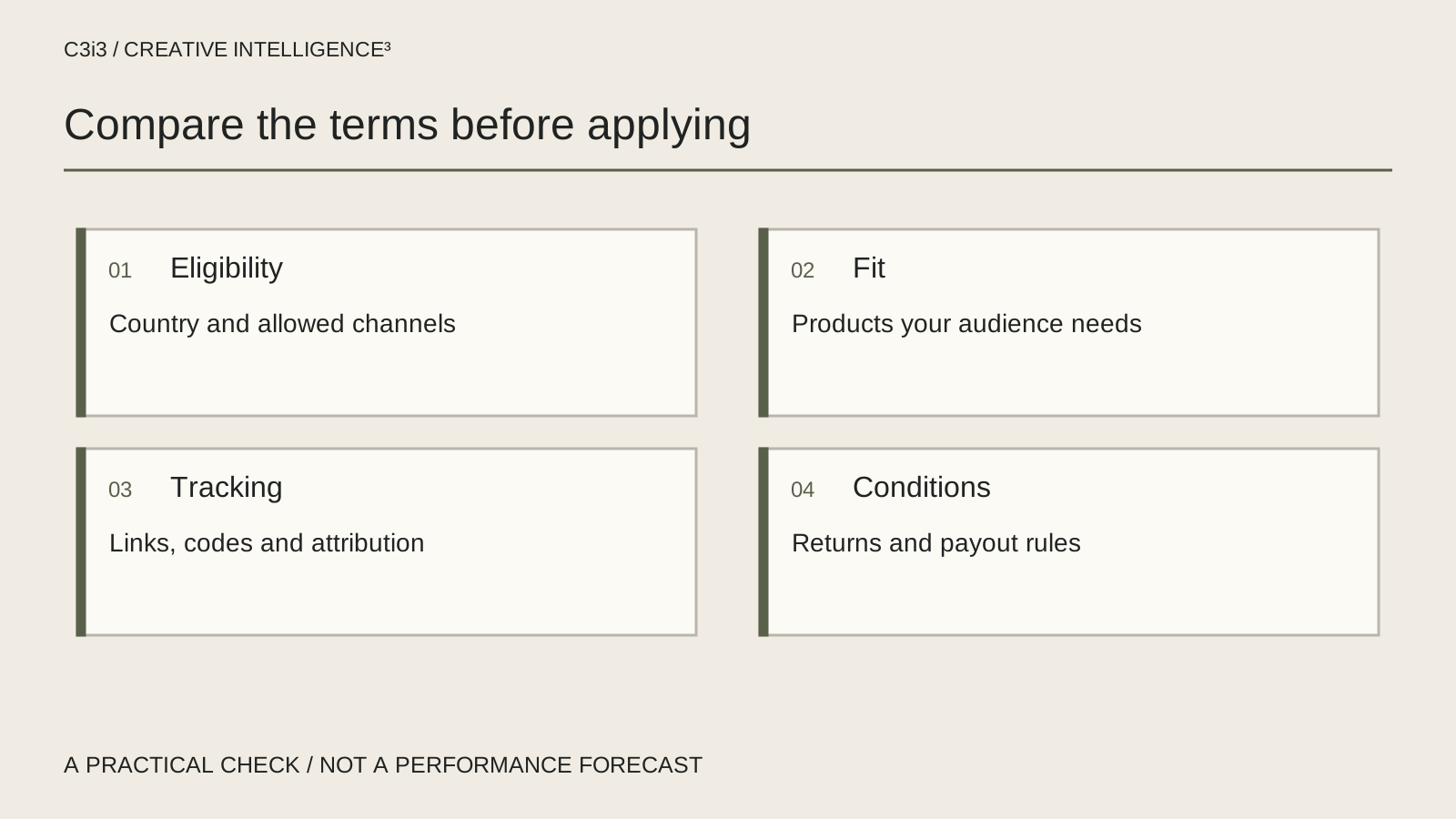
Country fit is a practical filter, not an item to leave until the caption is finished. Check the market served by the storefront, the destinations supported by the retailer and whether the specific product is available there. An English-language page does not automatically serve every English-speaking viewer. A creator's location and the audience's location also need separate entries in the planning sheet.
Try the intended customer journey as a visitor. Open the retailer's destination selector, search for the exact product and inspect the relevant delivery information. Do not treat a product appearing in search as evidence that it can be purchased in the viewer's country. Keep a dated note rather than publishing a permanent claim about availability.
The OLIVE YOUNG Global affiliate page is one example where the relevant storefront and market must be checked carefully. Our review found a U.S. shipping restriction on the Global site. A creator targeting American viewers should resolve that mismatch before building content around Global links. Cross-border beauty content can be useful, but the buying route must match the audience you are addressing.
What should you check about links, codes and attribution?
A viewer can watch a routine, open a link, compare products elsewhere and complete a purchase much later. The creator may have influenced that decision without receiving an attributed transaction. Equally, a dashboard may show an initial transaction that is not yet final. These distinctions belong in your comparison before you choose a workflow.
Ask which event establishes attribution, whether another channel can take precedence, how returns affect the record and which report is authoritative. Do not assume that entering a creator code guarantees credit. The YesStyle Influencer Program terms, for example, include attribution priority rules. The application page alone is not the complete operating instruction.
Create a link inventory with the article or video, destination product, creator account, date checked and reporting reference. Test that the destination opens correctly without making a purchase or generating activity prohibited by the program. Preserve the original tracking parameters when adapting a link. A cleaner-looking address is not an improvement if it disconnects the attribution you intended to use.

How should you compare programs without relying on headline claims?
Use a short evidence sheet rather than a popularity score. Give each criterion a status of confirmed, unclear or unsuitable. Do not invent a numeric rating for a rule you have not verified. A missing answer should remain visible until the retailer or network supplies it.
Start with the application route and market, then add approved traffic sources, product coverage, reporting access, cancellation handling and account ownership. Include content rights separately: permission to publish your own recommendation is different from a retailer's right to reuse your photograph or video. Ask what happens to previously published material if participation ends.
A comparison becomes useful when it changes a decision. A creator with a searchable review website may prioritize stable deep links and archived reporting. A creator making social-first tutorials may need clear mobile navigation and an easy way to maintain product selections. Neither is inherently better. Write down the arrangement you can actually maintain, the unresolved conditions and the reason one candidate fits the next piece of content. Avoid calling a program best without saying best for whom.
What makes a beauty recommendation useful beyond its affiliate link?
Describe the actual experience behind the recommendation. Explain what you used, how it fits the content and which observations are personal rather than universal. Texture, packaging and application can be demonstrated, but a personal routine is not evidence that everyone will experience the same result. Separate an ingredient description from a claim about treatment or suitability.
Include limitations that affect the buying decision: an unavailable shade, an applicator the viewer may dislike or a product format that does not suit the demonstrated task. These details are often more helpful than a polished list of benefits. If you have not used the item, do not write as if you have. A research-based selection can still be useful when its basis is stated plainly.
Keep the commercial relationship clear beside the recommendation. The FTC's disclosure guidance explains that people should be able to recognize material connections. Treat this as part of the content design: readers should not need to search a footer to understand why the link is there. Consult appropriate advice for the specific arrangement when necessary.
How can you keep affiliate content from becoming a maintenance problem?
Every published product link creates a small maintenance obligation. Products disappear, packaging changes, retailer routes move and programs revise their rules. Before adding another program, decide who will notice those changes and who can update the content. A larger list is not useful if half of the buying routes become unreliable.
Use one inventory for the content you control. Record the publication URL, channel owner, retailer, product identifier, destination market and last review date. Tag links that appear in several places so a discontinued item can be found quickly. Keep draft ideas separate from approved recommendations. Do not silently replace a reviewed item with a different product while retaining the original review.
Plan a simple fallback. If an item is no longer available, explain that in the article or remove the shopping link while keeping useful editorial context. If you offer alternatives, research them as separate products. When participation ends, check the program's instructions and remove or revise links accordingly. Clear ownership makes this routine work manageable without pretending that an affiliate page can remain accurate forever.
What should your first beauty affiliate content test include?
Choose one real reader question, one content format and a small group of genuinely relevant products. Define what would count as useful evidence before the content goes live. A completed application is not a sales result. A view is not a click. A click is not a confirmed purchase. Keep those events in separate columns.
For a routine video, record the product questions you expect, where a viewer can find the product information and which report will be checked afterward. For a written comparison, verify that the selection criteria and limitations are visible without requiring a purchase. Use an explicit review date for program details that can change.
After publication, review the whole path. Did viewers ask the question you anticipated? Did the destination work for their market? Were clicks recorded? Were reported transactions still pending? Decide what needs editing before producing another version. This is a learning process, not a guaranteed earnings formula. A focused test gives you something concrete to improve while protecting the editorial value that made the recommendation worth reading in the first place.
Keep this checklist beside you
Questions before the next step
Which beauty affiliate program should a new creator choose?
Choose the arrangement that fits your real audience, content and available buying routes. Start with official eligibility and market information. Then compare the work required to maintain useful recommendations. Popularity alone cannot tell you whether a program fits your channel, and acceptance into a program does not establish that the products are appropriate for your viewers.
Can a creator join several beauty affiliate programs?
Check each program rather than assuming the answer is universal. Programs can have restrictions on simultaneous participation, approved accounts and promotion methods. Keep an inventory of the arrangements you have accepted and clarify anything that conflicts. Joining more programs also increases reporting and maintenance work, even when participation is permitted.
Do affiliate links make every recommendation a review?
No. A link explains a commercial route; it does not establish firsthand experience. Identify whether the content is a personal review, a researched comparison or a product selection. Describe the basis of the recommendation accurately, disclose relevant commercial connections and avoid presenting retailer copy as your own experience.

How C3i3 Can Help
C3i3 helps brands and creators organize affiliate content, useful buying paths and reporting around real customer questions. We can help turn a scattered collection of applications, links and product ideas into a defined editorial and measurement process.
Bring the channels you use, the programs you are considering and the places where viewers get stuck. We can review the workflow and content needs without promising approval, placement or earnings.