






































In this article
A creator asks whether your business has an affiliate program. You like the idea of working with people who already know your market, but a signup link alone does not create a useful partnership. Someone must choose suitable partners, answer product questions and maintain a reporting process both sides understand.
Affiliate marketing for small business works best as an operating decision, not a shortcut around marketing work. The useful question is not how many people will join. It is whether the right people can explain your products accurately, reach appropriate customers and use a program you can reliably support. Start with those conditions before recruiting widely.
Which customer and product should your first affiliates focus on?
Choose one understandable product or service use case. A broad invitation to promote anything in your catalog makes it difficult for creators to judge fit. A focused brief can say who the offer is for, what problem it addresses and which facts need to be explained accurately. That gives a prospective partner something concrete to evaluate.
For example, a small stationery brand could start with creators who already demonstrate planning and journaling routines. A creator whose audience asks practical questions about notebooks may be more relevant than a larger account with no connection to that use. This is an example of selection logic, not evidence that any particular creator will produce sales.
Service businesses need an equally clear definition of the next step. A completed inquiry form is not the same as a signed customer. Decide which action the program can verify and how it will be assessed. Avoid assigning a commission-triggering meaning to an event that nobody has agreed how to validate. Document the definition before sharing recruitment material.
How do you identify creators who fit your products?
Read recent content rather than relying on a profile description. Look for evidence that the creator can explain a product in the context your customer recognizes. Check the questions viewers ask, the language used and whether the content format fits what you need. Public comments are clues about subject interest, not a reliable substitute for audience demographics.
Build a small research sheet with the official channel, relevant content examples, business contact route and a reason for considering the creator. Keep observations separate from assumptions. If you need audience geography or another non-public metric, ask for a recent media kit or an agreed summary rather than inventing it from the creator's identity.
Do not turn this process into a demand for positive coverage. A creator needs room to decide whether the product is suitable. If the campaign requires a defined production deliverable, review process or usage license, discuss those items as a separate commercial arrangement. An affiliate relationship by itself does not mean the brand owns every piece of content a partner makes.
What should an affiliate application actually ask?
Ask for the information required to evaluate fit and administer the relationship. The creator's public channels, intended promotional method, audience focus and business contact are usually more useful at this stage than a lengthy personal biography. Explain why each requested item is necessary and who will have access to it.
| Question | Why it helps | Avoid assuming |
|---|---|---|
| Which channel will you use? | Checks an actual publishing route | All followers see every post |
| Which content fits this product? | Tests editorial relevance | A large audience guarantees purchases |
| Which markets do you serve? | Checks audience and fulfillment fit | Nationality proves audience location |
| How will you disclose the relationship? | Opens a practical content discussion | The platform badge explains everything |
| Who handles business questions? | Creates a clear contact route | A public username identifies the contracting party |
Keep the application proportionate. Collecting sensitive information before you know whether there is a suitable relationship creates unnecessary handling work. Obtain account, tax or payment information only through the program's proper secure onboarding process when it is actually needed. Never request account passwords as part of a creator application.
What must creators receive before they promote anything?
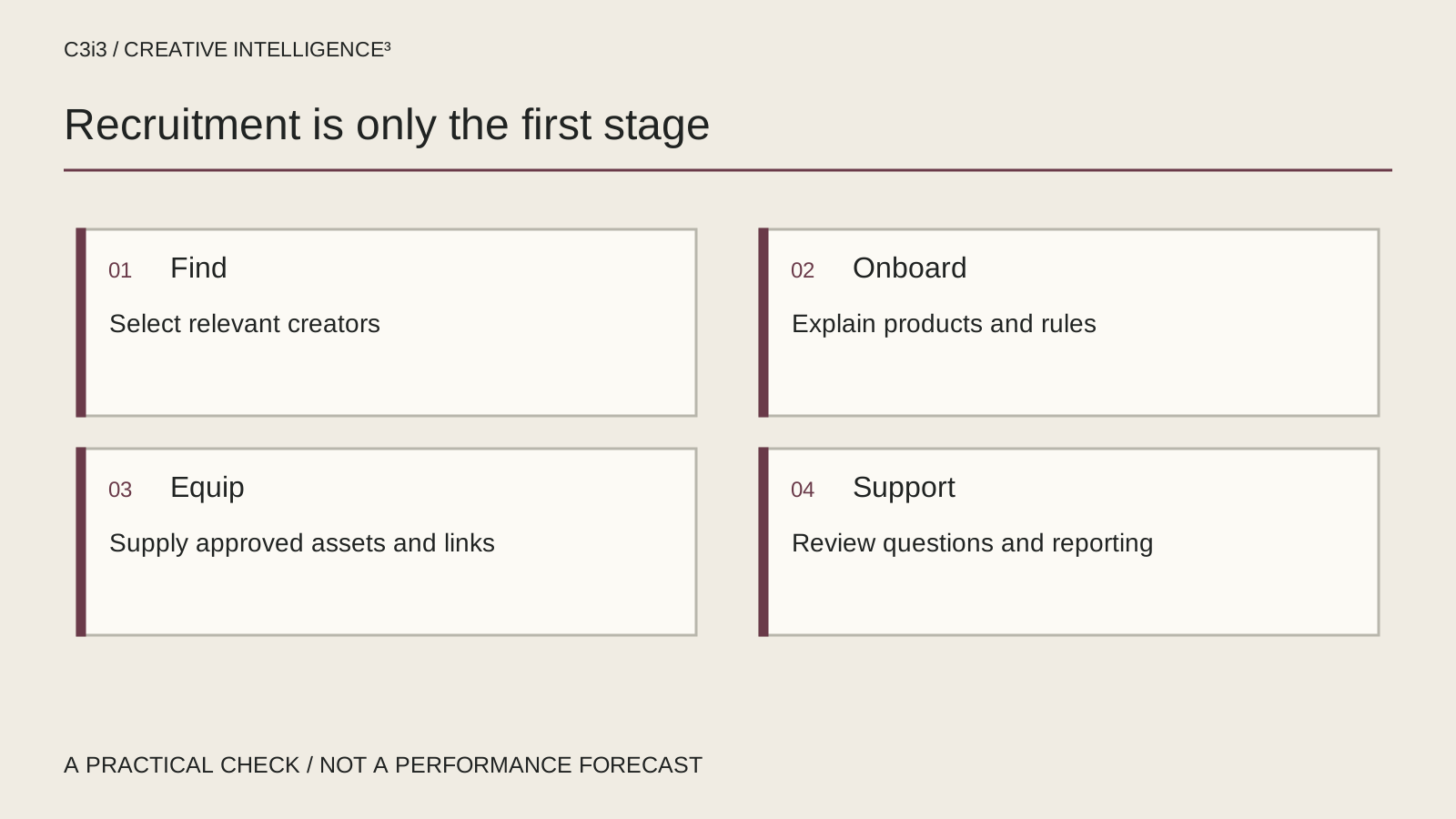
Prepare a short onboarding pack: approved product facts, appropriate product images, the correct destination links, the reporting route and a business contact for questions. Explain which claims require support and which materials the creator has permission to reuse. A shared folder is useful only if someone keeps its contents current.
Include clear guidance about explaining the commercial relationship. The FTC's influencer disclosure guidance says the disclosure belongs with the endorsement message. Do not hide that discussion in an administrative document and assume it will appear in the final content. A practical brief should tell the creator whom to ask when the wording or placement is unclear.
Describe the boundaries of the agreement without dictating an untrue personal opinion. A creator who has not used a product should not be handed a script saying they use it every day. If the business needs a demonstration, arrange a genuine opportunity to understand the item and agree on a suitable format. Accuracy protects the audience and reduces avoidable revisions.

How should a small business test affiliate tracking?
Follow the customer journey before recruitment expands. Check that a partner-specific link reaches the right page, survives ordinary navigation where expected and records the supported test event. Use the platform's documented testing route. Do not place fake customer orders or manufacture conversions to make a program look active.
Distinguish traffic analytics from affiliate credit. Google's manual campaign-tagging documentation explains how campaign parameters provide traffic-source information. Those parameters can help organize reporting, but they do not replace the affiliate platform's rules about which partner receives credit for a transaction.
Name the owner of each check. The website team should verify the destination and form behavior; the program manager should verify partner assignments and order states. Record the date and expected result. When a creator asks why a link or report behaves differently, the team will have a tested baseline rather than a collection of guesses about what the software probably does.
What should happen after a creator joins?
Give new partners a clear first task and a reachable contact, then review whether they can actually use the materials. Common obstacles are missing product details, broken links, unavailable items and uncertainty about what content is permitted. Fixing those issues is more useful than sending repeated generic reminders to publish.
Review partners using the purpose of the program. An affiliate who helps customers understand a specialist product may need different support from a creator making a short product demonstration. Do not rank partners using a single total without accounting for the content, offer and reporting period. Investigate an inactive account before assuming the creator is uninterested.
Maintain an exit process as well as an invitation. Explain what happens to access, links, unpublished materials and existing content when a relationship ends. Keep permissions and approved assets under business control. A small program becomes easier to run when the same person can find the current agreement, answer a question and identify the latest reporting status.
Keep this checklist beside you
Questions before the next step
Can a service business recruit affiliates?
It may be possible, depending on the offer, industry rules and program terms. Define the qualifying action and validation process carefully. An inquiry, booking and completed service are different events and should not be treated as interchangeable.
Should I accept every creator who applies?
No. Review fit, promotional methods and your ability to support the relationship. A large list of accounts can create administrative work without a clear customer benefit. Explain your selection process and keep it relevant to the program.
Does an affiliate signup include a social post?
Not automatically. A defined post, video, review cycle or content license should be agreed expressly. Separate commissioned production from participation in a performance-based program so each party understands what they are committing to.

How C3i3 Can Help
C3i3 can help define the creator brief, prepare application and landing-page content and organize the reporting handoff. Bring the products you want to support and the questions your team is receiving from prospective partners.