






































In this article
The creator report shows clicks. The store report shows orders using a partner's code. Your analytics dashboard gives the campaign a different result again. It is tempting to conclude that one system is broken. First check whether the systems are answering the same question.
Affiliate tracking software can record link activity, assign partner credit and manage the status of an order. Website analytics may describe visits or allocate credit using another model. A code report may simply record code use. These views can all be valid while producing different totals. A useful reconciliation explains their boundaries instead of forcing them to match.
Are you comparing the same reporting definitions?
Write a definition beside every number you intend to compare. Does a click mean a link request, a person or an event after a redirect? Does an order mean placed, paid, approved or no longer returnable? A dashboard label can look familiar while representing a different stage from the export your colleague is using.
Set the reporting period and time zone explicitly. An activity recorded near midnight can fall into different dates in two systems. A recent order may appear in one report before another finishes processing. These operational details are easy to overlook when a team screenshots totals rather than exporting the underlying definitions and date settings.
Start with one product and one partner. Comparing every affiliate and all orders at once can hide a simple configuration issue. Keep an investigation log with the system, metric, time zone, status and question. This gives support teams something concrete to examine and prevents repeated changes to tracking settings while the team is still trying to establish what happened.
Does a coupon code automatically identify the winning affiliate?
Not necessarily. The software must be configured to use the code in the intended way. impact.com's promo-code documentation, for example, distinguishes code behavior and crediting logic. A code's use and a partner receiving transaction credit are related concepts, but they are not automatically identical.
Ask the program manager which rule applies to the actual code. Is the code only a promotional identifier, does it participate in tracking or does it have a specific credit condition? Also ask whether a partner priority or another rule can take precedence. Do not borrow a description from another merchant's program and assume yours works the same way.
A code can be shared beyond the creator's original audience. It may appear on a coupon site, in a private message or in a customer's saved notes. Treat code use as evidence of use under the configured system, not proof that the buyer watched a particular video. This distinction matters when judging creative effectiveness as well as when calculating partner credit.
How do different attribution rules create different answers?
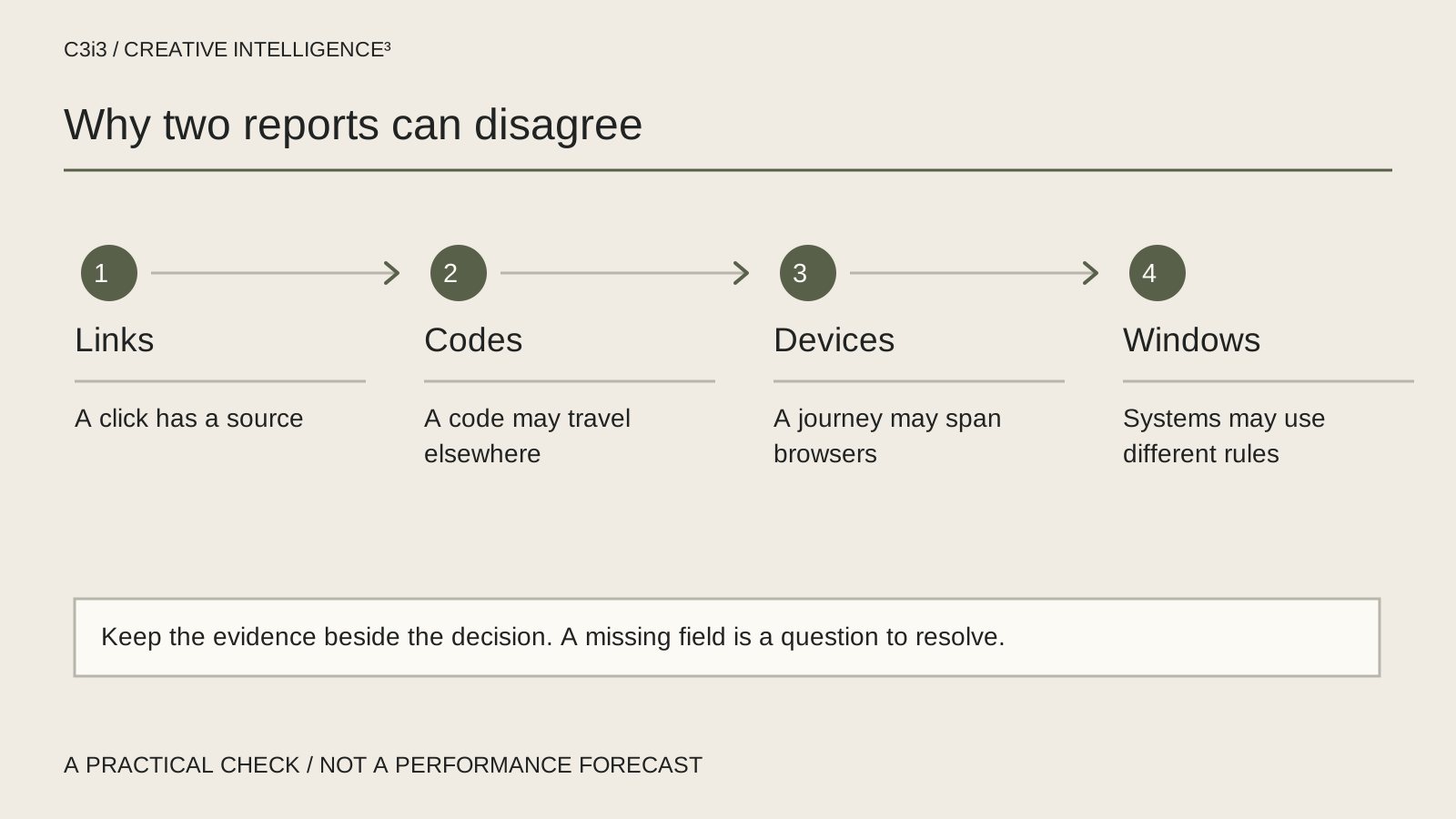
Attribution is the rule used to allocate credit for an observed outcome. A last-click rule answers a different question from a first-click rule. The impact.com credit-policy overview describes these alternatives. Your contract and account settings determine the relevant arrangement; the existence of a tracking link alone does not establish it.
Website analytics can apply its own reporting scope and attribution settings. Google's traffic-source scope documentation distinguishes user, session and event-level information. A report about how a person first arrived is not the same as a report about the session in which they bought something.
Keep the explanation visible in management reports. Write which system governs affiliate credit and which system provides audience or website context. That is more useful than presenting two unlabeled totals and asking a creator to explain the difference. When the reporting objective changes, decide whether the current model still answers the business question before changing the configuration.
Which discrepancy should you investigate first?
Sort disagreements into a few practical categories. A missing click needs a different investigation from a recorded order that has not been approved. Use a small comparison sheet, with customer details removed, to decide who should handle each issue.
| Disagreement | Possible explanation to test | Evidence needed |
|---|---|---|
| Click total differs | Different click definition or redirect handling | Metric definition and link test |
| Code used but no partner credit | Code credit rule or partner priority | Actual program configuration |
| Order appears in store only | Timing, eligibility or integration issue | Non-sensitive order reference and status |
| Approved amount differs from estimate | Return, cancellation or validation | Order history and approval state |
| Analytics assigns another channel | Different scope or attribution model | Report scope and settings |
These are hypotheses, not conclusions. Confirm the facts in the relevant account or ask official support. Do not use a dashboard disagreement as grounds to accuse a partner of misconduct without evidence. A well-structured check should make it easier to resolve a problem, not create a new dispute around an unexplained number.

What can links and analytics fail to observe?
A shopper can click on a phone, later visit on another device or encounter several marketing channels before ordering. Browser settings, consent choices and blocked scripts can also limit what a website observes. No responsible reporting plan should assume it has a complete record of every customer decision.
Use campaign parameters consistently where they are appropriate, while preserving the affiliate tracking information required by the program. Before adding or rewriting parameters, confirm the platform's supported link format. A tidier-looking URL is not an improvement if an essential partner identifier disappears during a redirect.
Record uncertainty directly. Use categories such as attributed, assisted context and unavailable rather than creating a synthetic total from incomplete reports. Comments, messages and customer stories may help explain a campaign's role, but they need an agreed collection method and should not be silently converted into transactions. Keep personal information out of any public performance example.
When should you change affiliate tracking software?
Consider a change when the current system cannot support an essential business requirement and a documented configuration or integration fix will not solve it. Examples include a reporting export the team needs, a supported partner workflow or a reliable way to reconcile order statuses. A lower-looking dashboard total alone is not a reason to migrate.
Build a requirements list before comparing vendors. Include the store or service system, supported promotional methods, link and code rules, partner access, export needs and staff responsibilities. Ask vendors to demonstrate the relevant workflow using a realistic but non-sensitive example. Avoid accepting a generic presentation as proof that your specific attribution problem is solved.
Plan the transition carefully if you do move. Existing links, partner agreements, historic reports and pending transactions need an owner. Keep dated exports and a clear cutoff so creators know which account governs which activity. Test the new process before directing an active campaign toward it. Software helps implement a measurement plan; it cannot replace the decisions that define that plan.
Keep this checklist beside you
Questions before the next step
Should affiliate sales equal the total shown in Google Analytics?
Not necessarily. The systems may use different scopes, eligibility rules and attribution models. First document what each report measures. Compare like-for-like records where possible and explain the remaining differences rather than assuming one total must be wrong.
Can a code be used without the creator receiving credit?
It depends on the configured rules and program terms. Some codes have specific tracking or credit conditions, and other priorities may apply. Check the exact arrangement in your platform instead of assuming that any code use assigns the sale.
Will new software capture every customer journey?
No system should be treated as a complete record of human decision making. Device changes, privacy choices and unobserved activity can create gaps. A useful implementation makes supported attribution clear and labels the information that is unavailable.

How C3i3 Can Help
C3i3 can help map campaign links, landing pages and reporting responsibilities before a tracking change. We can organize a practical reconciliation worksheet and coordinate the website checks with your program manager.